
Looking for Scopus journals in Kenya or Web of Science journals to support a promotion file or grant report? Not many Kenyan journals are indexed, so most researchers pair a brief local list with international titles. This guide covers both and shows how to confirm indexing within minutes.
Scopus and Web of Science: The Essentials
Scopus is Elsevier's selectively compiled database of abstracts and citations; CiteScore originates there and its data underlies the SCImago Journal Rank (SJR). Web of Science belongs to Clarivate and its Core Collection consists of SCIE (sciences), SSCI (social sciences), AHCI (arts and humanities) and ESCI (emerging sources); Journal Citation Reports is where the Journal Impact Factor is published. Journals in both databases are evaluated again and may be discontinued. See Scopus explained and Web of Science explained for more. For a journal's current status, the database record itself is the best evidence.
| Term | What it is | Where to check |
|---|---|---|
| Scopus | A selectively built database of abstracts and citations from Elsevier | Scopus Sources |
| SCIE | Science Citation Index Expanded — the Web of Science index focused on science | Master Journal List |
| SSCI | Social Sciences Citation Index — the Web of Science index focused on social science | Master Journal List |
| AHCI | Arts & Humanities Citation Index — the Web of Science index focused on the humanities | Master Journal List |
| ESCI | Emerging Sources Citation Index — titles in Web of Science that clear a quality screen | Master Journal List |
| Journal Impact Factor | A two-year citation average; every Web of Science Core Collection journal has had one since the 2023 release | Journal Citation Reports |
| CiteScore | Four-year citation average for journals included in Scopus | Scopus Sources |
| SJR | SCImago Journal Rank — a Scopus-derived measure that weights citations by prestige | SCImago |
| Quartile (Q1–Q4) | A journal's rank among others in a single subject category for one year | JCR or SCImago |
Kenyan journals that report Scopus coverage cluster in medicine and in food, agriculture and nutrition. Universities are striving to lift the standards of their journals, but the majority of Kenyan titles are still not indexed. To see the present picture, filter SCImago’s rankings to Kenya; bear in mind that some international journals are edited in Kenya but published elsewhere, so the publisher’s country may differ. A journal’s stated scope is a better guide to fit than its location.
Scopus and Web of Science Journals From Kenya
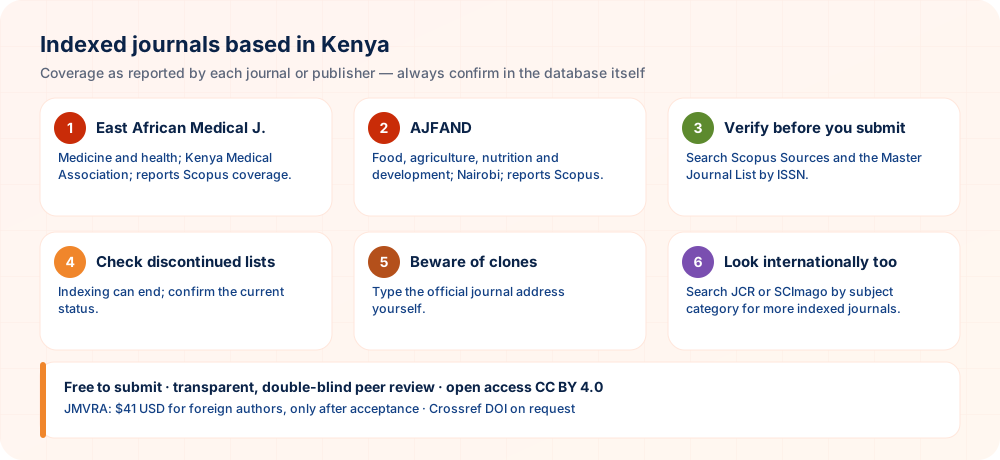
The titles below are produced in Kenya and state, on their own websites or via their publisher, that Scopus and/or Web of Science covers them. On the day you make your decision, verify each ISSN in Scopus Sources and the Master Journal List.
| Journal | Publisher | Subject | Reported coverage |
|---|---|---|---|
| East African Medical Journal | Kenya Medical Association | Medicine and health | Reported: Scopus; hosted on AJOL |
| African Journal of Food, Agriculture, Nutrition and Development (AJFAND) | Africa Scholarly Science Communications Trust, Nairobi | Food, agriculture and nutrition | Reported: Scopus |
Further noteworthy journals (Scopus or Web of Science indexing not confirmed)
| Journal | Publisher | Reported coverage |
|---|---|---|
| African Journal of Health Sciences | Kenya Medical Research Institute (KEMRI), Nairobi | Open access; hosted on AJOL |
| Journal of Agriculture, Science and Technology (JAGST) | Jomo Kenyatta University of Agriculture and Technology, Juja | AJOL hosts it; verify Scopus status via ISSN |
| Journal of the Kenya National Commission for UNESCO | Kenya National Commission for UNESCO, Nairobi | Open access; check indexing |
Checked 4 October 2026. “Reported” means the journal or publisher says so; we have not independently confirmed it.
Indexing Verification Checklist
- Check the ISSNTake the print and online ISSN directly from the journal's official website
- Scopus SourcesDo an ISSN search to confirm the status and coverage years
- Master Journal ListDo an ISSN search and record SCIE, SSCI, AHCI or ESCI
- Removed?Find out whether the title appears on Scopus's discontinued list
- Keep a recordScreen captures with dates for your promotion or grant file
International Publishing for Researchers in Kenya
Since just a small portion of journals based in Kenya are in Scopus or Web of Science, most researchers who need indexed outlets also send work to international titles, such as African regional journals, society journals and the big global publishers. A 2025 study of Scopus coverage in Africa (Kanyika & Kim) calls this a “continued struggle”: African journals in Scopus are increasing in number, but only gradually.
Three points deserve attention before you settle on an international journal. First, the article processing charge (APC), and whether the publisher gives waivers or reductions to authors from low- and middle-income countries. Second, whether your institution or funder will pay APCs. Third, whether your field has a diamond open access journal, which is free for both readers and authors; DOAJ lets you filter by “without fees”. Talk to your university’s research office or your grant manager about whether APCs may be charged to a research grant, and settle this prior to submitting.
Quartiles, Impact Factor and Top-Tier Journals
Note where each metric comes from. The Journal Impact Factor for Web of Science titles is published in Journal Citation Reports, whereas CiteScore and SJR are based on Scopus. Q1 means the top quarter of a journal's subject category in a single year, so compare figures only when category and year are the same.
Kenyan researchers will often find that the highest-impact journals in their field are international, not local. Find them through subject categories in Journal Citation Reports, Scopus Sources or SCImago, and then read recent articles to test whether the journal is right for you. Our guide to finding high impact factor journals takes you through the method in sequence.
Picking an Indexed Journal for Your Subject
| Field | Journals published in Kenya | Then search |
|---|---|---|
| Medicine & health | East African Medical Journal; African Journal of Health Sciences (indexing should be checked) | JCR and Scopus medical subject categories |
| Food, agriculture & nutrition | AJFAND; JAGST (check indexing) | Scopus agricultural and biological sciences; SCIE |
| Engineering & technology | Few Kenyan titles indexed | Scopus engineering; SCIE |
| Education & social sciences | Journal of the Kenya National Commission for UNESCO (please check indexing) | SSCI, ESCI and Scopus social sciences |
| Business & economics | University business journals (check indexing) | Scopus business and economics categories |
Getting Your Paper Ready for an Indexed Journal
Desk rejection is what happens most often to submissions at a selective journal, yet it can frequently be avoided. Before you send your paper:
- Assess the fit through the aims and scope statement plus three recent articles; where your manuscript would look out of place, try another journal.
- Explain why local research matters globally. State what readers in other places can learn from your data or setting.
- Refine language and layout. Authors whose first language is not English benefit from a colleague's read-through or professional editing.
- Reply to every reviewer. If revisions are requested, handle each comment in a table of responses.
Frequent Mistakes With Indexed Journals
- Treating a homepage logo as proof, rather than checking the database record.
- Not specifying the index: “Web of Science” could be SCIE, SSCI, AHCI or ESCI.
- Not noticing a discontinuation: indexing from last year may have ended.
- Depending on a number alone: a paper outside the journal's scope will be rejected quickly.
How JMVRA suits authors in Kenya
Based in India, JMVRA (ISSN 2984-8911) is an international open access journal covering many disciplines. It is not a Kenyan journal, but it accepts papers from authors in Kenya. JMVRA is not in Scopus or Web of Science; it serves authors who want an affordable, peer-reviewed open access journal rather than an indexed one.
- Fee: $41 USD is charged to foreign authors following acceptance, not ahead of it, and includes up to 5 authors.
- Review: double-blind, transparent review by subject experts, with a similarity figure under 15%.
- Access: open access under CC BY 4.0; a Crossref DOI can be obtained when requested.
- Indexing in brief: the journal is included in Google Scholar, and Scopus, Web of Science and DOAJ do not include it.
Your Submission Toolkit for Indexed Journals, Written for Kenya
| Item | Tip |
|---|---|
| Manuscript | Through the journal’s template, together with an English title, abstract and keywords |
| Cover letter | Shows why the journal suits the paper and why the findings matter to readers beyond Kenya |
| ORCID iDs | Supplied per author to preserve record accuracy |
| Approvals | Proof of ethics clearance, plus any research permit that Kenya demands |
| Data availability statement | How to locate the data, or why it cannot be made available |
Collaborating Internationally From Kenya
Regional collaborators
Shared projects throughout East Africa pool datasets, techniques and potential reviewers.
Researchers in the diaspora
Kenyan researchers based overseas make ideal co-authors and mentors.
Co-supervision
Co-authorship follows when theses are supervised by more than one person.
Agreeing authorship
Settle roles, author order and data ownership in writing before you begin.
Practical Tips for Kenyan Researchers Targeting Indexed Journals
Kenyan researchers frequently work on applied topics in health, agriculture and development, often with partners abroad. The following suggestions help you aim at a suitable indexed outlet and present your findings effectively.
- Lead with the local relevance. Explain in the introduction why your county, community or sector matters beyond its borders. Editors look for lessons that readers elsewhere can borrow, not only a regional description.
- Use field data transparently. Describe how participants were chosen, how consent was obtained and what limits fieldwork imposed. Honest reporting of constraints builds reviewer trust far more than a polished but vague method section.
- Study recent papers in the target journal. Read several recent articles on similar topics to see typical length, structure and referencing style. Matching those conventions shows respect for the journal and reduces avoidable formatting corrections.
- Plan collaboration before data collection. If a foreign partner is involved, agree on data ownership, authorship and acknowledgement of funders at the outset. Written understanding avoids awkward negotiations when the manuscript is nearly finished.
- Budget time for language polishing. Ask a colleague outside your project to read the draft for clarity. Fresh eyes catch ambiguous sentences and missing steps that you no longer notice.
Show clearly why your Kenyan evidence matters to an international audience, and choose a journal whose recent articles resemble your own.
Questions Researchers Often Ask
Summary and What to Do Next
To publish in indexed outlets, Kenyan researchers typically mix a few local titles with international journals in their discipline. Check every claim and work out costs before submitting.
- Find out whether the rule at your institution refers to an index, a quartile, Scopus or Web of Science.
- Build a shortlist for your field with the help of the tables above and international databases.
- Check each title by its ISSN and keep a record of what you find.
- Look at the list of research journals in Kenya if you want options that are not indexed.
Ready to send in your paper?
Submission to JMVRA is online and free. Review always comes first; the $41 USD publication fee applies only after your paper is accepted.
Related searches
Kenyan researchers reading this guide often also want to know about publishing a journal article in Kenya, what paper publication costs, which journals are indexed in Scopus and Web of Science, titles with a high impact factor, and affordable open access options. These guides cover those topics:
- Low-cost journal publication in Kenya
- High impact factor journals in Kenya
- Research journals in Kenya
- How a low-fee journal is funded
- Locating high impact factor journals
- How to choose a journal
- Checking an indexing claim yourself
- Recognising a predatory journal
- Publishing with JMVRA from outside India
- JMVRA publication charges
References and Sources
Checked on 4 October 2026. Indexing status can change, so confirm it before submitting.
- SCImago journal rankings — Kenya
- East African Medical Journal on AJOL
- AJFAND
- Kanyika & Kim (2025), Continued struggle: the growth of Scopus-indexed journals in Africa
- Discoverability of African journals by Google Scholar and inclusion in Scopus (PMC)
- Scopus Sources
- Clarivate Master Journal List
- ISSN Portal
- SCImago Journal & Country Rank
- Journal Citation Reports
Kenyan Authors Publishing With JMVRA
- Submit onlineWherever you live; there is no fee to submit
- Pre-reviewScope assessment and similarity (below 15%)
- Double-blind reviewExperts in your field assess it, and the decision follows by email
- Accepted — $41 USDOne charge applies to up to 5 authors
- PublishedPublicly accessible under CC BY 4.0
Details: Publication charges · Peer review · Advice for authors outside India.
Ready to Publish? Submit to JMVRA
JMVRA is aligned with UGC's Suggested Parameters for Choosing Peer-Reviewed Journals.
JMVRA is a Transparent, Peer-Reviewed, Open Access Journal (Refereed Journal). Following the discontinuation of the UGC and UGC-CARE journal listing, and in alignment with the latest UGC-CARE recommendations and guidelines, JMVRA is aligned with UGC’s Suggested Parameters for Choosing Peer-Reviewed Journals.
Where to go next on jmvra.org
Key Terms
Subjects and search phrases this article addresses.
Related Reading
Further reading for Kenyan researchers, including advice on selecting a journal.
Affordable Journal Publication in Kenya
Read the guide RelatedChoosing High-Impact Journals in Kenya
Read the guide RelatedResearch Journals in Kenya: A Verified List
Read the guide RelatedResearch Journals in Tanzania: A Verified List
Read the guide RelatedResearch Journals in Nigeria: A Checked List for Researchers
Read the guide RelatedWhat International Authors Should Know About JMVRA
Read the guide RelatedChecking a Journal’s Indexing Claims
Read the guideKeep Reading on the JMVRA Blog
Find this guide on the JMVRA journal blog, a collection of practical guidance on publishing, indexing, metrics and research integrity that favours verifiable content over promotion.