
Searching for low cost journal publication in Kenya? Seeing a paper published should not eat up a month’s earnings. Here is a guide to what journals in Kenya and overseas normally charge, where free and affordable routes exist, how to tell when a predatory offer uses a cheap price as bait, and five checks to complete before you pay anything. It is written for students, scholars and faculty in Nairobi, Kenya; Juja, Kenya; Nakuru, Kenya; Eldoret, Kenya. Always judge a journal by its editorial practice, not only by its price.
How Much Journal Publication Costs in Kenya
Journals at Kenyan universities often ask for small processing or publication fees in shillings, some ask for nothing, and international titles can charge APCs in US dollars. Every journal decides its own policy.
| Model | What authors pay | Typical publisher |
|---|---|---|
| Diamond open access | Free for readers and authors alike | Titles funded by universities, learned societies or sponsors |
| What national or university journals charge | A small fee, frequently charged in Kenyan shillings | Titles from universities and learned societies |
| International APC | Between hundreds and several thousand US dollars | Commercial open access publishers and large non-profits |
| Subscription or hybrid | Often zero cost; open access is an optional paid extra | Journals that libraries subscribe to for a price |
Several things are paid for by an APC: peer review management, editing and typesetting, hosting, persistent identifiers such as DOIs, and indexing metadata. A journal backed by a university or society can charge little or nothing; commercial open access journals usually charge more. Weigh the process, not just the price.
Free and Affordable Routes for Kenyan Researchers
A number of Kenyan university journals run on their own online journal platforms with little or no author charge, and many African titles on AJOL are open access. Read each journal’s latest fee statement.
- Diamond open access journals — try DOAJ, filtering by subject and “without fees”; a good start for authors in Kenya.
- National and university journals — frequently inexpensive and widely read at home: look at African Journals Online (AJOL), University of Nairobi Journals and JKUAT journals.
- APC waivers and discounts — publishers commonly give these to authors in lower- and middle-income countries; read each publisher’s policy.
- Institutional agreements — your library or university might have deals that cover or reduce APCs.
- Preprints — posting early findings is free, but preprints do not take the place of peer-reviewed publication.
What a Sound Low-Fee Journal Should Still Offer
Paying less must never mean a weaker review. When picking an affordable journal, make sure it still provides the basics that every author in Kenya has a right to expect:
- Genuine peer review — look for a named review model, unbiased reviewers and feedback you can apply.
- Similarity screening — a stated threshold and a check before review; it serves you and the journal equally.
- A clear licence — open access usually relies on Creative Commons, which shows readers how they may reuse your work.
- Permanent hosting — a lasting article page in an archive, and a DOI if the journal offers one.
- Correct metadata — dependable titles, authors and references so databases and search engines can find and cite the article.
- Transparent policies — ethics, corrections, retractions and refunds should be recorded in writing before you submit.
Affordable Does Not Mean Predatory
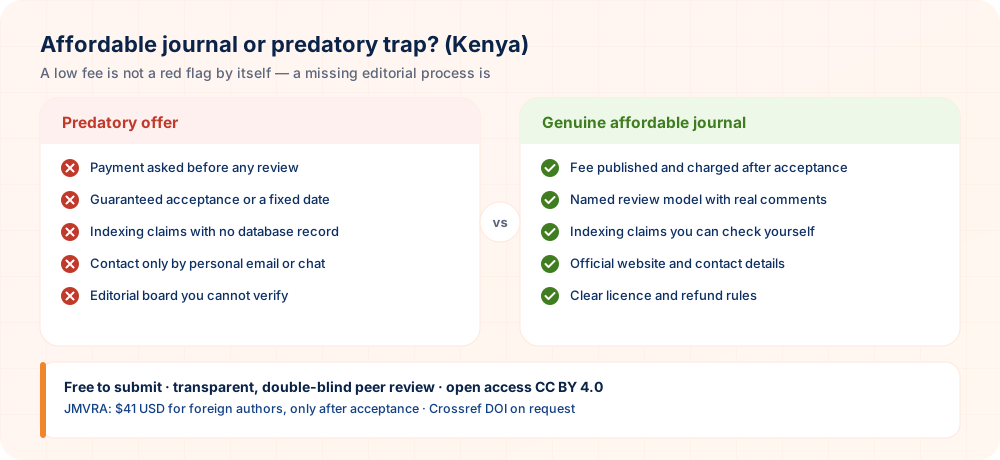
Rock-bottom prices are a common trap. Predatory publishers guarantee acceptance, make up impact factors and want payment before any review. Reputable low-cost journals state fees before submission, bill after real acceptance, and return usable reviewer comments. Looking at several fee pages before deciding is wise.
- Fees demanded before review or a decision has happened.
- Promises of “guaranteed” acceptance, or of acceptance by a set date.
- Boasts of Scopus, Web of Science or impact factor status that the databases do not display.
- A website that copies the name or ISSN of an existing journal.
- Fees changed after acceptance, or payment requested to an individual’s account.
Five Things to Check Before Paying a Publication Fee
- Acceptance is legitimateThe journal itself sends the decision, with reviewer comments attached
- Fee was stated up frontIt matches the amount given before submission
- Proper payment routeThrough the journal’s own page only, never an individual’s account
- Check what is includedNumber of authors, certificates, DOI and extras
- Keep every documentAcceptance letter, invoice and receipt
Funding and Support Available in Kenya
Grants administered by universities, or projects licensed by NACOSTI, can sometimes cover publication costs; settle this with your grant manager before submitting.
Fix the publication budget when you design the study, not once the paper is accepted. Enter the expected fee in grant applications, ask co-authors’ institutions whether they will split it, and keep a cheaper second journal ready if your first choice is out of reach.
Compare the Full Cost, Not Only the Headline Fee
| Item | What to check |
|---|---|
| Base fee | The APC or publication charge as announced, and the currency it is in |
| Authors covered | The number of authors the fee includes and the price of any extra authors |
| Extras | Any page, colour, DOI, certificate or hard-copy fees |
| Payment costs | Currency conversion and bank charges on payments across borders |
| Waivers | Whether you can get a waiver or discount, and how to ask for one |
| Value | Judge the quality of review, the audience reached and whether the indexing meets your needs |
How to Pay a Publication Fee Safely From Kenya
Cross-border payments bring extra costs that are easy to overlook: bank charges, currency conversion and, at times, intermediary fees. Prior to paying, ask the journal which payment methods it takes, whether the amount is stated in Kenyan shillings or US dollars, and whether the invoice can carry the name your institution requires for reimbursement.
- Wait for a real acceptance before paying, and then pay only into the journal’s official bank account or via its payment page.
- Do not pay into anyone's personal account or through an agent.
- Store the invoice, receipt and acceptance letter in one folder, so audits and reimbursement run smoothly.
- If the invoice amount differs from the listed fee, ask for a written clarification before you pay.
Affordable Publication From Anywhere in Kenya
Everything happens online, from submission through review to payment, so authors in Nairobi, Kenya; Juja, Kenya; Nakuru, Kenya; Eldoret, Kenya; Kisumu, Kenya; Mombasa, Kenya; Nyeri, Kenya; Meru, Kenya and any other city publish under identical conditions. Choose a journal because of its subject fit and its process; your location has no effect on the fee.
Where JMVRA suits authors in Kenya
Based in India, JMVRA (ISSN 2984-8911) is an international open access journal covering many disciplines. It is not a Kenyan journal, but it accepts papers from authors in Kenya. Its fee is modest because it operates on a no-profit, no-loss basis, not because peer review is skipped.
- Fee: A paper from foreign authors in Kenya attracts $41 USD, payable only after acceptance and shared by up to 5 authors.
- Review: a transparent double-blind peer review is carried out by subject experts, and similarity must stay under 15%.
- Access: open access under CC BY 4.0, and a Crossref DOI can be requested.
- Honest on indexing: Google Scholar indexes our articles, while Scopus, Web of Science and DOAJ do not.
Budgeting for Publication Costs in Kenyan shilling (KES)
| Item | What to check |
|---|---|
| Publication fee | The currency and the moment of payment; foreign authors pay JMVRA $41 USD only after acceptance |
| Payment charges | Bank or card charges on an international payment sent from Kenya |
| Authors covered | Does the fee extend to all co-authors? (JMVRA: up to five) |
| Optional services | Language editing, a DOI or printed copies, ordered only if needed |
Sending an International Fee From Kenya
- Wait until the acceptance email arrives — genuine journals do not ask for payment before review
- Pay only through official payment details — shown on the journal website or in the acceptance email
- Confirm the sum in Kenyan shilling (KES) — your bank applies its own exchange rate
- Keep your receipts — handy for reimbursement and your records
Getting Published from Kenya Without Overspending
Kenyan researchers work across universities, hospitals and research institutes, often under tight budgets. These tips focus on efficient preparation and on paying only for services that genuinely help.
- Plan publication within the grant. When writing a proposal, include a line for dissemination costs. Funders are usually more receptive to publication expenses planned in advance than to requests made after the project ends.
- Explain your study site clearly. Describe the county, setting and population in enough detail for an outsider to picture the context. Clear descriptions help reviewers judge whether your findings could apply elsewhere.
- Practise a short pitch for your paper. Write a brief statement of what is new in your study and why it matters. This sharpens your cover letter and helps editors decide quickly whether the manuscript fits.
- Keep mobile payment receipts. If you pay through a mobile or bank service, save the confirmation message and a screenshot. These records are useful when claiming reimbursement or resolving a payment query.
- Share results with stakeholders. After publication, send a plain summary to the community, ministry or organisation involved. Practical feedback makes your research more valuable and encourages future cooperation.
Budget for publication from the start, describe your setting clearly, and keep receipts so that your paper reaches both readers and funders.
Questions Researchers Often Ask
Summary and What to Do Next
Affordable publishing in Kenya is achievable once you know where to search and what to verify. Favour journals with a clear workflow and a stated fee, take advantage of waivers and institutional help, and do not pay until a genuine acceptance arrives.
- Find out exactly what your institution requires.
- Make a list of the diamond, national and fairly priced international journals in your area.
- Complete the five checks before you pay any fee.
- Browse the list of research journals in Kenya as well as high impact factor journals in Kenya.
Ready to send in your paper?
Submission to JMVRA is online and free. Review always comes first; the $41 USD publication fee applies only after your paper is accepted.
Related searches
Visitors from Kenya reading this page frequently look up low cost journal publication, publication charges, APC waivers, free open access journals and secure ways to pay as well. These guides deal with each of those questions:
References and Sources
Checked on 4 October 2026. Fees and policies can change, so confirm them before submitting.
Getting Published From Kenya With JMVRA
- Submit onlineAuthors worldwide; no cost to submit
- Initial checkScope fit and similarity (below 15%)
- Double-blind reviewSubject specialists evaluate it; you get the result by email
- Accepted — $41 USDOne payment for up to 5 authors
- PublishedFree-to-read, CC BY 4.0 licence
Details: Publication charges · Peer review · Advice for authors outside India.
Ready to Publish? Submit to JMVRA
JMVRA is aligned with UGC's Suggested Parameters for Choosing Peer-Reviewed Journals.
JMVRA is a Transparent, Peer-Reviewed, Open Access Journal (Refereed Journal). Following the discontinuation of the UGC and UGC-CARE journal listing, and in alignment with the latest UGC-CARE recommendations and guidelines, JMVRA is aligned with UGC’s Suggested Parameters for Choosing Peer-Reviewed Journals.
More useful pages at jmvra.org
Key Terms
Subjects and search phrases this article addresses.
Related Reading
Further guides for researchers in Kenya.
Keep Reading on the JMVRA Blog
You are reading part of the JMVRA journal blog, a source of hands-on guidance about publishing, indexing, metrics and research integrity that aims to be verifiable, not promotional.