
Months have gone into your research, analysis and writing. Now you face a question that can make or break the paper’s path: which journal should receive it? A poor choice can cost months to a desk rejection, hide the paper from the readers who need it or, worst of all, land it in a predatory journal. This guide offers a 10-step process built on free, official sources, a scorecard for ranking your shortlist, and a 12-point checklist.
Not sure which route fits you — Scopus, Web of Science or low-cost open access? Start with Scopus vs Web of Science vs open access, then return to this guide to pick the journal.
The Importance of Journal Selection
- Acceptance: a poor match between paper and journal is among the most frequent causes of desk rejection, however good the research is.
- Readers and citations: a journal that your intended readers really follow offers your work the best chance of being read and cited.
- Reputation: a predatory or hijacked journal can damage your standing, and some institutions refuse to count such publications.
- Time: each rejection costs weeks or months, so choosing well at the start protects deadlines for theses, promotions and grants.
- Recognition: appointment, promotion and funding panels frequently examine where you published and whether it satisfies their rules.
Free Official Tools for Picking a Journal
Go to the original source for each claim. These tools are free to use, and some provide more with an institutional login.
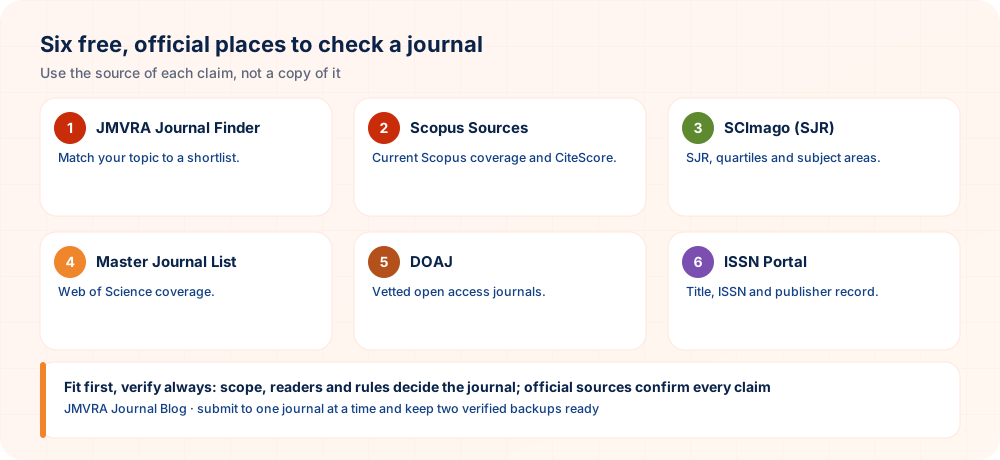
| Tool | What it does | Best for |
|---|---|---|
| JMVRA Journal Finder | Matches your topic to suitable journals | Starting a longlist |
| Scopus Sources | Lists Scopus-covered titles with CiteScore | Confirming Scopus coverage |
| SCImago Journal & Country Rank | SJR, quartiles, subject categories | Comparing Scopus journals in a field |
| Clarivate Master Journal List | Web of Science coverage by index | Confirming WoS coverage |
| DOAJ | Directory of vetted open access journals | Checking open access credentials |
| ISSN Portal | Official ISSN records | Confirming title, ISSN and publisher |
| Google Scholar Metrics | h5-index of top publications by field | Gauging visibility in Google Scholar |
| Think. Check. Submit. | A checklist for trusted journals | Screening a journal you do not know |
| Retraction Watch Hijacked Journal Checker | Known cloned journal websites | Spotting hijacked journals |
| JMVRA journal verification | Confirms genuine JMVRA details | Checking JMVRA itself |
Big publishers also run their own journal finders; these help, but they point only to that publisher’s titles. Learn more in our journal finder guide.
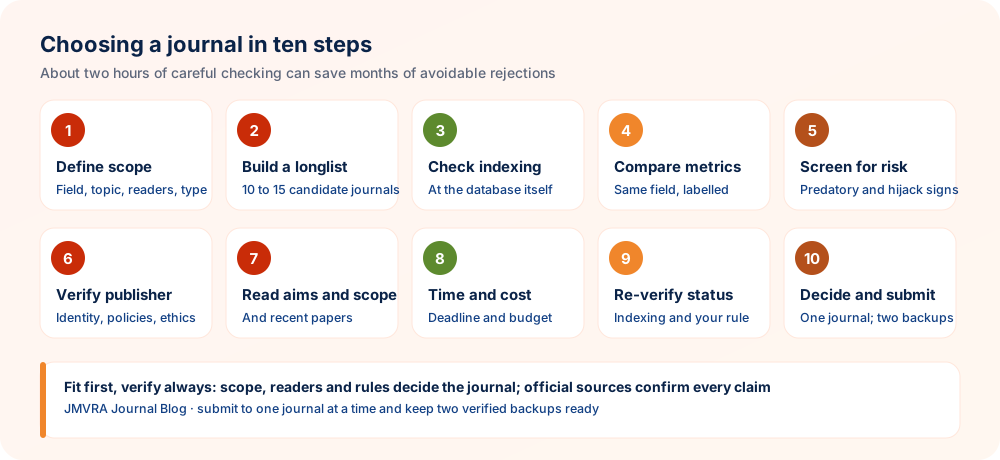
The 10-Step Process in Brief
| # | Step | Tool or source | Approx. time |
|---|---|---|---|
| 1 | Define scope and audience | Your own notes | 15 min |
| 2 | Build a longlist | Journal finders, your reference list, colleagues | 15 min |
| 3 | Check indexing | Scopus Sources, Master Journal List, DOAJ | 10 min |
| 4 | Compare metrics | SCImago, Scopus Sources, Google Scholar Metrics | 15 min |
| 5 | Screen for predatory and hijacked journals | Think. Check. Submit., hijacked journal checker | 10 min |
| 6 | Verify the publisher | ISSN Portal, the publisher’s policies, membership bodies | 10 min |
| 7 | Read aims and scope | Journal websites and recent issues | 20 min |
| 8 | Check timeline and cost | Author guidelines and fee pages | 10 min |
| 9 | Re-verify indexing and your rule | Databases; your institution’s rule | 5 min |
| 10 | Decide and submit | Cover letter, author guidelines | 30 min |
Altogether it takes about two hours — a small investment set against months of avoidable rejections.
Step 1: Define Your Scope and Audience
Before you open any tool, write down:
- Core discipline — for example, electrical engineering, oncology or social psychology.
- Specific sub-topic — renewable energy storage, cancer biomarkers, workplace motivation.
- Target readers — academics, clinicians, engineers, teachers, policymakers.
- Article type — original research, review, case report, short communication.
- Novelty — a small step forward or a major finding? Answer honestly, because it determines how selective a journal you should target.
- Your rule — does your university, funder or employer demand a specific database or list? Obtain it in writing.
Step 2: Build a Longlist
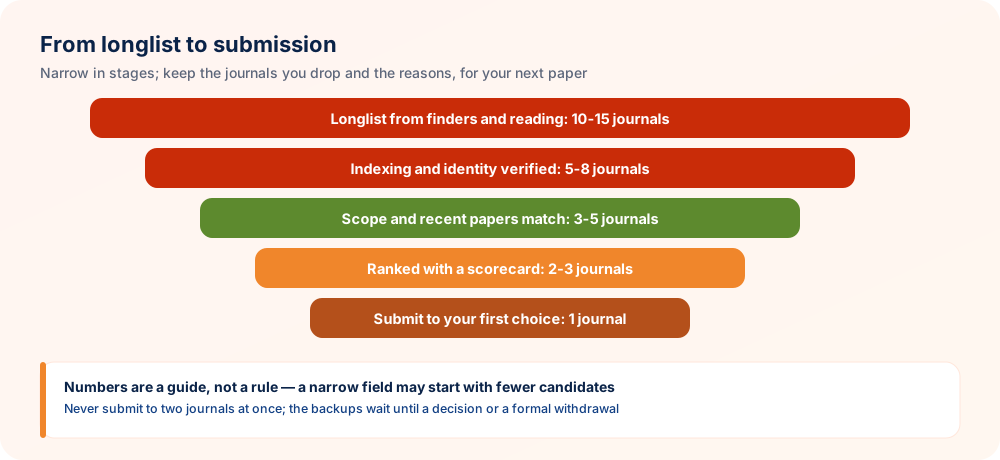
Aim for 10–15 candidates drawn from several sources:
- Type your title and keywords into the JMVRA Journal Finder or a similar finder.
- Note which journals published the main papers cited in your own reference list.
- Ask your supervisor and colleagues where they read and publish in your area.
- Browse subject categories in SCImago or the Master Journal List.
Good keywords make every finder work better: see Choosing Keywords That Get Your Paper Found.
Step 3: Check Indexing at the Source
Cut the longlist down to journals whose indexing meets your needs. Do not trust a badge on the journal’s own website:
- Scopus: search the Scopus Sources page and make sure coverage is current.
- Web of Science: search the Master Journal List and record which index applies (SCIE, SSCI, AHCI or ESCI).
- DOAJ: look in DOAJ for open access journals.
- Website match: make sure the website given in the database is the one you are visiting.
Need a walkthrough? See the notes on finding Scopus-indexed journals and on checking a journal in four databases.
Step 4: Compare Metrics With Care
Combine several metrics and compare only within the same field:
| Metric | Source | What it tells you |
|---|---|---|
| Journal Impact Factor | Clarivate JCR (subscription) | Average recent citations per article |
| CiteScore | Scopus (free to view) | Citations per document over four years |
| SJR and quartile | SCImago (free) | Prestige-weighted citations; Q1 = top 25% of a category |
| h5-index | Google Scholar Metrics (free) | Visibility of recent articles in Google Scholar |
| Journal h-index | SCImago (free) | Long-term citation impact |
State the name and source of every metric you cite, and never treat unlike metrics as if they sat on one scale. See CiteScore vs Impact Factor vs SJR and Scopus quartiles explained.
Step 5: Check for Predatory and Hijacked Journals
Treat this as your key safety test, and drop any journal that displays the following red flags:
- A promise of certain acceptance, or of a set publication date, made before peer review.
- Requests for money ahead of review, or for transfers into individual accounts or to middlemen.
- Statements about indexing that you are unable to verify in the database directly.
- Editors who cannot be verified, or whose expertise lies outside the subject area.
- Hijacking is likely when the site address differs from the one recorded in Scopus, Web of Science or the ISSN Portal.
Use Think. Check. Submit. together with the hijacked journal checker, and afterwards go through our predatory journal checklist and journal hijacking guide.
Step 6: Confirm the Publisher
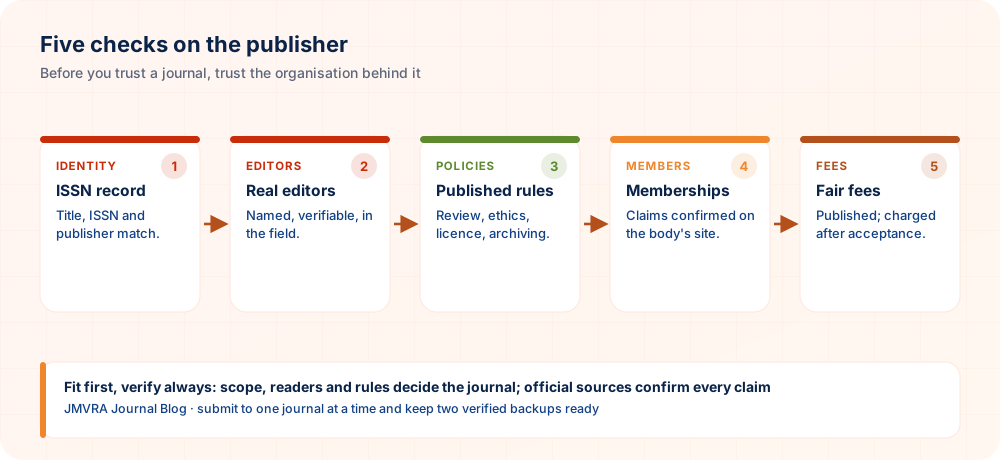
- ISSN record: the title, ISSN and publisher listed in the ISSN Portal agree with what the website shows.
- Editors: editors are identified by name, with affiliations that can be checked and a publication record in the subject.
- Policies: the journal openly states its approach to peer review, ethics, corrections and retractions, licensing and archiving.
- Memberships: verify any membership the journal claims, such as of COPE, on the website of the organisation concerned.
- Fees: stated up front, with the moment of payment made clear; ideally you pay only once the paper is accepted.
Step 7: Study the Aims and Scope
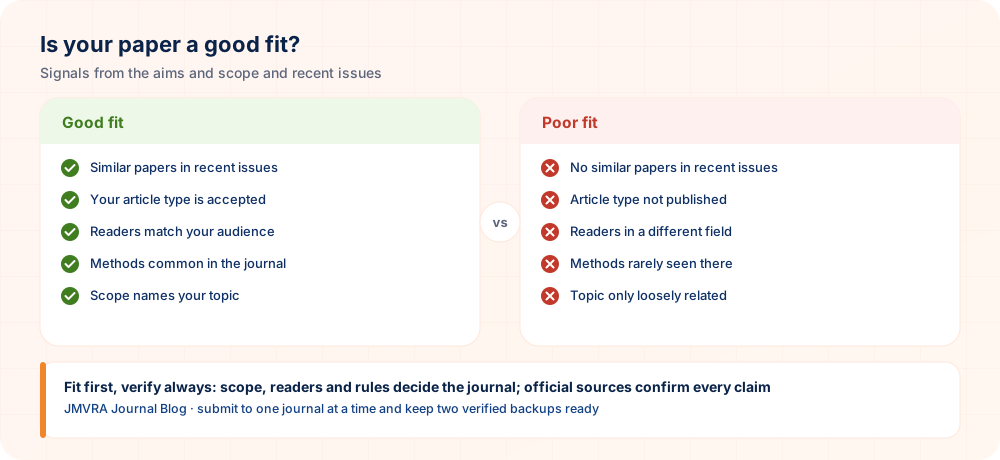
Many authors slip up at this point. A journal may sit in the correct subject category yet have a scope that does not fit your work. Ask yourself:
- Is your kind of study accepted there: empirical, theoretical, review or case study?
- Does its scope reach your exact topic and not merely the broad discipline?
- Will it reach the readers you want?
- Have papers close to yours appeared in it lately?
Step 8: Review Timeline and Cost
- Timeline: when a thesis or promotion deadline looms, look at what the journal itself says about review duration. Durations differ greatly, and selective journals frequently need months and several revision rounds. Build in extra slack for revisions so that a delay does not put your own deadline at risk.
- Cost: find out whether article processing charges (APCs) apply, at what stage they are billed, and if waivers are available. Plenty of subscription journals ask authors for no payment; consult our free-to-publish Scopus journals guide.
- Agents: do not pay any agent who offers a journal slot, a schedule or acceptance; always submit straight through the journal’s official website.
To see how fees work, read what a publication fee pays for.
Step 9: Re-Check Indexing and Your Rule
Indexing is not fixed: Scopus and Web of Science both add and remove journals. Confirm your final pick again right before submitting, and re-read your institution’s present requirement. A quick check now can spare you from discovering a problem after the paper is already under review.
India-Based Researchers: UGC CARE
During the period when the UGC-CARE list was active, its Group II covered journals found in Scopus and Web of Science. UGC has since ended the UGC-CARE journal listing and put forward suggestive parameters for selecting peer-reviewed journals, and a public notice stated that the archived list serves as a reference only. Find out what your university currently requires. The UGC public notice (PDF) and our UGC CARE 2026 guide are worth reading.
JMVRA’s statement
“JMVRA is aligned with UGC’s Suggested Parameters for Choosing Peer-Reviewed Journals.”
“JMVRA is a Transparent, Peer-Reviewed, Open Access Journal (Refereed Journal). Following the discontinuation of the UGC and UGC-CARE journal listing, and in alignment with the latest UGC-CARE recommendations and guidelines, JMVRA is aligned with UGC’s Suggested Parameters for Choosing Peer-Reviewed Journals.”
For more: JMVRA and UGC CARE — complete status.
Step 10: Make Your Choice and Submit
By this stage you ought to hold a ranked list of two or three verified journals that suit your paper. Send the manuscript to your top pick, and keep the rest in reserve should it be rejected. Having alternatives lined up makes it easier to respond quickly after a decision.
- Lay out the manuscript precisely as the journal’s author guidelines require.
- Prepare a cover letter written for this journal; the cover letter template can help.
- Add every required declaration, covering AI use, data, funding, conflicts of interest, ethics and originality.
- Use the official portal for submission, and do not email a manuscript unless the journal requests it.
Use a Scorecard to Rank Your Shortlist
If two or three journals all seem suitable, a plain weighted scorecard turns the decision into something visible. Set weights to match your circumstances: a thesis deadline could increase the importance of timeline, while limited funds could increase that of cost. Fill in the scores honestly, since a flattering score for a favourite journal defeats the purpose.
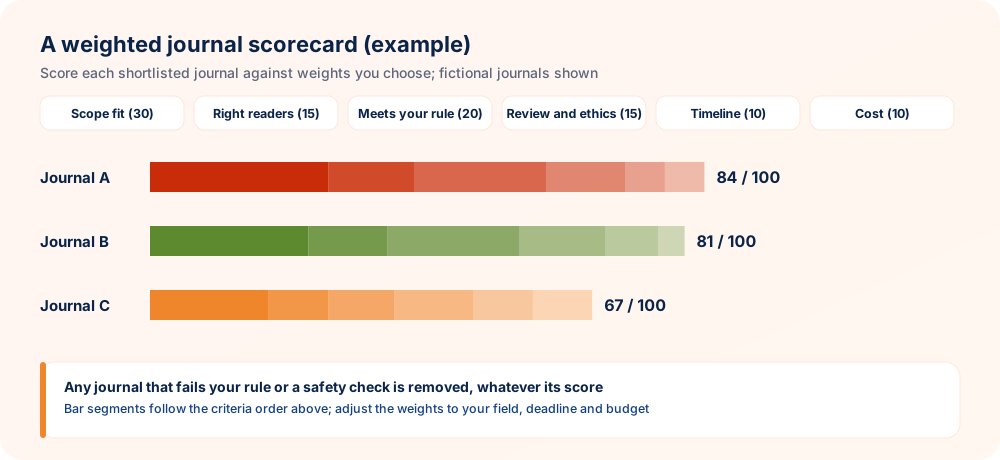
| Criterion | Weight | Journal A | Journal B | Journal C |
|---|---|---|---|---|
| Match with scope (comparable recent papers, article type) | 30 | |||
| Right readers | 15 | |||
| Satisfies your requirement (required indexing or list) | 20 | |||
| Peer-review model, ethics and policies | 15 | |||
| Schedule suits your deadline | 10 | |||
| Cost within budget | 10 | |||
| Total | 100 |
A journal that does not meet your rule or fails a safety check (Steps 5 and 6) is dropped, regardless of its total score.
How JMVRA Fits In
Many master’s students, PhD scholars and researchers in India find that a genuine, low-cost, peer-reviewed open access journal is a sensible, good-quality option whenever their requirement is a peer-reviewed journal and not a particular database. Always read the rule itself, not a summary of it, before relying on this route. JMVRA, the Journal of Modern and Versatile Research Approach, provides:
| Check | JMVRA |
|---|---|
| Identity | ISSN 2984-8911; publishing since June 2023; official website jmvra.org |
| Peer review | Transparent double-blind assessment by subject specialists, with reviewer comments delivered alongside the decision |
| Indexing, stated openly | Google Scholar lists JMVRA, and it is registered with Crossref and the ISSN Portal / ROAD; at present it is not indexed in Scopus, Web of Science or DOAJ. |
| Metric, labelled | An impact factor of 11.25 based on Google Scholar, which is neither a JCR Impact Factor nor a Scopus CiteScore |
| Cost | Authors from India pay ₹971 INR and foreign authors $41 USD, but only once the paper is accepted; submitting costs nothing |
| Access and licence | Published as open access with a CC BY 4.0 licence; a Crossref DOI is available if requested |
| Decisions | Decisions on acceptance or rejection are communicated by email and WhatsApp |
Should your rule demand Scopus or Web of Science, pick a journal confirmed in those databases. Read how JMVRA’s 11.25 is calculated and verify genuine JMVRA details.
8 Frequent Mistakes and Their Fixes
| Mistake | Fix |
|---|---|
| Relying only on impact factor when choosing | Combine several metrics, compare them inside your own field, and put scope fit first |
| Sending work that falls outside the journal’s scope | Study the aims and scope and look for comparable recent papers |
| Leaving out predatory and hijack checks | Confirm facts at official sources and apply the checklists given in Steps 5 and 6 |
| Invariably targeting the largest journal first | Fit the novelty of your paper to how selective the journal is |
| Ignoring timelines | Compare what the journal says about its review process with your deadline |
| Sending every paper to the same journal | Repeat the whole process for every manuscript |
| No backup plan | Before submitting, order two or three verified journals by preference |
| Omitting the cover letter | Compose a brief letter customised to each submission |
Pre-Submission Checklist With 12 Points
- My topic falls within the journal’s scope
- My type of article is accepted by the journal
- I verified indexing in the database directly (where my rule needs it)
- No signs of predatory behaviour or hijacking
- I checked the publisher’s identity, ISSN and policies
- I compared metrics inside my field and named their sources
- The review schedule suits my deadline
- Fees and when they are due are clear and affordable for me
- I read the author guidelines in full
- Manuscript laid out according to the guidelines
- A cover letter prepared specifically for this journal
- I picked two verified fallback journals
Share Your Research Through JMVRA
Submit your research to JMVRA for publication
JMVRA (ISSN 2984-8911) is a peer-reviewed, open access journal spanning many disciplines. Submission is free. Specialist reviewers assess your paper, and you receive the acceptance or rejection decision by email and WhatsApp.
- 1. Get ready by reading the guidelines
- 2. Submit online
- 3. Peer review
- 4. Decision by email & WhatsApp
- 5. Open-access publication
Your At-a-Glance Checklist
- ScopeSubject, audience and article type settled
- VerifiedIndexing and identity confirmed with the original source
- SafeNo indications of predatory or hijacked status
- FitComparable recent papers located
- PracticalSchedule and expense suit you
- RankedA top pick and two reserves
Making a Stepwise Journal Selection Process Work
A stepwise process only helps if you actually follow it. These tips make the method easier to apply during a busy semester and keep your notes in a form others can review.
- Use a single tracking sheet. Create a simple spreadsheet with a row per journal and a column per check. Seeing everything in one place makes gaps obvious and comparisons fair.
- Set a time limit for research. Journal hunting can expand endlessly. Give yourself a fixed block of days, then decide with the information you have rather than waiting for perfect certainty.
- Record the date of each check. Journal details change, so note when you verified each point. Dated notes tell you what to re-check just before you submit.
- Ask a colleague to repeat one check. Have a peer independently verify a key detail such as scope or publisher identity. A second pair of eyes catches errors you might overlook.
- Stop when two options remain. Once your list is reduced to two strong candidates, choose using fit and practical constraints. Further comparison seldom produces a clearer answer and delays your paper.
Track every check in one place, date your notes and set a deadline, so careful selection never turns into endless delay.
Questions Researchers Often Ask
In Summary
Picking a journal should not be a matter of guessing; it calls for a methodical approach. Set your scope, compile a longlist, check each claim with its official source, exclude predatory and hijacked titles, study the aims and scope, weigh timeline and cost, and rank the shortlist candidly. Around two hours of careful effort can spare you months of rejection and safeguard your reputation. When a genuine, low-cost, peer-reviewed open access journal fits your rule and your paper, JMVRA is ready to review it.
Found a good match? Send your paper to JMVRA
JMVRA (ISSN 2984-8911) is a peer-reviewed, open access journal spanning many disciplines. Submission is free. Specialist reviewers assess your paper, and you receive the acceptance or rejection decision by email and WhatsApp.
- 1. Get ready by reading the guidelines
- 2. Submit online
- 3. Peer review
- 4. Decision by email & WhatsApp
- 5. Open-access publication
References and Sources
The Ten Steps in Brief
- ScopeSubject, audience, requirement
- Longlist10 to 15 candidate journals
- VerifyIndexing, identity and safety
- FitAims, scope and recent papers
- DecideUse a scorecard; one journal at a time
Related: Scopus vs WoS vs open access · Predatory journal checklist · Submit Paper.
Ready to Publish? Submit to JMVRA
JMVRA is aligned with UGC's Suggested Parameters for Choosing Peer-Reviewed Journals.
JMVRA is a Transparent, Peer-Reviewed, Open Access Journal (Refereed Journal). Following the discontinuation of the UGC and UGC-CARE journal listing, and in alignment with the latest UGC-CARE recommendations and guidelines, JMVRA is aligned with UGC’s Suggested Parameters for Choosing Peer-Reviewed Journals.
Handy links within jmvra.org
Key Terms
Subjects and search phrases this article addresses.
Related Reading
Further guides on selecting and verifying a journal.
Scopus, Web of Science or Open Access: Which Fits?
Read the guide RelatedSelecting a Journal: A Practical Method
Read the guide RelatedJournal Finder — Find a Reliable Low-Cost Journal Aligned with UGC CARE, Quickly
Read the guide RelatedPredatory Journal Checklist for 2026
Read the guide Related7 Ways to Find Scopus-Indexed Journals in 2026
Read the guide RelatedWriting an IMRaD Paper Journals Accept (2026)
Read the guideKeep Reading on the JMVRA Blog
The JMVRA journal blog includes this guide, one of many practical pieces on publishing, indexing, metrics and research integrity, prepared so readers can verify them without any sales pitch.