
Locating a suitable Scopus indexed journal ranks among the key steps in academic publishing. Elsevier’s abstract and citation database, Scopus, covers tens of thousands of journals, book series and conference proceedings in every discipline, and its list shifts monthly as titles are added and dropped. Here are all the dependable ways to find, verify and select a Scopus indexed journal for your paper in 2026. Treat any list you download as a snapshot that can go out of date.
The Importance of Scopus Indexing
- Credibility: the Content Selection and Advisory Board (CSAB) of Scopus evaluates journals before they are chosen.
- Citation tracking: citations are logged throughout the Scopus database and feed into author profiles and h-indices.
- Institutional rules: numerous universities and institutions mention Scopus in their PhD, appointment and promotion requirements.
- Grants and rankings: Scopus data is frequently used by funders and ranking systems.
- Discoverability: scholars around the world use Scopus to look for literature.
What Is Scopus?
Scopus, an abstract and citation database, was launched by Elsevier in 2004. It indexes peer-reviewed journals, book series, conference proceedings and trade publications drawn from science, technology, medicine, social sciences and the arts and humanities. Numbers change all the time, so visit the Scopus content pages, where Elsevier posts the latest figures along with the whole source list.
Making Sense of Scopus Journal Metrics
| Metric | Method of calculation | Window | Where | Free? |
|---|---|---|---|---|
| CiteScore | Citations in years Y−3 to Y to documents published in those same four years, divided by those documents | 4 years | Scopus | Yes |
| SJR | Citations weighted by prestige, so those from high-SJR journals carry more weight | 3 years | SCImago, based on Scopus data | Yes |
| SNIP | Citations per paper normalised for the citation potential of the subject field | 3 years | Scopus / CWTS | Yes |
| Journal Impact Factor | Citations in year Y to items from Y−1 and Y−2, divided by citable items | 2 years | Clarivate JCR (Web of Science) | No |
| h-index | h articles cited at least h times each | Varies | SCImago, Google Scholar, others | Yes |
The Impact Factor does not originate in Scopus; it is taken from Clarivate’s Journal Citation Reports, which cover Web of Science journals. Our metrics comparison guide has details.
Understanding Quartile Rankings
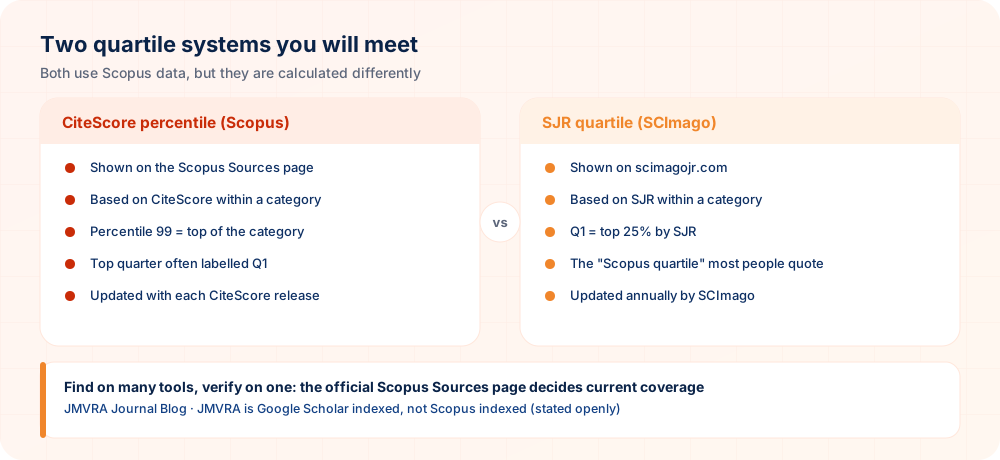
Two related systems will come up. On the Scopus Sources page, each journal has a CiteScore percentile in its subject categories, and the top quarter is often marked Q1. SCImago issues SJR quartiles, from Q1 to Q4 by SJR within each category, and these are what most people mean by “Scopus quartile”. Because a journal may sit in different quartiles across categories and years, always state the category, year and system. Our Scopus quartile guide explains further.
7 Ways to Find Scopus Indexed Journals
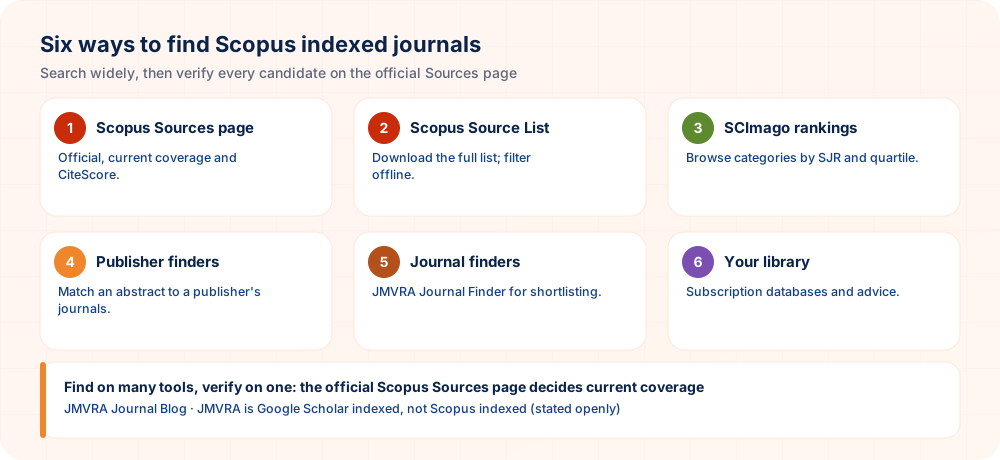
Build a shortlist using several methods, and then verify each journal through Method 1.
Method 1: Using the Official Scopus Sources Page
The Scopus Sources page is the definitive place for checking present coverage.
- Go to the Sources page and search using the title, ISSN, publisher or subject area.
- Visit the journal’s own source page to view its coverage years, CiteScore, SJR, SNIP and percentiles for each category.
- Make sure coverage is still active and extends to the current year.
- Match the publisher and website against the journal you intend to submit to.
Method 2: Get the Scopus Source List as a Download
On its Scopus content pages, Elsevier offers the full Scopus Source List as a spreadsheet. Each title appears with its ISSN, publisher, coverage, subject codes (ASJC) and status, and there are separate lists for discontinued and newly accepted titles. Filter by subject, open access or publisher, and fetch a new copy from time to time, since coverage changes monthly.
Method 3: Using SCImago Journal Rank
- Visit scimagojr.com and select “Journal Rankings”.
- Pick your subject area, category and the most recent year.
- Order the list by SJR, and filter by country or open access where helpful.
- Open each journal to see its SJR trend, quartiles per category and h-index.
Method 4: Journal Finders From Publishers
Big publishers provide tools that compare your title and abstract with the journals they publish, such as Elsevier’s Journal Finder. These give useful ideas, yet they recommend only that publisher’s own titles, so pair them with SCImago and the Sources page.
Method 5: Using the JMVRA Journal Finder and Scopus List
Use the JMVRA Journal Finder to shortlist journals by topic, and JMVRA’s list of Scopus indexed journals to browse by subject. Regard both as places to begin, and confirm each title on the Scopus Sources page.
Method 6: Asking Your Library and Colleagues
Librarians are able to query subscription databases, carry out Scopus searches through institutional access, and advise on which journals your institution accepts. Experienced colleagues know what their field reads and how those journals treat authors. A short conversation with either can save hours of searching.
Method 7: Look at the Literature You Cite
Note where the papers you cite appeared. Journals carrying the work you build on often suit your own paper best, and you already know who reads them. Verify each on the Sources page.
ASJC Codes and Subject Categories
Scopus sorts its sources using the All Science Journal Classification (ASJC), in which broad subject areas split into narrower categories that each have a four-digit code. Quartiles and percentiles are worked out inside these categories, which makes picking the correct one important. Look up the categories of journals you already cite, and compare candidates within one category and not across different fields.
Using the Source List Spreadsheet to Best Effect
| Filter or column | Use it to |
|---|---|
| Status: active or inactive | Retain only titles whose coverage is active |
| ASJC codes | Narrow the list to your own subject categories |
| Open access flag | Pick out open access titles, then review each one’s fee policy |
| Publisher and country | Identify journals run by societies, universities or regions |
| Source type | Distinguish journals from book series and proceedings |
| Discontinued titles sheet | Steer clear of journals with ended coverage |
Note the date of the file you worked from, and download a new copy before you use it again.
A Practical Example: Building a Shortlist for an Engineering Paper
Suppose your paper is about battery thermal management. A shortlist could sensibly be assembled as follows:
- Work out probable categories from the references you cite, such as energy engineering and mechanical engineering.
- On SCImago, list the Q1–Q3 journals of those categories for the most recent year.
- Drop journals whose latest issues carry no thermal-management studies.
- For the eight that remain, record the access model, APC and any review times they publish.
- Verify each on the Scopus Sources page and retain three: an ambitious target, a realistic one and a fallback.
Tools Compared
| Tool | Type | Cost | Best for |
|---|---|---|---|
| Scopus Sources page | Official database | Free | Checking present coverage and metrics |
| Scopus Source List (spreadsheet) | Official data file | Free | Filtering every title offline |
| SCImago | Ranking portal built on Scopus data | Free | Exploring categories by SJR and quartile |
| Elsevier Journal Finder | Publisher matcher | Free | Suggestions drawn from one publisher’s journals |
| JMVRA Journal Finder | Shortlisting tool | Free | Pairing your topic with candidate journals |
| Library subscription databases | Institutional | Via your library | Further journal profiles and guidance |
The Way Scopus Chooses Journals
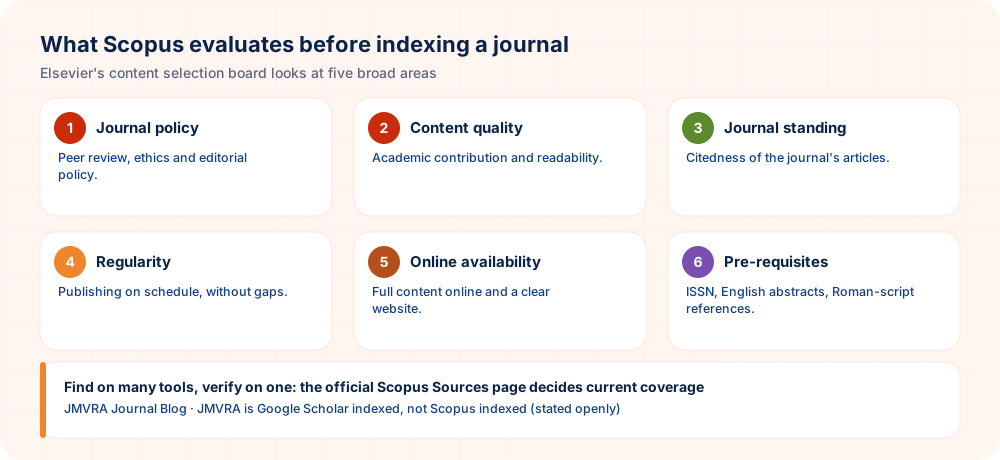
Journals submit an application to Scopus and the CSAB assesses them. As set out on Elsevier’s content policy and selection page, titles first have to satisfy basic conditions: peer-reviewed content, a registered ISSN, titles and abstracts in English, references in Roman script and a publication ethics statement. They are then judged on journal policy, content quality, standing, regularity of publishing and online availability. Applicants normally need a history of regular publication, and titles already indexed are reviewed again, with some being discontinued.
Editors may find our guide to starting a new journal and registering DOIs useful for the identity and policy fundamentals that indexes look for.
Steering Clear of False Scopus Claims
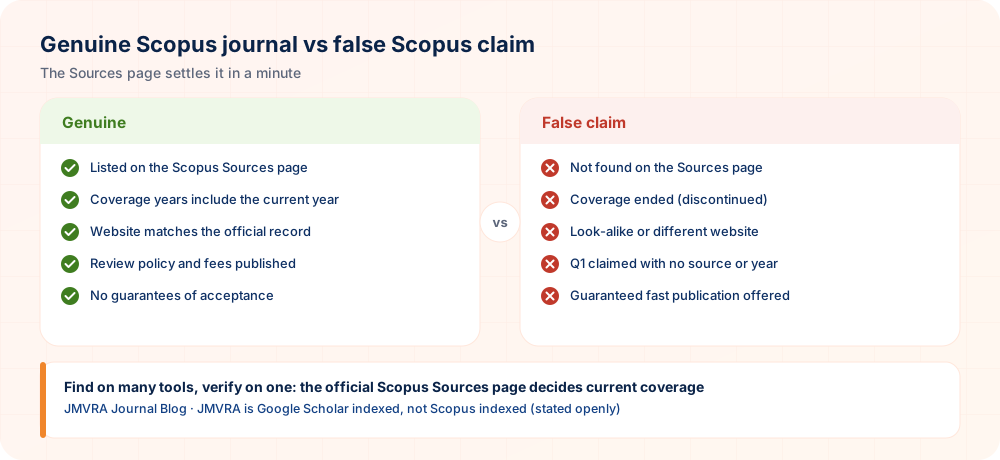
- “Scopus indexed” on the website but absent from the Sources page: the claim is untrue.
- Coverage that has ended: the journal might have been discontinued, and papers from then on are not indexed.
- A website that differs from the official record may indicate a cloned journal; read our journal hijacking guide.
- “Q1” given without a category, year or source, or paired with promises of guaranteed, quick publication.
- Unsolicited invitations that urge you to hurry and submit to a “Scopus journal”.
Our predatory journal checklist offers a complete routine to follow.
Step-by-Step Selection of the Right Scopus Journal
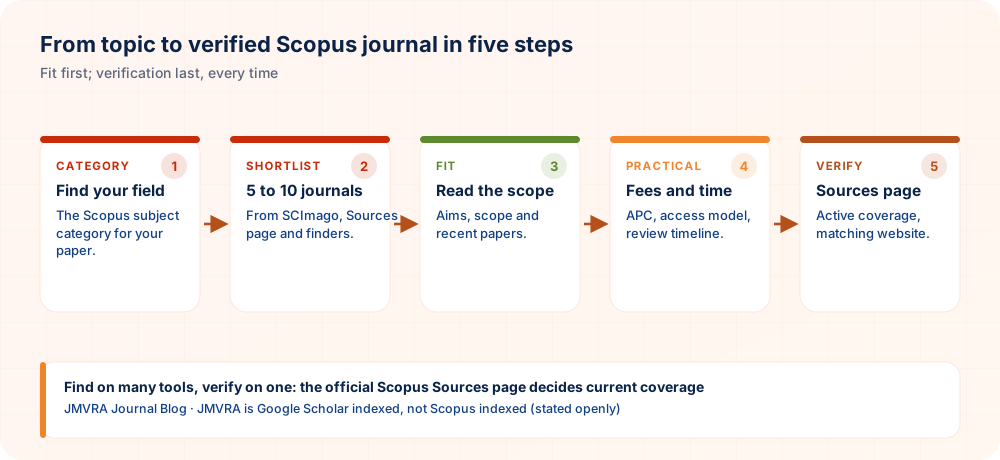
- Identify your subject category (ASJC) so that journals are compared inside the correct field.
- Set a realistic target: Q1/Q2 suits your strongest work, while Q2/Q3 may fit early-career or niche papers.
- Shortlist five to ten journals using SCImago, the Sources page and journal finders to find candidates.
- Read aims, scope and recent papers, because a poor scope match is a major reason for desk rejection.
- Check timelines against your own deadlines, as selective journals may take months.
- Check access and fees, covering subscription, open access and any APC.
- Verify current coverage on the Sources page prior to submission.
- Submit through the official website and follow your paper’s progress; once it is published, look at your Scopus author profile.
How JMVRA Fits In
JMVRA is not indexed in Scopus and is absent from every Scopus list. It is a low-cost, open access, peer-reviewed journal for papers whose rule calls for a genuine peer-reviewed journal and not Scopus in particular.
JMVRA, stated openly
JMVRA is visible in Google Scholar and registered with Crossref and the ISSN Portal / ROAD; for now it is not indexed in Scopus, Web of Science or DOAJ.
- Review: transparent, double-blind peer review. Specialist reviewers assess your paper, and you receive the acceptance or rejection decision by email and WhatsApp.
- Fee: Indian authors pay ₹971 INR and foreign authors $41 USD, but only once the paper is accepted.
- Access: readable by all through the CC BY 4.0 licence (ISSN 2984-8911); ask whenever a Crossref DOI is needed.
- Metric: an impact factor of 11.25 based on Google Scholar, which is not a Scopus or JCR metric.
Compare the routes in Scopus vs Web of Science vs open access.
Share Your Research Through JMVRA
Get your research published in JMVRA
JMVRA (ISSN 2984-8911) is a peer-reviewed, open access journal spanning many disciplines. Submission is free. Specialist reviewers assess your paper, and you receive the acceptance or rejection decision by email and WhatsApp.
- 1. Follow the guidelines when preparing
- 2. Submit online
- 3. Peer review
- 4. Decision by email & WhatsApp
- 5. Go live in open access
Checklist for Your Scopus Journal
- CategorySubject category pinned down
- ShortlistFive to ten candidates gathered with different tools
- FitScope and latest papers agree
- PracticalitiesFees, access and schedule understood
- CoverageShown as active on the Sources page for this year
- IdentityWebsite and ISSN agree with the official entry
Using Scopus Source Lists with Confidence
A source list is only helpful when you read it carefully. These tips show how to avoid misreading entries, so that your search for indexed journals leads to sound and verifiable choices.
- Search by ISSN, not only by title. Titles can be similar or reused, while ISSNs identify a journal precisely. Matching the ISSN reduces the risk of confusing a genuine title with an imitation.
- Note the status column. Look at whether a title is listed as active or discontinued. A journal that once appeared in the list may no longer be covered for new papers.
- Filter by subject area. Narrow the list to your discipline before comparing entries. Broad lists contain thousands of titles, and a focused filter keeps your attention on realistic options.
- Save a copy of the file you used. Keep the downloaded list with its date in your records. If your institution later asks how you checked, you can show exactly what you saw.
- Confirm on the journal's own page too. Compare what the journal says about itself with what the official list shows. Any mismatch deserves a question to the editor or advice from a librarian.
Match ISSNs, read status columns and keep dated copies, so every indexing check you make can be repeated and defended.
Questions Researchers Often Ask
In Summary
Finding a Scopus indexed journal is easy if you apply the right tools in sequence. Start by browsing and shortlisting with SCImago, the Sources page and journal finders, then read the scope and recent papers, weigh fees and timelines, and, before submitting, confirm present coverage at the official Scopus Sources page. Watch for false claims, and let fit count alongside quartile.
Looking for a genuine, low-cost peer-reviewed option? Send your paper to JMVRA
JMVRA (ISSN 2984-8911) is a peer-reviewed, open access journal spanning many disciplines. Submission is free. Specialist reviewers assess your paper, and you receive the acceptance or rejection decision by email and WhatsApp.
- 1. Follow the guidelines when preparing
- 2. Submit online
- 3. Peer review
- 4. Decision by email & WhatsApp
- 5. Go live in open access
References and Sources
The Five Steps in Brief
- CategoryYour subject field in Scopus
- ShortlistUse SCImago, the Sources page and finders
- FitScope plus recent papers
- PracticalCost, access and schedule
- VerifyThe official Sources page
See also: Scopus quartiles · Scopus search · Scopus journal list.
Ready to Publish? Submit to JMVRA
JMVRA is aligned with UGC's Suggested Parameters for Choosing Peer-Reviewed Journals.
JMVRA is a Transparent, Peer-Reviewed, Open Access Journal (Refereed Journal). Following the discontinuation of the UGC and UGC-CARE journal listing, and in alignment with the latest UGC-CARE recommendations and guidelines, JMVRA is aligned with UGC’s Suggested Parameters for Choosing Peer-Reviewed Journals.
Helpful pages on jmvra.org
Key Terms
Subjects and search phrases this article addresses.
Related Reading
Additional guides about Scopus and journal verification.
Scopus Quartiles Q1 to Q4: Meaning & Free Check
Read the guide RelatedFree Scopus Searching in 2026
Read the guide RelatedFind a Scopus Article by Title or DOI for Free
Read the guide Related50 No-APC Scopus Journals for 2026 by Field
Read the guide RelatedWhat Makes a Journal Scopus-Indexed?
Read the guide RelatedPredatory Journal Checklist for 2026
Read the guideKeep Reading on the JMVRA Blog
This guide belongs to the JMVRA journal blog, which offers practical advice on publishing, indexing, metrics and research integrity, written to be checkable instead of promotional.