
A predatory journal takes publication fees but does not deliver real peer review, editorial oversight or the services it advertises. Authors end up losing money, time and reputation, and their papers may be placed where few people will read or trust them. This checklist sets out red and green flags, free official tools, a step-by-step verification routine and advice for anyone who has already been caught out. Even a short check before you submit is far cheaper than withdrawing a paper afterwards.
One key point runs through this whole guide: being new, regional, multidisciplinary, inexpensive or absent from selective databases does not make a journal predatory. What defines a predatory journal is deception and the lack of genuine review — false claims, fake editors, guaranteed acceptance and fees charged for no real work.
Defining a Predatory Journal
A predatory journal puts earning money above scholarship. It collects fees from authors yet fails to offer what honest journals do: real peer review, capable editing, truthful statements about indexing and fees, and dependable long-term access to its content. Common behaviours include:
- Taking fees without genuine peer review and accepting nearly every submission.
- Making untrue claims of being indexed in Scopus, Web of Science, PubMed or DOAJ.
- Showing made-up or bought metrics as though they were official.
- Pushing aggressive, flattering invitations that nobody asked for.
- Naming editors who do not exist, have passed away or never agreed to serve.
- Promising publication within days of submission.
Librarian Jeffrey Beall made the term “predatory publishing” popular, and his list of potential predatory publishers was widely known until it was removed in 2017. Copies and successor lists still circulate online, but Beall does not maintain them and they may be outdated or mistaken, so handle them with care and never rely on them alone. Treat any such list as a prompt to investigate, not as a verdict.
What Does Not Make a Journal Predatory
| Feature | Why it is not proof | What to check instead |
|---|---|---|
| Not indexed in Scopus, Web of Science or DOAJ | Selective databases cover only a fraction of journals, so many genuine ones are missing | Whether the journal makes false claims, plus its review process and policies |
| A low or modest publication fee | Plenty of genuine journals keep fees low, while costly journals can still be doubtful | When the fee is charged and what it covers |
| A multidisciplinary scope | Many respected journals publish across disciplines | Whether the editorial board covers the fields it publishes |
| “International Journal of…” in the title | Thousands of genuine journals use this phrase | Identity, people and policies |
| A new journal | Every journal was new once | A credible publisher, board and review process |
| A non-JCR metric, clearly labelled | Other metrics exist (CiteScore, SJR, Google Scholar-based values) | Whether the metric is named, sourced and not presented as a JCR Impact Factor |
12 Red Flags vs 12 Green Flags
| Red flag | Green flag |
|---|---|
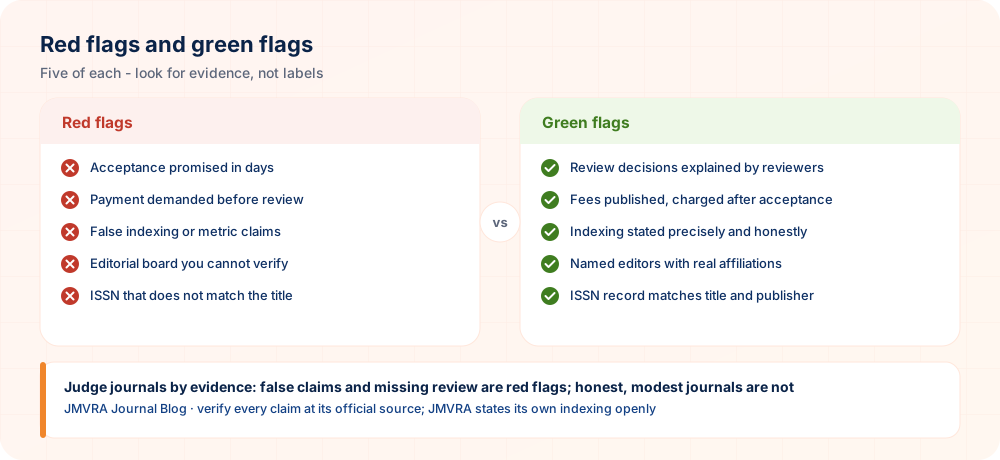
| Unsolicited, flattering invitations: “Dear Respected Author…” | You found the journal through your reading, a database or a colleague |
| Acceptance promised within days | A review process with substantive comments from reviewers |
| “Guaranteed publication” before review | A clear statement that decisions depend on peer review |
| Indexing claims you cannot find at the database itself | Indexing stated precisely, and verifiable at the source |
| Metrics with no named source, or presented as a JCR Impact Factor when they are not | Metrics named with their source and year, or none claimed |
| An editorial board you cannot verify | Named editors with real, checkable affiliations |
| A careless website: broken links, copied text, missing policies | A clear website with aims, scope, guidelines and policies |
| Hidden or changing fees | Fees published in advance |
| Payment demanded before review, or to personal accounts | Fees charged only after acceptance, through official channels |
| A scope that mixes unrelated fields with no matching editors | A defined scope with editors who cover it |
| An ISSN that does not match the title on the ISSN Portal | An ISSN record that matches the title and publisher |
| A very new domain claiming a long history | A domain and archive consistent with the journal’s stated history |
When Do Red Flags Become Too Many?
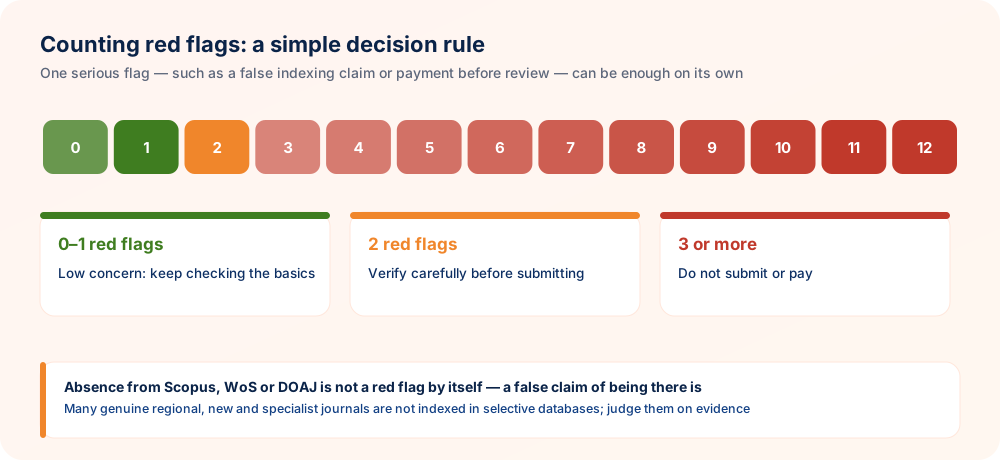
A workable rule: with two red flags, verify with great care; with three or more, do not submit or pay. A few flags are serious enough to count alone — a false indexing claim, guaranteed acceptance, payment requested before review, or an ISSN that actually belongs to a different journal. Write down what you find so that your decision rests on evidence rather than a feeling.
Free Tools for Verifying Any Journal
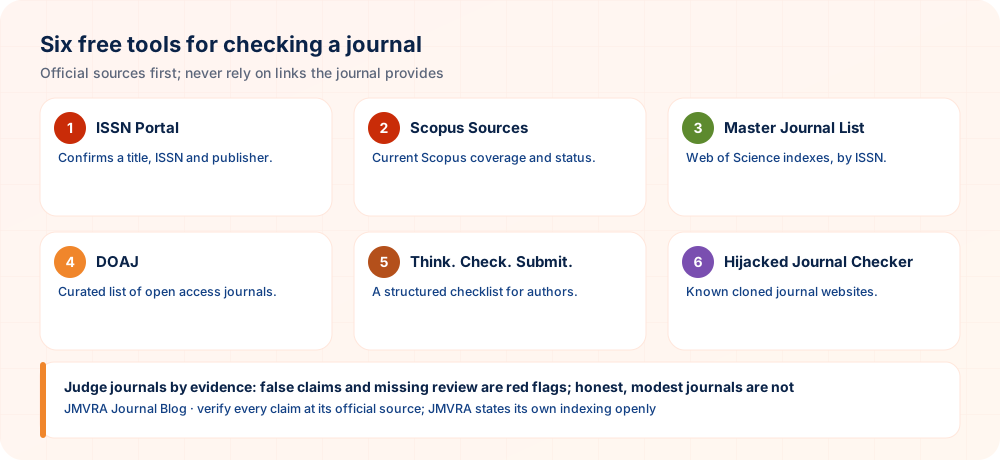
| Tool | Use it to |
|---|---|
| ISSN Portal | Confirm the journal’s ISSN, title and publisher |
| Scopus Sources page | Check current Scopus coverage and status |
| Master Journal List | Check Web of Science indexing and which index |
| DOAJ | Check listing among curated open access journals |
| NLM Catalog | Check MEDLINE status for medical journals |
| COPE member search | Confirm any claimed COPE membership |
| Think. Check. Submit. | Work through a structured checklist |
| Retraction Watch Hijacked Journal Checker | Check known cloned journal websites |
| ICANN domain lookup | See when a website domain was registered |
Watchlists that need a subscription exist as well, and your library may offer access. Treat them as one source of information among several, never as the final word.
Step by Step: Check a Journal Before You Submit
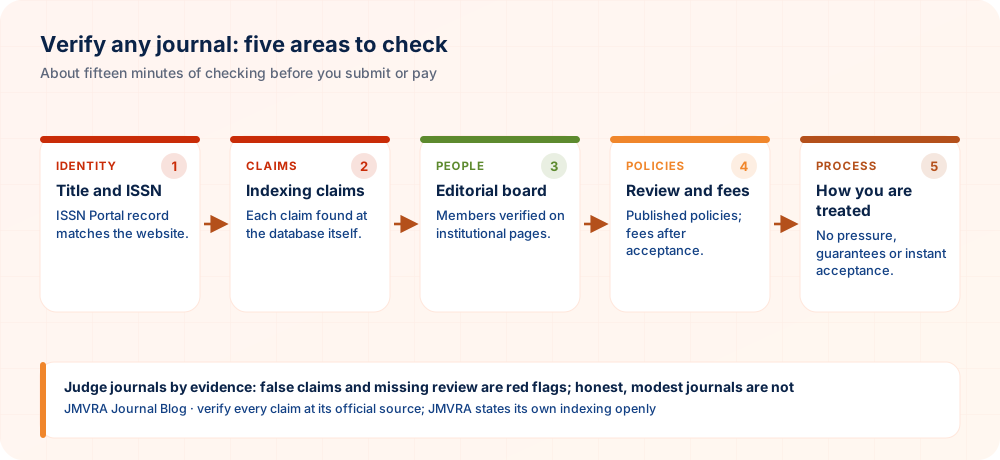
- Confirm identity. Enter the ISSN into the ISSN Portal and make sure the website agrees on title, publisher and country.
- Check each indexing claim at its source. Use Scopus Sources, the Master Journal List, DOAJ or the NLM Catalog, and make sure the website listed there is the one you are viewing. A journal that claims nothing is fine; one that claims something untrue should be dropped immediately.
- Look for clones. Use the Hijacked Journal Checker, then compare the web address character by character against the official record.
- Examine the website. Look for aims and scope, author guidelines, a peer review policy, ethics policies, fees and a genuine archive.
- Check the domain age against the history the journal claims.
- Verify the editorial board. Locate two or three members on institutional pages and think about emailing one of them.
- Confirm memberships like COPE by consulting the body’s own website, if the journal says it belongs.
- Question metrics. A metric ought to give its source and year; the Journal Impact Factor is published by Clarivate alone.
- Read recent articles. Do they fit the scope, hang together and carry proper references?
- Ask your librarian or supervisor, and work with Think. Check. Submit.
Further reading: the predatory journals red-flag checklist, the journal hijacking guide and the database checking guide.
Metric Claims: Which Are Real and Which to Question
| Claim | Who publishes it | How to treat it |
|---|---|---|
| Journal Impact Factor | Clarivate (Journal Citation Reports) only | Verify in JCR; a JIF claimed for a journal not in Web of Science is false |
| CiteScore | Scopus (Elsevier) | Verify on the Scopus Sources page |
| SJR and quartile | SCImago, from Scopus data | Verify on scimagojr.com for the category and year |
| Google Scholar-based metrics | Calculated from Google Scholar data | Acceptable if clearly labelled as such, never presented as a JIF |
| “Impact factor” from paid or unknown services | Commercial metric or badge services | Treat with caution; these are not the Journal Impact Factor |
Each metric is described in our metrics comparison guide.
Fresh Threats From the AI Era
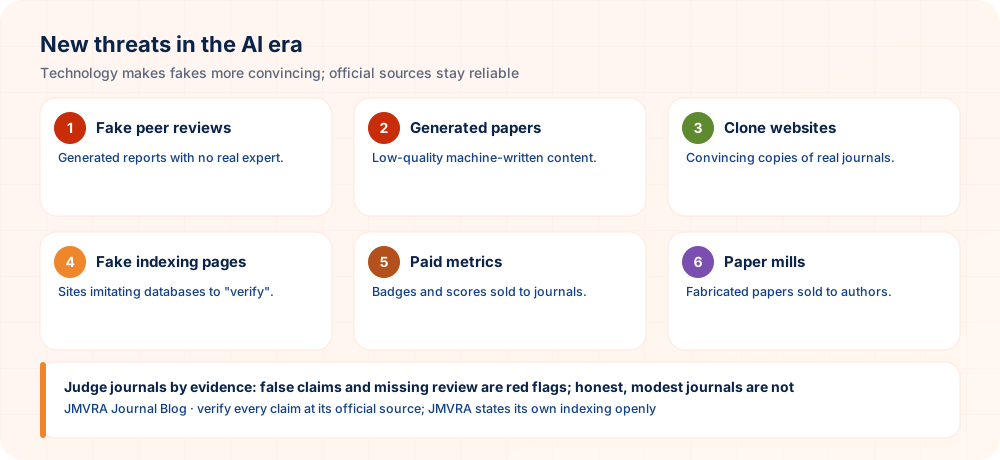
- Fake peer reviews produced by AI so that a non-existent process appears real.
- Machine-generated papers that fill issues with poor-quality content.
- Convincing clone websites with invented boards and histories.
- Fake “verification” pages that imitate real databases.
- Paper mills that sell fabricated or plagiarised papers and authorship.
Protection: enter the official database addresses yourself, and never follow a journal’s own links to “proof” of indexing. Our guide to using AI ethically covers the author’s side.
How to Read an Invitation Email
| What you see | Why it matters |
|---|---|
| Sent from a free email address or look-alike domain | Genuine journals use their official domain |
| Flattery about an unrelated paper of yours | A mass-mailing technique |
| “Publish in 3 days” or “guaranteed acceptance” | No genuine journal can promise outcomes |
| A discount that expires today | Pressure to stop you checking |
| Links to pay or submit directly | Find the official site yourself instead |
A Worked Example: Comparing Two Journals
Imagine two fictional journals both inviting you to submit. Here is what the checklist reveals about each:
| Check | Journal A | Journal B |
|---|---|---|
| ISSN Portal | Matches title and publisher | ISSN belongs to a different journal |
| Indexing claims | Claims Google Scholar only; true | Claims Scopus; not on the Sources page |
| Metric | None claimed | “Impact factor 7.8” with no source |
| Editorial board | Three members confirmed | Names not found; one denies involvement |
| Fees | Published; after acceptance | Pay within 24 hours to “secure” acceptance |
| Process | Reviewer comments received | “Accepted” two days after submission |
| Red flags | 0 | 6 — do not submit or pay |
Journal A is humble and absent from selective databases, yet it is honest and genuine. Journal B boasts impressive claims, and every single one is untrue. It is evidence, not prestige, that settles the matter.
Paper Mills and Publication Agents
Some operators run no journal whatsoever; instead they sell authorship slots, ready-made papers or “guaranteed” placement in named journals. Typical warning signs are offers to put your name on a paper you did not write, fees paid to an agent rather than to a journal, promises of a place in one particular indexed journal, and requests to submit through another person’s account. Buying authorship or papers is serious misconduct and can result in retraction and disciplinary action. Always send your own work straight to journals through their official websites. If an offer feels too convenient, step back and ask why anyone would need to be paid for it.
What to Do If You Have Already Published in a Doubtful Journal
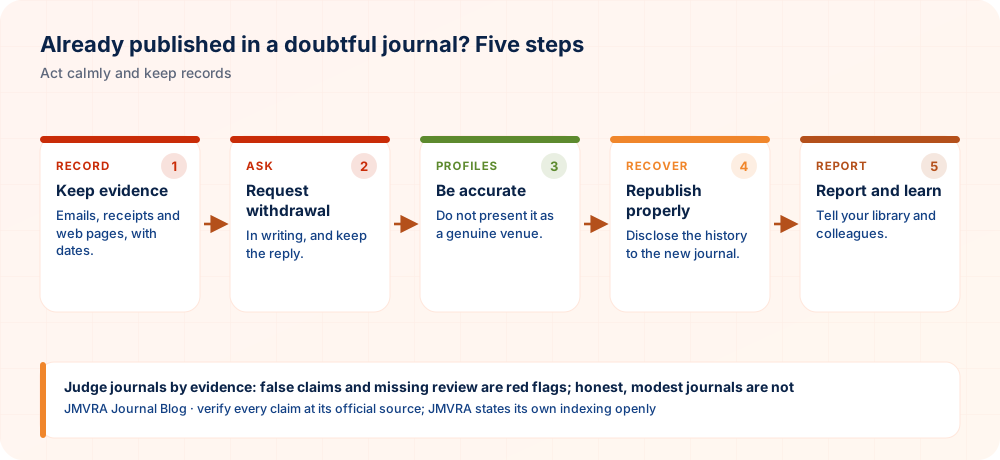
- Keep evidence such as emails, receipts and web pages, along with their dates.
- Ask for withdrawal in writing and save the reply. Do not pay any further “withdrawal fees”.
- Keep your profiles accurate: do not describe the paper as a publication in a reputable venue, and ask your institution how it should be listed or annotated.
- Republish properly if the work is sound, and tell the new journal’s editor about the earlier publication.
- Report and learn: inform your library or research office, and pass on the lessons to your colleagues.
Notes for Indian Researchers
- The UGC-CARE list is now archived and kept for reference only, so it does not signal current validation. Follow your institution’s present rule and judge journals against UGC’s suggested parameters; read the UGC notice and our UGC CARE 2026 guide.
- The pressure to publish for PhD requirements and promotions makes offers of guaranteed acceptance tempting; they are the clearest warning sign of all.
- Be wary of false claims of “UGC CARE listed in 2026” and of agents who offer to place papers in return for a fee.
- Report concerns to the research office or library at your institution.
How JMVRA Measures Up to This Checklist
We urge authors to run this checklist on every journal, JMVRA included. This is the evidence you can check:
| Check | JMVRA | Where to verify |
|---|---|---|
| Identity | ISSN 2984-8911; publishing since June 2023 | ISSN Portal |
| Indexing, stated openly | Found in Google Scholar; absent from Scopus, Web of Science and DOAJ | Each database; JMVRA’s indexing page |
| Metric, labelled | 11.25 Google Scholar-based impact factor — not a JCR Impact Factor | Impact factor explained |
| Peer review | Transparent, double-blind peer review by subject experts | Peer review policy |
| Fees | ₹971 INR for Indian authors / $41 USD for foreign authors, payable only after acceptance | Publication charges |
| Process | No guaranteed acceptance; decisions by email and WhatsApp | Author guidelines |
| Official website and contact | jmvra.org; [email protected] | Journal verification page |
Share Your Research Through JMVRA
Bring your research to JMVRA
JMVRA (ISSN 2984-8911) is a peer-reviewed, open access journal spanning many disciplines. Submission is free. Specialist reviewers assess your paper, and you receive the acceptance or rejection decision by email and WhatsApp.
- 1. Prepare according to the guidelines
- 2. Submit online
- 3. Peer review
- 4. Decision by email & WhatsApp
- 5. Publish with open access
Your 15-Minute Checklist
- IdentityISSN Portal record matches the website
- ClaimsEvery indexing claim found at its source
- Clone checkDomain matches; not on the hijacked list
- PeopleTwo or three editors verified
- Policies and feesReview, ethics and fee pages read; fee after acceptance
- ProcessNo guarantees, no pressure, no payment before review
Habits That Keep You Clear of Predatory Journals
Checking a single journal is useful, but lasting protection comes from routine. These habits help researchers stay alert when new invitations, websites and unfamiliar titles appear.
- Never act on the first email. Pause before replying to any invitation, however flattering. Take a day to research the sender independently and discuss it with a colleague before sending a file.
- Build a personal list of trusted venues. Keep a record of journals your supervisors and peers have used with good experiences. Starting from known venues reduces the need to evaluate unfamiliar names under pressure.
- Check the contact details in person. Look for a real postal address, a named editor and a working email domain. Vague or mismatched details suggest the operation may not be accountable.
- Trust slow, clear communication. Genuine editors explain the review process and do not hurry you towards payment. Pressure, deadlines or special discounts should make you more cautious, not less.
- Share warning signs with your group. When you spot a suspicious journal, tell your lab or department. Collective awareness protects early-career researchers who might not recognise the signs.
Pause, verify independently and share what you learn, because steady habits protect you better than any single checklist.
Questions Researchers Often Ask
In Summary
Predatory journals have grown more sophisticated, yet the defence is unchanged: verify identity, check every claim at its official source, confirm that the people and policies are real, and refuse guarantees and pressure. If you judge journals on evidence and honesty rather than fame, cost or membership of a particular database, you will publish safely. A little patience at the selection stage protects your reputation for years afterwards.
Ready to publish safely? Submit your paper to JMVRA
JMVRA (ISSN 2984-8911) is a peer-reviewed, open access journal spanning many disciplines. Submission is free. Specialist reviewers assess your paper, and you receive the acceptance or rejection decision by email and WhatsApp.
- 1. Prepare according to the guidelines
- 2. Submit online
- 3. Peer review
- 4. Decision by email & WhatsApp
- 5. Publish with open access
References and Sources
Five Areas to Check
- IdentityISSN Portal match
- ClaimsVerified at each database
- PeopleEditors confirmed
- PoliciesReview, ethics, fees
- ProcessNo guarantees or pressure
Related: Red-flag checklist · Journal hijacking · Journal verification.
Ready to Publish? Submit to JMVRA
JMVRA is aligned with UGC's Suggested Parameters for Choosing Peer-Reviewed Journals.
JMVRA is a Transparent, Peer-Reviewed, Open Access Journal (Refereed Journal). Following the discontinuation of the UGC and UGC-CARE journal listing, and in alignment with the latest UGC-CARE recommendations and guidelines, JMVRA is aligned with UGC’s Suggested Parameters for Choosing Peer-Reviewed Journals.
Related pages on jmvra.org
Key Terms
Subjects and search phrases this article addresses.
Related Reading
Further guides on verifying journals and protecting your research.
Predatory Journals and Their Red Flags: A Complete Checklist
Read the guide RelatedJournal Hijacking: Spotting Cloned Journal Sites
Read the guide RelatedChecking Scopus, WoS, DOAJ & PubMed for Free
Read the guide RelatedCiteScore vs Impact Factor vs SJR vs SNIP vs Google Scholar h-index
Read the guide RelatedCloned & Fake Journal Alert: Protect Your Paper
Read the guide RelatedUGC-CARE List 2026: Status, Group I & Group II
Read the guideKeep Reading on the JMVRA Blog
Published on the JMVRA journal blog, this guide gives practical direction on publishing, indexing, metrics and research integrity, with a focus on what can be verified instead of on promotion.