
Nearly every author starts by asking “How much will it cost to publish my paper?”, yet journal websites make it surprisingly hard to find out. Charges run from zero to several thousand US dollars, and the single word “fee” can cover very different things. Here we split a publication fee into its components, compare the principal models, describe what a reasonable fee looks like and offer worked examples along with a budget plan. To see the bigger picture of picking an affordable journal, read our companion guide to low-cost journal publication for students and researchers. Reading it before you shortlist journals can save you from avoidable surprises later.
What Your Publication Fee Covers
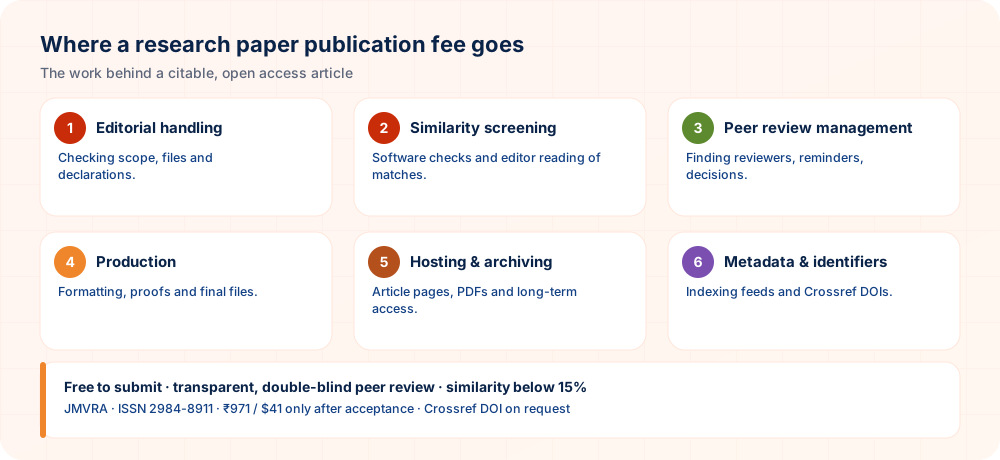
Even when the whole process is online, publishing a research article takes genuine effort. The manuscript must be screened, matched to reviewers, followed up through review, revised, prepared for release, hosted on a durable page, described with metadata that indexes can read and, if requested, given a DOI. For many open access journals a fee is how this work is funded without readers being charged. Understanding these steps helps you judge whether a quoted fee looks realistic.
Efficient technology such as online submission, automated similarity screening and digital-first production can hold costs down, yet the editorial steps must never vanish. Comparing fees really means comparing what work is done for the money.
Fee Models Compared
| Model | Who pays | Typical author cost | Watch for |
|---|---|---|---|
| Subscription | Libraries and readers | Usually none | Your paper’s access is restricted; look into self-archiving rights |
| High-APC open access | Authors or funders | High, often in USD | Whether you qualify for a waiver or discount |
| Diamond open access | Institutions or sponsors | None | More limited scope; possibly selective |
| Hybrid | Subscription with an optional APC | Expensive when open access is selected | Being charged twice by one journal |
| Low-cost open access | Authors pay a modest fee | Low and published | Check the review process, policies and indexing claims |
No model wins by default. A subscription journal can suit a paper that has to appear in a certain database, a diamond journal may fit a regional subject, and a low-cost open access journal may work well for a student project or for a paper that must be freely readable without grant funding. Match the model to what the paper actually needs rather than choosing by price alone.
Signs of a Fair Fee
- Published in advance as a set amount on the journal’s own website.
- Charged after acceptance and never required in order to get a review.
- Clear about what is included — review, publication, certificate, DOI and the number of authors covered.
- Paid via official channels and backed by a receipt or invoice.
- Unconnected to the decision — there are no “fast-track” or “guaranteed acceptance” tiers.
Worked Cost Examples
Taking the charges JMVRA publishes — ₹971 INR for Indian authors or $41 USD for foreign authors for each accepted paper, covering up to five authors, with ₹500 added per extra author — the cost of typical cases looks like this:
| Situation | Total fee | When payable |
|---|---|---|
| A supervisor with three B.Tech students (India) | ₹971 INR | After acceptance |
| One PhD scholar with a supervisor and a co-guide (India) | ₹971 INR | After acceptance |
| Faculty team of seven authors (India) | ₹971 INR + ₹1000 = ₹2501 | After acceptance |
| A pair of authors based outside India | $41 USD | After acceptance |
| Paper declined after review | Nothing | — |
| Crossref DOI wanted | On request | Contact the editorial office |
Learn the cost ahead of submission
JMVRA lists all of its charges openly: ₹971 INR (Indian) or $41 USD (foreign) for each accepted paper covering up to five authors, due only once the paper is accepted.
Planning Your Budget by Career Stage
| Author | Typical situation | Budget tips |
|---|---|---|
| Undergraduate and postgraduate students | Project teams without a grant | Split the fee among team members; find out if your college backs student publications |
| PhD scholars | Papers linked to a thesis, university regulations | Decide early how many papers you will write; look into fellowship contingency funds or department support |
| Faculty members | Steady publishing for appraisals | Map out a year’s worth of papers; certain institutions repay fees when a receipt is shown |
| Independent researchers | Self-funded | Pick journals that publish their fees and add no extras; steer clear of paid “publication services” |
At any career stage, include the fee in your plan from the outset, because a small known fee is simpler to handle than a charge that appears unexpectedly at the end.
Hidden Charges You Should Ask About
- Per-page or excess-length charges levied on lengthy papers.
- Extra author charges once a fixed number of authors is exceeded.
- Colour figure or print charges, sometimes introduced during the proof stage.
- “Processing” or submission fees demanded ahead of review.
- Currency and bank charges on payments made abroad.
- Optional services such as editing, DOI and hard copies that are portrayed as compulsory.
If anything is vague, put your question to the journal in writing prior to submitting, and save the reply.
Invoices, Receipts and Getting Reimbursed
- Before you pay, find out whether the invoice should be in your name or your institution’s.
- Make payment only with the details shown on the official site or sent in the acceptance email.
- Store the transaction reference, receipt, acceptance letter and paper ID in one place.
- Give your institution these documents along with the link to the published article.
Paying When You Are Outside India
At JMVRA, foreign authors pay $41 USD for each accepted paper. Your bank converts the sum to your currency using its own rate and might add a small fee for international transfers. Pay only once the paper is accepted and only via official channels. For more on payment and documents, see our guide for international authors. Keep proof of payment until the article appears online.
What Is Included in JMVRA’s Fee
| Item | Included? |
|---|---|
| Initial screening and similarity checking | Yes |
| Open-process, two-way anonymous peer review | Yes |
| Publication as open access under CC BY 4.0 | Yes |
| Article page plus PDF in the journal archive | Yes |
| Digital publication certificate | Yes, after publication |
| Up to five authors | Yes; ₹500 per additional author |
| Crossref DOI | Available on request — contact the editorial office |
| Printed copies | Optional, and only if you choose them |
Once you know what is included, you can compare fairly, because a journal advertising a smaller fee but adding charges for authors, pages or certificates can turn out more expensive.
A Fair Comparison of Two Quotes
Say two journals both suit your paper. Journal P advertises a low fee but adds a charge for each page past eight pages and for each author past three, whereas Journal Q charges one fee that covers five authors. Take a twelve-page paper with four authors:
| Item | Journal P | Journal Q |
|---|---|---|
| Headline fee | Low | Moderate |
| Four extra pages | Charged | Included |
| Fourth author | Charged | Included |
| When payable | At submission | After acceptance |
| Combined risk in case of rejection | Fee lost | Nothing |
Journal Q gives better value despite a higher advertised fee, and when you pay counts for as much as how much you pay.
When You Are Unable to Pay a Fee
- Diamond open access journals ask for nothing from authors or readers; look in DOAJ for fee-free journals in your field.
- Subscription journals typically publish with no author charges; find out if you are allowed to share a preprint or the accepted version.
- Institutional support: numerous colleges and universities repay fees to faculty members and at times to students.
- Project budgets: publication costs are frequently permitted in grant-funded work, so include them in the proposal.
- Waivers: certain publishers waive or lower fees under specific conditions, so enquire prior to submitting.
Five Questions to Judge Value for Money
- Will the paper receive peer review, including comments I am able to read?
- Can readers access it freely on a permanent page, with a licence that is clear?
- Is the requirement this paper must satisfy met by the journal?
- Do I know the full cost today, and is it due only following acceptance?
- Would I be able to back up this choice with evidence when explaining it to my supervisor or committee?
When all five answers are yes, the fee is worth paying, regardless of its amount.
Common Money Mistakes Among Authors
| Mistake | Better practice |
|---|---|
| Paying an agent who claims to “handle everything” | Send your paper and payment straight to the journal |
| Paying prior to getting written acceptance | Hold on until the acceptance email with your paper ID arrives |
| Two co-authors settling the same fee separately | Decide in advance who the single payer is |
| Losing the receipt | Keep a copy together with the letter of acceptance right away |
| Sending money to an individual's account or a digital wallet | Pay only through the official payment details |
Fee Checklist
- Stated amountA set figure shown on the journal's own website
- TimingBilled only after an acceptance decision
- What is coveredPeer review, publishing, listed authors, DOI
- Additional costsWhether page, author or print charges exist
- Authorised routeBank or payment instructions issued by the journal
- PaperworkKeep the receipt, acceptance letter and paper ID
Managing Publication Costs Without Compromising Research Quality
Paying to publish is a normal part of scholarly communication for many authors, yet unclear charges cause real stress. These habits keep your spending transparent and your decisions defensible.
- Request an itemised statement. Before agreeing to anything, ask for a written breakdown showing what the charge includes. Clear itemisation lets you compare offers fairly and spot additional costs that appear later.
- Check funding sources first. Ask your department, supervisor, research office or grant administrator whether publication costs can be covered. Many scholars never ask and end up paying personally for something that was reimbursable.
- Keep every receipt and invoice. File payment confirmations with the invoice and the matching email. Institutions usually need these documents for reimbursement, and they protect you if a payment is ever questioned.
- Never let price replace diligence. A low charge does not make a journal trustworthy, and a high one does not make it better. Verify editorial practice and transparency first, then consider affordability.
Ask for itemised written costs, explore funding, keep your receipts, and let diligence rather than price guide your choice.
Questions Researchers Often Ask
In Summary
A fee can be called affordable when it is modest, announced beforehand, collected only after acceptance and explicit about its contents. Weigh journals by what the money buys, such as genuine review, open access and lasting availability, and plan the cost into your budget early. Metrics and indexing are covered in low-cost, high-impact factor journals; the review stages are described in transparent peer review and the standard publication process. Keep every fee quotation in writing so you can refer back to it later.
Ready to send in your paper?
Sending a paper to JMVRA through the online system costs nothing. After screening, it goes into a transparent double-blind peer review, and only upon acceptance do Indian authors pay ₹971 INR and foreign authors $41 USD. File every confirmation email you receive for future reference.
References and Sources
Taking a Draft Through to a Published Paper
- PrepareStick to the template and author guidelines
- Submit onlineCosts nothing; write down your paper ID
- ScreeningFit with the journal’s subject scope, completed declarations and a similarity level kept under 15%
- Double-blind reviewDecision by email and WhatsApp
- AcceptedPayment of ₹971 INR / $41 USD falls due, and the paper is then published in open access
Further information: Publication guidelines · Peer review · Publication charges.
Ready to Publish? Submit to JMVRA
JMVRA is aligned with UGC's Suggested Parameters for Choosing Peer-Reviewed Journals.
JMVRA is a Transparent, Peer-Reviewed, Open Access Journal (Refereed Journal). Following the discontinuation of the UGC and UGC-CARE journal listing, and in alignment with the latest UGC-CARE recommendations and guidelines, JMVRA is aligned with UGC’s Suggested Parameters for Choosing Peer-Reviewed Journals.
Further reading on jmvra.org
Key Terms
Subjects and search phrases this article addresses.
Related Reading
Further guides on peer-reviewed publishing at a fair price.
Keep Reading on the JMVRA Blog
This article sits on the JMVRA journal blog, where practical guidance covering publishing, indexing, metrics and research integrity is written to be verifiable, not promotional.