
Pick a Journal Before the Draft Is Done
Many authors pick a journal only once the manuscript is finished, which is the wrong order and wastes time, because the venue dictates length limits, structure, citation style and even how the contribution is framed. Revisiting these points late usually means rewriting sections you thought were done.
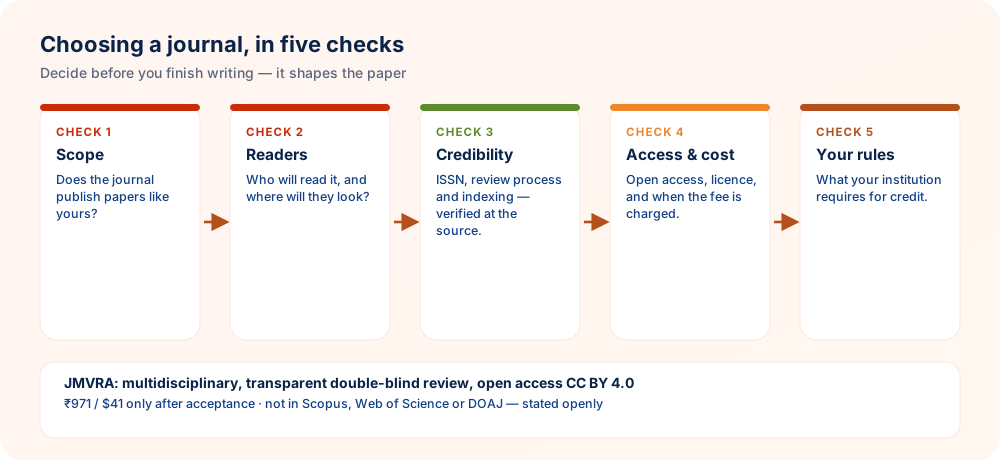
Name a main journal and a fallback while the draft is still forming. The paper will come out more focused and you will skip a tedious round of reformatting afterwards.
Match the Scope
Papers most often get rejected before review because they do not suit the journal. Scope is more than a formality, since it decides whether a qualified reviewer is available.
- Study the aims and scope statement of the journal instead of relying on its name
- Go through three recent articles and ask whether they match yours in type as well as subject
- Make sure the journal has covered your method as well as your subject area
- See which journals published the works you cite, as that is a strong hint
- With interdisciplinary research, settle on the main field and mention the second in your cover note
Identify the Readership
Decide whom you want to reach, then select the journal that this audience genuinely reads.
| You want to reach | Favour |
|---|---|
| Experts in a tightly defined subfield | A journal dedicated to one subject |
| An audience spanning multiple disciplines | A multidisciplinary journal |
| Professionals in the field as well as scholars | A practice-oriented or professional journal that is open to read |
| People at institutions lacking subscriptions | A journal with open access |
| Researchers within a particular region | A regional journal that has a real local audience |
Check Credibility
Apply identical checks to each candidate journal, famous ones included. Fifteen minutes is all it takes, and it is the most valuable quarter of an hour in the entire selection process.
- ISSN verified with the official registry
- An identified editor and a verifiable editorial board
- A peer review procedure explained in detail
- Publicly available ethics, correction and retraction policies
- Fees revealed prior to submission
- Indexing claims checked on each service's own website rather than judged by logos
- An unbroken publication history that anyone can inspect
- An example DOI that opens correctly
Also read Warning Signs of a Predatory or Cloned Journal and Journal Indexing in Plain Language.
Select an Access Model
The access model determines who is able to read your work and what publishing costs you.
- Open access — readable free of charge at once, normally paid for by a fee following acceptance
- Subscription — authors pay nothing, yet readers lacking a subscription cannot access the article
- Hybrid — a subscription title where you can pay to make an individual article open
- Diamond — open access that costs authors nothing, funded by an institution or a society
Start by reading your funder's rules, since some require open access under a particular licence. Read Open Access in Practice: Routes and Licences for details.
Weigh the Charges
Get the figure before submitting. If a journal keeps its publishing cost hidden until after acceptance, that already says a lot about how it works. Ask in writing if the fee is not listed anywhere.
- Is the fee listed publicly ahead of submission?
- Is payment due only once an independent decision is made?
- What is included — review, editing, DOI, hosting, certificates?
- Can a waiver be obtained, and what is the way to ask for it?
- Is there an institutional agreement that pays for it?
As an example, JMVRA lists its fee in the open: ₹971 INR for authors in India and $41 USD for foreign authors, charged for each accepted article and due only after acceptance. Refer to Publication Charges.
Your Paper's Journey at JMVRA, From Submission to Publication
- SubmissionPaper ID assigned
- ScreenScope & similarity
- ReviewDouble-blind
- DecideEmail & SMS
- AmendItem by item
- AcceptCopyright & fee
- ProduceDOI provided when requested
- PublishMonthly issue
How long review takes depends on the reviewers and on any revision required, so no set turnaround is promised; you are told of acceptance or rejection by email and WhatsApp.
Check Institutional Requirements
A journal is unable to say if publishing with it will meet the expectations of your university, funder or promotion committee. Those bodies alone can decide, and what they say takes priority over all other advice on this page. Keep their answer on file.
- Request your research office's requirements in writing.
- Find out if it keeps a list of its own or relies on a specific database.
- Enquire what proof about the journal you ought to keep.
- Save the response along with its date.
Build a Shortlist
Do not depend on one journal alone. Draw up a ranked list of three or four.
| Rank | Choose | Reasoning |
|---|---|---|
| 1 | Closest match, hardest to enter | Worth trying, since even a rejection brings helpful reviews |
| 2 | Good fit with a close match to its scope | A sensible goal for the majority of papers |
| 3 | Sound fit and a dependable process | A trustworthy choice should the first two say no |
| 4 | Broad or multidisciplinary | A reasonable backup that still finds an audience |
Submit in Order
- Send your paper to only one journal at once, because parallel submission violates publication ethics.
- Prepare the formatting for that journal ahead of submission rather than after acceptance.
- After a rejection, study the reviews carefully before going to the next journal on your list, because they typically make the paper better.
- Make revisions between submissions. Sending the unchanged manuscript to the next journal throws away the feedback you have just received.
Mistakes to Avoid
| Mistake | Cost |
|---|---|
| Choosing after writing | Repeated reformatting and a paper pitched at no specific readership |
| Selecting solely by metrics | Weak fit, a desk rejection and months wasted |
| Answering an invitation received by email | The usual path into an exploitative journal |
| Omitting the credibility check | Research left in a place that assessors ignore |
| Failing to consult your institution | A publication that fails to count for your intended purpose |
| Aiming at a single journal | Rejection means starting over instead of moving on to the next option |
At-a-Glance Checklist
- Scope matchesLatest articles resemble yours
- Claims confirmedISSN and indexing checked at source
- Fee understoodLearn it before submitting, pay after acceptance
- Institution consultedWritten reply, prior to submission
An Easy Scoring Sheet
| Criterion | Score |
|---|---|
| Scope fit | 0–2 |
| Credibility verified | 0–2 |
| Meets institutional rules | 0–2 |
| Reasonable, clearly stated fees | 0–2 |
| Readership you want | 0–2 |
Send the paper first to the journal with the top score and hold the rest in reserve.
Warning Signs When Choosing
Unverifiable indexing
Statements you are unable to verify.
Payment before review
A warning sign.
Guaranteed acceptance
A legitimate journal never offers this.
No policies
No pages on review, ethics or fees.
Practical Tips for Building Your Journal Shortlist
Choosing where to publish is a decision worth treating like a small research project. These ideas help you compare options fairly, avoid pressure and keep a record that supports your choice.
- Read before you rank. Browse recent issues of each candidate and note whether papers resemble yours in method, depth and length. Fit is easier to judge from real articles than from an aims statement.
- Ask supervisors and senior colleagues. Experienced people often know which outlets handle your topic fairly and which behave carelessly. Their short advice can save you months of delay or regret.
- Beware unsolicited invitations. Emails praising your earlier work and promising instant publication deserve scepticism. Look up the journal independently and never submit simply because someone contacted you first.
- Prepare a fallback order. Rank your preferred journals before submitting, so that if the first declines, you can adapt the manuscript and move on promptly instead of starting the search again.
- Keep a short rationale. Write a few lines explaining why the chosen outlet suits your work. This helps when completing cover letters and when your department asks how you made the decision.
Judge journals from actual content, seek trusted advice, treat unsolicited offers cautiously, and prepare a ranked fallback list in advance.
Questions Researchers Often Ask
At what stage should I select a journal?
Before the writing is complete, because the scope, audience and format of the journal influence how you frame and present your paper.
How can I confirm that a journal is legitimate?
Confirm the ISSN on the ISSN Portal, test every indexing claim on the relevant service's own site, go through the review policy and make sure the fee is stated openly in advance.
Is my chosen journal going to be accepted by my institution?
That is for your institution to decide. Put the question to your research office in writing prior to submitting, and file the answer.
How many journals are worth comparing?
Between two and four normally gives enough basis for an informed decision.
Is cost the factor that should settle my decision?
Price is relevant, though suitability, credibility and institutional rules take precedence.
Ready to Publish? Submit to JMVRA
JMVRA is aligned with UGC's Suggested Parameters for Choosing Peer-Reviewed Journals.
JMVRA is a Transparent, Peer-Reviewed, Open Access Journal (Refereed Journal). Following the discontinuation of the UGC and UGC-CARE journal listing, and in alignment with the latest UGC-CARE recommendations and guidelines, JMVRA is aligned with UGC’s Suggested Parameters for Choosing Peer-Reviewed Journals.
Handy links within jmvra.org
Key Terms
Subjects and search phrases this article addresses.
Keep Reading on the JMVRA Blog
The JMVRA journal blog includes this guide, one of many practical pieces on publishing, indexing, metrics and research integrity, prepared so readers can verify them without any sales pitch.
The List Has Ended. Here Is How to Check a Journal Yourself.
Read the article From the blogThe Definitive Guide to Publishing in Affordable, Multidisciplinary, Open-Access Journals with Global Reach
Read the article From the blogDOAJ Journal List: The Directory of Open Access Journals Explained
Read the articleRelated Reading
Further reading on the same theme from the JMVRA blog.