
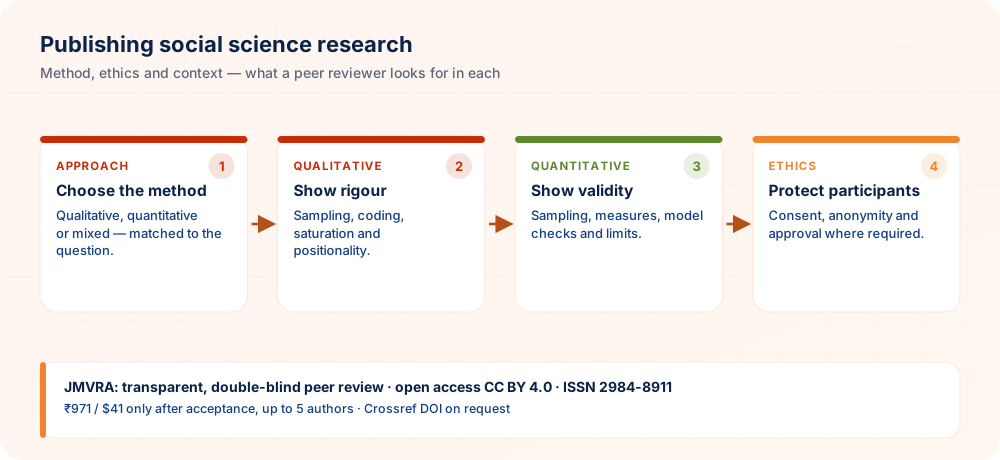
Work in social science journals ranges from surveys, ethnographies and policy analysis to experiments and theory, and reviewers apply the standards that suit each kind. All of it requires a clear argument, open methods and careful ethics. This guide explains what social science reviewers look for and how to select a suitable peer-reviewed journal.
Common Approaches by Field
| Field | Common approaches |
|---|---|
| Sociology | Mixed methods, interviews, ethnography and surveys |
| Education | Action research, assessment data and studies in classrooms |
| Economics | Policy evaluation, field experiments and econometric analysis |
| Political science | Survey experiments, comparative analysis and case studies |
| Media and communication | Discourse analysis, audience research and content analysis |
Qualitative Research Standards
- Set out how the sample was drawn and participants recruited
- Outline how you coded and analysed data (thematic, grounded theory, etc.)
- Back up themes with quotations
- Reflect on your own positionality and reflexivity
- Show trustworthiness through credibility, transferability and dependability
Quantitative Research Standards
- State the sampling frame and the response rate
- Apply weights when the design calls for them
- Give model specifications along with robustness checks
- Do not draw causal conclusions from correlations unless justified
Ethical Practice in Social Research
Vulnerable groups such as children, marginalised communities and people living through conflict often take part in social research. Secure ethics approval, choose consent procedures that fit participants’ literacy and language, guard identities with care (people in small communities are easily recognised), and think about how publication could affect those involved. Discussing these choices openly in the methods section reassures reviewers.
Indian Data Sources
- NSS and PLFS surveys (MoSPI)
- National Family Health Survey (NFHS)
- Census of India
- ASER education reports
- Administrative data at state and district level
Choosing a Journal
- Fit your method. Certain journals lean towards quantitative studies, while others also take qualitative and theoretical papers.
- Fit your readers. Decide between discipline-specific journals and multidisciplinary or policy-focused ones.
- Browse recent issues. Look for papers using your method or from your region.
An Example of Presenting Qualitative Findings
Theme: Informal lending seen as a social duty
“If my neighbour lends me money, I cannot refuse when she needs help at harvest. It is not only money we owe.” (P7, woman, 38, Nashik district)
Begin by introducing the theme, add one or two typical quotations tagged with anonymised identifiers, then interpret them and tie them back to the literature. (Quotation is illustrative.)
The 10 Most-Searched Questions on This Topic
Here are the ten questions researchers search for most on this subject, each with a direct answer.
best peer reviewed journals in social sciences
Journals matching your field, method and readership that offer genuine review; check each one.
social science research paper format
Sections usually go: introduction, then literature, methods, findings, discussion and conclusion; the layout shifts with method.
qualitative research publication
Describe your sampling, coding and analysis, illustrate themes using quotes, and reflect on positionality.
thematic analysis paper
A qualitative technique for finding patterns throughout the data, with every step described.
positionality statement
A statement considering how the researcher’s own background could influence the study.
NFHS data research paper
Studies drawing on the National Family Health Survey should cite the round and methods.
PLFS data analysis
Studies based on India’s Periodic Labour Force Survey.
education research journal India
Journals that carry education research; confirm their scope and review process.
mixed methods research
Bringing qualitative and quantitative approaches together within a single study.
social science journal publication India
Select according to field, method and readership, and verify review and recognition.
How JMVRA Fits In
JMVRA is a Transparent, Peer-Reviewed, Open Access Journal (Refereed Journal). Following the discontinuation of the UGC and UGC-CARE journal listing, and in alignment with the latest UGC-CARE recommendations and guidelines, JMVRA is aligned with UGC’s Suggested Parameters for Choosing Peer-Reviewed Journals. UGC public notice (PDF)
Across its humanities and social sciences scope, JMVRA publishes double-blind reviewed social science research, including sociology, education, economics, political science and media studies.
- ISSN
- 2984-8911 (online) · publishing since June 2023
- Issues
- Monthly issues across many disciplines
- Review
- Two-way anonymous review by specialists
- Access
- Available as open access (CC BY 4.0)
- Fee
- ₹971 INR for Indian and $41 USD for foreign authors, due only after acceptance
- DOI
- Crossref — available as an optional extra
- Indexing
- Google Scholar only; not Scopus, Web of Science or DOAJ
- Impact factor
- 11.25, derived from Google Scholar data
Screening begins the moment a paper arrives and each decision is sent as soon as it is reached, yet JMVRA never promises a set number of days: actual review time depends on the reviewers and on how much revision the paper needs.
At-a-Glance Checklist
- Method defendedThe reason this approach suits the question
- Rigour shownCoding steps or model checks explained
- Context clarifiedWritten for readers beyond your region
- Participants safeguardedThrough consent and anonymity
- Data sources creditedOfficial Indian datasets included
Applying Theory Effectively in Social Science Papers
- Select a theory that actually explains your question, not one included as decoration
- Define the main concepts and show how they inform your expectations or analysis
- Link theory with method by showing how the framework steered data collection or coding
- Revisit theory in the discussion and state what your findings add, confirm or challenge
Generalisation and Context
| Claim | Needs |
|---|---|
| “In this sample, X was associated with Y” | Reliable measurement and analysis |
| “This is likely true for similar groups” | An account of the sample and its context |
| “This is true for the population” | A representative sample with suitable weighting |
| “X causes Y” | A strong experimental or quasi-experimental design |
Keep your conclusions in line with your design. Refer to how to write the methods section.
Writing Social Science Findings With Care for Communities
Social research often concerns people's lives, beliefs and circumstances. Writing responsibly about communities improves both the ethics and the persuasiveness of your paper.
- Explain how you gained access. Describe how you approached the community or institution, who agreed to help and what they were told. Readers judge findings partly by how participants came to take part.
- Protect identities in quotations. Use pseudonyms and remove details such as village names or job titles that could expose someone. Check whether participants agreed to be quoted in the form you use.
- State your own position. Mention briefly how your background might influence what you noticed or missed. Reflexivity is valued, and it need not be long to be effective.
- Avoid sweeping statements. Tie conclusions to the setting you studied rather than claiming they hold for every society. Careful wording prevents reviewers from challenging overreach.
- Return findings where possible. Consider sharing a short summary with the participating group or organisation. This courtesy builds goodwill and can reveal misunderstandings in your interpretation.
Report social research respectfully, protect those who shared their stories, and keep claims anchored to the context you studied.
Questions Researchers Often Ask
How Transparent Peer Review Works, Stage by Stage
- SubmissionEarly screening looks at plagiarism, formatting and scope.
- Reviewer selectionExperts in the paper’s subject are assigned on the Scholar9 portal.
- Double-blind reviewThe assessment considers clarity and significance as well as method and originality.
- DecisionThe verdict, whether accept, revise or reject, reaches authors through email and WhatsApp.
- RevisionEach of the comments is answered in turn by the authors.
- TransparencyScholar9 shows the review record, and the report is supplied on request.
Of the three transparency models (open reports, optional reviewer identity, open participation), see how JMVRA applies them.
Ready to Publish? Submit to JMVRA
JMVRA is aligned with UGC's Suggested Parameters for Choosing Peer-Reviewed Journals.
JMVRA is a Transparent, Peer-Reviewed, Open Access Journal (Refereed Journal). Following the discontinuation of the UGC and UGC-CARE journal listing, and in alignment with the latest UGC-CARE recommendations and guidelines, JMVRA is aligned with UGC’s Suggested Parameters for Choosing Peer-Reviewed Journals.
Further reading on jmvra.org
Key Terms
Subjects and search phrases this article addresses.
Related Reading
Further reading on the same theme from the JMVRA blog.
Publishing Commerce Research: Topics & Methods
Read the guide RelatedManagement Research in 2026: Topics & Reviewer Expectations
Read the guide RelatedHR Management Research Topics & Methods for 2026
Read the guide RelatedFormatting a Manuscript for Submission
Read the guide RelatedEthics Policy
Read the guide RelatedJournal Finder — Discover a Trustworthy Low-Cost Journal, UGC CARE-Aligned, Without Delay
Read the guideKeep Reading on the JMVRA Blog
This article sits on the JMVRA journal blog, where practical guidance covering publishing, indexing, metrics and research integrity is written to be verifiable, not promotional.