
Human resource management research lies at the meeting point of management, psychology and labour economics. The field has moved quickly since 2020, with hybrid work, AI-based hiring, employee well-being and the gig economy raising fresh questions and generating fresh data. Here you will find current HRM topics, the methods reviewers look for and the practical details that make an HR paper publishable. Checking recent issues of a target journal helps you judge which topics are already crowded.
HRM Topics for 2026
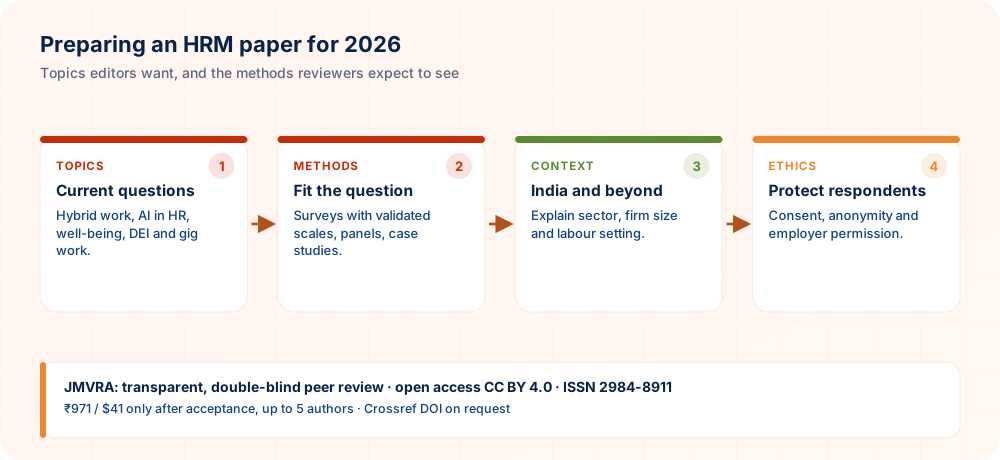
- Remote and hybrid work, covering productivity, engagement and control
- Use of AI and analytics in hiring, performance and people decisions
- Burnout, mental health and employee well-being
- Outcomes and policies related to diversity, equity and inclusion
- HR practices in gig and platform work where no employment exists
- Retaining talent and building an employer brand
- Sustainability and green HRM
- Career development, upskilling and learning
Methods and Scales
| Approach | Notes |
|---|---|
| Surveys built on validated scales | Choose well-known scales (for example engagement or burnout) and give their reliability |
| Multi-level studies | Multi-level analysis is needed when employees sit within teams or organisations |
| Longitudinal designs | Take measurements at multiple time points to back causal claims |
| Qualitative interviews | Helpful for emerging phenomena like AI adoption in HR |
| HR analytics data | Records from organisations, used with permission and anonymised |
HRM Research Within India
India provides varied settings, from IT services and manufacturing to the public sector, MSMEs and a large informal workforce. Make the context plain for international readers by covering labour codes, organisational culture and sector features. Studies that compare sectors or regions are particularly prized.
Ethical Responsibility in HR Research
- Taking part should be voluntary for employees and never imposed by managers
- Safeguard anonymity, most of all in small teams
- Treat HR records according to data-protection rules
- Do not ask questions that might put participants’ jobs at risk
Writing Tips
- Tie in HR theory. Frameworks such as social exchange, job demands–resources and AMO.
- Present the measurement model. Give reliability and validity ahead of the hypotheses.
- Make implications concrete. State what HR managers should really do differently.
Building an HR Survey Reviewers Can Rely On
- Rely on established scales and credit their sources
- Where feasible, measure predictors and outcomes at different times
- Build in reverse-coded items and attention checks
- Trial the questionnaire on 20–30 respondents
- Give the response rate and any non-response checks
- Run a test for common method bias
The 10 Most-Searched Questions on This Topic
Here are the ten questions researchers search for most on this subject, each with a direct answer.
call for papers HR management journal
Invites authors to submit work on human resource management to a journal that uses peer review.
HRM research topics 2026
Green HRM, retention, gig work, DEI, well-being, AI in HR and hybrid work.
AI in HR research paper
Research on AI in hiring, performance management and people analytics, ethics included.
employee engagement scale
Well-known scales like the Utrecht Work Engagement Scale, with reliability reported.
job demands resources model
A popular theory that accounts for burnout and engagement.
green HRM research
HR practices that advance environmental sustainability.
HR research paper format
Sections: the introduction first, followed by theory with hypotheses, then method, results, discussion and implications.
multi level analysis HR
Analysis that takes into account employees grouped inside teams or organisations.
HR analytics research
Studies that draw on organisational HR data, used with permission and anonymised.
HRM peer reviewed journal India
Journals that carry HRM research; confirm their review and recognition.
How JMVRA Fits In
JMVRA is a Transparent, Peer-Reviewed, Open Access Journal (Refereed Journal). Following the discontinuation of the UGC and UGC-CARE journal listing, and in alignment with the latest UGC-CARE recommendations and guidelines, JMVRA is aligned with UGC’s Suggested Parameters for Choosing Peer-Reviewed Journals. UGC public notice (PDF)
Within its management and commerce scope, JMVRA publishes human resource management research that is reviewed double-blind, and it accepts submissions throughout the year.
- ISSN
- 2984-8911 (online) · publishing since June 2023
- Issues
- Monthly issues across many disciplines
- Review
- Two-way anonymous review by specialists
- Access
- CC BY 4.0 open access
- Fee
- ₹971 INR for Indian and $41 USD for foreign authors, due only after acceptance
- DOI
- Crossref — available as an optional extra
- Indexing
- A Google Scholar entry exists; Scopus, Web of Science and DOAJ entries do not
- Impact factor
- 11.25, derived from Google Scholar data
Screening begins the moment a paper arrives and each decision is sent as soon as it is reached, yet JMVRA never promises a set number of days: actual review time depends on the reviewers and on how much revision the paper needs.
At-a-Glance Checklist
- Gap identifiedThe contribution of this study
- Scales checkedReferenced and accompanied by reliability
- Common-method biasHandled in the design or the analysis
- Context clarifiedSector and setting outlined
- Practical implicationsAimed at managers and policymakers
Selecting a Research Design for HRM
| Design | Good for | Watch out for |
|---|---|---|
| Cross-sectional survey | Links among attitudes and perceptions | Common method bias; causal claims |
| Longitudinal survey | Change over time; stronger causal inference | Attrition between waves |
| Multi-source data | Lowering common method bias (for example through employee and supervisor ratings) | Matching respondents correctly |
| Qualitative interviews | The way and the reason HR practices function in context | Open sampling and analysis |
| Mixed methods | Using interviews to explain survey patterns | Combining the two parts rather than merely stacking them |
Presenting HR Survey Results Clearly
- Characterise the sample by sector, organisation size, roles and response rate
- Give scale reliability and validity, using alpha or composite reliability together with evidence of discriminant validity
- Deal with common method bias through procedural remedies and a statistical test
- State effect sizes in addition to significance levels
- Explain practical implications by spelling out what HR managers can change
Strengthening Human Resource Survey Papers Before Submission
HR researchers frequently rely on questionnaires from employees and managers. A few careful steps before analysis can prevent common objections and make your results easier to trust.
- Pilot the questionnaire. Test your instrument on a small group from a similar workplace and note confusing wording. Revising early is far easier than defending an unclear item to a reviewer.
- Describe the organisations fairly. Say what kinds of firms, sectors and job levels took part, without naming individuals. Context allows readers to judge whether your findings apply to their own setting.
- Address common method concerns. When one respondent answers every question, explain steps you took, such as anonymity assurances or separating items, to reduce bias. Acknowledge any remaining limits.
- Respect employee confidentiality. Make clear that managers cannot trace answers back to individuals, and report only grouped results. Staff answer more honestly when they feel safe.
- Link findings to practice. Close with specific suggestions HR practitioners could try, and be modest about what your data can support. Useful implications make a paper memorable.
Pilot your instrument, protect respondents and connect results to workplace practice to give your HR paper lasting value.
Questions Researchers Often Ask
How Transparent Peer Review Works, Stage by Stage
- SubmissionFirst comes screening for plagiarism, formatting and scope.
- Reviewer allocationThe Scholar9 portal is used to assign subject experts.
- Double-blind reviewEvaluation looks at the originality, method, significance and clarity of the work.
- DecisionEmail and WhatsApp carry the verdict: accepted, revision needed or rejected.
- RevisionEvery comment is addressed by the authors, point by point.
- TransparencyA record of the review appears on Scholar9, with the report provided when requested.
There are three transparency models, namely open reports, optional reviewer identity and open participation — how JMVRA applies them is explained here.
Ready to Publish? Submit to JMVRA
JMVRA is aligned with UGC's Suggested Parameters for Choosing Peer-Reviewed Journals.
JMVRA is a Transparent, Peer-Reviewed, Open Access Journal (Refereed Journal). Following the discontinuation of the UGC and UGC-CARE journal listing, and in alignment with the latest UGC-CARE recommendations and guidelines, JMVRA is aligned with UGC’s Suggested Parameters for Choosing Peer-Reviewed Journals.
Handy links within jmvra.org
Key Terms
Subjects and search phrases this article addresses.
Related Reading
Further reading on the same theme from the JMVRA blog.
Publishing Psychology Research: APA, Ethics & Statistics
Read the guide RelatedPublishing Social Science Research: Methods & Ethics
Read the guide RelatedPublishing Commerce Research: Topics & Methods
Read the guide RelatedFormatting a Manuscript for Submission
Read the guide RelatedPlagiarism in Research Papers: Kinds, Detection and Staying Within the Limit
Read the guide RelatedAbstract Writing: What Every Sentence Must Do
Read the guideKeep Reading on the JMVRA Blog
The JMVRA journal blog includes this guide, one of many practical pieces on publishing, indexing, metrics and research integrity, prepared so readers can verify them without any sales pitch.