
Few social science fields have reporting standards as well developed as psychology: APA style, ethics rules, validated instruments, and ever stricter demands for statistical detail and openness. Satisfying them often separates a fast rejection from a smooth review. Here you will find what psychology journals look for and how to pick one. Reading a journal's recent papers first shows how closely it follows these norms.
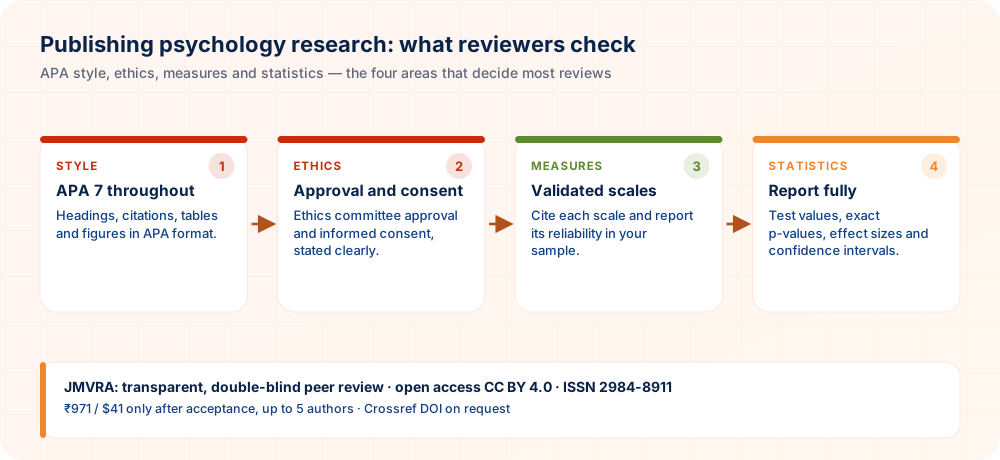
Essentials of APA Style (7th Edition)
- A title page carrying an author note, plus an abstract of roughly 150–250 words
- Author–date citations within the text, such as (Sharma & Rao, 2024)
- References that present DOIs as https://doi.org/ links
- Numbered tables and figures accompanied by notes
- APA format for statistics looks like this: d = 0.62, p = .019, t(58) = 2.41
Ethics Requirements
- Approval from an ethics committee. Name the committee and give the approval number.
- Informed consent. Explain how participants gave consent, including parental consent for minors.
- Confidentiality. State the way data were anonymised and kept.
- Debriefing. Necessary whenever participants were deceived in any way.
Measures and Scales
Choose validated instruments and give their reliability for your own sample, using Cronbach’s alpha or McDonald’s omega. When you translate or adapt a scale, say into Hindi or another regional language, explain how you translated and back-translated it and check its validity with your sample. Citing the original scale authors alongside any adaptation helps reviewers trace the instrument's history.
Reporting Statistics Properly
| Report | Why |
|---|---|
| Confidence intervals reported with effect sizes | A p-value on its own says nothing about size |
| Sample size justification | A power analysis demonstrates that the study was able to detect effects |
| Assumption checks | Checks such as normality and homogeneity |
| All tested hypotheses | The field is well aware of the problem of selective reporting |
Matching Psychology Subfields to Journals
Clinical and counselling
Treatment programmes, assessment and mental health services.
Educational
Studies of learning, motivation and assessment within schools and colleges.
Organisational
Behaviour at work, employee well-being and leadership.
Social and cognitive
Perception, memory, attitudes and decision-making.
Open Science Practices
- Registering hypotheses and analysis plans in advance
- Making data and materials available when ethics permit
- Disclosing every measure and condition
- Replication studies
A Brief Example of APA-Style Results
Control-condition participants showed higher exam anxiety (M = 47.6, SD = 9.1) than those given mindfulness (M = 42.1, SD = 8.3); d = 0.63, 95% CI [0.26, 0.99], t(118) = 3.46, p < .001.
One sentence holds the means, standard deviations, test statistic with its degrees of freedom, the exact p, and the effect size with its confidence interval. (Values are illustrative.)
The 10 Most-Searched Questions on This Topic
Here are the ten questions researchers search for most on this subject, each with a direct answer.
best peer reviewed journals in psychology
Pick journals matching your area that run rigorous review and satisfy your requirement, and verify each of them.
APA 7 format research paper
Citations in author–date form, DOIs written as links, and tables and statistics set out in APA format.
psychology research ethics approval
Clearance given by an institutional ethics committee, stated along with its approval number.
informed consent psychology research
People join a study once they understand it, and minors additionally require consent from a parent.
Cronbach alpha reporting
State how reliable each scale proved in your own sample.
effect size reporting psychology
Give effect sizes like d or η² together with confidence intervals.
scale translation back translation
When adapting scales, translate them, back-translate, and verify validity.
psychology research topics India
Studies of mental health, student well-being, digital habits and stress at work.
pre-registration psychology
Recording hypotheses and planned analyses in a public registry ahead of data collection.
psychology journal India
Psychology appears in both Indian and international journals, so confirm each one's review and ethics policies.
How JMVRA Fits In
JMVRA is a Transparent, Peer-Reviewed, Open Access Journal (Refereed Journal). Following the discontinuation of the UGC and UGC-CARE journal listing, and in alignment with the latest UGC-CARE recommendations and guidelines, JMVRA is aligned with UGC’s Suggested Parameters for Choosing Peer-Reviewed Journals. UGC public notice (PDF)
Within its humanities and social sciences scope, JMVRA publishes psychology research that is reviewed double-blind, and it expects the ethics and reporting standards outlined above.
- ISSN
- 2984-8911 (online) · publishing since June 2023
- Issues
- Monthly issues across many disciplines
- Review
- Two-way anonymous review by specialists
- Access
- Free to read, CC BY 4.0 licence
- Fee
- ₹971 INR for Indian and $41 USD for foreign authors, due only after acceptance
- DOI
- Crossref — available as an optional extra
- Indexing
- Psychology researchers will find it in Google Scholar but not in Scopus, Web of Science or DOAJ
- Impact factor
- 11.25, derived from Google Scholar data
Screening begins the moment a paper arrives and each decision is sent as soon as it is reached, yet JMVRA never promises a set number of days: actual review time depends on the reviewers and on how much revision the paper needs.
At-a-Glance Checklist
- APA 7 followedCovers citations, tables and headings
- Ethics declaredConsent procedure and approval number
- Scales referencedPlus reliability from your sample
- Effect sizes givenBeyond p-values alone
- Data sharedWhenever the journal or discipline expects this
Preregistration and Transparency
Preregistration
Logging hypotheses and analysis plans prior to collecting data, for instance on OSF.
Open materials
Making questionnaires and stimuli available so that others can repeat the study.
Open data
Releasing anonymised data when consent and ethics permit it.
Exploratory labels
Keeping planned tests clearly apart from exploratory analyses.
How to Report Results as Reviewers Expect
| Element | Example |
|---|---|
| Descriptive statistics | M = 3.42, SD = 0.81 |
| Test statistic | t(118) = 2.45 |
| Exact p value | p = .016 |
| Effect size | d = 0.45, with a 95% CI |
| Assumption checks | Normality and homogeneity checks, along with the handling of any violations |
Refer to the APA 7 format guide.
Protecting Participants While Preparing a Psychology Manuscript
Psychology studies involve real people, so ethical care and honest reporting matter as much as analysis. These habits help you present participant-based work with confidence.
- Describe consent in plain terms. Explain how participants were informed, whether they could withdraw, and how their answers were kept confidential. Reviewers want to see that agreement was voluntary and understood.
- Justify each instrument you used. Say why a scale suits your population, whether it was adapted or translated, and how reliability was checked in your sample. Unexplained instruments weaken otherwise careful studies.
- Report all planned analyses. Describe every test you intended to run, including those that gave unremarkable results. Selecting only favourable outcomes misleads readers and is a recognised research concern.
- Discuss sample limits candidly. If participants were students, volunteers or from a single city, say so and explain how that affects how widely findings apply. Honest limits increase trust.
- Handle sensitive data securely. Store responses on protected devices, remove identifiers when analysing, and decide beforehand when raw files will be deleted. State this plan briefly in the manuscript.
Respect for participants and transparent reporting are what make a psychology paper trustworthy to reviewers and readers.
Questions Researchers Often Ask
How Transparent Peer Review Works, Stage by Stage
- SubmissionThe paper is first examined for plagiarism, formatting and scope.
- Assigning reviewersSubject specialists are selected using the Scholar9 portal.
- Double-blind reviewJudged on clarity, significance, method and originality.
- DecisionAn outcome of acceptance, revision or rejection is delivered by email and WhatsApp.
- RevisionA point-by-point response to all comments is given by authors.
- TransparencyReview record kept on Scholar9; the report can be requested.
Transparency takes three forms: open reports, optional reviewer identity and open participation. Learn how JMVRA applies them.
Ready to Publish? Submit to JMVRA
JMVRA is aligned with UGC's Suggested Parameters for Choosing Peer-Reviewed Journals.
JMVRA is a Transparent, Peer-Reviewed, Open Access Journal (Refereed Journal). Following the discontinuation of the UGC and UGC-CARE journal listing, and in alignment with the latest UGC-CARE recommendations and guidelines, JMVRA is aligned with UGC’s Suggested Parameters for Choosing Peer-Reviewed Journals.
Pages worth visiting on jmvra.org
Key Terms
Subjects and search phrases this article addresses.
Related Reading
Further reading on the same theme from the JMVRA blog.
Publishing Social Science Research: Methods & Ethics
Read the guide RelatedPublishing Commerce Research: Topics & Methods
Read the guide RelatedManagement Research in 2026: Topics & Reviewer Expectations
Read the guide RelatedFormatting a Manuscript for Submission
Read the guide RelatedEthics Policy
Read the guide RelatedAvoiding Plagiarism in Research Papers: Types, Detection and Threshold Guidance
Read the guideKeep Reading on the JMVRA Blog
As part of the JMVRA journal blog, this guide shares practical help on publishing, indexing, metrics and research integrity, and is written to be verifiable rather than promotional.