
Research in management spans strategy, marketing, finance, operations, entrepreneurship and international business, borrowing methods from economics, psychology and statistics. Papers that tie theory to evidence and offer something of use to managers are what international management journals want. Here are current topics, the methods reviewers expect and the weaknesses that most often cause rejection. Matching your contribution to a journal's stated scope early saves wasted submissions.
Present-Day Management Research Topics
International business and strategy
FDI, entry into markets, global value chains and multinationals from emerging markets.
Marketing
Influencer and digital marketing, along with consumer behaviour, trust in brands and sustainability claims.
Supply chain and operations
Logistics, resilience, and lean and digital operations.
Entrepreneurship
Social enterprise, family business, MSMEs and start-up ecosystems.
Finance and governance
ESG, fintech adoption and corporate governance.
Technology and management
Digital transformation, platform business models and AI in decision-making.
Methods Reviewers Expect
| Method | Good practice |
|---|---|
| Survey research | Use of validated scales and pilot tests, with sampling explained and common-method bias checked |
| Modelling with structural equations (SEM/PLS-SEM) | Report the measurement model (reliability, validity) first and the structural model afterwards |
| Case studies | Justified choice of cases, several data sources and a clear analysis |
| Secondary and panel data | Robustness checks plus data sources such as CMIE Prowess and annual reports |
| Qualitative interviews | Sampling, the coding approach, saturation and quotations |
Common Weaknesses
- Student convenience samples stretched to generalise about managers
- Adapting scales with no test of reliability and validity
- Lack of a theoretical framework, so hypotheses seem to come from nowhere
- Managerial “implications” that the results do not support
- Reviews of literature that omit recent international studies
A Standard Structure
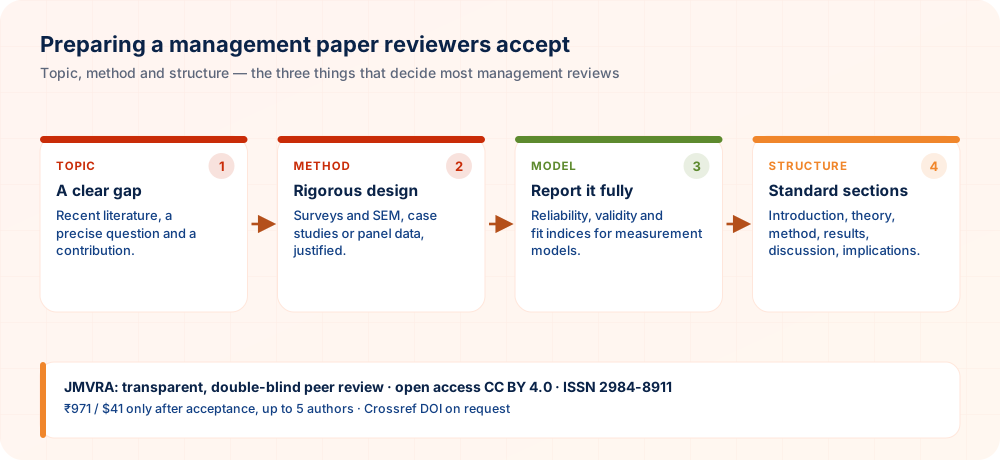
- Introduction. The problem, the gap, research questions and contribution.
- Literature review and hypotheses. Theory backing every hypothesis.
- Methodology. Covers design, sample, measures and analysis.
- Results. Tables presenting statistics clearly.
- Discussion. Implications for theory and management, limitations and directions for future research.
Ethical Practice in Management Research
- Informed consent obtained from participants in surveys and interviews
- Respondents kept anonymous, along with organisations when needed
- Authorisation to use data from companies
- Truthful reporting of response rates
An Example of Reporting a Measurement Model
| Construct | Items | Cronbach’s α | Composite reliability | AVE |
|---|---|---|---|---|
| Perceived usefulness | 4 | 0.87 | 0.91 | 0.72 |
| Trust | 5 | 0.84 | 0.89 | 0.62 |
| Adoption intention | 3 | 0.81 | 0.88 | 0.71 |
Before any hypothesis tests, reviewers look for reliability and convergent validity (commonly α and CR above 0.70 and AVE above 0.50), together with a discriminant validity check. Values shown are illustrative. Reporting these figures in a table lets reviewers verify them at a glance.
The 10 Most-Searched Questions on This Topic
Here are the ten questions researchers search for most on this subject, each with a direct answer.
call for papers international management journal
A call for management research submissions; confirm the scope, article types and deadlines.
management research topics 2026
AI in management, entrepreneurship, fintech, supply chain resilience, ESG and digital transformation.
management research paper format
Begin with the introduction, move through literature with hypotheses and methodology, then results, and close with discussion and implications.
PLS-SEM in management research
A SEM approach built on variance; describe both the measurement model and the structural model in full.
common method bias
Distortion that appears when every variable is captured using a single method; survey studies should test for it and deal with it.
case study research management
A close examination of one or several cases that draws on more than one source of data.
managerial implications example
Concrete, evidence-backed steps that managers could take in light of the findings.
CMIE Prowess data research
A popular database of Indian companies, used in finance and management research.
MBA research paper publication
Turn dissertation findings, prepared with a faculty guide, into an article in a genuine peer-reviewed journal.
management journal India
Management research appears in many Indian and international journals, so check how each one actually operates.
How JMVRA Fits In
JMVRA is a Transparent, Peer-Reviewed, Open Access Journal (Refereed Journal). Following the discontinuation of the UGC and UGC-CARE journal listing, and in alignment with the latest UGC-CARE recommendations and guidelines, JMVRA is aligned with UGC’s Suggested Parameters for Choosing Peer-Reviewed Journals. UGC public notice (PDF)
Management and commerce papers can be sent to JMVRA at any time for its monthly issues, and subject experts review them double-blind. The journal is currently open for submissions. Pick the closest subject area when you submit so that suitable reviewers see your work.
- ISSN
- 2984-8911 (online) · publishing since June 2023
- Issues
- Monthly issues across many disciplines
- Review
- Two-way anonymous review by specialists
- Access
- Openly accessible under CC BY 4.0
- Fee
- ₹971 INR for Indian and $41 USD for foreign authors, due only after acceptance
- DOI
- Crossref — available as an optional extra
- Indexing
- Google Scholar yes; not Scopus, Web of Science or DOAJ
- Impact factor
- 11.25, derived from Google Scholar data
Screening begins the moment a paper arrives and each decision is sent as soon as it is reached, yet JMVRA never promises a set number of days: actual review time depends on the reviewers and on how much revision the paper needs.
At-a-Glance Checklist
- Clear contributionStated in both the introduction and the conclusion
- Measurement documentedReliability, validity and fit indices
- Limitations acknowledgedSample, bias and how far results generalise
- Implications givenFor both theory and practice
- Ethics addressedConsent and protection of data
Drafting a Clear Contribution Statement
- Name the gap — what remains unknown or disputed, backed by key citations
- Say what you did — the design, setting and data, in a single sentence
- Say what you found — the headline result, stated plainly
- Say what it adds — separately for theory and for practice
How to Report Structural Equation Models
| Item | Report |
|---|---|
| Measurement model | Factor loadings, reliability, plus convergent and discriminant validity |
| Model fit | Fit indices judged against accepted, cited thresholds |
| Structural paths | Coefficients along with significance and effect sizes |
| Mediation or moderation | The technique applied, for example bootstrapped indirect effects |
| Software | Name and version |
Sharpening the Argument in a Management Research Paper
Management reviewers often find that the data are acceptable but the argument is blurred. Spending time on logic and positioning can lift a paper more than extra statistics.
- State the gap in one sentence. Write a single plain sentence naming what is unknown and why it matters, then test it on a colleague. If they cannot repeat it, the introduction needs more focus.
- Tie hypotheses to reasoning. Explain why each relationship should exist, drawing on theory and earlier findings, before stating it. Hypotheses that appear without justification look arbitrary.
- Choose measures with care. Prefer established scales and report how you adapted them for your context. Home-made items need more evidence of quality than most authors expect.
- Offer rival explanations. Discuss at least one alternative reason for your result and say why your reading is more convincing. Anticipating objections shows maturity.
- Separate practice from theory. Present theoretical contribution and managerial implications under distinct headings so each audience finds its answer quickly.
A clearly stated gap, reasoned hypotheses and honest alternatives will persuade management reviewers more than complicated analysis alone.
Questions Researchers Often Ask
How Transparent Peer Review Works, Stage by Stage
- SubmissionPlagiarism, layout and fit with the journal’s scope are screened at the start.
- Choosing reviewersSpecialists in the field are appointed through the Scholar9 portal.
- Double-blind reviewThe paper is evaluated for clarity, significance, method and originality.
- DecisionAuthors are told by email and WhatsApp whether the paper is accepted, needs revision or is rejected.
- RevisionAuthors respond to all comments one point at a time.
- TransparencyScholar9 holds the review record; ask for the report if you want it.
Three models of transparency exist: open reports, optional reviewer identity and open participation. Read how JMVRA applies them.
Ready to Publish? Submit to JMVRA
JMVRA is aligned with UGC's Suggested Parameters for Choosing Peer-Reviewed Journals.
JMVRA is a Transparent, Peer-Reviewed, Open Access Journal (Refereed Journal). Following the discontinuation of the UGC and UGC-CARE journal listing, and in alignment with the latest UGC-CARE recommendations and guidelines, JMVRA is aligned with UGC’s Suggested Parameters for Choosing Peer-Reviewed Journals.
More useful pages at jmvra.org
Key Terms
Subjects and search phrases this article addresses.
Related Reading
Further reading on the same theme from the JMVRA blog.
HR Management Research Topics & Methods for 2026
Read the guide RelatedPublishing Psychology Research: APA, Ethics & Statistics
Read the guide RelatedPublishing Social Science Research: Methods & Ethics
Read the guide RelatedFormatting a Manuscript for Submission
Read the guide RelatedAbstract Writing: What Every Sentence Must Do
Read the guide RelatedJournal Finder — Speedy Search for a Sound, Budget-Friendly, UGC CARE-Aligned Journal
Read the guideKeep Reading on the JMVRA Blog
You are reading part of the JMVRA journal blog, a source of hands-on guidance about publishing, indexing, metrics and research integrity that aims to be verifiable, not promotional.