
Searching for Tanzanian journals indexed in Scopus? Only a handful are indexed, though the University of Dar es Salaam is working on adding more. The guide names those that report coverage, demonstrates ISSN-based verification, and explains how to identify strong international journals in your field.
Scopus and Web of Science: The Essentials
Elsevier publishes Scopus, a database of abstracts and citations chosen selectively; it is the origin of CiteScore and its data underlies the SCImago Journal Rank (SJR). Web of Science is a Clarivate database; its Core Collection comprises ESCI (emerging sources), AHCI (arts and humanities), SSCI (social sciences) and SCIE (sciences), and Journal Impact Factors are given in Journal Citation Reports. Journals in both can be reassessed and dropped. Additional reading: Scopus explained and Web of Science explained.
| Term | What it is | Where to check |
|---|---|---|
| Scopus | Elsevier’s curated citation and abstract database | Scopus Sources |
| SCIE | Science Citation Index Expanded: the index in Web of Science that covers sciences | Master Journal List |
| SSCI | Social Sciences Citation Index: the index in Web of Science that covers social sciences | Master Journal List |
| AHCI | Arts & Humanities Citation Index: the index in Web of Science that covers the humanities | Master Journal List |
| ESCI | Emerging Sources Citation Index: journals in Web of Science that were screened for quality | Master Journal List |
| Journal Impact Factor | A citation average over two years, given since the 2023 release to every journal of the Web of Science Core Collection | Journal Citation Reports |
| CiteScore | A four-year citation average covering Scopus journals | Scopus Sources |
| SJR | SCImago Journal Rank, a measure from Scopus data in which prestige carries more weight | SCImago |
| Quartile (Q1–Q4) | A journal’s rank inside one subject category in a specified year | JCR or SCImago |
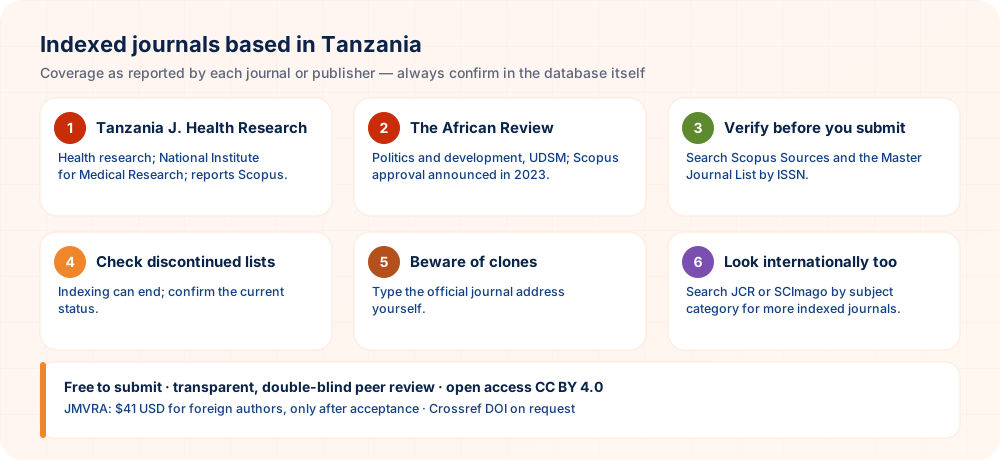
Few Tanzanian journals are indexed, and those that are indexed are recent: UDSM reported Scopus approval for The African Review in November 2023, and stated it intends to move its remaining 24 journals toward Scopus as well. To see the present list, narrow SCImago’s rankings to Tanzania. Because such lists change, treat any listing as a snapshot and recheck before relying on it.
Tanzanian Journals Covered by Scopus and Web of Science
Published in Tanzania, the journals below say they are covered by Scopus and/or Web of Science, according to their own websites or their publisher. Cross-check each ISSN in Scopus Sources and the Master Journal List when you make your choice.
| Journal | Publisher | Subject | Reported coverage |
|---|---|---|---|
| Tanzania Journal of Health Research | National Institute for Medical Research (NIMR) | Health research | Reported: Scopus; hosted on AJOL |
| The African Review | College of Social Sciences, University of Dar es Salaam | African politics, development, international affairs | Reported by UDSM: Scopus (approved November 2023) |
Other journals of note whose Scopus or Web of Science indexing has not been confirmed
| Journal | Publisher | Reported coverage |
|---|---|---|
| Tanzania Journal of Science | College of Natural and Applied Sciences, University of Dar es Salaam | Found on AJOL; confirm Scopus listing by ISSN |
| Tanzania Journal of Engineering and Technology | College of Engineering and Technology, University of Dar es Salaam | Hosted on AJOL; check indexing |
| Huria: Journal of the Open University of Tanzania | The Open University of Tanzania | Hosted on AJOL; check indexing |
Checked 4 October 2026. “Reported” means the journal or publisher says so; we have not independently confirmed it.
Indexing Verification Checklist
- Get hold of the ISSNThe print ISSN and online ISSN as the official site displays them
- Scopus SourcesType in the ISSN, then read the coverage years and status
- Master Journal ListType in the ISSN; see whether SCIE, SSCI, AHCI or ESCI is the one
- Still indexed?Look in the discontinued titles list kept by Scopus
- Keep the proofDated screenshots, to go in a promotion or grant file
Publishing Abroad From Tanzania
Since only a small portion of Tanzania’s journals are in Scopus or Web of Science, most researchers needing indexed outlets also publish internationally — in African regional titles, society journals and the big international publishers. A 2025 study of Scopus coverage in Africa (Kanyika & Kim) calls this a “continued struggle”: African journals in Scopus are increasing in number, but only slowly. Choosing a regional or society title can be a sensible route when it matches your topic and readership.
Before settling on an international journal, look at three things: the article processing charge (APC), including whether the publisher grants waivers or discounts to authors in lower- and middle-income countries; whether your institution or funder covers APCs; and whether a diamond open access journal (free to read and free to publish in) exists in your field — DOAJ lets you filter by “without fees”. Raise APCs early with your supervisor or grant manager, and find out whether your institution has deals with specific publishers.
Quartiles, Impact Factor and Top-Tier Journals
Three metrics are used most in the field. The Journal Impact Factor is Clarivate’s, calculated over two years and available only for Web of Science journals; CiteScore uses four years of Scopus data; SJR is SCImago’s weighted measure, again from Scopus data. Quartiles Q1–Q4 show a journal’s rank in one subject category in one year. None of these says anything about how good a single article is.
Researchers in Tanzania will usually find that international journals, not local ones, offer the best high-impact choices in a field. Look them up by subject category in Journal Citation Reports, Scopus Sources or SCImago, then read recent papers to test whether they suit you. Our walkthrough on how to find high impact factor journals lays out the method.
Picking an Indexed Journal for Your Subject
| Field | Tanzanian-published journals | Then search |
|---|---|---|
| Health research | Tanzania Journal of Health Research | JCR and Scopus medicine and public health |
| Social sciences & politics | The African Review | SSCI, ESCI and Scopus social sciences |
| Natural sciences | Tanzania Journal of Science (check indexing) | Scopus life and physical sciences; SCIE |
| Engineering | Tanzania Journal of Engineering and Technology (check indexing) | Scopus engineering; SCIE |
| Agriculture | Few Tanzanian titles indexed | Scopus agricultural and biological sciences |
Getting Your Paper Ready for an Indexed Journal
Heavy submission volumes at indexed journals mean editors reject a large part of papers early, mostly because of poor fit or presentation and not because the science is unsound. Here is how to improve your odds:
- Show the contribution at once. In the abstract and the closing paragraph of the introduction, explain what is new and why it matters more broadly.
- Demonstrate knowledge of the journal’s field. Build on recent publications, among them relevant articles from the target journal.
- Be rigorous in reporting methods. Apply the reporting guideline suited to your design (for example CONSORT, PRISMA or STROBE) so reviewers are able to judge rigour.
- Skip the generic cover letter. Briefly say why the readers of this journal would value the paper.
Frequent Mistakes With Indexed Journals
- Trusting a logo on the journal’s front page in preference to the database record.
- Not stating the index — “Web of Science” can mean SCIE, SSCI, AHCI or ESCI.
- Missing that a journal was discontinued — last year’s indexing may have ended.
- Choosing only on a metric — a journal outside your field will reject the paper quickly.
JMVRA as an option for authors in Tanzania
Based in India, JMVRA (ISSN 2984-8911) is an international open access journal covering many disciplines. It is not a Tanzanian journal, but it accepts papers from authors in Tanzania. JMVRA is not in Scopus or Web of Science; it serves authors who want an affordable, peer-reviewed open access journal rather than an indexed one.
- Fee: foreign authors pay $41 USD, and only after acceptance; as many as 5 authors are included.
- Review: subject experts give each paper a transparent double-blind peer review, and similarity needs to stay under 15%.
- Access: open access under CC BY 4.0; a Crossref DOI can be requested whenever needed.
- Indexing in plain terms: it is in Google Scholar and not in Scopus, Web of Science or DOAJ.
A Preparation Kit for Submitting to Indexed Journals From Tanzania
| Item | Tip |
|---|---|
| Manuscript | In the template the journal provides, with the title, abstract and keywords in English |
| Cover letter | Sets out the journal fit and the reasons readers beyond Tanzania will find the work valuable |
| ORCID iDs | Every author needs one, which keeps the records correct |
| Approvals | Ethics clearance and any research permits that Tanzania requires |
| Data availability statement | Say where the data is available, or why it is not shareable |
International Collaboration Starting in Tanzania
Regional collaborators
Collaborative projects around East Africa pool data, methods and reviewers.
Researchers in the diaspora
Tanzanian researchers based overseas make natural co-authors and mentors.
Co-supervision
Papers drawn from a thesis with co-supervisors have co-authors.
Agreeing authorship
Settle roles, author order and data ownership in writing before you begin.
Practical Tips for Tanzanian Authors Planning Indexed Submissions
Tanzanian researchers often combine fieldwork, teaching and community engagement, and many publish with partners overseas. These suggestions help you shape strong submissions and choose venues with care.
- Translate community findings carefully. If interviews were held in Kiswahili, explain how quotations were translated and checked. Describing this step shows rigour and helps readers trust your qualitative evidence.
- Give partners a defined role. When working with overseas colleagues, state in writing who leads analysis, writing and correspondence. Clear roles avoid delays and prevent confusion over authorship.
- Describe your study site precisely. Name the region, setting and time frame of data collection in plain terms. Specific descriptions let readers decide how far your results apply to their own settings.
- Select journals by readership. Ask who needs your findings: policymakers, clinicians, farmers or other scholars. Choose a journal whose audience matches, since fit often matters more than prestige.
- Verify offers independently. Do not trust a journal solely because it contacts you. Search for it yourself, read its policies and ask a senior colleague before sharing files or paying anything.
Be precise about your setting and methods, define partner roles early, and choose a journal because its readers need your findings.
Questions Researchers Often Ask
Summary and What to Do Next
Tanzania has few indexed journals, but the number is rising. Use them where they match your work, publish internationally where they do not, and verify every claim at its source.
- Establish what the requirement you follow actually names: Scopus, Web of Science, a quartile or an index.
- Select candidate journals in your field from the tables above and from international databases.
- Check each title by its ISSN and keep a record of what you find.
- Find titles that are not indexed in the directory of research journals in Tanzania.
Ready to send in your paper?
Submission to JMVRA is online and free. Review always comes first; the $41 USD publication fee applies only after your paper is accepted.
Related searches
People in Tanzania who read this guide often go on to search for affordable open access journals, high impact factor journals, Scopus and Web of Science indexed journals, paper publication fees and journal publication in Tanzania. The guides below address those topics:
- Low-cost journal publication in Tanzania
- High impact factor journals in Tanzania
- Research journals in Tanzania
- How a low-fee journal is funded
- Locating high impact factor journals
- How to choose a journal
- Checking an indexing claim yourself
- Recognising a predatory journal
- Publishing with JMVRA from outside India
- JMVRA publication charges
References and Sources
Checked on 4 October 2026. Indexing status can change, so confirm it before submitting.
- SCImago journal rankings — Tanzania
- UDSM — The African Review achieves Scopus indexing
- Daily News — UDSM attains Scopus indexing status
- Kanyika & Kim (2025), Continued struggle: the growth of Scopus-indexed journals in Africa
- Discoverability of African journals by Google Scholar and inclusion in Scopus (PMC)
- Scopus Sources
- Clarivate Master Journal List
- ISSN Portal
- SCImago Journal & Country Rank
- Journal Citation Reports
Submitting to JMVRA From Tanzania
- Submit onlineTanzanian and foreign authors are welcome, and submitting carries no fee
- ScreeningSubject fit and similarity review (below 15%)
- Double-blind reviewThe paper is judged by subject experts, and you are informed by email
- Accepted — $41 USDJust one fee, with up to 5 authors included
- PublishedReleased as open access (CC BY 4.0)
Details: Publication charges · Peer review · Advice for authors outside India.
Ready to Publish? Submit to JMVRA
JMVRA is aligned with UGC's Suggested Parameters for Choosing Peer-Reviewed Journals.
JMVRA is a Transparent, Peer-Reviewed, Open Access Journal (Refereed Journal). Following the discontinuation of the UGC and UGC-CARE journal listing, and in alignment with the latest UGC-CARE recommendations and guidelines, JMVRA is aligned with UGC’s Suggested Parameters for Choosing Peer-Reviewed Journals.
Handy links within jmvra.org
Key Terms
Subjects and search phrases this article addresses.
Related Reading
Additional reading for researchers in Tanzania on picking a journal.
Affordable Journal Publication in Tanzania
Read the guide RelatedHigh-Impact Journals for Researchers in Tanzania
Read the guide RelatedResearch Journals in Tanzania: A Verified List
Read the guide RelatedResearch Journals in Kenya: A Verified List
Read the guide RelatedResearch Journals in Ghana: A Verified List
Read the guide RelatedWhat International Authors Should Know About JMVRA
Read the guide RelatedChecking a Journal’s Indexing Claims
Read the guideKeep Reading on the JMVRA Blog
The JMVRA journal blog includes this guide, one of many practical pieces on publishing, indexing, metrics and research integrity, prepared so readers can verify them without any sales pitch.