
Are you after high impact factor journals in Tanzania? Promotions and grants frequently depend on impact factors, quartiles and rankings, and such numbers are simple to misinterpret or counterfeit. This guide covers the meaning of the key metrics, ways to avoid fake impact factors, the journals published in Tanzania that report international indexing, and a step-by-step approach for finding the highest-impact journals in your subject. It is meant for researchers in Dar es Salaam, Tanzania; Dodoma, Tanzania; Arusha, Tanzania; Morogoro, Tanzania.
What a High Impact Factor Actually Tells You
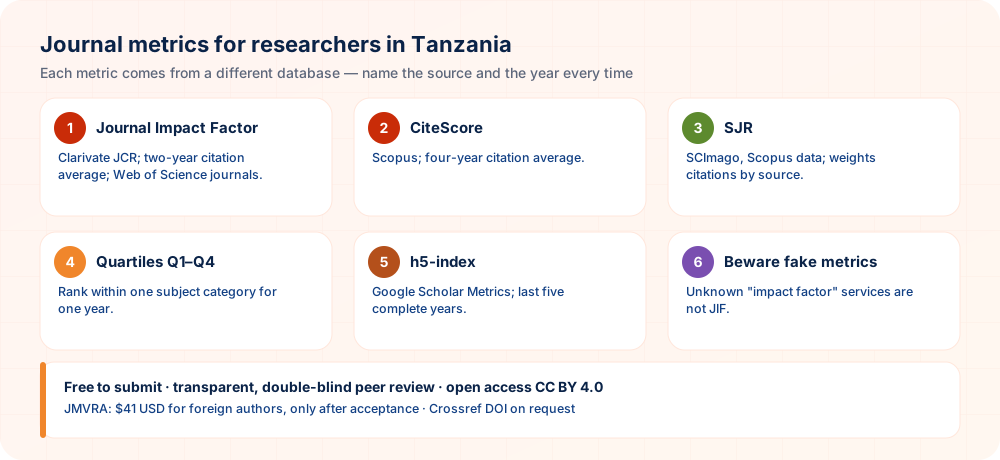
A “high impact” journal is one whose recent articles are cited often on average compared with others in its field. The best-known indicator is the Journal Impact Factor (JIF) published by Clarivate in Journal Citation Reports; Scopus-based alternatives include CiteScore and the SCImago Journal Rank (SJR). All of them describe the journal itself, not your own article, a point worth remembering for authors in Tanzania.
| Metric | Data source | Window | Where to check |
|---|---|---|---|
| Journal Impact Factor | Web of Science (Clarivate) | 2 years | Journal Citation Reports |
| CiteScore | Scopus (Elsevier) | 4 years | Scopus Sources |
| SJR | Scopus data, SCImago | Prestige-adjusted figure across 3 years | SCImago Journal & Country Rank |
| Quartile (Q1–Q4) | JCR or SCImago | Measured over a year, inside a category | JCR or SCImago |
| h5-index | Google Scholar Metrics | 5 years | Google Scholar Metrics |
Invented Impact Factors and Misleading Metrics
Many sites sell or hand out “impact factors” that have no relation to Clarivate's Journal Impact Factor. Be wary of a journal that advertises a large figure from an unknown source or says it has a JIF without a Master Journal List entry: it is misleading you. Ask which database, which year, and whether the database's own site displays the figure.
Journals Published in Tanzania That Are Indexed
Few Tanzanian journals are indexed, and those that are have joined recently: the Tanzania Journal of Health Research reports Scopus coverage, while the University of Dar es Salaam announced in November 2023 that The African Review had won Scopus approval, and it intends to put more of its journals forward. Always confirm a claimed indexing status in the database itself rather than relying on a journal’s own website.
| Journal | Publisher | Subject | Reported coverage |
|---|---|---|---|
| Tanzania Journal of Health Research | National Institute for Medical Research (NIMR) | Health research | Reported: Scopus; hosted on AJOL |
| The African Review | College of Social Sciences, University of Dar es Salaam | African politics, development, international affairs | Reported by UDSM: Scopus (approved November 2023) |
As of 4 October 2026, this coverage was reported by each journal or publisher. Current numbers are available from Journal Citation Reports (Journal Impact Factor and quartile) and from Scopus Sources or SCImago (CiteScore or SJR).
Online Journals and Platforms Available in Tanzania
E-journals are now the usual format for journals in Tanzania. The services below can help you locate them, compare them and confirm their standing:
- African Journals Online (AJOL) — A non-profit platform that hosts peer-reviewed journals published in Africa; abstracts are free and many journals are fully open access.
- University of Dar es Salaam Journals — The journal portal of UDSM, where many Tanzanian university journals are hosted.
- Open University of Tanzania journals — The online journal system of OUT, which includes Huria.
- Tanzania Commission for Universities (TCU) — Responsible for regulating and accrediting universities across Tanzania.
- COSTECH — The Tanzania Commission for Science and Technology, which promotes and coordinates research in Tanzania.
- Directory of Open Access Journals — Look up open access journals satisfying DOAJ’s criteria, narrowing the results by publisher country (Tanzania) or by “without fees”.
- SCImago country rankings — Journal rankings built on Scopus, limited to titles published in Tanzania and showing quartiles and SJR.
- ISSN Portal — First check a journal's stated ISSN, exact title and country of publication against the official record.
A directory or platform listing does not by itself prove high impact or international indexing. Look at each journal in the citation databases on your own.
Locating Top-Tier Journals in Your Field
- Identify your subject category the way JCR and SCImago classify journals.
- Go to that category in JCR or SCImago and sort its journals by the metric your requirement names.
- Read three current articles from every shortlisted journal to assess the fit.
- Check the current year's metric and quartile at the original source.
- Before submitting, check the fees, open access options and any waivers.
| Field | Titles published in Tanzania | Then search |
|---|---|---|
| Health research | Tanzania Journal of Health Research | JCR and Scopus medicine and public health |
| Social sciences & politics | The African Review | SSCI, ESCI and Scopus social sciences |
| Natural sciences | Tanzania Journal of Science (check indexing) | Scopus life and physical sciences; SCIE |
| Engineering | Tanzania Journal of Engineering and Technology (check indexing) | Scopus engineering; SCIE |
| Agriculture | Few Tanzanian titles indexed | Scopus agricultural and biological sciences |
Open Access, Costs and Impact
Open access is offered by several high-impact journals via an article processing charge, some are diamond open access, and many subscription titles charge authors nothing. It reaches more readers, particularly where library budgets cannot stretch to subscriptions, yet its effect on citations differs by field; paying a large APC for impact alone is not worthwhile.
- Weigh the fee before shortlisting, just like the metric and the fit.
- Look for waivers: many publishers help authors from lower- and middle-income countries in this way.
- Think about self-archiving: where the policy allows, the accepted manuscript may be shared in a repository free of charge.
- Consult your library to learn if an agreement with the publisher pays or reduces the APC for authors in Tanzania.
A Practical Path to High-Impact Publication
A first paper in a Q1 journal is rare. A sensible plan is to build a record step by step: start with a sound paper in a respected national or regional journal, progress to indexed journals in your area, and approach the strongest journals only once you have publications, collaborators and a study with evident international relevance.
- Raise the quality of the study: state the question clearly, design soundly, enrol an adequate sample and report fully.
- Give it an international angle: show what readers beyond Tanzania can take from it.
- Find collaborators who can bring more expertise or data.
- Answer reviewers completely — most high-impact papers pass through a revision round.
Preparing to Submit to a Top-Tier Journal
- Suitable categoryThe journal's subject category corresponds to your paper
- Metric foundJIF or quartile located in JCR or SCImago for this year
- Fit testedThree recent articles examined; your work belongs among them
- Charges verifiedAPC, waivers and open access options identified
- Second journal fixedA dependable fallback journal selected early
How JMVRA suits authors in Tanzania
Based in India, JMVRA (ISSN 2984-8911) is an international open access journal covering many disciplines. It is not a Tanzanian journal, but it accepts papers from authors in Tanzania. JMVRA does not have a Clarivate impact factor; it is a good fit for papers that need an affordable, peer-reviewed open access home rather than a Scopus or WoS-indexed one.
- Fee: Foreign authors pay $41 USD after acceptance, and the charge is shared by up to 5 authors.
- Review: subject experts run a transparent, double-blind peer review; similarity must be under 15%.
- Access: every reader can access it under CC BY 4.0; authors may request a Crossref DOI.
- Our position on indexing: Google Scholar indexes it, while Scopus, Web of Science and DOAJ do not.
A Step-by-Step Path to High-Impact Journals for Authors in Tanzania
| Stage | Goal |
|---|---|
| First papers | Sound research, transparently reported, in credible peer-reviewed journals |
| Building | Partnerships across East Africa, bigger samples and more robust methods |
| Targeting | Q1 or Q2 journals in your own subject category, with standing you have checked in JCR or Scopus |
| Sustaining | A consistent research direction, along with data sharing and service as a journal reviewer |
The Role of Journal Metrics in Tanzania
- Make the metric clear — CiteScore, SJR, JIF, or a number sourced from Google Scholar
- Look for the source — and examine the journal's record there on your own
- Measure within a single field — not between fields
- Keep proof of your checks — with dates, in case evaluators ask
Tanzania Researcher's Checklist for Safe Journal Choice
Researchers in Tanzania frequently work on applied topics such as agriculture, health and education. The following advice helps you choose publication outlets that suit applied work and protect your professional standing.
- Highlight practical relevance. State clearly how your findings could inform practice or policy, and support the claim with evidence. Journals that value applied research will respond well to this clarity.
- Keep community consent documents safe. When studies involve villages, schools or clinics, preserve permission letters and consent records. Editors may ask for proof, and good records show respect for participants.
- Read two or three recent issues. Browse several recent issues of a candidate journal to see whether similar work appears. Titles, methods and article length reveal whether your paper truly belongs there.
- Check how the journal handles corrections. A responsible journal explains how errors are corrected or retracted. Locating that policy before you submit signals that editors take quality seriously.
- Share results with participants. Plan a simple way to report findings back to the communities involved. This honours their contribution and strengthens trust for future research.
Show the practical value of your work, protect consent records, and judge a journal by what it actually publishes and how it corrects mistakes.
Questions Researchers Often Ask
Summary and What to Do Next
Publishing high-impact work from Tanzania is realistic when you have the right paper, the right journal and an honest reading of the metrics. Check each number at its source, select by fit within your category, and grow your record gradually.
- Establish your requirement and subject category.
- Draw up a shortlist of journals using JCR or SCImago, then read their recent articles.
- Confirm metrics and fees before submitting.
- You can also read about journals in Tanzania covered by Scopus and Web of Science and about affordable journal publishing in Tanzania.
Ready to send in your paper?
Submission to JMVRA is online and free. Review always comes first; the $41 USD publication fee applies only after your paper is accepted.
Related searches
Many readers in Tanzania of this guide additionally search for high impact factor journals, Q1 and Q2 journals, Scopus and Web of Science indexing, and ways of checking journal metrics. The guides that follow answer those queries:
References and Sources
Checked on 4 October 2026. Metrics are updated every year, so confirm them at the original source.
- Journal Citation Reports
- SCImago journal rankings — Tanzania
- Scopus Sources
- Clarivate Master Journal List
- Tanzania Commission for Universities
- COSTECH
- UDSM — The African Review achieves Scopus indexing
- Daily News — UDSM attains Scopus indexing status
- Discoverability of African journals by Google Scholar and inclusion in Scopus (PMC)
Tanzanian Authors Publishing in JMVRA
- Submit onlineAuthors from any country can apply; there is no submission fee
- ScreeningFit with scope plus similarity test (below 15%)
- Double-blind reviewSubject experts evaluate it; the outcome is sent by email
- Accepted — $41 USDOnly one fee, for up to 5 authors
- PublishedOpen access, licensed under CC BY 4.0
Details: Publication charges · Peer review · Advice for authors outside India.
Ready to Publish? Submit to JMVRA
JMVRA is aligned with UGC's Suggested Parameters for Choosing Peer-Reviewed Journals.
JMVRA is a Transparent, Peer-Reviewed, Open Access Journal (Refereed Journal). Following the discontinuation of the UGC and UGC-CARE journal listing, and in alignment with the latest UGC-CARE recommendations and guidelines, JMVRA is aligned with UGC’s Suggested Parameters for Choosing Peer-Reviewed Journals.
Quick links across jmvra.org
Key Terms
Subjects and search phrases this article addresses.
Related Reading
Additional guides for researchers based in Tanzania.
Keep Reading on the JMVRA Blog
Our JMVRA journal blog carries this guide along with other practical advice on publishing, indexing, metrics and research integrity, all written so that claims can be verified and nothing is promotional.