
Searching for a list of journals in Ghana? Here you will find Ghanaian research journals set out by publisher, subject and reported indexing, links to the university journal platforms at Legon and KNUST, and steps for vetting a journal prior to submission. The guide serves researchers in Accra, Ghana; Kumasi, Ghana; Cape Coast, Ghana; Tamale, Ghana and elsewhere. Comparing a journal's scope with your paper's topic early on avoids wasted effort.
Scholarly Publishing in Ghana
The Ghana Tertiary Education Commission (GTEC) regulates tertiary education in Ghana and accredits both institutions and programmes. Each university decides for itself which publications count towards appointment and promotion, and refereed journal articles generally carry the most weight.
The biggest journal systems belong to the University of Ghana and KNUST, whose titles include the Legon Journal of the Humanities, the Ghana Journal of Geography and KNUST’s Journal of Science and Technology. Learned societies contribute major journals as well: the Ghana Medical Association issues the Ghana Medical Journal, while the Ghana Science Association has a multidisciplinary journal of its own. Institutes under the CSIR publish work on agriculture and applied science. Browsing these sources shows which subject areas already have well-established outlets.
Few Ghana-based journals are found in Scopus: a 2024 overview of editorial metrics looked at eight Ghana-based journals in Scopus (SCImago data, March 2024). A far larger group of Ghanaian titles sits on African Journals Online, which makes them easier for international readers to find.
Research Journals Published in Ghana
Each journal below is published in Ghana by a university, society or research body that can be identified. The “reported coverage” column repeats what the journal or its publisher says about itself, so check any indexing claim in Scopus Sources or the Master Journal List before submitting. A claim on a journal's own page is a starting point, not final proof.
| Journal | Publisher | Subject area | Reported coverage |
|---|---|---|---|
| Ghana Medical Journal | Ghana Medical Association | Medicine and health | Reported: Scopus and MEDLINE; hosted on AJOL |
| Journal of the Ghana Science Association | Ghana Science Association | Multidisciplinary sciences | Reported by the association: Scopus |
| Legon Journal of the Humanities | University of Ghana, Legon | Humanities | Listed in DOAJ; check Scopus by ISSN |
| Ghana Journal of Geography | University of Ghana, Legon | Geography and resource development | Hosted on AJOL; check indexing |
| Journal of Science and Technology (JUST) | Kwame Nkrumah University of Science and Technology, Kumasi | Science and technology | University journal; check indexing |
| Ghana Journal of Agricultural Science | Council for Scientific and Industrial Research (CSIR), Ghana | Agriculture | Hosted on AJOL; check indexing |
Reviewed on 4 October 2026 against each journal’s own site or publisher. Treat it as a starting point: it neither ranks journals nor covers every one.
Online Journal Platforms and Directories to Use
Journals from Ghana sit on university systems and on AJOL, and their status can be cross-checked in international directories. Send your submission via the website of the particular journal.
African Journals Online (AJOL)
A non-profit service listing peer-reviewed African journals, offering free abstracts and many titles that are fully open access.
UG Journal Management Services
The journal platform of the University of Ghana, home to Legon titles in the humanities, sciences and social sciences.
KNUST journals
JUST and other academic titles issued by Kwame Nkrumah University of Science and Technology in Kumasi.
Ghana Tertiary Education Commission (GTEC)
The regulator of tertiary education in Ghana, responsible for accrediting institutions and programmes. Visit.
Directory of Open Access Journals
Look up open access journals that satisfy DOAJ’s criteria, and narrow the results by publisher country (Ghana) or by “without fees”. Visit.
SCImago country rankings
Scopus-derived journal rankings limited to titles published in Ghana, showing quartiles and SJR. Visit.
ISSN Portal
Check that the ISSN, exact title and country of publication all match before you trust a journal. Visit.
Where Research Happens in Ghana
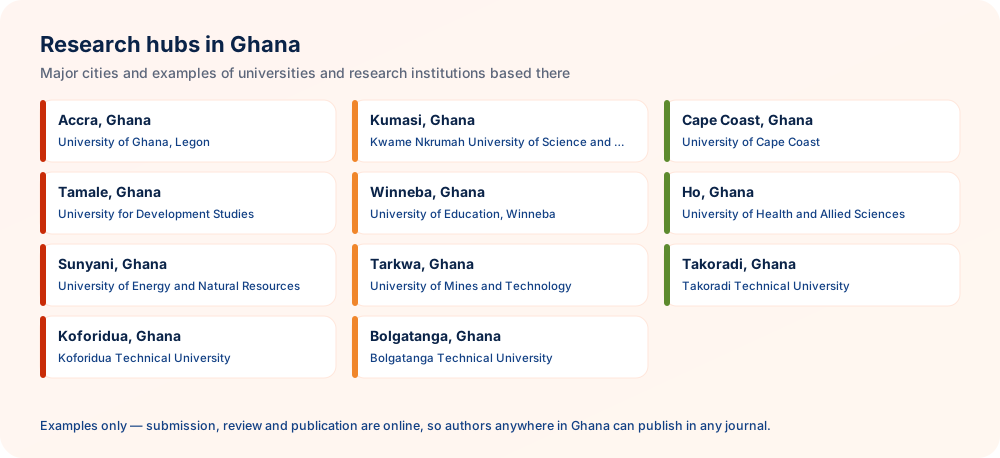
Research in Ghana is centred on Accra, Kumasi and Cape Coast, and universities and technical universities operate in every region.
Picking the Right Journal
Let the paper's requirements guide you: the audience you want, the recognition your institution expects, and the formats a journal accepts. Pick two or three candidates, look through what they have lately published, and prepare a trustworthy second choice ahead of submitting.
Fees and Affordable Options
Every Ghanaian journal decides its own charges. Certain university and society titles ask for processing or publication fees in cedis, others ask for nothing, and international journals can bill APCs in dollars. Verify the fee, and what it covers, on the journal’s official website. Keeping a screenshot of the fee page for your records can help if a dispute arises later.
Pay only after a genuine acceptance, pay only through official channels, and ask about waivers. By way of comparison, JMVRA's fee for foreign authors is $41 USD, due only after acceptance and covering up to five authors.
The full comparison method is in our guide to low-cost journal publication, useful from any location, together with how a low-fee journal manages its costs.
Checking a Journal Step by Step
- The title recorded for the ISSN on the ISSN Portal is identical to the journal's.
- Contact routes for both the publisher and editorial office are easy to find.
- There is a written description of peer review, and it is applied in practice.
- Claimed indexing is confirmed inside the database rather than by a logo alone.
- Costs are openly disclosed and arise following acceptance.
Checklist Before You Submit a Manuscript
- Journal verifiedScope, requirement and indexing reviewed
- Template usedLayout, reference style and length
- Similarity screenedAll sources credited, your own earlier work too
- Ethics addressedApproval, consent and conflicts disclosed
- Author details correctNames and affiliations in their intended form
- Cover letter preparedThe reason this paper fits this journal
How JMVRA suits authors in Ghana
Based in India, JMVRA (ISSN 2984-8911) is an international open access journal covering many disciplines. It is not a Ghanaian journal, but it accepts papers from authors in Ghana.
- Fee: $41 USD is charged to foreign authors after acceptance only, and up to 5 authors are covered.
- Review: subject experts run an open double-blind peer review, and similarity is capped below 15%.
- Access: CC BY 4.0 open access; request a Crossref DOI and you can have one.
- Our indexing, in plain terms: Google Scholar lists us; not Scopus, Web of Science or DOAJ.
A 12-Month Publication Plan for Ghana-Based Researchers
| Months | Focus |
|---|---|
| 1–3 | Settle on a narrow question and two or three journals to aim for; look at national resources such as university research offices and the CSIR institutes, and at the international databases |
| 4–6 | Gather and analyse your data, and draft straight into the template of the journal you are targeting |
| 7–9 | Ask a supervisor or colleague for feedback, and submit to just one journal at a time |
| 10–12 | Answer reviewer comments with a revision; once published, promote the paper and refresh ORCID and Google Scholar |
Choosing a Language as an Author in Ghana
Researchers in Ghana work in English and Ghanaian languages such as Twi. Choose the language according to who needs to read the paper.
Publish in a Ghanaian language, for example Twi
Speaks to readers, practitioners and policy makers within Ghana.
Publishing in English
Gets in front of readers, reviewers and indexes worldwide.
Abstract in two languages
Pairing a paper in a Ghanaian language such as Twi with an English title and abstract helps international readers find it.
Language editing support
Have a colleague or editor read the final version before you submit.
Practical Tips for Ghanaian Authors Planning Publications
Ghanaian scholars balance teaching loads, supervision and fieldwork alongside writing. These tips focus on habits that make steady progress possible and keep your submissions credible and well prepared.
- Write in short, protected sessions. Block regular writing periods in your week and guard them like lectures. Small, consistent sessions produce a finished manuscript far sooner than occasional marathon attempts.
- Turn dissertations into articles. Select one clear question from your thesis and build a focused paper around it. Cutting chapters of background keeps the article within what a journal will accept.
- Share authorship with student collaborators fairly. When students contribute substantially, credit them appropriately and discuss it openly. Fair recognition motivates teams and prevents later complaints to journals or institutions.
- Verify a journal through its own records. Visit the publisher's site, read the aims and contact details, and ask colleagues about their experience. Do not rely solely on an email invitation to submit.
- Keep an evidence folder. Store acceptance letters, review reports, payment receipts and final proofs together. Promotion committees and funders may later ask for supporting documents and you will be ready.
Protect regular writing time, credit collaborators fairly, and verify every journal before committing your work or your money.
Questions Researchers Often Ask
Summary and What to Do Next
Ghana offers robust university journal systems alongside a small set of internationally indexed titles. Begin with the list above, confirm what your institution requires, and verify each journal at its source prior to submission. Doing this check each time protects your work from low-quality outlets.
- Get written confirmation of your institution’s publication requirement.
- Pick journals from the table to form your shortlist, then read through their latest articles.
- Our Scopus and Web of Science guide for Ghana explains how to confirm indexing.
- Prepare the manuscript in the journal’s template, then submit through the journal’s own web address.
Ready to send in your paper?
Submission to JMVRA is online and free. Review always comes first; the $41 USD publication fee applies only after your paper is accepted.
Related searches
Visitors from Ghana who find this guide useful tend to be after affordable open access journals, high impact factor journals, Scopus and Web of Science indexed journals, paper publication fees and journal publication in Ghana. The following guides address those subjects:
- Low-cost journal publication in Ghana
- High impact factor journals in Ghana
- Scopus and Web of Science journals in Ghana
- How a low-fee journal is funded
- Locating high impact factor journals
- How to choose a journal
- Checking an indexing claim yourself
- Recognising a predatory journal
- Publishing with JMVRA from outside India
- JMVRA publication charges
References and Sources
Checked on 4 October 2026. Indexing, fees and policies can change, so check them again before submitting.
- Ghana Tertiary Education Commission
- University of Ghana journals
- KNUST journals
- Ghana Science Association — Journal
- Ghana Medical Journal on AJOL
- Scopus and SCImago editorial metrics of Ghana-based journals
- Scopus Sources
- Clarivate Master Journal List
- ISSN Portal
Ghanaian Authors Publishing With JMVRA
- Submit onlineAny country may submit; no fee at submission
- ScreeningChecks on scope and similarity (below 15%)
- Double-blind reviewSubject experts review it; the decision is emailed
- Accepted — $41 USDA single fee, covering up to 5 authors
- PublishedOpen access under CC BY 4.0
Details: Publication charges · Peer review · Advice for authors outside India.
Ready to Publish? Submit to JMVRA
JMVRA is aligned with UGC's Suggested Parameters for Choosing Peer-Reviewed Journals.
JMVRA is a Transparent, Peer-Reviewed, Open Access Journal (Refereed Journal). Following the discontinuation of the UGC and UGC-CARE journal listing, and in alignment with the latest UGC-CARE recommendations and guidelines, JMVRA is aligned with UGC’s Suggested Parameters for Choosing Peer-Reviewed Journals.
Helpful pages on jmvra.org
Key Terms
Subjects and search phrases this article addresses.
Related Reading
Further guides for Ghana-based researchers, plus help with choosing a journal.
Affordable Journal Publication in Ghana
Read the guide RelatedHigh-Impact Journals for Ghanaian Researchers
Read the guide RelatedScopus & Web of Science Journals: Ghana
Read the guide RelatedA Researcher’s Verified Guide to Journals in Nigeria
Read the guide RelatedResearch Journals in Kenya: A Verified List
Read the guide RelatedWhat International Authors Should Know About JMVRA
Read the guide RelatedChoosing a Journal: A 7-Step Scoring Framework
Read the guideKeep Reading on the JMVRA Blog
This guide belongs to the JMVRA journal blog, which offers practical advice on publishing, indexing, metrics and research integrity, written to be checkable instead of promotional.