
Looking for Scopus journals in Nepal? Indexed titles from Nepal are mostly medical, with a few in forestry and paediatrics. The guide lists them, clarifies MEDLINE versus Scopus, and demonstrates verifying indexing by ISSN and finding reputable international journals. A journal can be respected locally yet missing from the database your institution cares about.
Scopus and Web of Science: The Essentials
Scopus, an Elsevier product, indexes abstracts and citations on a selective basis; CiteScore is generated from it and the SCImago Journal Rank (SJR) is built on its data. Clarivate owns Web of Science, whose Core Collection contains SCIE (sciences), SSCI (social sciences), AHCI (arts and humanities) and ESCI (emerging sources); the Journal Impact Factor is released via Journal Citation Reports. Journals in both databases are assessed again from time to time and may be removed. More background is in Scopus explained and Web of Science explained. For a journal’s present status, nothing beats the database record itself.
| Term | What it is | Where to check |
|---|---|---|
| Scopus | Elsevier’s selectively compiled database of abstracts and citations | Scopus Sources |
| SCIE | Science Citation Index Expanded — the part of Web of Science devoted to the sciences | Master Journal List |
| SSCI | Social Sciences Citation Index — the part of Web of Science devoted to the social sciences | Master Journal List |
| AHCI | Arts & Humanities Citation Index — the part of Web of Science devoted to the humanities | Master Journal List |
| ESCI | Emerging Sources Citation Index — titles in Web of Science that have passed a quality screen | Master Journal List |
| Journal Impact Factor | A two-year citation average; every Web of Science Core Collection journal has received one since the 2023 release | Journal Citation Reports |
| CiteScore | A four-year citation average, available for Scopus-listed journals | Scopus Sources |
| SJR | SCImago Journal Rank — prestige-weighted, and calculated from Scopus data | SCImago |
| Quartile (Q1–Q4) | A journal’s rank against others in a single subject category for a single year | JCR or SCImago |
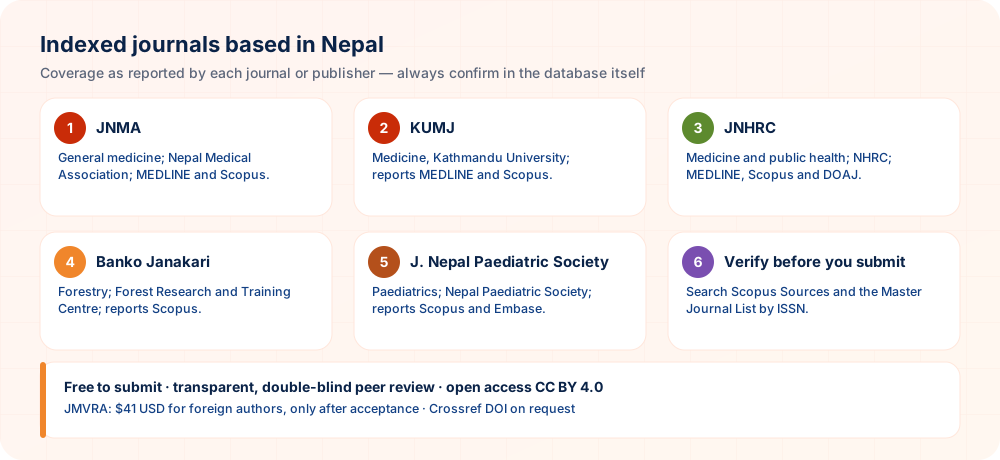
Medicine leads Nepal’s indexed journals: JNMA, KUMJ and JNHRC state both MEDLINE and Scopus coverage. Banko Janakari (forestry) and the Journal of Nepal Paediatric Society also state Scopus coverage. Narrow SCImago’s rankings to Nepal to see the latest list.
Nepal-Based Scopus and Web of Science Journals
Every journal below is published in Nepal and says, on its own website or through its publisher, that it has Scopus and/or Web of Science coverage. Match each against its ISSN in Scopus Sources and the Master Journal List on the day you decide. Keep a note of the date, since a database status can change.
| Journal | Publisher | Subject | Reported coverage |
|---|---|---|---|
| Journal of Nepal Medical Association (JNMA) | Nepal Medical Association, Kathmandu | General medicine | Reported: MEDLINE/PubMed and Scopus |
| Kathmandu University Medical Journal (KUMJ) | Kathmandu University, Dhulikhel | Medicine | Reported: MEDLINE/PubMed and Scopus |
| Journal of Nepal Health Research Council (JNHRC) | Nepal Health Research Council, Kathmandu | Medicine and public health | Reported: MEDLINE/PubMed, Scopus and DOAJ |
| Banko Janakari | Forest Research and Training Centre, Kathmandu | Forestry and natural resources | Reported: Scopus; hosted on NepJOL |
| Journal of Nepal Paediatric Society (JNPS) | Nepal Paediatric Society | Paediatrics | Reported: Scopus and Embase; hosted on NepJOL |
Checked 4 October 2026. “Reported” means the journal or publisher says so; we have not independently confirmed it.
Indexing Verification Checklist
- Find the ISSNTake the print and the online ISSN from the journal’s own official site
- Scopus SourcesEnter the ISSN, then check the journal’s status and its coverage years
- Master Journal ListEnter the ISSN and note whether SCIE, SSCI, AHCI or ESCI is shown
- Dropped?Find out if the title appears on Scopus’s list of discontinued sources
- Archive itScreen captures with dates, ready for a promotion or grant file
International Publishing Options From Nepal
Nepal has more indexed domestic journals than numerous other countries, but in most disciplines the widest selection is still overseas. When searching abroad, compare the article processing charge (APC), ask whether your university’s publisher agreement covers it, and look for a diamond open access journal (free for authors and readers alike) in your area — DOAJ has a “without fees” filter.
Numerous international publishers give APC waivers or discounts to authors in lower-income countries, so read the publisher’s waiver policy before submitting.
Quartiles, Impact Factor and Top-Tier Journals
Three metrics dominate. The Journal Impact Factor is a Clarivate figure over a two-year window, limited to Web of Science journals; CiteScore is based on four years of Scopus data; SJR is SCImago’s weighted measure, also from Scopus data. Quartiles Q1–Q4 place a journal within one subject category for a single year. None of them captures the quality of an individual article.
Most researchers in Nepal will find the highest-impact venues in their discipline among international journals rather than local ones. Search them by subject category in Journal Citation Reports, Scopus Sources or SCImago, then read recent articles to judge the match. Our guide to finding high impact factor journals walks through the method one step at a time. Remember that a journal's readership and scope matter as much as its numbers.
Picking an Indexed Journal for Your Subject
| Field | Nepal-published journals | Then search |
|---|---|---|
| Medicine & public health | JNMA; KUMJ; JNHRC | JCR and Scopus medicine; MEDLINE |
| Paediatrics | Journal of Nepal Paediatric Society | Scopus paediatrics; SCIE |
| Forestry & environment | Banko Janakari | Scopus forestry and environmental science |
| Engineering & science | NepJOL journals (check indexing) | Scopus engineering and physical sciences |
| Social sciences & education | NepJOL journals (check indexing) | SSCI, ESCI and Scopus social sciences |
MEDLINE, PubMed and Scopus Compared
- MEDLINE is the selective index run by the US National Library of Medicine; its journals show up in PubMed with MeSH indexing.
- PubMed also contains articles from PubMed Central and other sources, so being “in PubMed” does not necessarily mean MEDLINE.
- Scopus is its own citation database, with a separate selection process.
When your requirement names one, check that specific database using the ISSN.
Getting Your Paper Ready for an Indexed Journal
Indexed journals receive so many submissions that editors turn away a big share at the first stage, typically for poor fit or presentation, not for flawed science. You can improve your chances by doing the following:
- State your contribution clearly. In the abstract and the last paragraph of the introduction, say what is new and why it matters beyond your own setting.
- Show familiarity with the field. Cite recent work, including pertinent papers from the journal you are aiming at.
- Report methods in full. Follow the reporting guideline that matches your design (CONSORT, PRISMA or STROBE, for instance) so that reviewers can judge rigour.
- Do not send a stock cover letter. Add a few lines on why this journal’s readers would find the paper worthwhile.
Frequent Mistakes With Indexed Journals
- Accepting a logo on a homepage as evidence rather than consulting the database record.
- Not naming the index: “Web of Science” can refer to SCIE, SSCI, AHCI or ESCI.
- Missing a discontinuation: a journal that was indexed last year could have been dropped this year.
- Trusting a number alone: when the scope does not fit, the paper will be rejected before long.
How JMVRA suits authors in Nepal
Based in India, JMVRA (ISSN 2984-8911) is an international open access journal covering many disciplines. It is not a Nepali journal, but it accepts papers from authors in Nepal. JMVRA is not in Scopus or Web of Science; it serves authors who want an affordable, peer-reviewed open access journal rather than an indexed one.
- Fee: nothing is due until acceptance; after that foreign authors pay $41 USD, covering at most 5 authors.
- Review: first a similarity check (under 15%), then transparent double-blind peer review by subject specialists.
- Access: articles are open access with a CC BY 4.0 licence, and a Crossref DOI can be had on request.
- Frank about indexing: Google Scholar carries the articles, but Scopus, Web of Science and DOAJ do not.
Submission Pack for Nepal-Based Authors Targeting Indexed Journals
| Item | Tip |
|---|---|
| Manuscript | Set out in the journal’s template, with an English-language title, abstract and keywords |
| Cover letter | States the journal fit and the value of the work for readers outside Nepal |
| ORCID iDs | One for each author, so the records remain correct |
| Approvals | Proof of ethics clearance, plus any research permit Nepal requires |
| Data availability statement | The place where the data can be found, or the reason it cannot be shared |
Working With International Collaborators From Nepal
Regional collaborators
Shared projects across South Asia pool data, methods and reviewers.
Researchers in the diaspora
Nepali researchers based overseas make natural co-authors and mentors.
Co-supervision
Where a thesis has joint supervisors, its papers have joint authors.
Agreeing authorship
Settle roles, author order and data ownership in writing before you begin.
Practical Tips for Nepali Researchers Selecting Indexed Journals
Researchers in Nepal, particularly in medicine and the sciences, often juggle clinical or fieldwork duties with writing. These suggestions help you use limited time well and select realistic, trustworthy outlets.
- Write in short, regular sessions. Set aside brief protected periods for writing around clinical or teaching duties. Steady small sessions usually produce a finished draft sooner than waiting for a long free stretch.
- Report ethics clearly. State which review board approved the study and how participants gave consent. Health journals in particular expect this detail, and its absence is a common reason for early returns.
- Distinguish biomedical lists from general ones. A biomedical literature index and a multidisciplinary citation database have different criteria. Understand which one your discipline relies on so that you do not rely on the wrong signal.
- Use free tools for language and references. Reference managers and free grammar aids reduce routine errors. Still read every citation yourself, because automated tools can mismatch authors, journals and years.
- Seek mentors beyond your institution. A senior researcher abroad or at another college can comment on drafts and suggest suitable journals. Polite, specific requests with a short summary usually receive more helpful replies.
Protect regular writing time, document ethics carefully, and understand exactly what each kind of index does and does not tell you.
Questions Researchers Often Ask
Summary and What to Do Next
Medicine is where Nepal’s indexed journals are strongest. In other fields, look abroad, verify every claim and choose by fit.
- Ask whether the rule at your institution refers to Scopus, Web of Science, a quartile or an index.
- Build a shortlist for your field using the tables above and the international databases.
- Check each title by its ISSN and keep a record of what you find.
- Non-indexed options appear in the list of research journals in Nepal.
Ready to send in your paper?
Submission to JMVRA is online and free. Review always comes first; the $41 USD publication fee applies only after your paper is accepted.
Related searches
Readers in Nepal who use this guide often search too for affordable open access journals, high impact factor journals, Scopus and Web of Science indexed journals, paper publication fees and journal publication in Nepal. The following guides address those topics:
- Low-cost journal publication in Nepal
- High impact factor journals in Nepal
- Research journals in Nepal
- How a low-fee journal is funded
- Locating high impact factor journals
- How to choose a journal
- Checking an indexing claim yourself
- Recognising a predatory journal
- Publishing with JMVRA from outside India
- JMVRA publication charges
References and Sources
Checked on 4 October 2026. Indexing status can change, so confirm it before submitting.
- SCImago journal rankings — Nepal
- Nepal Journals Online
- Journal of Nepal Health Research Council
- NLM — About MEDLINE
- Scopus Sources
- Clarivate Master Journal List
- ISSN Portal
- SCImago Journal & Country Rank
- Journal Citation Reports
JMVRA as a Route to Publication From Nepal
- Submit onlineAuthors in Nepal and elsewhere can apply; submitting is free of charge
- Entry checkRelevance to scope and similarity (below 15%)
- Double-blind reviewSpecialist reviewers evaluate the paper, and the decision is sent by email
- Accepted — $41 USDA flat fee shared by up to 5 authors
- PublishedLicensed CC BY 4.0, open to everyone
Details: Publication charges · Peer review · Advice for authors outside India.
Ready to Publish? Submit to JMVRA
JMVRA is aligned with UGC's Suggested Parameters for Choosing Peer-Reviewed Journals.
JMVRA is a Transparent, Peer-Reviewed, Open Access Journal (Refereed Journal). Following the discontinuation of the UGC and UGC-CARE journal listing, and in alignment with the latest UGC-CARE recommendations and guidelines, JMVRA is aligned with UGC’s Suggested Parameters for Choosing Peer-Reviewed Journals.
Further reading on jmvra.org
Key Terms
Subjects and search phrases this article addresses.
Related Reading
Additional guides for researchers in Nepal, and for choosing a journal.
Affordable Journal Publication for Nepali Researchers
Read the guide RelatedHigh-Impact Journal Guide for Researchers in Nepal
Read the guide RelatedResearch Journals in Nepal: NepJOL & Indexing
Read the guide RelatedThe Philippines and Its Research Journals: A Complete Researcher Guide
Read the guide RelatedResearch Journals in Indonesia: SINTA & Scopus
Read the guide RelatedWhat International Authors Should Know About JMVRA
Read the guide RelatedChecking a Journal’s Indexing Claims
Read the guideKeep Reading on the JMVRA Blog
This article sits on the JMVRA journal blog, where practical guidance covering publishing, indexing, metrics and research integrity is written to be verifiable, not promotional.