
Are you searching for high impact factor journals in Nepal? Promotions and grants frequently hinge on impact factors, quartiles and rankings, yet these figures are simple to misunderstand and even to counterfeit. Here you will find what the principal metrics mean, ways to steer clear of fake impact factors, the journals published in Nepal that report international indexing, and a stepwise approach for locating the highest-impact titles in your discipline. The guide is aimed at researchers in Kathmandu, Nepal; Dhulikhel, Nepal; Lalitpur, Nepal; Pokhara, Nepal. Bookmark the official metric sites so every figure you cite can be traced back quickly.
What a High Impact Factor Actually Tells You
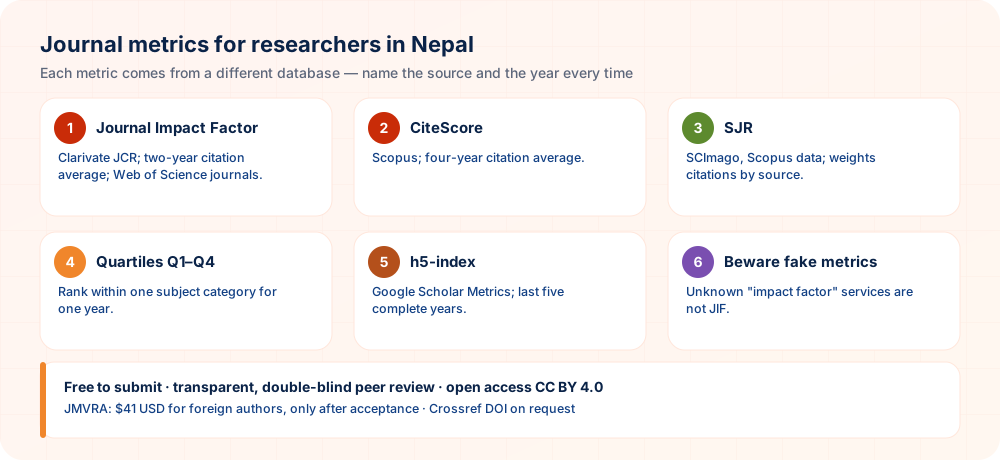
An impact metric reduces a journal’s citations during a fixed period to a single value. Two years of Web of Science data underlie the Journal Impact Factor, four years of Scopus data underlie CiteScore, and SJR gives each citation a weight according to the prestige of the citing journal. Because fields cite at different rates, keep comparisons to journals in one subject category, and, for researchers in Nepal especially, read the definition of any metric before reading its number.
| Metric | Data source | Window | Where to check |
|---|---|---|---|
| Journal Impact Factor | Web of Science (Clarivate) | 2 years | Journal Citation Reports |
| CiteScore | Scopus (Elsevier) | 4 years | Scopus Sources |
| SJR | Scopus data, SCImago | Spanning 3 years and weighted for prestige | SCImago Journal & Country Rank |
| Quartile (Q1–Q4) | JCR or SCImago | Single-year, single-category measure | JCR or SCImago |
| h5-index | Google Scholar Metrics | 5 years | Google Scholar Metrics |
Invented Impact Factors and Misleading Metrics
Lots of sites sell or issue “impact factors” that are unconnected with Clarivate’s Journal Impact Factor. When a journal promotes a big number from an unknown service, or asserts a JIF yet is not in the Master Journal List, it is misleading you. Three points need checking: the database, the year, and confirmation on the database’s own website.
Indexed Journals From Nepal
Medical titles dominate the indexed journals of Nepal. MEDLINE and Scopus coverage is reported by the Journal of Nepal Medical Association, by the Kathmandu University Medical Journal and by the Journal of Nepal Health Research Council.
| Journal | Publisher | Subject | Reported coverage |
|---|---|---|---|
| Journal of Nepal Medical Association (JNMA) | Nepal Medical Association, Kathmandu | General medicine | Reported: MEDLINE/PubMed and Scopus |
| Kathmandu University Medical Journal (KUMJ) | Kathmandu University, Dhulikhel | Medicine | Reported: MEDLINE/PubMed and Scopus |
| Journal of Nepal Health Research Council (JNHRC) | Nepal Health Research Council, Kathmandu | Medicine and public health | Reported: MEDLINE/PubMed, Scopus and DOAJ |
| Banko Janakari | Forest Research and Training Centre, Kathmandu | Forestry and natural resources | Reported: Scopus; hosted on NepJOL |
| Journal of Nepal Paediatric Society (JNPS) | Nepal Paediatric Society | Paediatrics | Reported: Scopus and Embase; hosted on NepJOL |
Each journal or publisher provided the coverage details here as of 4 October 2026. For the up-to-date Journal Impact Factor and quartile, go to Journal Citation Reports; for CiteScore or SJR, go to Scopus Sources or SCImago. Because metrics change, add the date you checked when you quote one.
Nepal’s Online Journals and Platforms
E-journals are now the usual format for journals in Nepal. The services below help you discover them, weigh them against one another and verify their standing:
- Nepal Journals Online (NepJOL) — Started in 2007 with INASP support and run by the Tribhuvan University Central Library, it hosts hundreds of Nepali journals that can be read freely.
- University Grants Commission Nepal — Distributes grants to universities and backs quality assurance across higher education.
- Nepal Health Research Council — Oversees ethics for health research in Nepal and is the publisher of JNHRC.
- Directory of Open Access Journals — Look up open access journals that satisfy DOAJ’s criteria, narrowing results by publisher country (Nepal) or by “without fees”.
- SCImago country rankings — Journal rankings built on Scopus and limited to titles published in Nepal, showing quartiles and SJR.
- ISSN Portal — Compare a candidate journal’s title, ISSN and country of publication against the official record.
Presence on a platform or in a directory proves neither high impact nor international indexing; go and look at each journal in the citation databases.
Locating Top-Tier Journals in Your Field
- Pick the JCR and SCImago subject category that matches your own field.
- Call up the category’s journals in JCR or SCImago, then order them by the metric your requirement names.
- For each journal on your Nepal shortlist, read three recently published articles to judge how closely your work matches.
- Check the current year's metric and quartile at the original source.
- Before submitting, check the fees, open access options and any waivers.
| Field | Journals based in Nepal | Then search |
|---|---|---|
| Medicine & public health | JNMA; KUMJ; JNHRC | JCR and Scopus medicine; MEDLINE |
| Paediatrics | Journal of Nepal Paediatric Society | Scopus paediatrics; SCIE |
| Forestry & environment | Banko Janakari | Scopus forestry and environmental science |
| Engineering & science | NepJOL journals (check indexing) | Scopus engineering and physical sciences |
| Social sciences & education | NepJOL journals (check indexing) | SSCI, ESCI and Scopus social sciences |
Open Access, Costs and Impact
An article processing charge often buys open access in high-impact journals, a few titles are diamond open access, and plenty of subscription journals ask authors for nothing. Open access brings wider readership, notably in places where libraries cannot pay for subscriptions, though the effect on citations depends on the field. A large APC is not worth paying just for the sake of impact.
- Sort out the fee question ahead of the shortlist, next to the metric and the fit.
- Ask about waivers: many publishers offer them to researchers from lower- and middle-income countries.
- Use self-archiving: where the journal's policy allows it, place the accepted manuscript in a repository without paying anything.
- Check with your library to learn if an agreement with the publisher pays for, or reduces, the APC for authors in Nepal.
A Practical Path to High-Impact Publication
Impact comes from the quality and reach of the research, not from the journal name by itself. Build up a set of peer-reviewed papers that match their venues, collaborate with people whose expertise adds value, and keep your sturdiest, most widely applicable findings for the leading journals of your discipline. A coherent research agenda lets each paper strengthen the rest.
- Strengthen the study itself: a clear question, a sound design, a sufficient sample and complete reporting all matter.
- Give it an international angle: show what readers beyond Nepal can take away from the work.
- Collaborate when it brings in extra expertise or data.
- Respond to every reviewer comment — high-impact papers are usually revised.
Preparing to Submit to a Top-Tier Journal
- Right categoryThe journal's subject category matches your paper
- Metric checkedJIF or quartile confirmed in JCR or SCImago for the current year
- Fit confirmedThree recent published articles read; your paper sits comfortably beside them
- Costs knownAPC, waivers and open access routes all established
- Fallback chosenA credible second journal identified in advance
How JMVRA suits authors in Nepal
Based in India, JMVRA (ISSN 2984-8911) is an international open access journal covering many disciplines. It is not a Nepali journal, but it accepts papers from authors in Nepal. JMVRA does not have a Clarivate impact factor; it is a good fit for papers that need an affordable, peer-reviewed open access home rather than a Scopus or WoS-indexed one.
- Fee: Only after acceptance, foreign authors pay $41 USD, and this covers up to 5 authors at most.
- Review: similarity must stay under 15%, and then subject specialists conduct an open, double-blind peer review.
- Access: the journal is open access under CC BY 4.0, and a Crossref DOI is available if you ask.
- Plain about indexing: papers are findable in Google Scholar, but not in Scopus, Web of Science or DOAJ.
A Phased Path Toward High-Impact Journals From Nepal
| Stage | Goal |
|---|---|
| First papers | Well-reported work of good quality, published in genuine peer-reviewed journals |
| Building | Joint work across South Asia, bigger samples and sturdier methods |
| Targeting | Pick Q1 or Q2 journals in your own subject category and check them in JCR or Scopus |
| Sustaining | Staying with one line of research, sharing data and reviewing for journals |
The Role of Metrics in Nepal
- Name the metric — JIF, CiteScore, SJR, or a number taken from Google Scholar
- Find the figure's origin — then check the journal there yourself
- Only compare journals within one subject — never with those from other areas
- Record what you verified — with the date, in case an evaluator asks
Getting Your Research Published from Nepal
Scholars in Nepal sometimes face limited access to paid databases and distant collaborators. The guidance below focuses on resourceful, low-cost habits that still lead to careful and credible publication decisions.
- Use open repositories for background reading. Many reputable articles and preprints are freely available through open repositories and institutional archives. Build your literature review from these sources when subscriptions are unavailable, and cite what you actually read.
- Find a mentor beyond your department. Reach out politely to an experienced researcher in your field, even abroad, and ask for feedback on an outline. A mentor's perspective often saves time and prevents common mistakes.
- Be cautious with unsolicited invitations. Emails promising rapid publication for a payment deserve suspicion. Read the journal's own website carefully and consult senior colleagues before replying or sending any manuscript.
- Keep field notes and photographs organised. Fieldwork materials become evidence later. Label files by date and location, and store copies in two places so that a lost device never erases months of effort.
- Write the methods section first. Describing what you did while it is fresh produces accurate detail. The rest of the paper becomes easier once the methods are settled and clear.
Use free reading sources, seek mentorship, and treat unsolicited offers with caution so limited resources never push you towards a poor choice.
Questions Researchers Often Ask
Summary and What to Do Next
Publishing in high-impact journals from Nepal is realistic when you pair a strong paper with a suitable journal and read the metrics honestly. Check each number at its source, choose according to fit within your category, and build your record gradually.
- Find your subject category and note your requirement.
- Use JCR or SCImago to narrow the list, then read recent articles.
- Confirm metrics and fees before submitting.
- Related guides cover low-cost journal publication in Nepal as well as Scopus and Web of Science journals in Nepal.
Ready to send in your paper?
Submission to JMVRA is online and free. Review always comes first; the $41 USD publication fee applies only after your paper is accepted.
Related searches
Readers in Nepal who use this guide often go on to search for Scopus and Web of Science indexing, Q1 and Q2 journals, high impact factor journals and methods for checking a journal’s metrics. The guides below respond to those needs:
References and Sources
Checked on 4 October 2026. Metrics are updated every year, so confirm them at the original source.
Getting Published From Nepal Through JMVRA
- Submit onlineOpen to authors worldwide; nothing is charged when you submit
- Entry checkRelevance to scope and similarity (below 15%)
- Double-blind reviewSubject experts review the paper, and the decision arrives by email
- Accepted — $41 USDA flat fee shared by up to 5 authors
- PublishedLicensed CC BY 4.0, open to everyone
Details: Publication charges · Peer review · Advice for authors outside India.
Ready to Publish? Submit to JMVRA
JMVRA is aligned with UGC's Suggested Parameters for Choosing Peer-Reviewed Journals.
JMVRA is a Transparent, Peer-Reviewed, Open Access Journal (Refereed Journal). Following the discontinuation of the UGC and UGC-CARE journal listing, and in alignment with the latest UGC-CARE recommendations and guidelines, JMVRA is aligned with UGC’s Suggested Parameters for Choosing Peer-Reviewed Journals.
Further reading on jmvra.org
Key Terms
Subjects and search phrases this article addresses.
Related Reading
Further guides for researchers in Nepal.
Keep Reading on the JMVRA Blog
This article sits on the JMVRA journal blog, where practical guidance covering publishing, indexing, metrics and research integrity is written to be verifiable, not promotional.