
Looking for a list of journals in the USA? Much of the world’s most cited literature appears in journals from the United States, which are mostly run by scholarly societies and university presses. Here you will find leading US journals with publisher and reported indexing, an outline of PubMed, MEDLINE and federal public access rules, and advice on avoiding predatory journals. Its audience is international authors targeting US journals, as well as researchers in Boston, USA; New York, USA; Washington, DC, USA; Chicago, USA.
Scholarly Publishing in the USA
The USA has no national list of approved journals; in the US each university sets its own tenure and promotion criteria, and accreditation concerns institutions rather than journals. What it does have is an unusually large number of journal publishers: university presses, commercial and non-profit open access publishers, and scholarly societies including the American Psychological Association, the American Physical Society, the American Medical Association, the American Chemical Society and the American Association for the Advancement of Science. A journal’s standing therefore has to be judged on its own record rather than through a central list.
Federal policy influences how US research gets published. Under the NIH Public Access Policy, accepted manuscripts from NIH-funded research have to be made public in PubMed Central on publication, without embargo, for papers accepted from 1 July 2025. The US National Library of Medicine operates MEDLINE, the selective biomedical index that is searched through PubMed.
Regulators in the US have also taken action against deceptive publishers: a federal court ruled in 2019 that OMICS Group must pay more than $50.1 million in a Federal Trade Commission case about false claims on peer review and indexing and about hidden fees.
Listing of Research Journals in the USA
Each journal below is published in the USA by a university, society or research body that can be identified. The “reported coverage” column gives what the journal or its publisher says about itself; check any indexing in Scopus Sources or the Master Journal List prior to submitting.
| Journal | Publisher | Subject area | Reported coverage |
|---|---|---|---|
| Science | American Association for the Advancement of Science, Washington, DC | Multidisciplinary sciences | Reported coverage: SCIE and Scopus |
| Proceedings of the National Academy of Sciences (PNAS) | National Academy of Sciences, Washington, DC | Multidisciplinary sciences | Reported: SCIE, Scopus and MEDLINE |
| JAMA | American Medical Association, Chicago | Medicine | Reported: SCIE, Scopus and MEDLINE |
| The New England Journal of Medicine | Massachusetts Medical Society, Boston area | Medicine | Reported: SCIE, Scopus and MEDLINE |
| Journal of the American Chemical Society | American Chemical Society, Washington, DC | Chemistry | Reported coverage: SCIE and Scopus |
| Physical Review Letters | American Physical Society | Physics | Reported coverage: SCIE and Scopus |
| American Economic Review | American Economic Association | Economics | Reported: SSCI and Scopus |
| Journal of Applied Psychology | American Psychological Association, Washington, DC | Psychology | Reported: SSCI and Scopus |
Details were checked against each journal's own website or publisher as of 4 October 2026. Treat this as a starting point; it neither ranks journals nor lists all of them.
Online Journal Platforms and Directories to Use
Use these to find and check US journals and understand federal access rules; then submit via the journal’s own system.
PubMed and MEDLINE
MEDLINE index and PubMed search service of the US National Library of Medicine for biomedical literature. Visit.
NIH Public Access Policy
From 1 July 2025, accepted manuscripts from NIH-funded work must be publicly available in PubMed Central on publication, without embargo. Visit.
National Science Foundation
A major federal funder of research beyond medicine, with public access requirements of its own. Visit.
Directory of Open Access Journals
Find open access journals that satisfy DOAJ’s criteria; narrow the results by publisher country (the USA) or by “without fees”. Visit.
SCImago country rankings
Journal rankings based on Scopus, limited to journals published in the USA, showing quartiles and SJR. Visit.
ISSN Portal
Before trusting a journal, confirm its ISSN, its exact title and the country it is published from. Visit.
The USA’s Research Hubs
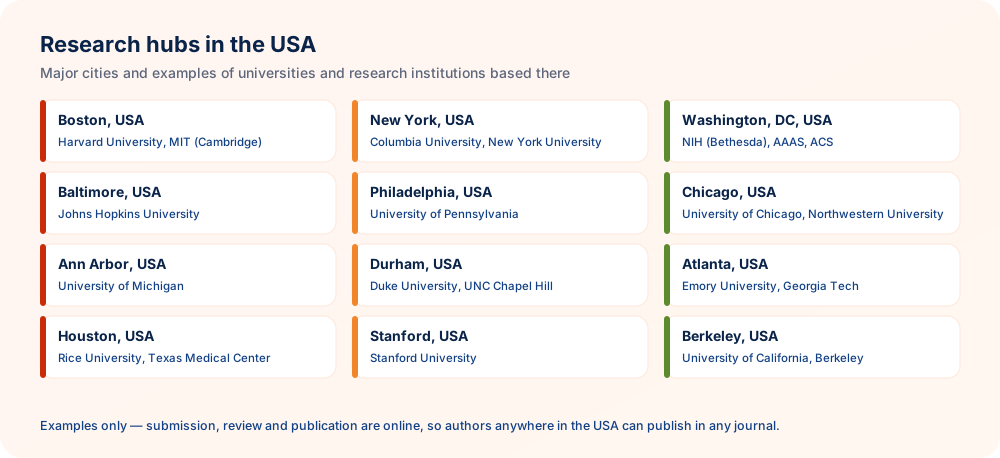
Major research clusters in the US lie along the West Coast, in Texas, the Southeast, the Midwest and the Northeast, though work is spread across many regions.
Picking the Right Journal
Begin with what the paper needs: its intended readers, the recognition your institution requires and the format the journal asks for. Cut the options down to two or three titles, read their latest issues and keep one reliable fallback before you submit.
Fees and Affordable Options
US journals mostly follow two models. Subscription journals generally charge authors nothing, although some levy page or colour fees and sell optional open access. Open access journals typically charge an APC, often from hundreds to several thousand US dollars. Diamond open access journals charge nothing. Read the fee page, and ask your library whether a publisher agreement covers the cost.
By comparison, JMVRA asks foreign authors for a single fee of $41 USD, payable only after acceptance and covering up to 5 authors — an economical choice for papers that do not require an indexed journal.
Read the guide to low-cost journal publication for our full method of comparing journals, with checks that work in any country, and how a low-fee journal meets its costs for the economics.
Public Access Rules at Federal Level
When a US federal agency funds your research, read its public access policy before picking a journal:
- NIH: when a paper is accepted from 1 July 2025 onward, the accepted manuscript must be accessible in PubMed Central on the day of publication, without any embargo.
- Other agencies, for instance the NSF, have public access requirements and repositories of their own.
- Journal compatibility: most large US journals offer a way to comply; check the author instructions to confirm it.
Checking a Journal Step by Step
- The title the ISSN Portal shows for the ISSN matches the one the journal uses.
- The publisher and the editorial office can be found, and you are able to contact them.
- A review procedure is set out and genuinely followed.
- You can find the journal inside the database itself, rather than only as a logo on its site.
- Fees are stated openly and asked for only after the paper is accepted.
Checklist Before You Submit a Manuscript
- Journal chosen with careScope, requirement and indexing verified
- Template adhered toLayout, reference style and length
- Overlap checkedAll sources cited, including work you wrote before
- Ethical matters settledApproval, consent and conflicts of interest declared
- Author details verifiedNames and affiliations written as intended
- Covering letter readyWhat makes the paper right for this journal
How JMVRA suits authors in the USA
Based in India, JMVRA (ISSN 2984-8911) is an international open access journal covering many disciplines. It is not a US journal, but it accepts papers from authors in the USA.
- Fee: Foreign authors are charged $41 USD, which is asked for only on acceptance and includes up to 5 authors.
- Review: transparent double-blind peer review by subject experts, with similarity kept below 15%.
- Access: open access at no cost to readers under CC BY 4.0; a Crossref DOI can be requested.
- Indexing in plain terms: Google Scholar includes the journal, but it is not included in Scopus, Web of Science or DOAJ.
A 12-Month Publication Roadmap for Researchers in the USA
| Months | Focus |
|---|---|
| 1–3 | Pick a focused question and two or three target journals; look at national systems such as funder public access policies, for instance those of NIH and NSF, plus the international databases |
| 4–6 | Carry out data collection and analysis, then write inside the target journal’s own template |
| 7–9 | Ask a supervisor or colleague for feedback, and submit to just one journal at a time |
| 10–12 | Revise as reviewers suggest, circulate the article after publication, and keep your ORCID and Google Scholar records current |
Language Options for Authors in the USA
Researchers in the USA work in English. Choose the language according to who needs to read the paper.
Plain international English
Defined terms and short sentences help reviewers everywhere.
Publishing in English
It connects with international readers, reviewers and indexes.
Local context explained
Describe national institutions, policies and data sources for readers from abroad.
Language editing support
Have a colleague or editor read the final version before you submit.
Practical Tips for American Authors Meeting Publication Obligations
Researchers in the United States often work under grant conditions, institutional policies and tight career timelines. These tips help you meet those obligations without compromising the quality or integrity of your papers.
- Read your grant terms before submitting. Funding agreements may set conditions about public access to results. Check them early so you can choose a journal and licence that allow you to comply.
- Involve your librarian. University librarians can explain repository deposit, licensing and open access arrangements. A short conversation before you submit can save you from accidentally signing away rights you need.
- Agree on corresponding author duties. Decide who will handle editorial email, revisions and proofs, and ensure that person's contact details remain current. Missed messages are a common cause of avoidable delay.
- Register preregistered studies honestly. If your study was preregistered, cite the registration and explain any departures from the plan. Transparency about changes strengthens confidence in your conclusions.
- Beware of tenure-driven shortcuts. Pressure to publish can tempt authors toward quick, unvetted venues. Slow down, vet the journal independently, and favour outlets whose review standards you can actually verify.
Know your funding and licensing obligations, involve your library early and refuse shortcuts that put your reputation at risk.
Questions Researchers Often Ask
Summary and What to Do Next
The USA has some of the most influential journals in the world, plus a broad range of society and open access titles. Choose according to field and audience, check federal access rules and verify every claim.
- Have your institution's requirement for publishing confirmed in writing.
- Shortlist journals from the table and read their newest articles.
- To verify indexing, consult our USA guide to Scopus and Web of Science journals.
- Format the manuscript to the journal's template, then upload it via the journal's website.
Ready to send in your paper?
Submission to JMVRA is online and free. Review always comes first; the $41 USD publication fee applies only after your paper is accepted.
Related searches
Related searches by researchers in the USA include affordable open access journals, high impact factor journals, Scopus and Web of Science indexed journals, paper publication fees and journal publication in USA. These guides cover them:
- Low-cost journal publication in the USA
- High impact factor journals in the USA
- Scopus and Web of Science journals in the USA
- How a low-fee journal is funded
- Locating high impact factor journals
- How to choose a journal
- Checking an indexing claim yourself
- Recognising a predatory journal
- Publishing with JMVRA from outside India
- JMVRA publication charges
References and Sources
Checked on 4 October 2026. Indexing, fees and policies can change, so check them again before submitting.
Publishing with JMVRA From the USA
- Submit onlineResearchers from any country can send work; submission is free
- First reviewScope and similarity (below 15%) are checked first
- Double-blind reviewReviewers who specialise in the topic; decision sent by email
- Accepted — $41 USDSingle charge for as many as 5 authors
- PublishedCC BY 4.0 open access
Details: Publication charges · Peer review · Advice for authors outside India.
Ready to Publish? Submit to JMVRA
JMVRA is aligned with UGC's Suggested Parameters for Choosing Peer-Reviewed Journals.
JMVRA is a Transparent, Peer-Reviewed, Open Access Journal (Refereed Journal). Following the discontinuation of the UGC and UGC-CARE journal listing, and in alignment with the latest UGC-CARE recommendations and guidelines, JMVRA is aligned with UGC’s Suggested Parameters for Choosing Peer-Reviewed Journals.
Pages worth visiting on jmvra.org
Key Terms
Subjects and search phrases this article addresses.
Related Reading
Further guides for researchers in the USA and for selecting a journal.
Affordable Journal Publication for US Researchers
Read the guide RelatedFinding High-Impact Journals as a US Researcher
Read the guide RelatedScopus & Web of Science Journals: USA
Read the guide RelatedResearch Journals in Haiti: Local & International
Read the guide RelatedRecognising a Predatory Journal
Read the guide RelatedWhat International Authors Should Know About JMVRA
Read the guide RelatedChoosing a Journal: A 7-Step Scoring Framework
Read the guideKeep Reading on the JMVRA Blog
As part of the JMVRA journal blog, this guide shares practical help on publishing, indexing, metrics and research integrity, and is written to be verifiable rather than promotional.