
Searching for low cost journal publication in the USA? Getting a paper published should not eat up a month’s income. This guide covers what journals in the USA and elsewhere usually charge, where free and low-cost options exist, how to recognise predatory offers that use cheap fees as bait, and five checks to run before paying anything. It is aimed at students, scholars and faculty in Boston, USA; New York, USA; Washington, DC, USA; Baltimore, USA. Librarians can often point you to arrangements that are easy to overlook when you browse alone.
What Publishing in a Journal Costs in The USA
US subscription journals generally charge authors nothing, though some add page or colour fees; open access journals normally levy an APC, typically ranging from hundreds to several thousand US dollars.
| Model | What authors pay | Typical publisher |
|---|---|---|
| Diamond open access | No fee to read or to publish | Journals financed by universities, societies or funding agencies |
| Fees at national and university journals | A modest fee, often in US dollars | Journals from societies and universities |
| International APC | Starting in the hundreds and reaching several thousand US dollars | Publishers of open access that are commercial or large non-profits |
| Subscription or hybrid | Typically no fee, with open access offered for an optional charge | Titles marketed to libraries through subscriptions |
What does an APC actually cover? Peer review management, editing, typesetting, online hosting, persistent identifiers such as DOIs, and indexing metadata. Backing from a university or society lets some journals charge little or nothing, while commercial open access journals usually charge more. Look at the process, not only the price.
Free and Low-Cost Choices for US Researchers
Diamond open access journals charge nothing, and many university libraries hold publisher agreements that cover or discount APCs — consult your library first.
- Diamond open access journals — refine DOAJ results by subject and “without fees”.
- National and university journals — frequently inexpensive and widely read at home; look at PubMed and MEDLINE, NIH Public Access Policy, National Science Foundation.
- APC waivers and discounts — they are available from many publishers for authors from lower- and middle-income countries; read the policy of each publisher.
- Institutional agreements — arrangements at your library or university can sometimes cover or discount APCs.
- Preprints — cost-free for early findings, but not an alternative to peer-reviewed publication.
What a Sound Low-Fee Journal Should Still Offer
Paying less should never mean a weaker review process. Before settling on an affordable journal, make sure it still provides the basics that any author in the USA has a right to expect:
- True peer review — a specified review model, reviewers working independently and feedback that guides your revision.
- Similarity screening — an openly stated threshold plus a check before review, protecting the journal and you.
- A clear licence — open access generally relies on Creative Commons, making the terms of reuse plain to readers.
- Permanent hosting — a durable article page along with an archive, and a DOI in case the journal assigns it.
- Correct metadata — titles, authors and references that are accurate, enabling search engines and databases to find and cite the article.
- Transparent policies — ethics, corrections, retractions and refunds spelled out in writing in advance of submission.
Affordable Does Not Mean Predatory
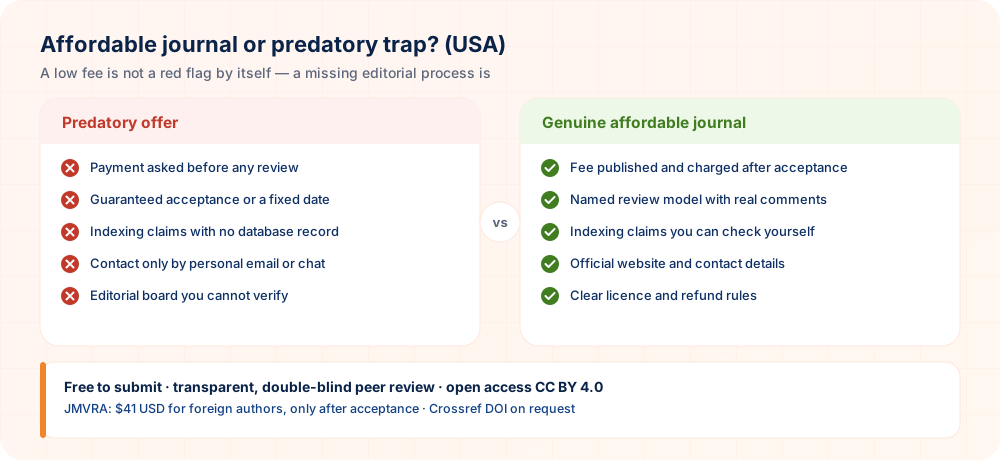
Be wary of cheap fees used as bait. Predatory outfits promise acceptance, claim made-up impact factors and demand payment before review. Trustworthy low-cost journals instead state the fee before you submit, collect it only when acceptance is real, and supply genuinely useful reviewer comments.
- Payment sought up front, before any review or decision.
- A “guaranteed” acceptance, or one promised for a particular date.
- Boasts about Scopus, Web of Science or impact factor that the databases cannot back up.
- A site taking over the name or ISSN belonging to a real journal.
- A changed fee after acceptance, or payment sent to a personal account.
Five Things to Check Before Paying a Publication Fee
- Genuine acceptanceA decision with reviewer comments, coming from the journal itself
- Fee was shownThe figure is the same as the one stated before you submitted
- Legitimate paymentHandled on the journal’s own page, and not by a personal account
- Understand the inclusionsAuthors covered, certificates, DOI and extras
- Store the evidenceAn invoice, a receipt and the acceptance letter
Funding Options and Support Across the USA
Public access policies apply at federal funders like NIH: where an NIH-funded paper is accepted from 1 July 2025, its accepted manuscript has to be in PubMed Central as soon as it is published, without any embargo. Read your grant terms early so the journal you pick can meet them.
Work out publication costs during study design, well before acceptance. List the expected fee in grant applications, see whether co-authors’ institutions can contribute, and keep a cheaper second journal in mind if the first turns out unaffordable.
Compare the Full Cost, Not Only the Headline Fee
| Item | What to check |
|---|---|
| Base fee | The advertised APC or publication charge and its currency |
| Authors covered | Number of authors in the fee and the price for further authors |
| Extras | Additional page, colour, DOI, certificate or printed-copy costs |
| Payment costs | Extra bank and foreign-exchange costs when you pay from another country |
| Waivers | Does a discount or waiver cover your case, and where do you ask for it? |
| Value | Rigour of the review process, readership, and the indexing your institution expects |
How to Pay a Publication Fee Safely From The USA
Cross-border payments carry extra hidden costs, including bank charges, currency conversion and, at times, intermediary fees. Prior to paying, ask the journal which payment methods it takes, whether it quotes the fee in US dollars or US dollars, and whether it can issue the invoice in the name your institution requires for reimbursement. Keep every receipt, since reimbursement offices often ask for proof of the exact amount paid.
- Transfer funds only after a real acceptance, using the journal’s official bank account or payment page and no other route.
- Do not pay into anyone's personal account or through an agent.
- Hold on to the acceptance letter, invoice and receipt as a set; you may need them for audits or to claim reimbursement.
- Request a written clarification if the charge you receive is not what the published fee states, and wait for it before paying.
Low-Cost Publication for Authors Anywhere in the USA
Because submission, review and payment all happen online, authors in Boston, USA; New York, USA; Washington, DC, USA; Baltimore, USA; Philadelphia, USA; Chicago, USA; Ann Arbor, USA; Durham, USA and any other city publish under identical terms. Choose a journal for its fit and its process; your location does not alter the fee.
How JMVRA suits authors in the USA
Based in India, JMVRA (ISSN 2984-8911) is an international open access journal covering many disciplines. It is not a US journal, but it accepts papers from authors in the USA. Its fee is modest because it operates on a no-profit, no-loss basis, not because peer review is skipped.
- Fee: The $41 USD charge for foreign authors is due after acceptance only and covers up to 5 authors.
- Review: subject experts carry out transparent double-blind peer review, and similarity has to stay below 15%.
- Access: open access under CC BY 4.0; a Crossref DOI can be requested whenever you want one.
- Plain statement on indexing: listed in Google Scholar, not in Scopus, Web of Science or DOAJ.
Planning Your Publication Costs in US dollar (USD)
| Item | What to check |
|---|---|
| Publication fee | The currency used and the moment the fee is collected; JMVRA charges foreign authors $41 USD, after acceptance only |
| Payment charges | Bank or card charges on a cross-border payment made from the USA |
| Authors covered | Check that every co-author is covered by the fee (JMVRA: up to five) |
| Optional services | Language editing, a DOI or hard copies, only if you need them |
Making an International Fee Payment from the USA
- Wait until the acceptance email arrives — genuine journals do not ask for payment before review
- Transfer money to no account but the official one — as listed on the journal’s site or in its acceptance email
- Confirm the amount in US dollar (USD) — conversion happens at your bank’s own rate
- Retain every receipt — for reimbursement and your files
Practical Tips for US Researchers Seeking Affordable Journals
Researchers in the United States often work under grant rules, institutional policies and tenure expectations at once. These tips help you align an affordable journal choice with those obligations.
- Read your grant terms. Funding agreements may specify where publication costs can be charged and which access rules apply. Check them with your sponsored programmes office before choosing a journal or paying anything.
- Consider a repository copy. Many institutions run repositories where an accepted manuscript can be deposited. Confirm what the journal's policy permits, then use this route to widen free access to your work.
- Weigh tenure expectations honestly. Discuss with your department chair or mentor which venues carry weight in evaluation. An affordable journal can still be a sound choice when it fits your field and audience.
- Request an itemised invoice. Ask for a receipt that names the article, the service charged and the payer. Clear documentation makes grant reporting and any later audit straightforward.
Let grant terms, repository options and departmental expectations guide the choice, and document every charge for later reporting.
Questions Researchers Often Ask
Summary and What to Do Next
Publishing cheaply from the USA is achievable once you know where to search and what to verify. Favour journals with a transparent process and a published fee, make use of waivers and institutional support, and do not pay until a genuine acceptance arrives.
- Find out exactly what your institution requires.
- Compile candidate journals in your field: diamond, national and inexpensive international ones.
- Complete the five checks before you pay any fee.
- You may also browse the list of research journals in the USA and high impact factor journals in the USA.
Ready to send in your paper?
Submission to JMVRA is online and free. Review always comes first; the $41 USD publication fee applies only after your paper is accepted.
Related searches
Readers in the USA who use this guide often go on to search for low cost journal publication, publication charges, APC waivers, free open access journals and safe ways to pay. The guides below answer those questions:
References and Sources
Checked on 4 October 2026. Fees and policies can change, so confirm them before submitting.
Publishing with JMVRA as an Author in the USA
- Submit onlineWelcomed from every country, with no fee at submission
- ScreeningSubject fit and similarity review (below 15%)
- Double-blind reviewExperts in the subject assess it; the decision reaches you by email
- Accepted — $41 USDJust one fee, with up to 5 authors included
- PublishedReleased as open access (CC BY 4.0)
Details: Publication charges · Peer review · Advice for authors outside India.
Ready to Publish? Submit to JMVRA
JMVRA is aligned with UGC's Suggested Parameters for Choosing Peer-Reviewed Journals.
JMVRA is a Transparent, Peer-Reviewed, Open Access Journal (Refereed Journal). Following the discontinuation of the UGC and UGC-CARE journal listing, and in alignment with the latest UGC-CARE recommendations and guidelines, JMVRA is aligned with UGC’s Suggested Parameters for Choosing Peer-Reviewed Journals.
Handy links within jmvra.org
Key Terms
Subjects and search phrases this article addresses.
Related Reading
Further guides for researchers based in the USA.
Keep Reading on the JMVRA Blog
The JMVRA journal blog includes this guide, one of many practical pieces on publishing, indexing, metrics and research integrity, prepared so readers can verify them without any sales pitch.