
Searching for research journals in Haiti? Academic journals based in Haiti are few and young, so scholars also publish in Haiti-focused journals overseas and in international titles. Here you will find verified journals, notes on language choices and advice on verifying a journal. It is written for researchers in Port-au-Prince, Haiti; Cap-Haïtien, Haiti; Les Cayes, Haiti and the Haitian diaspora. Reading each journal's aims page helps you judge whether your topic fits.
Scholarly Publishing in Haiti
The Université d’État d’Haïti (UEH) serves as the state university of Haiti. Laboratories and a pair of journals fall under its research directorate: RED (Recherche, Études, Développement), covering agronomy, biology, medicine and further sciences, and Chantiers, which deals with the humanities and social sciences and was launched in 2015. Research is also supported by the private Université Quisqueya and by public regional universities in Limonade, Cap-Haïtien and Les Cayes.
More journals are starting up. One is the Revue haïtienne Droit et Société (RHDS), which the Haitian Centre for Research in Social Sciences (CHARESSO) set up in 2024; it is bilingual, double-blind peer reviewed and devoted to legal and social research. Outside the country, research on Haiti appears in the Journal of Haitian Studies, which accepts English, French, Haitian Kreyòl and Spanish.
At the time this guide was checked, we were unable to confirm any Haiti-published journal in Scopus or Web of Science. Researchers who need indexed publication therefore turn to international journals, frequently working with collaborators.
Research Journals Published in Haiti
Each journal below is published in Haiti by a university, society or research body that can be identified. The “reported coverage” column repeats what the journal or its publisher says about itself, so check any indexing claim in Scopus Sources or the Master Journal List before submitting.
| Journal | Publisher | Subject area | Reported coverage |
|---|---|---|---|
| Revue haïtienne Droit et Société (RHDS) | Haitian Centre for Research in Social Sciences (CHARESSO) | Law and society | Founded 2024; double-blind peer review; French and English |
| Revue RED (Recherche, Études, Développement) | Université d’État d’Haïti, Port-au-Prince | Agronomy, biology, medicine and other sciences | University journal; check indexing |
| Revue Chantiers | Université d’État d’Haïti, Port-au-Prince | Humanities and social sciences | University journal (since 2015); check indexing |
| Journal of Haitian Studies | Haitian Studies Association (hosted at UC Santa Barbara, USA) | Haitian studies | Haiti-focused journal published outside Haiti; accepts English, French, Kreyòl, Spanish |
As of 4 October 2026, details were checked against the journal’s own website or publisher. This is a starting point and does not rank journals or list them all.
Online Journal Platforms and Directories to Use
Turn to UEH and CHARESSO for Haitian journals, and to international directories for finding and checking further options.
Université d’État d’Haïti (UEH)
Haiti’s public university, whose research directorate supervises laboratories and the journals RED and Chantiers. Visit.
CHARESSO
The Haitian Centre for Research in Social Sciences, which publishes RHDS and further journals.
Directory of Open Access Journals
Look up open access journals that satisfy DOAJ’s criteria, and narrow the results by publisher country (Haiti) or by “without fees”. Visit.
SCImago country rankings
Scopus-derived journal rankings limited to titles published in Haiti, showing quartiles and SJR. Visit.
ISSN Portal
Trust a journal only after confirming its ISSN, exact title and the country where it is published. Visit.
Where Research Happens in Haiti
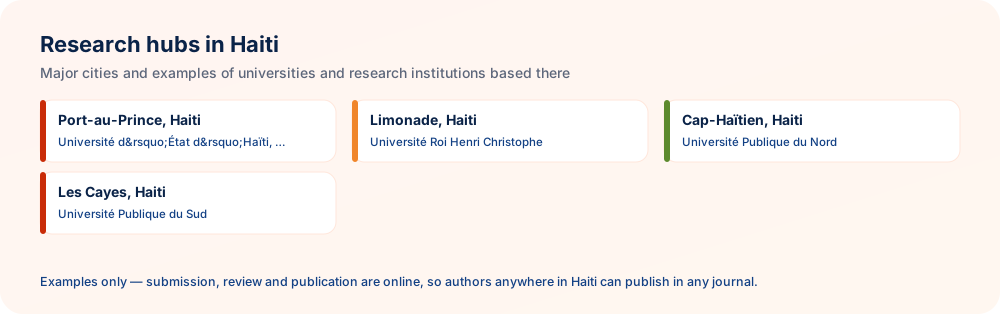
Research in Haiti is concentrated in Port-au-Prince, and public universities operate in the north and the south.
Picking the Right Journal
Begin from your own requirement, not from a list, when choosing a journal. Get written confirmation of what your university or funder accepts, shortlist journals whose recent papers resemble yours, and read their instructions for authors before formatting anything. A backup journal saves weeks if the first one rejects the paper. Record each journal’s scope statement as you shortlist.
Fees and Affordable Options
Journals in Haiti frequently charge little or nothing, while international ones range from free to expensive APCs. A lot of publishers grant waivers or discounts to authors from lower-income countries, so read the publisher’s waiver policy.
Payment belongs after a real acceptance and through official channels only. By contrast, JMVRA asks foreign authors for $41 USD, due only after acceptance, covering up to five authors.
Our full approach to comparing journals appears in the guide to low-cost journal publication, with checks usable anywhere, and in how a low-fee journal meets its costs.
Publishing in French
Alongside Haitian Kreyòl, French is a principal research language in Haiti. Choosing French need not limit international visibility: Scopus and Web of Science cover French-language journals, particularly in the humanities, social sciences, law and medicine, and most of them expect English titles and abstracts. Prior to submitting, verify the following:
- its stance on language, including any acceptance of bilingual papers;
- whether English-language abstracts and keywords are offered;
- whether your intended community is among its audience.
Publishing a single study twice in different languages, lacking explicit consent from each journal, is duplicate publication.
Haiti-Focused Journals and Collaboration Overseas
Much of the scholarship on Haiti is printed abroad, authored by Haitian academics living at home or in the diaspora and by foreign collaborators. Titles centred on Haiti, for instance the Journal of Haitian Studies, welcome submissions in several languages, and global journals covering health, agriculture, disaster studies, education and the social sciences frequently carry Haitian research. Matching your paper to a journal's usual readership improves its chances of being read.
- Collaborate fairly. Settle authorship and data ownership at the outset of a project.
- Publish at home as well. A short summary in French or Kreyòl brings findings to Haitian practitioners and policymakers.
- Look into fees and waivers before submitting to international journals.
Checking a Journal Step by Step
- Check the ISSN register entry and confirm that the full title is an exact match.
- Confirm that every board member can be traced and really holds the stated affiliation.
- Seek a clearly stated peer review type, supported by real reviewer reports.
- Test any indexing claim yourself: search Scopus Sources or the Master Journal List.
- Do not make any payment ahead of a genuine acceptance.
Checklist Before You Submit a Manuscript
- Journal validatedScope, requirement and indexing inspected
- Journal template appliedLayout, citation style and word count
- Similarity reviewedAll sources acknowledged, including your earlier work
- Ethics finishedDeclared conflicts, plus approval and consent
- Author details preciseNames and affiliations exactly as they will be printed
- Covering letter readyStates why this paper suits the journal, written with Haiti-based authors in mind
How JMVRA suits authors in Haiti
Based in India, JMVRA (ISSN 2984-8911) is an international open access journal covering many disciplines. It is not a Haitian journal, but it accepts papers from authors in Haiti.
- Fee: Nothing is due until the paper is accepted; foreign authors, including those in Haiti, then pay $41 USD, and one payment covers up to 5 authors.
- Review: the similarity score must be under 15%, after which subject specialists carry out transparent double-blind peer review.
- Access: the journal is open access with a CC BY 4.0 licence, and a Crossref DOI is available on request.
- Honest about indexing: our articles can be found in Google Scholar, but are not indexed in Scopus, Web of Science or DOAJ.
A 12-Month Publication Plan for Haiti-Based Researchers
| Months | Focus |
|---|---|
| 1–3 | Settle on a narrow question and two or three journals to aim for; look at national resources such as the Université d’État d’Haïti (UEH), and at the international databases |
| 4–6 | Carry out the data collection and analysis, and write the text straight into the template of your target journal |
| 7–9 | Ask a supervisor or colleague for feedback, and submit to just one journal at a time |
| 10–12 | Revise the paper according to reviewer feedback, circulate it once published, and update your ORCID and Google Scholar profiles |
Choosing a Language as an Author in Haiti
Researchers in Haiti work in French and Haitian Creole (Kreyòl). Choose the language according to who needs to read the paper.
Publish in French or Kreyòl
Speaks to readers, practitioners and policy makers within Haiti.
Publishing in English
Opens the door to readers, reviewers and indexes across the globe, Haiti included.
Abstract in two languages
Pairing a paper in French or Kreyòl with an English title and abstract helps international readers find it.
Language editing support
Have a colleague or editor read the final version before you submit.
Practical Tips for Haitian Scholars Writing for Journals
Haitian researchers often write across French, Kreyol and English and work in demanding circumstances. These suggestions help you protect your work, communicate it well and find supportive collaborators abroad.
- Decide the language of the article. Think about who most needs your findings. A paper in French may serve regional readers, while an English version may reach international collaborators; choose deliberately rather than by habit.
- Keep key terms consistent across languages. Make a short glossary of technical words in Kreyol, French and English. Using one agreed translation throughout avoids confusion for readers and for indexing of your keywords.
- Back up your work off site. Interruptions to power and travel are common, so keep copies of drafts and data in cloud storage and on a separate drive. Losing months of writing is entirely preventable.
- Seek diaspora and partner co-authors. Colleagues abroad can provide library access, statistical help and language review. Define their role clearly so that collaboration is balanced and your voice remains central to the paper.
- Explain local context to outside reviewers. Briefly describe institutions, communities and conditions that reviewers may not know. Context helps them judge your methods fairly instead of assuming an ordinary research environment.
Choose your language deliberately, protect your files, and give reviewers enough context to understand the setting of your Haitian research.
Questions Researchers Often Ask
Summary and What to Do Next
Haiti has few journals, though their number is rising, and Haiti-focused and international titles add more choice. Decide by audience and language, verify every journal, and budget for costs early.
- Make sure your institution’s requirement for publishing is put in writing.
- Select journals from the table and study their most recent articles.
- Our Scopus and Web of Science guide for Haiti explains how to confirm indexing.
- Set up your manuscript according to the journal’s template and upload it on the journal’s website.
Ready to send in your paper?
Submission to JMVRA is online and free. Review always comes first; the $41 USD publication fee applies only after your paper is accepted.
Related searches
Visitors from Haiti who find this guide useful tend to be after affordable open access journals, high impact factor journals, Scopus and Web of Science indexed journals, paper publication fees and journal publication in Haiti. The following guides address those subjects:
- Low-cost journal publication in Haiti
- High impact factor journals in Haiti
- Scopus and Web of Science journals in Haiti
- How a low-fee journal is funded
- Locating high impact factor journals
- How to choose a journal
- Checking an indexing claim yourself
- Recognising a predatory journal
- Publishing with JMVRA from outside India
- JMVRA publication charges
References and Sources
Checked on 4 October 2026. Indexing, fees and policies can change, so check them again before submitting.
- Université d’État d’Haïti
- Revue haïtienne Droit et Société
- CHARESSO — journals
- Journal of Haitian Studies
- Scopus Sources
- Clarivate Master Journal List
- ISSN Portal
Haitian Authors Publishing With JMVRA
- Submit onlineOpen to authors anywhere in the world, and nothing is charged when you submit
- Entry checkRelevance to scope and similarity (below 15%)
- Double-blind reviewSpecialist reviewers assess the paper and the verdict reaches you by email
- Accepted — $41 USDA flat fee shared by up to 5 authors
- PublishedLicensed CC BY 4.0, open to everyone
Details: Publication charges · Peer review · Advice for authors outside India.
Ready to Publish? Submit to JMVRA
JMVRA is aligned with UGC's Suggested Parameters for Choosing Peer-Reviewed Journals.
JMVRA is a Transparent, Peer-Reviewed, Open Access Journal (Refereed Journal). Following the discontinuation of the UGC and UGC-CARE journal listing, and in alignment with the latest UGC-CARE recommendations and guidelines, JMVRA is aligned with UGC’s Suggested Parameters for Choosing Peer-Reviewed Journals.
Further reading on jmvra.org
Key Terms
Subjects and search phrases this article addresses.
Related Reading
Further guides for Haiti-based researchers, plus help with choosing a journal.
Affordable Journal Publication for Haitian Researchers
Read the guide RelatedFinding High-Impact Journals From Haiti
Read the guide RelatedScopus & Web of Science Options for Haiti
Read the guide RelatedResearch Journals in the USA: A Verified Guide
Read the guide RelatedResearch Journals in the DR Congo: 2026 Guide
Read the guide RelatedWhat International Authors Should Know About JMVRA
Read the guide RelatedChoosing a Journal: A 7-Step Scoring Framework
Read the guideKeep Reading on the JMVRA Blog
This article sits on the JMVRA journal blog, where practical guidance covering publishing, indexing, metrics and research integrity is written to be verifiable, not promotional.