
Research paper publication turns your study into a lasting, citable addition to knowledge. Whether you are a student, PhD scholar, professor or first-time researcher, the process may look confusing, with its topics, formats, journals, peer review, revisions and fees. This full step-by-step guide walks through how to publish a research paper, from choosing a topic to sharing the finished article, and covers the submission guidelines and timeline to expect at JMVRA. Reading the whole process first helps you plan your time and avoid avoidable delays.
An Introduction to Research Paper Publication
To publish a research paper is to place your study’s question, methods, results and conclusions in a journal after editorial screening and peer review, giving other people the chance to read, test, cite and build on it. People publish their research to:
- Contribute to knowledge: once published, your paper joins the scholarly record of your discipline.
- Receive expert feedback: peer review strengthens both the work and how it is presented.
- Create a track record: publications back up degrees, appointments, promotions and funding bids.
- Reach practitioners: teachers, clinicians, engineers and policymakers can learn from open access papers.
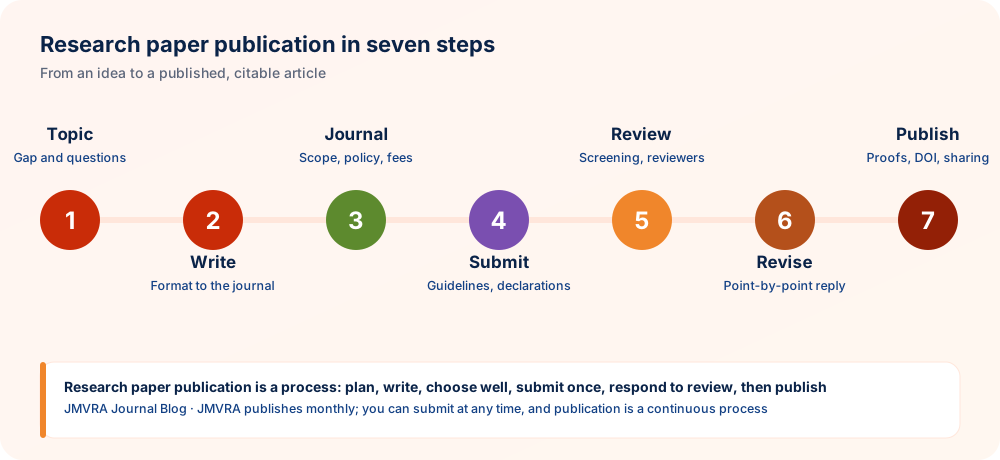
Overview of the Seven Steps
Step 1: Pick a Research Topic
- Relevant: a question of importance to your discipline and its readers.
- Manageable: focused enough to fit your time, data and resources.
- Gap: having reviewed the literature, say what remains unknown, disputed or untested.
- Questions: from one to three focused research questions or aims.
- Literature: go through recent studies and key reviews before designing your study.
To make the case for a gap, see how to write a literature review.
Step 2: Draft and Format Your Research Paper
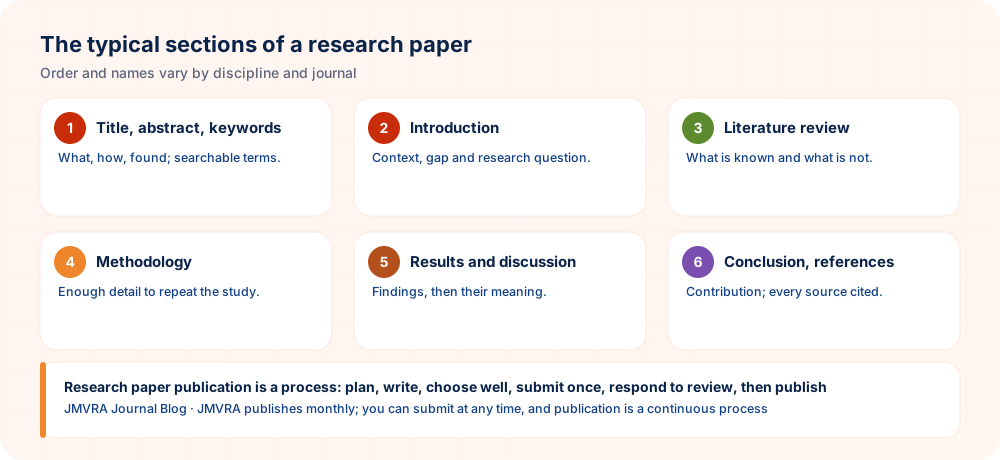
| Section | What it contains |
|---|---|
| Title | Precise and easy to search: topic, method or population, and result |
| Abstract | A stand-alone summary covering background, aim, method, results and conclusion |
| Key Terms | Words that readers would type into a search |
| Introduction | Background, the research gap and your question |
| Literature review | Existing knowledge organised by theme (at times part of the introduction) |
| Methodology | Design, sample, tools and analysis described so fully that the study can be repeated |
| Results | Results presented with tables and figures but no interpretation |
| Discussion | Interpretation, comparison with other studies and limitations |
| In Summary | What the work adds and what follows from it |
| References | All sources cited in a single uniform style |
Required structure differs among disciplines and journals, so always follow the author guidelines and template of your target journal. For detailed help, see how to write a research paper for publication and how to write an abstract.
Step 3: Identify the Right Research Journal
- Scope and readership: the journal covers your subject and article type, and reaches readers who need your findings.
- Publication policies: its ethics, plagiarism, authorship, licence and AI policies are openly published.
- Peer-review process: a declared model, with comments passed on to authors.
- Publication fees: the amount charged, the due date and what the charge includes — read low-cost journal publication.
- Verified indexing: any Scopus or Web of Science claim should be confirmed where it originates — read how to verify Scopus and Web of Science indexing.
- Up-to-date UGC guidance: the UGC-CARE list now sits in an archive, so refer to the UGC-CARE journal list and current guidance.
For the complete method, read how to choose the right journal in 10 steps.
Step 4: Send in Your Manuscript
- Read the author guidelines in full and use the journal’s template.
- Prepare your files: manuscript, figures, tables and any supplementary material, each saved in the format the journal asks for.
- Author declarations: confirm originality, that the paper is submitted once only, that all authors approve, and state conflicts of interest, funding and data availability.
- Ethical requirements: ethics approval and consent where human or animal subjects are involved; a statement on AI use if AI tools were employed.
- Cover letter or note to the editor: explain why the paper suits the journal — see cover letter templates.
- Use the official submission system on the journal’s own website, and never go through an agent.
Step 5: Learn How Peer Review Works
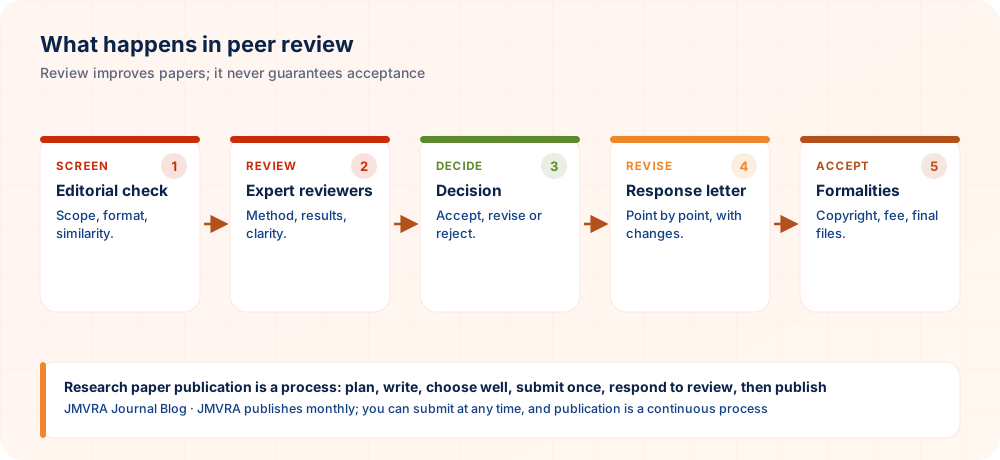
- Editorial screening: checks of scope, completeness, formatting and similarity.
- Reviewer evaluation: subject experts judge originality, methods, results and clarity.
- Revision requests: minor or major changes are asked for before a final decision.
- Acceptance or rejection: peer review gives no guarantee of acceptance, and rejection is a normal part of publishing.
Step 6: Revise Your Paper and Resubmit
- Write down and number each reviewer comment.
- Amend the manuscript and mark every change.
- Draft a response letter: quote each comment, say what you changed and where, and, where necessary, disagree courteously and back it with evidence.
- Send back the revised manuscript, the marked-up version and the response letter.
For templates and wording, see how to respond to peer review comments.
Step 7: Publication and Life After Publication
- Final proofreading: go through the proof to confirm that names, affiliations, figures, tables and references are correct.
- Publication charges, if applicable: pay only once the paper is accepted, and only through official channels.
- Online publication: the article is placed in the journal’s issue and archive.
- DOI, where offered: a lasting identifier used for citing and linking.
- Citation information: when listing the paper, use the citation format the journal provides.
- Share responsibly: promote the paper on ORCID, Google Scholar and your institutional profile while respecting the licence terms. Read how to increase citations ethically.
Submission Guidelines and Timeline at JMVRA
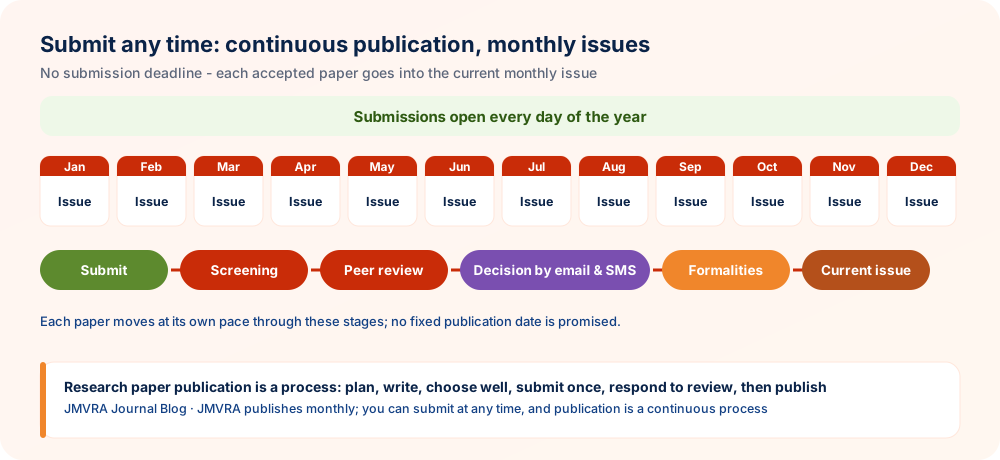
Submitting to JMVRA
- Submit any time: no submission deadline applies. JMVRA brings out monthly issues, and publication is a continuous process — when a paper is accepted and formalities are finished, it goes into the current issue.
- Guidelines: format your paper according to the publication guidelines, working from the journal template and forms; the portal expects an uploaded Word or PDF file.
- Before submitting: the work must be original and unpublished and not under review elsewhere, with an agreed author list and a similarity check (see the plagiarism policy); declare AI use before the reference list (AI policy).
- Submission: done online at jmvra.org/submitpaper.php — submitting costs nothing, and you receive a paper ID.
- Review: transparent, double-blind review by subject experts. Specialist reviewers assess your paper, and you receive the acceptance or rejection decision by email and WhatsApp.
- Tracking: follow every stage on the track page using your paper ID; no fixed publication date is promised.
- After acceptance: the author supplies the copyright form, the final copy and the fee (₹971 INR for Indian authors, $41 USD for foreign authors); publication follows as open access under CC BY 4.0, and a Crossref DOI can be had on request.
| Stage | What happens |
|---|---|
| 1. Submission | Receipt of manuscript and issue of paper ID |
| 2. Screening | Checks on scope, completeness, declarations and similarity |
| 3. Peer review | Transparent, double-blind assessment by subject experts |
| 4. Decision | Decision on acceptance, revision or rejection, sent through email and WhatsApp |
| 5. Revision | A point-by-point reply, when requested |
| 6. Acceptance formalities | Submission of copyright form, camera-ready copy and payment |
| 7. Production | Copy editing, proofing and, on request, DOI registration |
| 8. Publication | The article is published in the current monthly issue |
Fees for Research Paper Publication
| Cost | What it is | What to check |
|---|---|---|
| Submission fee | A fee for submitting (rare) | Whether it can be refunded; JMVRA makes no such charge |
| Article processing charge (APC) | A fee paid for open access publication | Amount, timing (following acceptance) and what is included |
| Extra authors | Certain journals limit authors covered by one fee | JMVRA: as many as 5 authors, with ₹500 for each extra author |
| Optional services | DOI, hard copies, reports | Itemised separately and truly optional |
| Editing of language or format | Services from third parties or the journal | Never required for acceptance |
Our low-cost journal publication guide compares budget-friendly choices, and JMVRA publication charges lists what JMVRA asks.
How Much Time Does Publication Take?
Timelines differ from journal to journal and paper to paper: editorial screening, peer review, revision (which depends on how fast you reply) and production all take time, and selective journals can take months. Be suspicious of any journal that promises a fixed acceptance date before review. JMVRA does not promise a fixed date: specialist reviewers evaluate your paper, and the acceptance or rejection decision reaches you by email and WhatsApp. Once formalities are finished, accepted papers go into the current monthly issue.
Free or Paid Publication
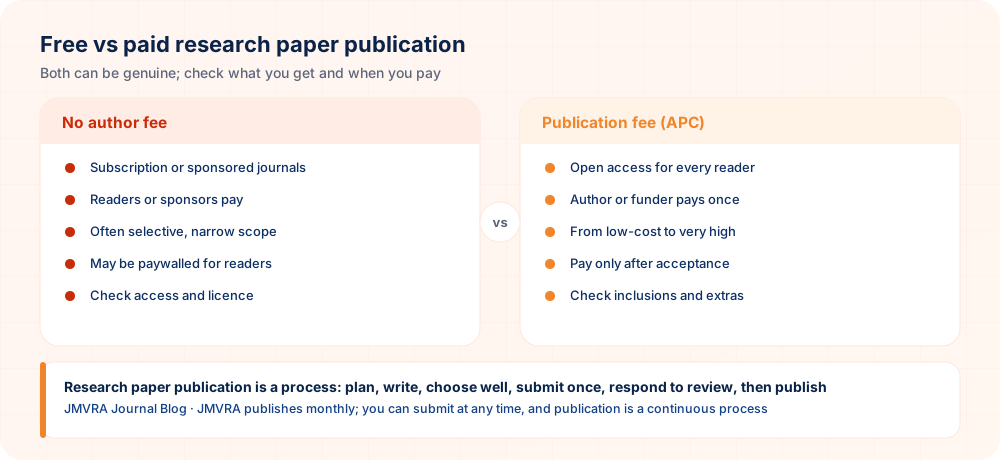
Journals without author fees are generally supported by subscriptions or sponsors, whereas journals with publication fees are generally open access and free for every reader. Either kind can be genuine. Judge each on its review process, policies and transparency, and pay only after acceptance. See free-to-publish Scopus journals. A fee on its own says nothing about quality, so look at how the journal actually behaves.
How to Recognise a Trustworthy Journal
| Area | What a good one shows |
|---|---|
| Editorial transparency | Editors named with affiliations you can verify; genuine contact details |
| Peer-review policy | A declared model, with reviewer comments passed on |
| Journal scope | Well-defined aims and subject areas, plus recent papers similar to yours |
| Publication ethics | Published policies on plagiarism, conflicts of interest, corrections and AI |
| Verified indexing | Assertions you are able to verify through DOAJ, the Master Journal List or Scopus Sources |
For warning signs and checks, use the predatory journal checklist.
Frequent Errors to Steer Clear Of
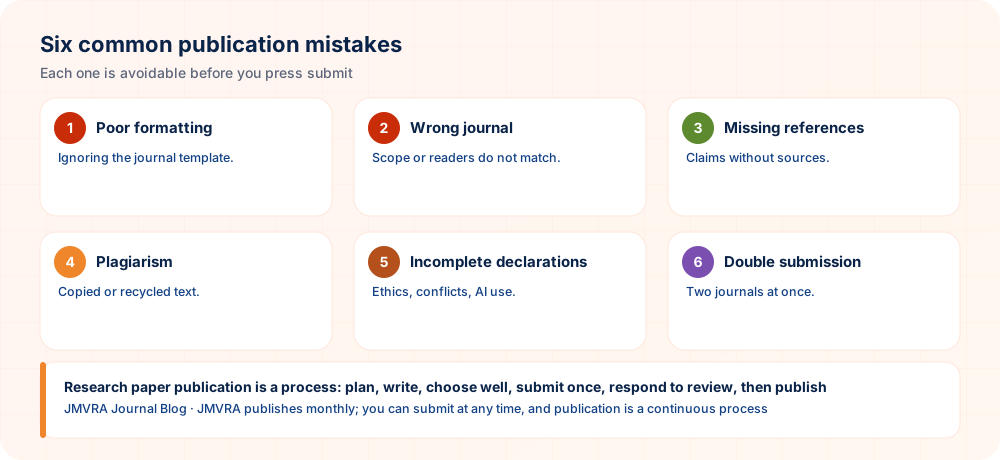
- Poor formatting: disregarding the template, word limits or reference style.
- Unsuitable journal selection: a mismatch of scope, readers or rules.
- Missing references: statements without sources, or citations that are inconsistent.
- Plagiarism: text that is copied or recycled, or paraphrase without a citation.
- Incomplete declarations: leaving out ethics, conflicts, funding or AI use.
- Double submission: sending one paper to two journals simultaneously.
Publication Checklist
- Research question and gap spelled out clearly
- The paper matches the journal’s template and structure
- Title, abstract and keywords are precise and easy to find
- Methods described in enough detail for the study to be repeated
- Each claim backed by a reference in a uniform style
- Similarity has been checked and the wording is your own
- Journal scope, policies and fees have been reviewed
- Every indexing claim has been confirmed at its source
- Declarations covering originality, authors, conflicts, ethics, funding, data and AI
- A cover letter or note to the editor is ready
- Every co-author has approved the final version
- Submission to a single journal only
Extra Advice for PhD Scholars
- Confirm the rule first: your university, institution, funder or degree programme may impose publication conditions, so get the latest version of the rule in writing.
- Plan early: allow time for review and revision ahead of submission deadlines.
- Agree on authorship with your supervisor prior to submission.
- Avoid overlap among papers drawn from one thesis, and cite your earlier work.
- Keep records: hold on to acceptance letters, reviewer comments and dated copies of the journal’s policies.
Researchers in India ought to go through the latest UGC guidance on choosing peer-reviewed journals.
Share Your Research Through JMVRA
Publish your findings in JMVRA
JMVRA (ISSN 2984-8911) is a peer-reviewed, open access journal spanning many disciplines. Submission is free. Specialist reviewers assess your paper, and you receive the acceptance or rejection decision by email and WhatsApp.
- 1. Draft in line with the guidelines
- 2. Submit online
- 3. Peer review
- 4. Decision by email & WhatsApp
- 5. Make it open access
Your At-a-Glance Checklist
- TopicGap and questions settled
- FormatThe journal template applied
- JournalScope, policies, fees and indexing reviewed
- SubmitAll declarations made; a single journal
- ReviewAnswer each point in turn
- PublishProofs verified; responsible sharing
Project Management Tips for Getting a Research Paper Published
Publishing is as much about managing a project as it is about the science. Planning the process, not just the writing, helps first-time authors avoid avoidable delays and disappointment.
- Write a one-paragraph contribution statement. Before drafting, state in plain words what is new and why a reader should care. Return to it whenever the manuscript drifts, and use it when selecting a journal.
- Shortlist several journals in advance. Prepare a ranked list of suitable journals so a rejection does not leave you starting over. Compare aims, article types, review practices and charges before choosing the first.
- Ask a colleague for a cold read. Give the draft to someone outside your project and ask where they got lost. Confusing passages for a friendly reader will be worse for a busy reviewer.
- Keep a submission log. Record each version, date of submission, correspondence and decision in one simple table. When questions arise months later, the log saves you from relying on memory.
- Prepare for revision, not just acceptance. Most papers need changes. Reserve time in your schedule and stay calm, polite and systematic when comments arrive, because revision is a normal stage rather than a setback.
Plan your journals, schedule and records in advance, and treat peer review as a normal conversation that improves the paper.
Questions Researchers Often Ask
In Summary
Anyone can learn to publish a research paper one step at a time: choose a focused topic, follow the journal’s structure when writing, select a journal you have checked, submit it once with every declaration, answer peer review constructively, and share the published work responsibly. Whenever you are ready, JMVRA accepts submissions at any time, issues monthly editions, and collects its fee only after acceptance.
Want to publish your research paper? Submit to JMVRA
JMVRA (ISSN 2984-8911) is a peer-reviewed, open access journal spanning many disciplines. Submission is free. Specialist reviewers assess your paper, and you receive the acceptance or rejection decision by email and WhatsApp.
- 1. Draft in line with the guidelines
- 2. Submit online
- 3. Peer review
- 4. Decision by email & WhatsApp
- 5. Make it open access
The Seven Steps Summarised
- TopicGap and questions
- WriteJournal’s structure
- JournalScope, fees, indexing
- Submit & reviewDeclarations; reply point by point
- PublishProofs, DOI, sharing
Related: Low-cost journal publication · UGC-CARE list and guidance · Submit Paper.
Ready to Publish? Submit to JMVRA
JMVRA is aligned with UGC's Suggested Parameters for Choosing Peer-Reviewed Journals.
JMVRA is a Transparent, Peer-Reviewed, Open Access Journal (Refereed Journal). Following the discontinuation of the UGC and UGC-CARE journal listing, and in alignment with the latest UGC-CARE recommendations and guidelines, JMVRA is aligned with UGC’s Suggested Parameters for Choosing Peer-Reviewed Journals.
Quick links across jmvra.org
Key Terms
Subjects and search phrases this article addresses.
Related Reading
Further guides on writing, journal selection and publishing.
Publishing a Research Paper in a Journal (2026)
Read the guide RelatedWriting an IMRaD Paper Journals Accept (2026)
Read the guide RelatedLow-Cost Journal Publication: Affordable Options Compared
Read the guide RelatedUGC-CARE List 2026: Old Lists, Notices & New Rules
Read the guide Related10 Steps to the Right Journal for Your Paper
Read the guide RelatedResponding to Reviewer Comments: Letter Templates
Read the guideKeep Reading on the JMVRA Blog
Our JMVRA journal blog carries this guide along with other practical advice on publishing, indexing, metrics and research integrity, all written so that claims can be verified and nothing is promotional.