
Months, maybe years, of effort have gone into your research and manuscript. Ahead of peer review, a single brief document influences how the editor first sees your work: the cover letter. A strong letter explains the importance of your study, why this specific journal is the right home for it and why it merits review. Below you will find the structure, three ready-to-copy templates, paragraph-level examples, the declarations editors look for, wording for AI disclosure and a 30-minute plan. Treat the letter as part of the submission, not an afterthought.
Why Is a Cover Letter Important?
- First impression: editors frequently read it before anything else, and it colours how they approach the manuscript.
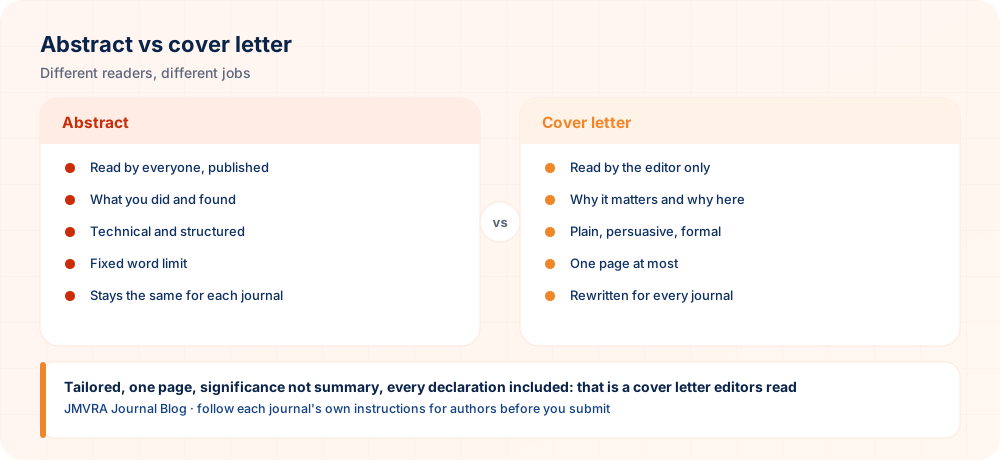
- Your pitch: the abstract tells readers what you did, whereas the cover letter explains why it matters and why the readers of this journal should care.
- Journal fit: a letter written for the journal shows that you have studied its aims and scope and are not circulating one paper to every journal.
- Declarations: numerous journals look for statements covering originality, ethics, conflicts of interest and authorship.
- Borderline decisions: if an editor hesitates over sending a paper out for review, a well-argued letter can tip the balance.
Desk rejection often comes down to scope mismatch or missing information, and a good cover letter helps prevent both. Checking the journal’s scope statement before writing is time well spent.
Before You Write: Choose the Journal
Writing a cover letter becomes much easier once you know precisely why your paper suits a journal. Work through our 10-step guide to choosing the right journal, note down the editor’s name, and locate one or two recent papers in that journal that are related to yours.
Cover Letter Structure: 7 Parts
| Part | What to include | Length |
|---|---|---|
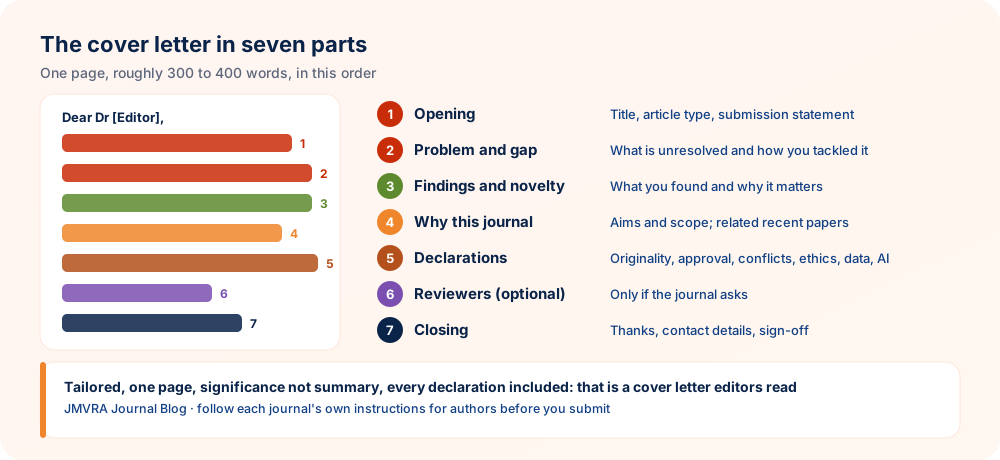
| 1. Opening | Title, article type and a statement that you are submitting | 2–3 sentences |
| 2. Problem and gap | The open problem, the gap and your approach | 3–4 sentences |
| 3. Findings and novelty | Main results and why they matter | 3–4 sentences |
| 4. Why this journal | Aims and scope; related recent papers from the journal | 2–3 sentences |
| 5. Declarations | Originality, single submission, approval, conflicts, ethics, data and AI | 4–6 sentences |
| 6. Reviewers (optional) | Suggested or excluded reviewers, only when requested | 2–3 sentences |
| 7. Closing | Thanks, corresponding author and sign-off | 2–3 sentences |
Total: a single page at most, around 300–400 words. Editors have little time, so be considerate of it.
Template 1: Original Research Article
Choose this for an experimental, clinical, field, computational or any other original study. Fill in every bracketed item.
Dear Dr [Editor’s full name],
We are happy to submit our manuscript titled “[Full title]” to be considered as a [Research Article] in [Journal name]. It runs to [X] pages and contains [Y] figures and [Z] tables.
Problem and gap
Even with progress in [field], the issue of [specific problem] has not been resolved. Existing approaches [briefly state the limitation]. Our study tackles this gap through [your approach or method].
Findings and significance
Our analysis revealed that [one or two key results]. The importance of this lies in [practical, clinical or theoretical implication]. Based on our search, no earlier study has [unique contribution — only if you have checked].
Why this journal
The manuscript matches the focus of [Journal name] on [specific part of the aims and scope]. It extends recent work published in the journal, such as [Author et al., year] on [topic], and should appeal to readers interested in [audience].
Declarations
This manuscript is original, has not appeared in print before and is not being considered by any other journal. Every author has approved the final manuscript and its submission. We declare that there are no conflicts of interest. [The study received approval from the [ethics committee] of [institution] (approval no. [number]), and all participants gave informed consent.] [Data and code can be accessed at [repository and DOI].] [AI use: please see the statement in the manuscript before the reference list.]
Suggested reviewers (only when requested)
[Name, affiliation, institutional email] — between three and five independent experts, none of whom has any conflict of interest with the authors.
We appreciate your consideration of our manuscript. Kindly direct correspondence to [corresponding author] at [email].
Sincerely,
[Full name]
[Position, department, institution]
[Email] · [ORCID iD]
Template 2: Review or Survey Article
Pick this one if you are submitting a narrative review, systematic review, meta-analysis or survey paper. Begin by confirming whether the journal considers reviews that it did not commission.
Dear Dr [Editor’s full name],
Please find our manuscript titled “[Title]”, submitted to be considered as a [Review / Systematic Review / Survey] in [Journal name].
Here we examine [topic] by synthesising [number] studies that appeared between [years]. The timing is right since [rapid growth of the field / conflicting findings / no recent synthesis]. [For systematic reviews: we followed [reporting guideline], and the protocol was registered as [registry and number].]
Anyone working in [field], be they researchers or practitioners, can lean on it as a reference. Contribution (1) is [first contribution]; (2) is [second contribution]; and finally (3) is [third contribution — for example, a research agenda].
We consider [Journal name] a good fit given [aims and scope; recent reviews in the journal; readership]. [Where the journal takes reviews by enquiry alone: we made a pre-submission enquiry on [date].]
The manuscript is original and is not being considered anywhere else. All authors approve the submission, and we declare that we have no conflicts of interest.
We are grateful for your consideration.
Sincerely,
[Full name, affiliation, email, ORCID iD]
Template 3: Revised Manuscript
Choose this template only once the editor has asked for a revised version, and enclose your point-by-point response letter as well — for help, see how to respond to peer review comments.
Dear Dr [Editor’s full name],
We are glad to resubmit our revised manuscript titled “[Title]” (Manuscript ID: [ID]) to be considered by [Journal name].
Thank you and the reviewers for the constructive comments, which have made the manuscript stronger. Every comment has been dealt with, and the accompanying response letter replies to each point in turn.
The main revisions are: (1) [change 1], (2) [change 2] and (3) [change 3]. In the revised manuscript, all changes are shown using [tracked changes / highlighting].
We trust that the revised manuscript answers the concerns raised by the reviewers. Each author has read and approved the revised version.
We are grateful for the chance to strengthen our work.
Sincerely,
[Full name, affiliation, email, ORCID iD]
Writing the Significance Paragraph
This paragraph carries the letter. State the gap, explain the main finding in everyday language and say who gains from it. Do not simply paste in your abstract.
| Weak | Strong |
|---|---|
| “This paper presents a study on solar panels.” | “Dust cuts rooftop solar output in dry regions, yet low-water cleaning methods are untested. We show that a [method] restores most of the lost output using far less water.” |
| “Our results are very important.” | “These results give district health planners a practical way to [benefit].” |
| “This is a novel study.” | “This is the first [design] study of [topic] in [setting] that we could find after searching [databases].” |
Writing the Journal-Fit Paragraph
- Quote or paraphrase the particular part of the aims and scope that your paper addresses.
- Mention one or two related papers the journal has published lately, and explain how yours builds on them.
- Identify the readers who will make use of your findings.
- Steer clear of empty phrases like “of interest to your readers” that are followed by nothing concrete.
Declarations Editors Expect
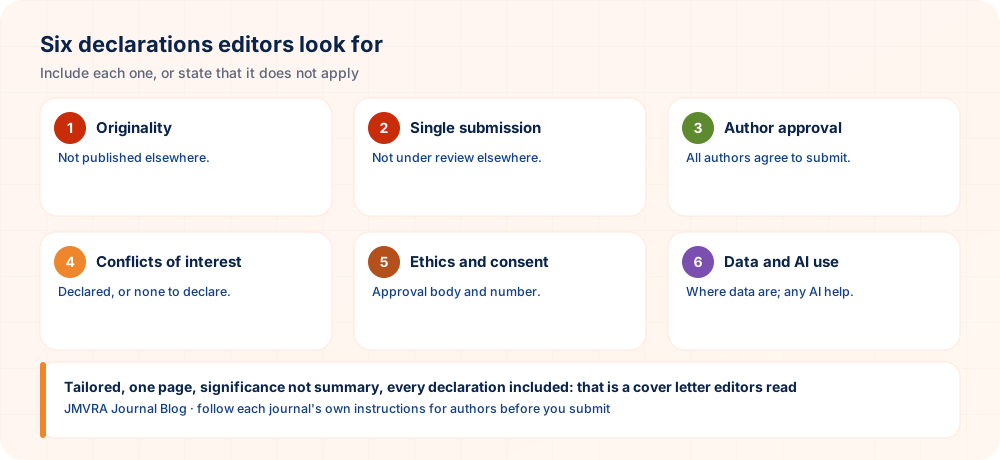
| Declaration | Example wording |
|---|---|
| Originality | “This manuscript is original and has not been published previously.” |
| Single submission | “It is not under consideration by any other journal.” |
| Author approval | “All authors have read and approved the manuscript and agree to its submission.” |
| Conflicts of interest | “The authors declare no conflicts of interest.” (or list them) |
| Ethics and consent | “Approved by [committee], [institution] (no. [number]); informed consent was obtained.” |
| Data availability | “Data are available at [repository, DOI]” or “on reasonable request” |
| Funding | “Funded by [funder] (grant [number])” or “no specific funding” |
Disclosing AI Use
A growing number of publishers expect authors to disclose any use of generative AI tools while preparing a manuscript, and the rules vary, so look up the policy of your chosen journal. AI tools cannot be credited as authors, and the authors stay accountable for every sentence, figure and citation. The JMVRA AI policy requests a brief statement before the reference list that names the tool, its version when known, and the purpose it served.
If you used an AI tool
“The authors used [tool name and version] to [improve the language and readability of the manuscript / another specific purpose]. The authors reviewed and edited all output and take full responsibility for the content.”
If you did not
“No generative AI tools were used in preparing this manuscript.”
Further guidance: how to use AI in research ethically.
Special Situations
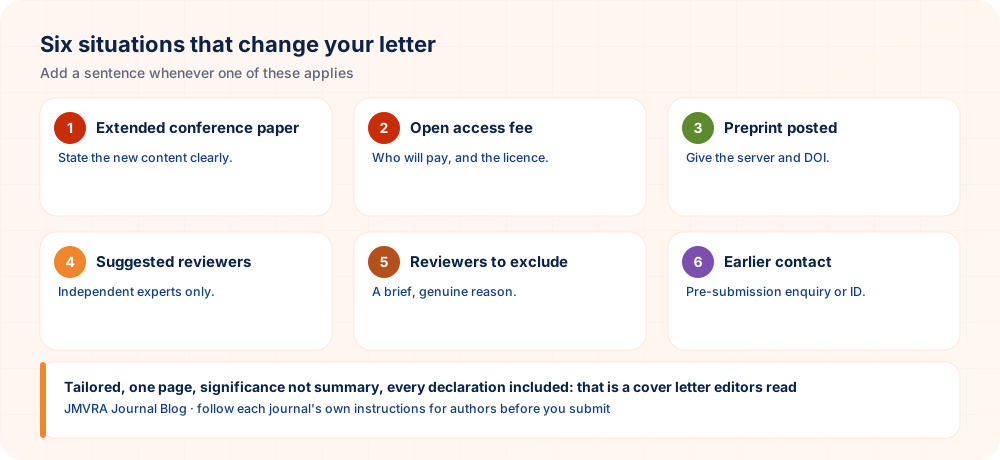
| Situation | What to write |
|---|---|
| Extended conference paper | Cite the conference paper and say plainly what is new in the journal version |
| Open access journal that charges a fee | Who will cover the article processing charge, and which licence you will choose if there is an option |
| Preprint already posted | The preprint server and DOI; first check the journal’s preprint policy |
| Other papers of your own that are related | Cite them and describe how this manuscript differs, so that no concern about overlap arises |
| Previous contact with the journal | When you made a pre-submission enquiry or earlier submission, give its date or reference number |
| Broad-readership journals | Show why the work matters beyond your own sub-field |
Suggesting Reviewers Ethically
Certain journals invite authors to propose reviewers. Put forward independent experts who have published recently on your subject, supply their institutional email addresses, and leave out collaborators, colleagues at your institution and anyone with a conflict of interest. Do not make up reviewers or give contact details that you control — fake peer review counts as misconduct and has led to retractions; see the guidance from COPE. If you have a genuine reason, you may ask that a particular reviewer be excluded, giving that reason briefly. Check the journal’s own rules before naming anyone.
10 Do’s and Don’ts
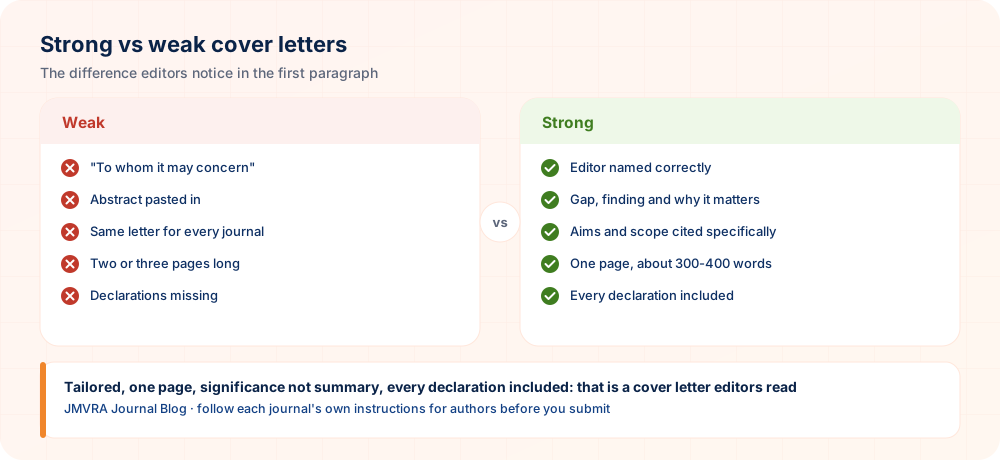
| Do | Don’t |
|---|---|
| Greet the editor by name | Open with “To whom it may concern” |
| Say why this particular journal suits the paper | Send an identical generic letter to every journal |
| Point out novelty and significance in brief | Paste your abstract |
| Keep to one page | Produce an essay of two or three pages |
| Refer specifically to the aims and scope | Use a vague “of interest to your readers” |
| Add every declaration the journal requires | Omit the originality or conflict statements |
| Refer to related papers from the same journal | Pack the letter with references to other journals |
| Proofread the names, titles and journal name | Leave typos or the name of the wrong journal |
| Abide by the journal’s own instructions | Disregard the author guidelines |
| Keep a formal and professional tone | Sound casual or boastful, or lean on jargon |
Write Your Cover Letter in 30 Minutes
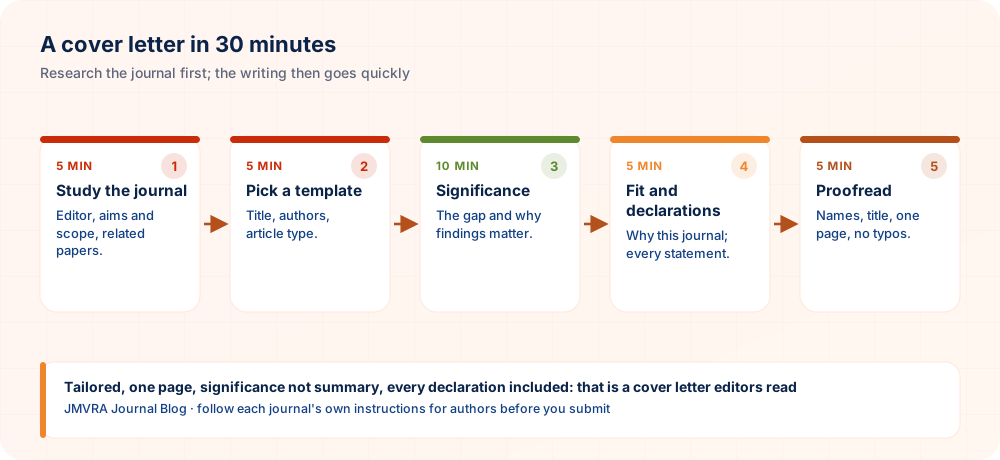
- Study the journal (5 minutes): identify the editor, go through the aims and scope, and pick out one or two relevant recent papers.
- Pick a template (5 minutes): enter the title, authors and article type.
- Write the significance (10 minutes): set out the gap and why your findings matter, using your own words.
- Add fit and declarations (5 minutes): explain why this journal, and include each statement it requires.
- Proofread (5 minutes): check the editor’s name, journal name and manuscript title, keep it to one page and remove errors.
Submitting to JMVRA: the Note for Editor
The online submission form at JMVRA has no slot for a separate cover-letter file. What it offers is an optional “Note for Editor” field in the final review step, which takes up to 500 characters. Put a condensed version of your letter there: the article type, the main finding and the key declarations.
Example “Note for Editor” (under 500 characters)
“This original research article reports [key finding] in [context], addressing [gap]. It is not under consideration elsewhere, all authors approve the submission, and there are no conflicts of interest. Ethics approval: [body, number]. AI use is declared before the reference list.”
- Format the manuscript according to the author guidelines, placing the AI statement (if there is one) before the reference list.
- Review is transparent and double-blind. Specialist reviewers assess your paper, and you receive the acceptance or rejection decision by email and WhatsApp.
- Nothing is charged when you submit; the fee of ₹971 INR (Indian authors) or $41 USD (foreign authors) falls due only after acceptance.
- JMVRA has a presence in Google Scholar and is registered at Crossref and the ISSN Portal / ROAD, though Scopus, Web of Science and DOAJ do not index it at the moment.
Share Your Research Through JMVRA
Have your work published in JMVRA
JMVRA (ISSN 2984-8911) is a peer-reviewed, open access journal spanning many disciplines. Submission is free. Specialist reviewers assess your paper, and you receive the acceptance or rejection decision by email and WhatsApp.
- 1. Match your manuscript to the guidelines
- 2. Submit online
- 3. Peer review
- 4. Decision by email & WhatsApp
- 5. Appear in open access
Your At-a-Glance Checklist
- NamedEditor and journal spelled correctly
- PitchedGap, finding and significance put in your own words
- FittedAims and scope referred to specifically
- DeclaredAll required statements added
- DisclosedAI use stated, or none
- ShortA single proofread page
Common Courtesies and Checks for a Journal Cover Letter
A cover letter is a brief professional introduction, and small details affect how editors perceive your care. Use these checks to keep it accurate, polite and appropriately modest.
- Address the editor properly. Find the current editor's name on the journal's website and use the right title. A generic greeting or a name from an older submission suggests you reused a template carelessly.
- Keep promises you can prove. State only what the manuscript demonstrates. Avoid sweeping words such as groundbreaking, and let a plain description of the contribution persuade the editor.
- Confirm the declarations are true. If you state that the work is original and not under consideration elsewhere, make certain every co-author agrees and that this is genuinely the case.
- Mention conflicts and funding openly. Disclose relevant relationships or support in the manner the journal requests. Early honesty prevents awkward questions later and shows respect for the editorial process.
- Proofread names and titles twice. Check that the manuscript title, author names and affiliations in the letter match the submission exactly. Mismatches look sloppy and can slow down administrative checks.
Keep the letter short, personal and truthful, and make sure every detail matches the manuscript you are submitting.
Questions Researchers Often Ask
In Summary
A carefully written cover letter links a finished manuscript to peer review. It needs only about 30 minutes, yet it can influence whether an editor goes on to read with interest. Apply the structure and templates in this guide, adapt each letter to its journal, explain significance instead of echoing the abstract, add every declaration and disclose AI use truthfully. Finally, read the letter aloud once to catch awkward phrasing before you send it.
Manuscript and letter ready? Submit your paper to JMVRA
JMVRA (ISSN 2984-8911) is a peer-reviewed, open access journal spanning many disciplines. Submission is free. Specialist reviewers assess your paper, and you receive the acceptance or rejection decision by email and WhatsApp.
- 1. Match your manuscript to the guidelines
- 2. Submit online
- 3. Peer review
- 4. Decision by email & WhatsApp
- 5. Appear in open access
References and Sources
Five Steps in Brief
- StudyEditor, scope and related papers
- PitchGap, finding and significance
- FitThe reason for this journal
- DeclareEthics, conflicts, data and AI
- CheckA single proofread page
Related: Writing for publication · Responding to reviewers · Submit Paper.
Ready to Publish? Submit to JMVRA
JMVRA is aligned with UGC's Suggested Parameters for Choosing Peer-Reviewed Journals.
JMVRA is a Transparent, Peer-Reviewed, Open Access Journal (Refereed Journal). Following the discontinuation of the UGC and UGC-CARE journal listing, and in alignment with the latest UGC-CARE recommendations and guidelines, JMVRA is aligned with UGC’s Suggested Parameters for Choosing Peer-Reviewed Journals.
Pages worth visiting on jmvra.org
Key Terms
Subjects and search phrases this article addresses.
Related Reading
Further guides on writing and submitting your paper.
Writing an IMRaD Paper Journals Accept (2026)
Read the guide RelatedResponding to Reviewer Comments: Letter Templates
Read the guide Related10 Steps to the Right Journal for Your Paper
Read the guide RelatedAbstract Writing Guide 2026: Structure & Samples
Read the guide RelatedUsing AI Ethically in Research Writing (2026)
Read the guide RelatedFormatting a Manuscript for Submission
Read the guideKeep Reading on the JMVRA Blog
As part of the JMVRA journal blog, this guide shares practical help on publishing, indexing, metrics and research integrity, and is written to be verifiable rather than promotional.