
Getting a research paper published is just half of the task. The remaining half — which most researchers never handle in a systematic way — is making certain that people working on the same questions find, read and cite it. Here you get 15 practical and ethical strategies, running from how you word the title to follow-up work months after publication.
Most of these strategies cost nothing and many need under an hour. None of them promises a particular number of citations — good research still has to be useful to others — yet taken together they clear away the obstacles that keep useful work from being found. Pick the ones that suit your field and revisit them with each new paper.
Why Citations Matter
Citations are the way research builds on earlier research. If other authors cite your paper, they are showing that your work shaped theirs. Citation counts also feed the indicators institutions and evaluators rely on — the h-index, citation-based ranking data and research profiles.
Bibliometric studies indicate that visibility counts: work of equal quality can attract very different numbers of citations depending on how easily it is found and read. That is encouraging, because you can improve visibility without altering any result.
Where Citations Matter in India
| Where | The way citations are used | What it means for you |
|---|---|---|
| Institutional appraisal and promotion | Certain institutions and committees look at citations and h-index next to the publication list | Maintain accurate profiles so your evidence can be checked easily |
| NAAC and NIRF data | Institutions report indicators of publications and citations drawn from bibliographic databases | Right affiliations improve your institution’s data |
| Research grants | Reviewers could consider how influential your earlier work has been | A clear record of cited work strengthens your proposal |
| International collaboration | Researchers whose work is cited are simpler to find and contact | Profiles and ORCID make you visible to potential collaborators |
| Your h-index | Grows as your papers collect citations | Our h-index guide explains how it is calculated |
Institutions apply different rules, so learn how the body that appraises or funds you treats citations. In our h-index guide you can read about the citation-based metric used most often.
Strategy 1: Give Your Paper a Findable Title
The title is the first — and frequently the only — thing a researcher sees when searching a database. Studies on title features have given mixed results across fields, though some patterns repeat: an analysis in 2015 covering about 140,000 papers found that shorter titles tended to attract more citations, while titles worded as questions have been associated with more downloads but not with more citations. Treat these as guidance rather than rules:
- Make titles short and specific — often below about 15 words.
- Place the key searchable term within the first few words.
- Think about a “Topic: Finding or Method” pattern where it makes things clearer.
- Choose a plain statement over a question, unless questions are the norm in your field.
- Mention the population, setting or method when people search by it.
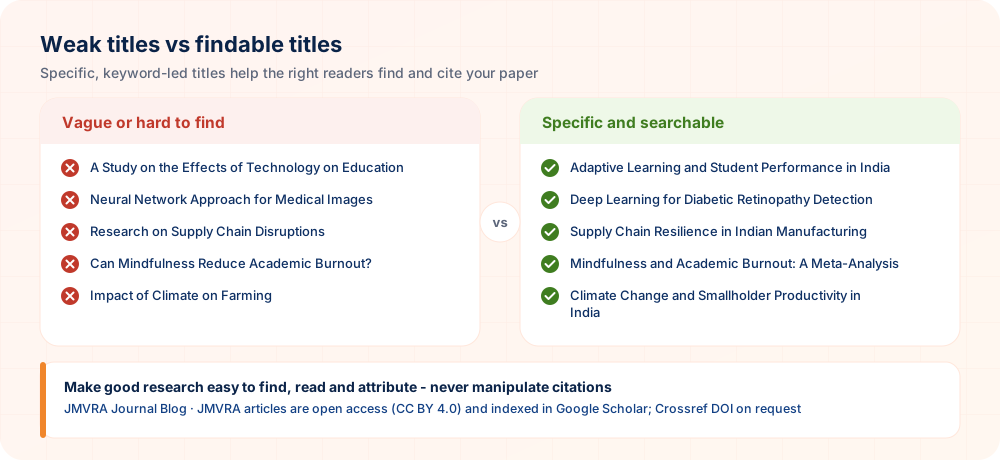
| Element | Weaker version | Stronger version |
|---|---|---|
| Length | A Study on the Effects of Climate Change on the Agricultural Productivity of Smallholder Farmers in the Semi-Arid Regions of India | Climate Change and Smallholder Farm Productivity in Semi-Arid India |
| Specificity | Impact of Technology on Education | AI-Powered Adaptive Learning and Student Performance: Evidence from Indian Secondary Schools |
| Statement vs question | Can Mindfulness Reduce Academic Burnout? | Mindfulness and Academic Burnout: A Meta-Analysis of Randomised Studies |
| Key Terms | Neural Network Approach for Medical Image Processing | Deep Learning for Diabetic Retinopathy Detection: A Systematic Review |
| Structure | Research on Supply Chain Disruptions During COVID-19 | COVID-19 and Supply Chain Resilience: Evidence from Indian Manufacturing Firms |
Strategy 2: Pick Keywords That Researchers Actually Search
Keywords let databases and search engines connect your paper with searches. Select the terms other researchers type when hunting for papers to cite, and not merely words that describe your own paper.
- Prefer the standard technical terms of your discipline over everyday phrasing.
- State the method you used whenever readers search by it (“systematic review”, “randomised controlled trial”, “machine learning”).
- Add the setting or population if it is relevant (“India”, “rural Bihar”, “secondary school students”).
- Study how the most-cited papers on your subject choose their keywords and adopt similar wording.
- Place your main keyword in the title and abstract as well, not only the keyword list.
- Skip words already in the title when the journal permits only a short keyword list, and never use the names of journals or authors as keywords.
In the journal SEO guide we explain how scholarly databases and search engines interpret a paper’s titles, abstracts and metadata.
Strategy 3: Write an Abstract That States Specific Findings
Far more people read your abstract than the full paper, and it is what they use to decide whether to read, download and cite. An abstract with concrete findings offers readers something to cite. Avoid vague closing lines, which add nothing a reader can use.
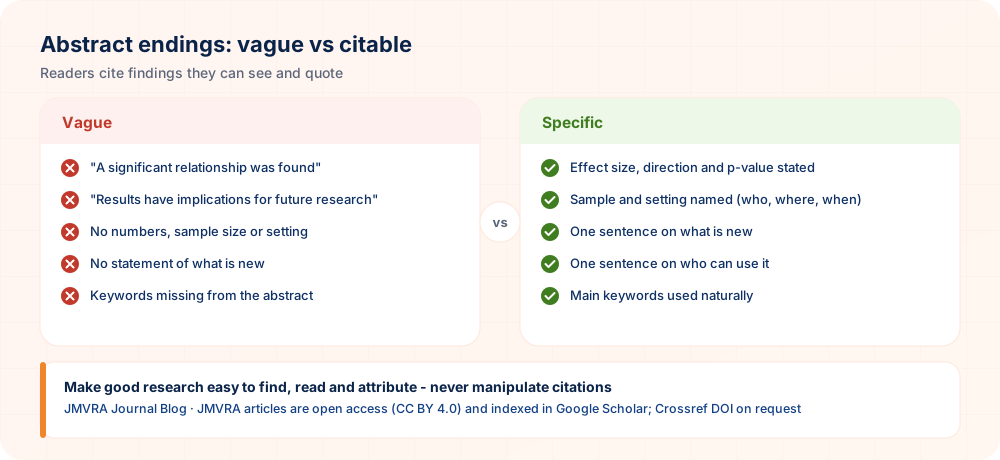
| Vague ending | Specific ending |
|---|---|
| “The results showed a significant relationship between the variables studied. These findings have implications for future research.” | “Anxiety scores were 34% lower among students sleeping seven or more hours (p < 0.001), suggesting that sleep-focused support could form part of student well-being programmes.” (illustrative) |
The second version gives the effect, its size, the group and the practical meaning, which makes it a sentence that another author can cite.
Strategy 4: Publish Where Your Readers Are
Your choice of journal determines who sees the paper. For citations, publishing where researchers on your topic really read counts for more than a marginally higher metric in a journal that your field ignores.
| Journal choice | Likely effect | What to do |
|---|---|---|
| Correct field, correct readership | The paper reaches those most likely to cite it | Browse recent issues; build a shortlist with a journal finder |
| Wrong field, higher metric | The readers are not people who would cite you | Do not leave your field simply for a number |
| Open access journal | Open to everyone, readers without subscriptions included | Choose open access, or share an accepted manuscript where this is permitted |
| Well-indexed journal | Simpler to find in the databases your readers use | Confirm indexing at the official source |
| A journal tier suited to the paper | Strong work gets a wide audience; solid work gets the appropriate one | Set your ambition to match what the paper contributes |
| Publication timeline | Publishing sooner starts the citation clock earlier | Check the timelines that the journal itself publishes |
The JMVRA Journal Finder and our journal selection guide can help you pair your paper with its audience.
Strategy 5: Make Your Paper Open to Read
Researchers can cite only what they are able to read. Numerous studies report that papers available openly receive more citations than similar papers behind paywalls; how large the advantage is differs by field and study and is still argued over, but the reasoning is straightforward — access takes away a barrier.
- Where your journal works on subscription, find out whether you may deposit your accepted manuscript in an institutional or subject repository, and at what point.
- Look up each publisher’s self-archiving policy at Sherpa Romeo; many permit sharing of the accepted manuscript, at times following an embargo.
- On academic networking sites, post a summary and a link, and upload the full text only if the publisher’s policy allows.
- For new papers, think about open access journals so that everyone can read the paper from its first day.
Further reading: Open Access in Practice: Routes and Licences.
Strategy 6: Use ORCID and Review Your Author Profiles
A citation that cannot be linked to you adds nothing to your record. Variations in names are common — notably where many researchers share a surname — and citations can end up divided between several profiles.
- Sign up for a free ORCID iD at orcid.org and put it on each submission, in your email signature and on your institutional page. Take a look at our ORCID guide.
- Review your Scopus author profile using the free Scopus Preview author lookup: ask for duplicate profiles to be merged and fix missing papers through Scopus’s author feedback process.
- Write your name in one consistent form and give the same affiliation on all papers.
Strategy 7: Establish a Presence on Academic Platforms
Researchers reach papers by several routes: scholarly search engines, databases, academic networks and professional social media. When you are present where your readers search, you raise the odds of being found.
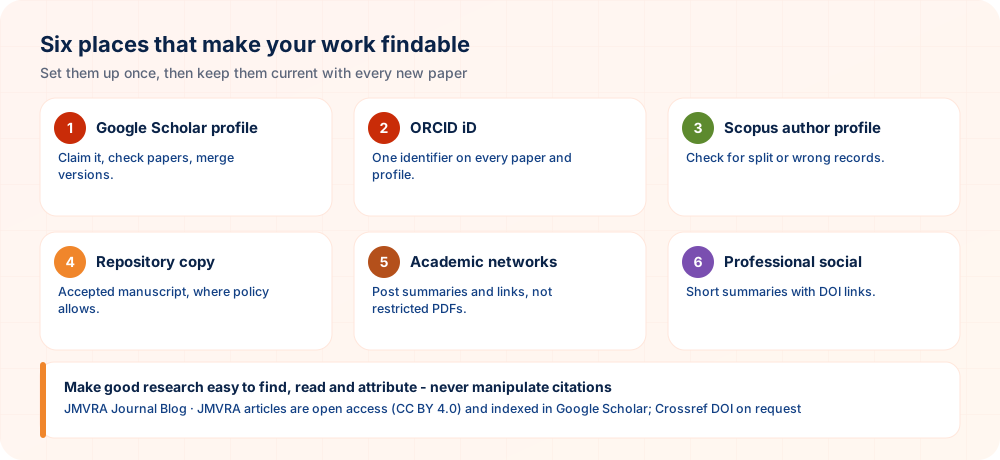
| Platform | What to do | Why it helps |
|---|---|---|
| Google Scholar profile | Set it up or claim it, review every paper, merge duplicate entries, add research keywords | Your papers are shown together, with “cited by” counts |
| ORCID | Link all publications; connect it with Scopus and your institution | Each paper correctly attributed |
| Scopus author profile | Review papers and affiliation; ask for corrections | An accurate record for formal evaluation |
| Institutional or subject repository | Deposit accepted manuscripts where the policy permits | A copy free to read for those without access |
| Academic networks (such as ResearchGate or Academia.edu) | Add summaries, links and permitted full texts; respond to questions | Another discovery route |
| Professional and social media | Share a brief summary with the DOI link when the paper is published | Reaches readers beyond your immediate field |
Which platform counts most differs between fields; a sensible start is your Google Scholar profile and ORCID. We compare Academia.edu, ResearchGate and Google Scholar side by side, and Google Scholar indexing shows how papers get into Scholar.
Strategy 8: Send the Paper by Email to Relevant Researchers
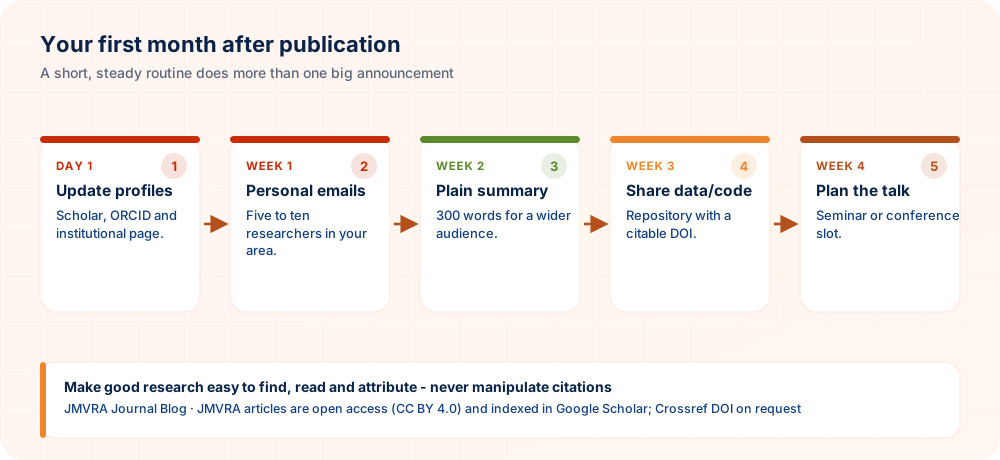
In the week or two after publication, pick five to ten researchers working on closely related questions — authors whose work you cited, for instance — and write each a brief, personal message:
This approach works because it is targeted rather than mass mailing, the recipients already work on the topic, and readers who engage with your paper are the likeliest to build on it. Keep the message personal, send it just once, and never ask anybody to cite you. A polite, specific note also tends to get a reply far more often than a generic one.
Strategy 9: Present Your Work
Seminars, workshops and conferences place your work before the researchers most likely to cite it. Show the DOI or a QR code for the paper on your last slide, and send the link to anyone who asks questions afterwards. Conference proceedings and special issues can also lead to publication; take a look at JMVRA’s conference publication and special issue pages.
Strategy 10: Produce a Plain-Language Summary
Many would-be readers will skip a full paper yet happily read a 300-word summary. Put on your institution’s website, a blog or a professional network, such a plain-language summary can reach scholars in nearby fields, practitioners and policymakers, and any of them may cite you in a review, report or new study.
- Begin with the finding, not the background.
- Say who can use the result and in what way.
- Link the paper using its DOI so that citations are credited to the right record.
Strategy 11: Cite Your Own Earlier Work Ethically
Self-citation is acceptable when it is relevant: if your new paper applies a method you published before, or develops your earlier findings, cite those works. Doing so ties your papers into a coherent body of work that readers can follow. Relevance is the limit — citing your earlier papers merely to boost your counts is manipulation, and unusually heavy self-citation can draw scrutiny to authors and journals alike.
Strategy 12: Work With Collaborators at Other Institutions
Papers with several authors often reach more readers, partly since each co-author brings a network and communities of their own. Working across institutions, disciplines and countries can broaden your audience — provided every author makes a real contribution and meets the criteria for authorship. Please read JMVRA’s authorship policy. Agreeing on author roles early avoids disputes later.
Strategy 13: Think About a Relevant Special Issue
A special issue brings together papers on a single theme, so readers who care about that theme find them side by side, and guest editors frequently publicise the issue through their own networks. Select special issues because they fit your work, not as a shortcut: they ought to meet the same peer review standards as regular issues. Examine the journal and guest editors as carefully as you would any journal — our journal hijacking guide lists the warning signs of fake calls for papers.
Strategy 14: Make Your Data and Code Available
Papers that offer reusable data or code give other researchers a reason to cite them, since anyone reusing your dataset or method cites your paper. Place data in a recognised repository that issues a DOI, mention it in the data availability statement of the paper, and share analysis code in a public code repository when suitable. Honour consent, privacy and any limits on use of your data.
Strategy 15: Follow Your Citations and Act on What You Learn
Keeping an eye on citations shows you where your research is having an effect and who your real academic community is.
- Google Scholar profile: “cited by” counts and a list of the papers citing you; you can switch on alerts for new citations.
- Scopus author profile (free through Scopus Preview): your documents and their citation counts in Scopus.
- Statistics from journals and repositories: views and downloads; for JMVRA, read how to check paper statistics.
After finding out who cites you, go through their papers and consider reaching out; such authors make natural collaborators and likely readers of your next paper. The free author lookup is covered in our Scopus search guide.
Citation Ethics: Practices to Avoid
Certain ways of “increasing citations” amount to misconduct, and journals, databases and institutions watch for them.
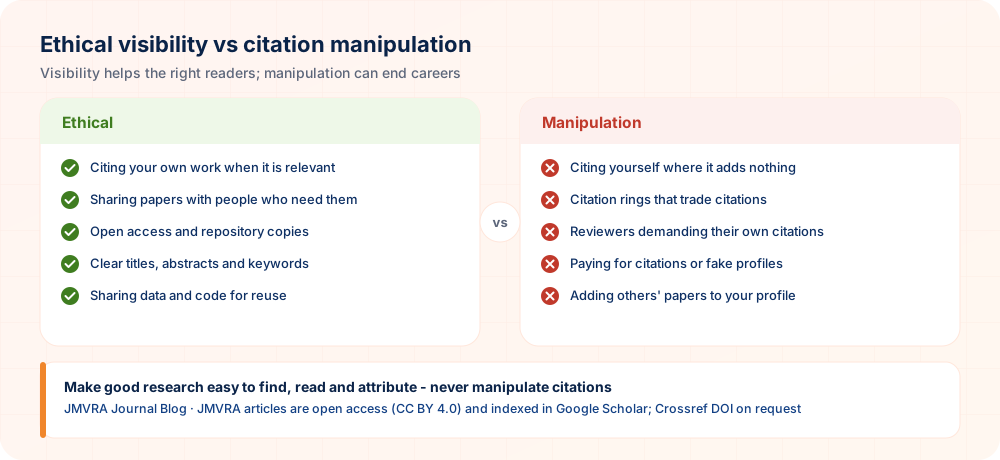
| Practice | Why it is a problem |
|---|---|
| Citation rings or exchanges | Groups that agree to cite one another distort the record and may face retractions |
| Coercive citation | Editors or reviewers who demand citations to their own work commit a recognised ethical breach |
| Irrelevant self-citation | Inflates metrics and may prompt investigations by databases or journals |
| Purchasing citations or using citation services | Fraud; it can end careers |
| Putting other people’s papers on your profile | Misstates your record and is easy to detect |
| Citing papers you have never read | Spreads mistakes and misrepresents sources |
When a reviewer asks you to cite papers that are not relevant, you may courteously decline and give your reasons, or take the matter to the editor. More on integrity is in getting your paper cited ethically.
Citations Do Not Equal Quality
Citation counts gauge attention within the research literature. They vary with the size of the field, the topic, the age of the paper and many other factors, and they can reward controversy as well as quality. Initiatives like the San Francisco Declaration on Research Assessment (DORA) urge institutions to evaluate research on its own merits and not on journal metrics alone. Treat citations as one sign of influence, together with the quality, rigour and usefulness of the work itself. A balanced reading of several indicators gives a fairer picture than any single number.
How JMVRA Helps With Discoverability
A number of the strategies above are part of the way JMVRA publishes:
Open access with a CC BY 4.0 licence
All articles can be read and shared freely, with no paywall for readers in any country.
Google Scholar indexed
JMVRA articles are discoverable through Google Scholar; look at your own profile after publication.
Crossref DOI available on request
A DOI provides your paper with a lasting, citable link that tracking services recognise.
Titles, abstracts and keywords
Your metadata is displayed on the article page for readers and for search engines.
Paper statistics
Counts of views and downloads show you where your work is being read.
Indexing stated openly
JMVRA is not indexed in Scopus, Web of Science or DOAJ.
Publishing with JMVRA
Search Google Scholar and you will find JMVRA; its registration is also held by Crossref and the ISSN Portal / ROAD. Scopus, Web of Science and DOAJ, however, do not index it at present.
- Review: transparent, double-blind peer review. Specialist reviewers assess your paper, and you receive the acceptance or rejection decision by email and WhatsApp.
- Fee: Indian authors pay ₹971 INR and foreign authors $41 USD, but only once the paper is accepted; submission is free of charge.
- Access: articles are open under CC BY 4.0 and carry ISSN 2984-8911; Crossref DOI can be requested.
- After it goes live: list the paper in your Google Scholar profile and ORCID, then pass the DOI link around.
Publish openly, then make the work findable
Submitting to JMVRA costs nothing. Subject specialists review your paper, and the accept or reject decision is sent to you by email and WhatsApp. The ₹971 INR (Indian) or $41 USD (foreign) fee is charged only after acceptance.
Full Citation Checklist: Before, During and After Publication
| Action | When |
|---|---|
| Select a journal that your future citers read | Before submission |
| Give the paper a specific title that leads with keywords | Before submission |
| Work four to six searchable keywords into the title, abstract and keyword list | Before submission |
| Compose an abstract that states specific findings | Before submission |
| Get an ORCID iD and put it on every paper | A single time, ahead of your first submission |
| Put the paper on your Google Scholar profile and ORCID | At publication |
| Deposit the accepted manuscript where the policy allows | At publication |
| Share a short summary together with the DOI link | At publication |
| Email the paper to five to ten relevant researchers | Within two weeks |
| Prepare a plain-language summary | Within a month |
| Share data and code under a DOI | At publication or shortly afterwards |
| Present the work at a seminar or conference | Within six months |
| Review citations and get in touch with citing authors | Every few months |
| Cite your relevant earlier work — only if it is relevant | In every new paper |
Quick Citation Checklist
- Findable titleShort, specific, keyword first
- Specific abstractEffect, group, setting and meaning
- Right audienceA journal read by your future citers
- Open copyOpen access or a permitted repository copy
- AttributionORCID and accurate author profiles
- OutreachPersonal emails, summary, talk; no manipulation
Habits That Help Your Published Paper Get Read
Citations follow readership, and readership follows visibility and clarity. These practical habits work after publication, when many authors assume the job is finished and simply wait.
- Write a findings-first first sentence. Open the abstract with what you discovered rather than background. Search results and alerts often show only a few lines, so make those lines carry your main contribution.
- Reuse consistent author names. Use one spelling of your name and one institutional affiliation across papers. Consistency lets indexing tools gather your work into a single profile instead of scattering it.
- Share data and code responsibly. When ethics and permissions allow, deposit datasets or analysis scripts in a trusted repository and cite them. Reusable material gives other researchers a concrete reason to cite you.
- Write to authors of related work. Send a brief, courteous note with the link to colleagues genuinely working on the same problem. Avoid mass mailing; a few well-chosen recipients are far more welcome.
- Update your profile after each paper. Add new work to your researcher profiles promptly and correct wrongly attributed items. Clean profiles help readers find, trust and cite everything you have written.
Earn citations by making your work easy to find, easy to understand and easy to reuse, never by artificial or reciprocal citation arrangements.
Questions Researchers Often Ask
In Summary
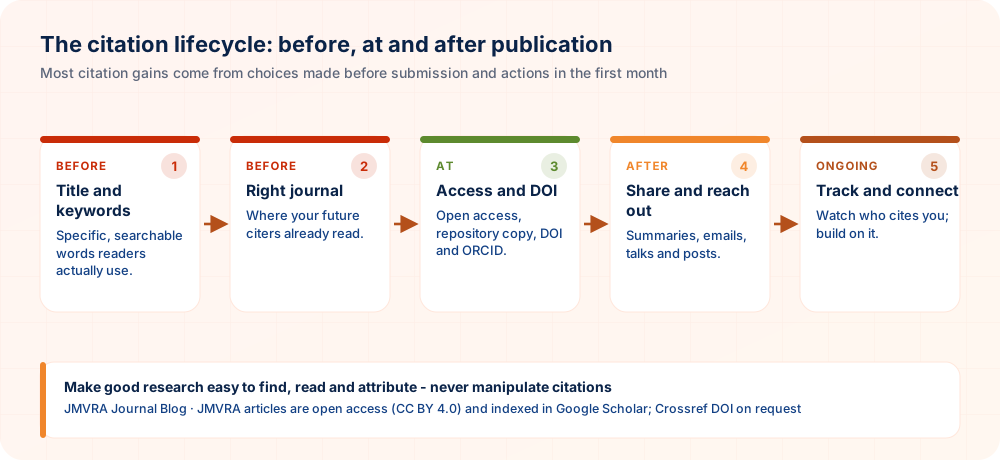
Earning more citations is not a matter of gaming the system; it means making sure that research deserving to be found is in fact found. The strategies in this guide apply at three stages: before submission (title, keywords, abstract, journal), at publication (open access, DOI, ORCID, profiles) and afterwards (outreach, talks, summaries, data sharing and tracking).
No one step changes a citation record overnight, but using five or six of them steadily — above all a findable title and abstract, the right journal, open access and personal outreach — builds up across a career. Stay ethical too: visibility helps the right readers find your work, whereas manipulation endangers it. Consistency matters more than any single burst of effort.
Ready to send in your paper?
JMVRA takes submissions online without any charge. Specialist reviewers evaluate the paper and tell you by email and WhatsApp whether it is accepted or rejected. A fee of ₹971 INR (Indian authors) or $41 USD (foreign authors) is required only upon acceptance.
References and Sources
Five Principles in Brief
- FindableTitle, abstract and keywords
- ReadableOpen access or a permitted copy
- AttributableDOI, ORCID and accurate profiles
- SharedEmails, summaries and talks
- EthicalNo rings, coercion or paid citations
Related: h-index explained · ORCID guide · Google Scholar indexing.
Ready to Publish? Submit to JMVRA
JMVRA is aligned with UGC's Suggested Parameters for Choosing Peer-Reviewed Journals.
JMVRA is a Transparent, Peer-Reviewed, Open Access Journal (Refereed Journal). Following the discontinuation of the UGC and UGC-CARE journal listing, and in alignment with the latest UGC-CARE recommendations and guidelines, JMVRA is aligned with UGC’s Suggested Parameters for Choosing Peer-Reviewed Journals.
Related pages on jmvra.org
Key Terms
Subjects and search phrases this article addresses.
Related Reading
Further reading on research visibility, metrics and author profiles.
Getting Your Research Cited the Ethical Way
Read the guide Relatedh-index Explained Simply, With Examples
Read the guide RelatedORCID iD: The Researcher ID Everyone Needs
Read the guide RelatedHow to Get Your Research Paper Indexed in Google Scholar: A Step-by-Step Guide
Read the guide RelatedSEO for Journals Without Tricks
Read the guide RelatedAcademia.edu, ResearchGate or Google Scholar: Which Is Right for You?
Read the guideKeep Reading on the JMVRA Blog
Published on the JMVRA journal blog, this guide gives practical direction on publishing, indexing, metrics and research integrity, with a focus on what can be verified instead of on promotion.