
No journal is the “best” one in general; there is only the journal that suits your paper and your circumstances. This guide explains how to choose a research journal by beginning with who you are: a student, a PhD scholar bound by a rule, a faculty member, a clinician, an interdisciplinary researcher or an author facing a deadline. It then presents five gates that every journal has to pass, together with a completed worksheet as an example.
Why Your Situation Determines the Journal
Most advice on how to choose a research journal opens with a list of titles. A stronger starting point is your own circumstances. A master’s student wrapping up a project, a PhD scholar who has to satisfy a university rule, a professor preparing for promotion and a clinician reporting patient data each need something different from a journal, even when the papers are of similar quality. Work out what you need first, and the shortlist shrinks on its own.
This guide complements the 10-step journal selection method by adding a decision guide organised by situation, five gates and a completed worksheet.
Applying Journal Selection Advice to Your Own Situation
General guidance works best when adapted. These suggestions help you translate the career-stage advice into concrete actions and keep your decision defensible months after you make it.
- Write your goal in a sentence. State plainly what you need from this publication, whether it is a degree requirement, a visible contribution or career progress. A written goal prevents drifting towards whichever journal replies fastest.
- Ask a co-author to challenge the choice. Invite a trusted collaborator to argue against your preferred journal. Weak points in your reasoning become obvious when someone else questions them.
- Keep a ranked backup list. Prepare a second and third choice before submitting to the first. If the paper is declined, you can redirect it quickly with only formatting changes.
- Tailor the paper, not just the format. After choosing, adjust emphasis and framing to the journal's readers. A paper that speaks to their questions is easier for editors to accept.
- Review the decision after publication. Once the paper appears, note what worked and what frustrated you. Those lessons make the next selection faster and more confident.
Define your goal in writing, test your reasoning with a collaborator and keep backups ready, so the decision remains clear and defensible.
Three Questions to Settle First
- Is there a rule I must meet? Your university, funder, employer or promotion scheme might specify certain indexes or lists. Ask for it in writing.
- Who should read this paper first? Is it for practitioners, for experts in a single field, or for a broad multidisciplinary readership?
- What are my practical limits? Budget, deadline, language requirements, and whether you need open access.
Choosing a Journal by Situation
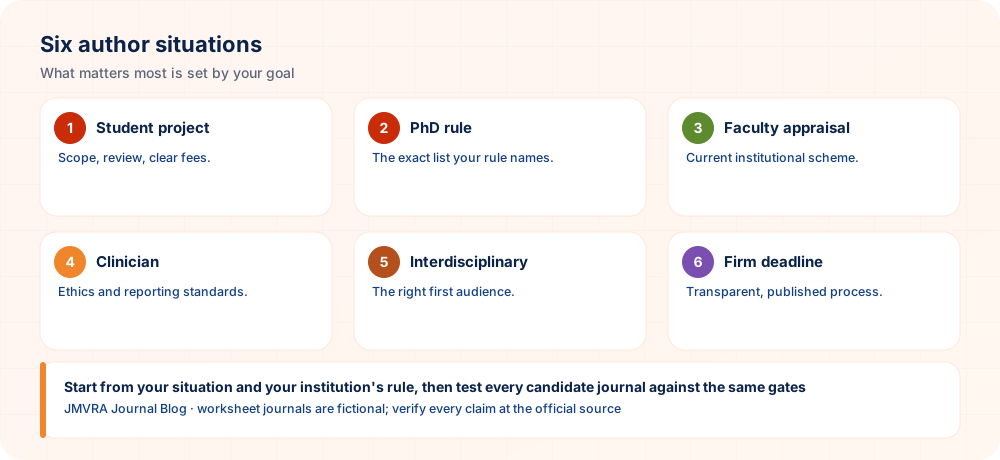
Pick the situation nearest to yours. Many authors belong to more than one — a PhD scholar facing a deadline, for instance — so feel free to combine rows.
Student project or course requirement
| Question | Answer |
|---|---|
| What matters most | Scope fit, a genuine peer-review process and clear, published fees; guidance in the author instructions. |
| What to verify | That the journal is peer reviewed, its fees are stated before submission and its archive is real and consistent. |
| Trap to avoid | Choosing a journal only because it is cheapest or promises speed, without reading its policies. |
PhD scholar with a university rule
| Question | Answer |
|---|---|
| What matters most | Your university’s written rule: which lists or indexes count, how many papers, and when they must be published. |
| What to verify | Each journal against the exact list named in the rule (for example Scopus or Web of Science), on the official database. |
| Trap to avoid | Relying on a journal’s own badge instead of the database, or on a friend’s idea of the rule. |
Faculty member for promotion or appraisal
| Question | Answer |
|---|---|
| What matters most | What your institution’s promotion or API scheme counts, and how it scores different journal types. |
| What to verify | The current institutional circular or IQAC guidance, and the journal’s status on any list it names. |
| Trap to avoid | Assuming an old list or another university’s practice applies to you. |
Clinician or health researcher
| Question | Answer |
|---|---|
| What matters most | Ethics approval, trial registration and reporting-guideline expectations; readers in clinical practice. |
| What to verify | That the journal asks for ethics and consent statements and follows recognised reporting guidelines. |
| Trap to avoid | Submitting clinical work to a journal with no ethics policy, which can harm credibility later. |
Interdisciplinary researcher
| Question | Answer |
|---|---|
| What matters most | Which community should read the paper first, and whether the journal’s scope genuinely welcomes mixed methods or fields. |
| What to verify | Recent articles in the journal that combine fields like yours, and the editorial board’s range. |
| Trap to avoid | Picking a narrow specialist journal whose reviewers may not value the other half of the work. |
Author with a firm deadline
| Question | Answer |
|---|---|
| What matters most | A journal whose process, issue frequency and fees are published and transparent, so you can plan. |
| What to verify | Published review policy, issue schedule and payment terms; never a promise of acceptance. |
| Trap to avoid | Paying anyone who guarantees acceptance or a publication date; no genuine journal can do that before review. |
Five Gates Every Journal Has to Pass
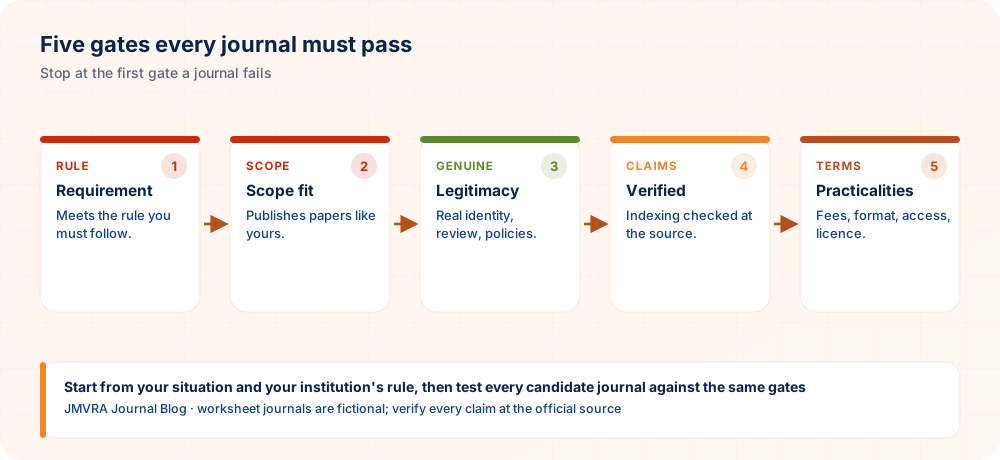
Whichever situation you are in, apply the same five gates to every candidate journal, in the given order. Stop at the first gate the journal fails, since comparing fees makes no sense for a journal that falls outside your rule.
| Gate | Question | Where to check |
|---|---|---|
| 1. Requirement | Does it meet the rule I must follow? | Your written rule; the official list it names |
| 2. Scope fit | Does it publish papers like mine? | Aims and scope; recent issues |
| 3. Legitimacy | Is the journal genuine and peer reviewed? | ISSN Portal; review and ethics policies; Think. Check. Submit. |
| 4. Verified claims | Are indexing and metric claims true? | Scopus Sources; Master Journal List; the metric’s named source |
| 5. Practicalities | Can I meet its fees, format, licence and process? | Author guidelines; fee page; template |
Choosing by Goal, Not by Hype
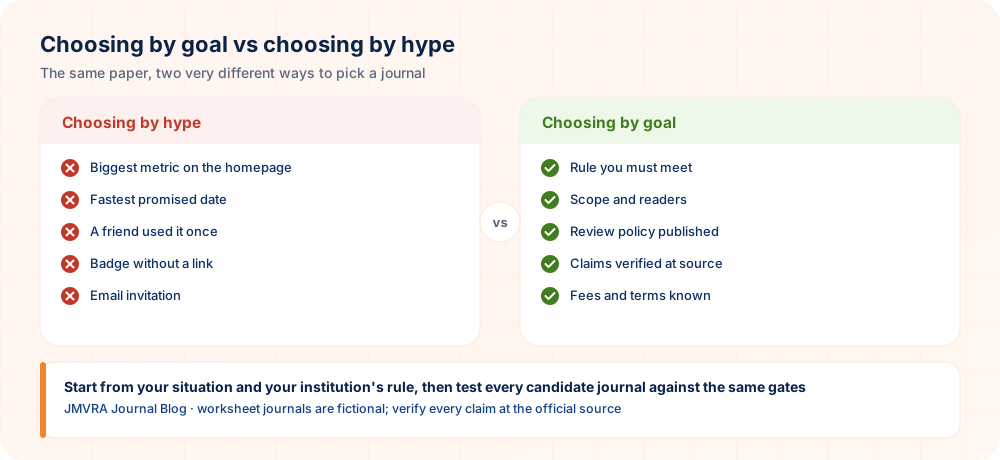
Big numbers on a homepage, promises of speed and invitations you never asked for are poor reasons to pick a journal. A journal selected for your goal, with verified claims and published terms, will serve you better than one selected for its marketing. Read about how to identify predatory journals and journal indexing explained.
A Completed Worksheet Example
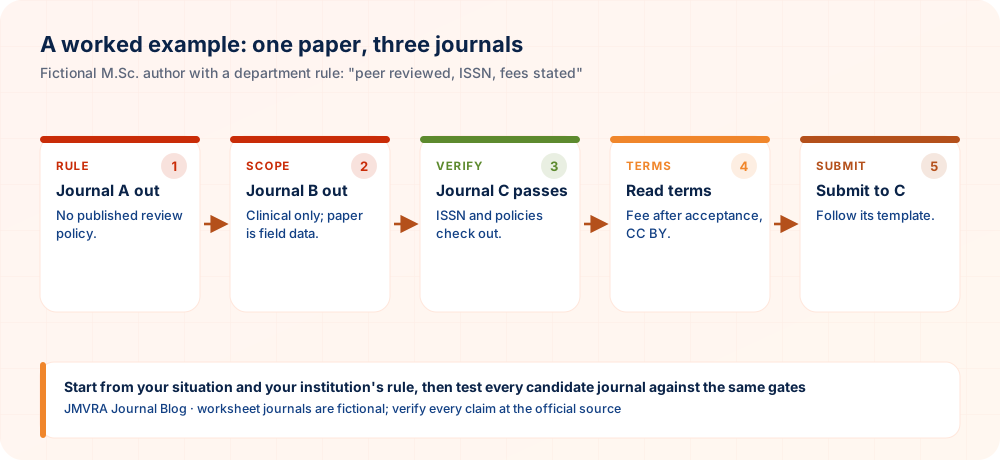
Imagine a fictional M.Sc. author who has completed a field study of groundwater quality. The department sets a simple requirement: “a peer-reviewed journal with an ISSN and stated fees”. Three fictional journals are put to the test.
| Gate | Journal A | Journal B | Journal C |
|---|---|---|---|
| 1. Requirement | ISSN yes; review policy missing | Yes | Yes |
| 2. Scope fit | — | No: clinical studies only | Yes: environmental science papers in recent issues |
| 3. Legitimacy | Stop: no review policy | — | ISSN Portal record matches website; policies published |
| 4. Verified claims | — | — | Claims modest and consistent with the database |
| 5. Practicalities | — | — | Fee after acceptance; CC BY licence; template available |
| Decision | Rejected at gate 3 | Rejected at gate 2 | Submit |
Note that the author never compared metrics at all: the gates decided the matter. Should two journals clear all five gates, go for the one whose readers you most want to reach.
Build Your Own Worksheet
Copy the gate table, place your three answers above it, and test three to five candidates. Save notes and links to your evidence (database pages, policy pages) so that you can show your supervisor or committee why you picked the journal. Tools like the JMVRA Journal Finder can help you assemble the candidate list. Dating your notes also helps if a journal’s status changes later.
Mistakes That Waste a Submission
- Starting from a journal’s advertising instead of your own requirement.
- Paying no attention to scope, which often leads to desk rejection; read about reasons for rejection.
- Submitting to two journals at once — never acceptable.
- Not reading the author guidelines and template before writing the final draft.
- Trusting an agent who chooses the journal and “guarantees” acceptance.
After You Choose
Lay out the paper as the journal’s guidelines require (research paper format explains how), draft a short cover letter or note to the editor (cover letter examples can help), and then work through the submission checklist.
How JMVRA Fits In
As a multidisciplinary, peer-reviewed, open access title, JMVRA suits authors who simply need a genuine refereed journal that has an ISSN, openly stated policies and modest, transparent fees — as many student and early-career authors do. You can find JMVRA in Google Scholar, and it is registered with Crossref and the ISSN Portal / ROAD, but Scopus, Web of Science and DOAJ do not currently index it. Where your rule names Scopus or Web of Science, select a journal that appears there instead; that is the honest advice.
JMVRA in brief
- Review: transparent, double-blind peer review, normally by at least two subject experts. Specialist reviewers assess your paper, and you receive the acceptance or rejection decision by email and WhatsApp.
- Fee: After acceptance only, ₹971 INR (Indian authors) or $41 USD (foreign authors) is payable; authors submit and go through review at no cost.
- Access: published openly under CC BY 4.0; ISSN 2984-8911; appears monthly; no submission deadline; a Crossref DOI if you ask.
- Indexing: JMVRA appears in Google Scholar and is registered with Crossref and the ISSN Portal / ROAD; it is not currently indexed in Scopus, Web of Science or DOAJ.
Share Your Research Through JMVRA
Submit your research to JMVRA for publication
JMVRA (ISSN 2984-8911) is a peer-reviewed, open access journal spanning many disciplines. Submission is free. Specialist reviewers assess your paper, and you receive the acceptance or rejection decision by email and WhatsApp.
- 1. Get ready by reading the guidelines
- 2. Submit online
- 3. Peer review
- 4. Decision by email & WhatsApp
- 5. Open-access publication
Your At-a-Glance Checklist
- RuleGet it in writing
- ReadersWho should read it first
- ScopeRecent issues match
- GenuinePolicies and identity
- VerifiedClaims checked at source
- TermsFees, format, licence
Questions Researchers Often Ask
In Summary
Selecting a research journal is simpler once you begin with your own circumstances. List your rule, readers and limits; run three to five journals through the five gates; retain the evidence; and settle on the one that passes every gate and reaches your target audience. Ignore hype, and never pay for guarantees.
Time to publish: submit your paper to JMVRA
JMVRA (ISSN 2984-8911) is a peer-reviewed, open access journal spanning many disciplines. Submission is free. Specialist reviewers assess your paper, and you receive the acceptance or rejection decision by email and WhatsApp.
- 1. Get ready by reading the guidelines
- 2. Submit online
- 3. Peer review
- 4. Decision by email & WhatsApp
- 5. Open-access publication
References and Further Resources
Choosing a Journal at a Glance
- SituationRule, readers, limits
- Gate 1Requirement
- Gates 2–3Scope and legitimacy
- Gate 4Verified claims
- Gate 5Practicalities
Related: 10-step method · Journal Finder · Submit Paper.
Ready to Publish? Submit to JMVRA
JMVRA is aligned with UGC's Suggested Parameters for Choosing Peer-Reviewed Journals.
JMVRA is a Transparent, Peer-Reviewed, Open Access Journal (Refereed Journal). Following the discontinuation of the UGC and UGC-CARE journal listing, and in alignment with the latest UGC-CARE recommendations and guidelines, JMVRA is aligned with UGC’s Suggested Parameters for Choosing Peer-Reviewed Journals.
Handy links within jmvra.org
Key Terms
Subjects and search phrases this article addresses.
Related Reading
Additional guides on selecting and verifying journals.
10 Steps to the Right Journal for Your Paper
Read the guide RelatedChoosing a Journal: A 7-Step Scoring Framework
Read the guide RelatedSpotting Predatory Journals: Signs & Scenarios
Read the guide RelatedJournal Indexing: Types, Benefits & Verification
Read the guide RelatedSubmitting a Research Paper: Checklist & Tips
Read the guide RelatedPeer-Reviewed Journals and How Review Works
Read the guideKeep Reading on the JMVRA Blog
The JMVRA journal blog includes this guide, one of many practical pieces on publishing, indexing, metrics and research integrity, prepared so readers can verify them without any sales pitch.