
“Indexed in…” is printed on nearly every journal website, yet the term carries quite different weight depending on the database. Here you will find out what journal indexing is, why it counts, the principal kinds of scholarly index, how Scopus, Web of Science and Google Scholar compare, how indexing is distinct from abstracting and evaluation, and precisely how to confirm a journal’s indexing status ahead of submission.
What Is Journal Indexing?
Journal indexing is when a database or directory keeps records of a journal’s articles — their titles, authors, abstracts, references and other metadata — so researchers are able to search for them. Certain indexes pick journals carefully using published criteria, while others take in nearly everything they come across. To say a journal is “indexed” without naming the index tells you very little. Always ask which index is meant.
Why Indexing Matters to Researchers
- Discoverability: articles that are indexed are simpler to locate and cite.
- Institutional rules: numerous universities, funders and selection panels specify particular databases.
- Metrics: curated databases supply citation metrics like CiteScore and the Journal Impact Factor.
- An early signal: being selected by a curated database hints at quality — yet it does not prove it alone.
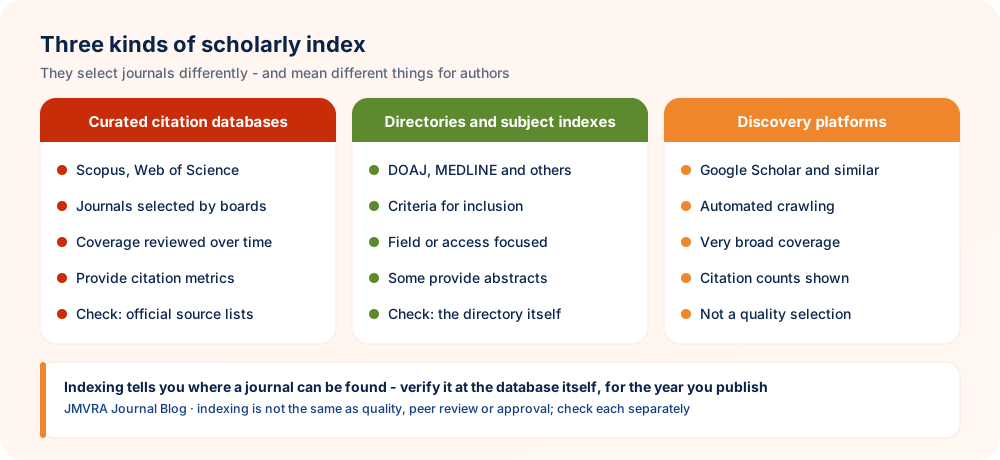
Types of Scholarly Indexes and Databases
| Type | Examples | How journals get in |
|---|---|---|
| Curated citation databases | Scopus, Web of Science Core Collection | Applications judged by a selection board, with continuing review |
| Open access directories | DOAJ | Open access journals apply against published criteria |
| Subject indexes | MEDLINE/PubMed and discipline databases | Chosen by subject committees or by set criteria |
| Discovery platforms | Google Scholar and similar | Scholarly content gathered by automatic crawling |
| Metadata and identifier services | Crossref | Publishers submit metadata when they register DOIs |
Scopus and Web of Science: Understanding Their Coverage
Elsevier’s Scopus and Clarivate’s Web of Science are both curated citation databases. A journal is assessed before either one starts covering it, and coverage can be withdrawn afterwards. The two partly overlap but differ. To check Scopus, go to Scopus Sources; for Web of Science, use the Master Journal List. More detailed guides: verify Scopus-indexed journals · Scopus vs Web of Science. Treat each database as a separate check rather than assuming one implies the other.
Google Scholar and Other Discovery Platforms
Google Scholar gathers scholarly material automatically — journals, repositories, theses and more — so its coverage is very wide and its citation counts tend to run higher than those of curated databases. Being findable there helps visibility, but it does not mean a board selected the journal, and it is not equivalent to Scopus or Web of Science indexing.
Indexing vs Abstracting vs Journal Evaluation
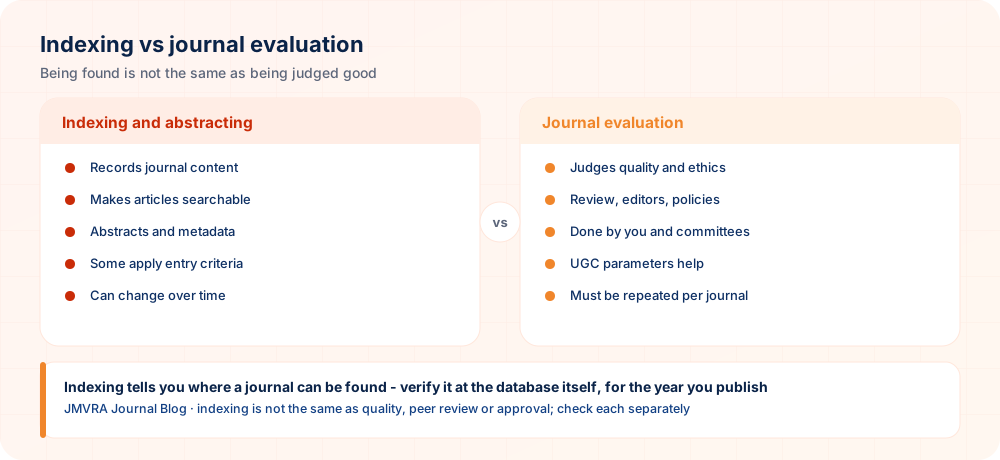
- Indexing stores bibliographic details so that content can be found.
- Abstracting attaches summaries (abstracts) to those records; many services provide both.
- Journal evaluation assesses quality, ethics and transparency — a job for you, your institution and frameworks like UGC’s suggestive parameters. Refer to the UGC-CARE list and current guidance.
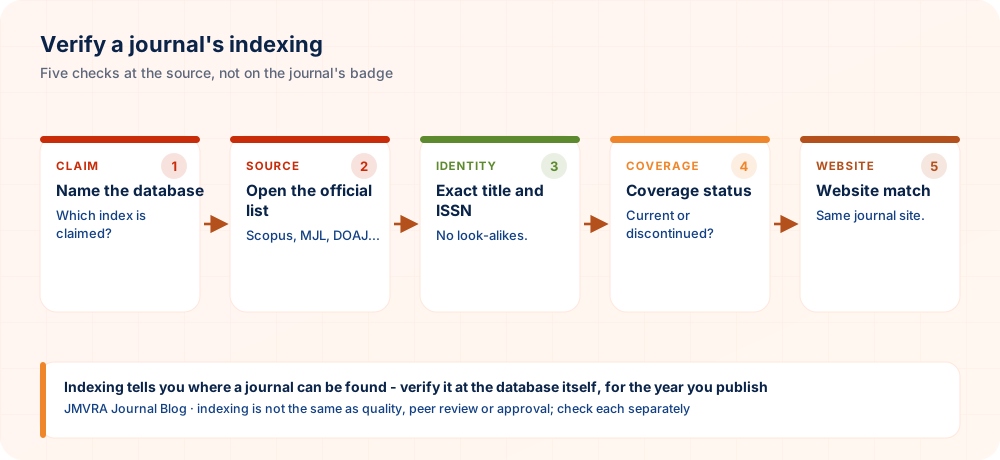
How to Verify a Journal’s Indexing Status
| Claim | Where to check officially |
|---|---|
| Scopus | Scopus Sources |
| Web of Science | Master Journal List |
| DOAJ | DOAJ |
| MEDLINE / NLM | NLM Catalog |
| Google Scholar | Look up an article title on Google Scholar |
| ISSN and identity | ISSN Portal |
Make sure the exact title and ISSN agree, and that the website the database lists is the one you are on.
Active, Historical and Discontinued Coverage
Coverage is tied to dates. A journal could be covered at present, could have been covered only during certain years, or could have been dropped. Articles from the covered years normally stay in the database, while new articles after a discontinuation are not indexed. Make a point of confirming that coverage includes the year in which you will publish.
Misleading Indexing Claims to Avoid
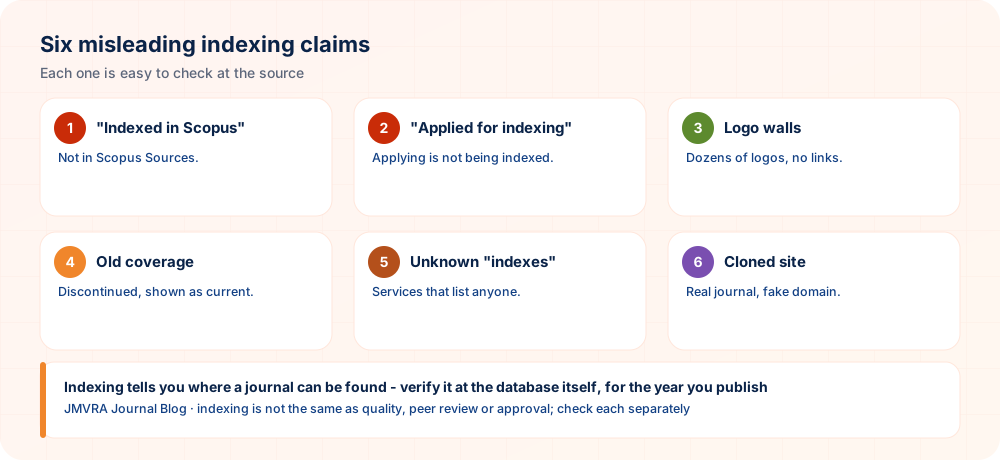
- “Indexed in Scopus” although the journal is missing from Scopus Sources.
- “Applied for indexing” shown as though it meant being indexed.
- Rows of database logos with no links, or naming unfamiliar services.
- Past or discontinued coverage passed off as current.
- A journal name and ISSN copied onto another website.
See the predatory journal checklist and the journal hijacking guide.
Indexed vs Peer-Reviewed Journals
Indexing and peer review are separate qualities. A peer-reviewed journal might not be in Scopus, and a database entry says nothing about how a journal reviews papers. Examine each on its own — see peer-reviewed journals explained. Doing so avoids confusing one signal for the other.
JMVRA’s Indexing, Stated Openly
Google Scholar shows JMVRA, which is registered with Crossref and the ISSN Portal / ROAD; Scopus, Web of Science and DOAJ do not currently index it. Complete, checkable information appears on JMVRA indexing and indexing and discovery details. The 11.25 figure for JMVRA is an impact factor based on Google Scholar — see how JMVRA calculates it.
JMVRA in brief
- Review: transparent, double-blind peer review, normally by at least two subject experts. Specialist reviewers assess your paper, and you receive the acceptance or rejection decision by email and WhatsApp.
- Fee: Authors pay ₹971 INR (Indian authors) or $41 USD (foreign authors) only once the paper is accepted; submission and review are free of charge.
- Access: open access, licensed CC BY 4.0; ISSN 2984-8911; monthly publication; submissions open year-round; Crossref DOI available on request.
- Indexing: JMVRA appears in Google Scholar and is registered with Crossref and the ISSN Portal / ROAD; it is not currently indexed in Scopus, Web of Science or DOAJ.
Share Your Research Through JMVRA
Submit your research to JMVRA for publication
JMVRA (ISSN 2984-8911) is a peer-reviewed, open access journal spanning many disciplines. Submission is free. Specialist reviewers assess your paper, and you receive the acceptance or rejection decision by email and WhatsApp.
- 1. Get ready by reading the guidelines
- 2. Submit online
- 3. Peer review
- 4. Decision by email & WhatsApp
- 5. Open-access publication
Your At-a-Glance Checklist
- NameWhich exact database?
- SourceConfirmed on the official list
- IdentityPrecise title and ISSN
- CoverageUp to date and covering your year
- WebsiteAgrees with the database record
- DistinctIndexing does not equal quality
Getting Real Value From Journal Indexing Information
Indexing helps people discover research, but the word is often used loosely. These practical points help you read indexing statements accurately and see what they do and do not tell you.
- Ask which database exactly. A vague phrase like indexed in many databases means little. Insist on named services and then confirm each one on that service's own website.
- Separate discovery from quality. Appearing in a search tool shows that records can be found, not that content has been judged excellent. Use indexing as one clue alongside review practice and ethics.
- Look for recent records. Open the database entry and see whether new issues are being added. Old coverage that has stopped should not be presented as current.
- Help your article be found. Use a clear title, relevant keywords and a complete abstract. Well-prepared metadata improves discovery whichever services a journal happens to appear in.
Treat indexing as a discovery aid, verify every named service directly and prepare your own article metadata carefully.
Questions Researchers Often Ask
In Summary
Journal indexing shows where a journal’s articles can be found and, in curated databases, that a selection board accepted the journal. Name the database, check the claim in its official list, match title and ISSN, confirm that coverage is current, and keep in mind that indexing is not the same as quality or peer review. Examine each one separately before you submit. A written note of what you checked gives you something to refer back to.
Time to publish: submit your paper to JMVRA
JMVRA (ISSN 2984-8911) is a peer-reviewed, open access journal spanning many disciplines. Submission is free. Specialist reviewers assess your paper, and you receive the acceptance or rejection decision by email and WhatsApp.
- 1. Get ready by reading the guidelines
- 2. Submit online
- 3. Peer review
- 4. Decision by email & WhatsApp
- 5. Open-access publication
References and Further Resources
Indexing at a Glance
- NameWhich database
- SourceOfficial list
- IdentityTitle plus ISSN
- CoverageCurrent year
- SeparateNot quality
Related: Verify Scopus journals · Impact factors · Submit Paper.
Ready to Publish? Submit to JMVRA
JMVRA is aligned with UGC's Suggested Parameters for Choosing Peer-Reviewed Journals.
JMVRA is a Transparent, Peer-Reviewed, Open Access Journal (Refereed Journal). Following the discontinuation of the UGC and UGC-CARE journal listing, and in alignment with the latest UGC-CARE recommendations and guidelines, JMVRA is aligned with UGC’s Suggested Parameters for Choosing Peer-Reviewed Journals.
Handy links within jmvra.org
Key Terms
Subjects and search phrases this article addresses.
Related Reading
Additional guides on indexing and checking journals.
Verify a Scopus-Indexed Journal Before Submitting
Read the guide RelatedHigh Impact Factor Journals: Verify Metrics First
Read the guide RelatedUGC-CARE List 2026: Old Lists, Notices & New Rules
Read the guide RelatedChecking Scopus, WoS, DOAJ & PubMed for Free
Read the guide RelatedHow a Research Journal Reviews Papers: Peer Review Explained
Read the guide RelatedPredatory Journal Checklist for 2026
Read the guideKeep Reading on the JMVRA Blog
The JMVRA journal blog includes this guide, one of many practical pieces on publishing, indexing, metrics and research integrity, prepared so readers can verify them without any sales pitch.