
Should you use Scopus or Web of Science? Every researcher, PhD scholar and librarian faces this choice when reviewing literature, picking a journal, checking an h-index or following an institutional rule. These two databases lead the field in academic citation data, yet they differ in coverage, metrics, history and access. This guide sets them side by side on the points that matter and shows which suits each task.
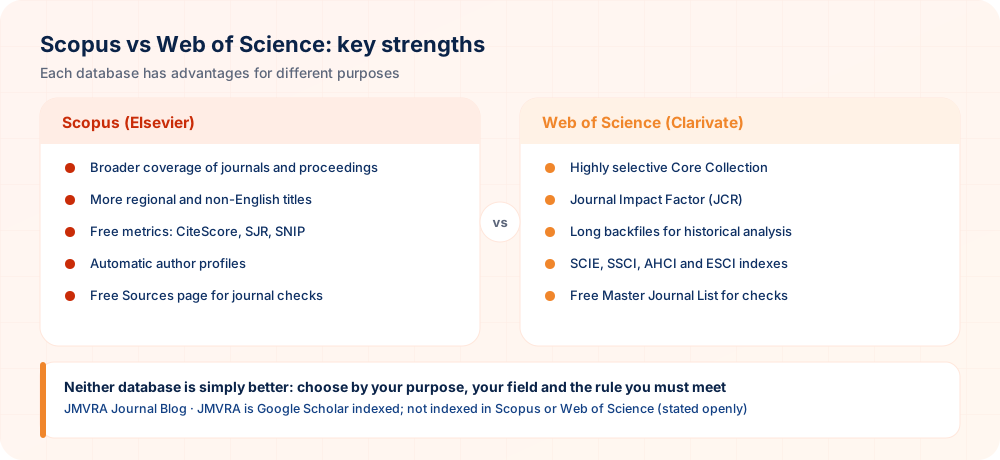
Short Answer: Which One Is Better?
Choose Scopus when
What you need is broad coverage, regional or applied research, conference proceedings or journal metrics at no cost, or else your rule specifies Scopus.
Pick Web of Science when
Your field or rule prizes the Journal Impact Factor or “SCI/SCIE”, or you require long-running historical citation data.
Use both when
You are conducting a systematic review or a bibliometric study, or you want the fullest possible picture of how much your work is cited.
Head-to-Head Comparison
| Dimension | Scopus | Web of Science |
|---|---|---|
| Provider | Elsevier | Clarivate |
| Origins | Launched in 2004 | Grew out of the Science Citation Index of the 1960s |
| Coverage | Wider: journals, book series, many conference proceedings | A more selective Core Collection, with separate indexes |
| Regional and non-English titles | Broader | More limited |
| Historical depth | Citation data generally from 1970 | Backfiles reaching back to 1900, depending on subscription |
| Main journal metric | CiteScore (free) | Journal Impact Factor (JCR, subscription) |
| Other metrics | SJR and SNIP; SCImago quartiles | Five-year JIF, Journal Citation Indicator, JIF quartiles |
| Author profiles | Scopus Author ID, created automatically | Web of Science researcher profiles |
| Free journal check | Scopus Sources page | Master Journal List |
| Full access | Institutional subscription | Institutional subscription |
Counts of covered titles shift all the time, so we do not quote them; each provider posts its current figures on its own website.
Coverage: What Does Each One Index?
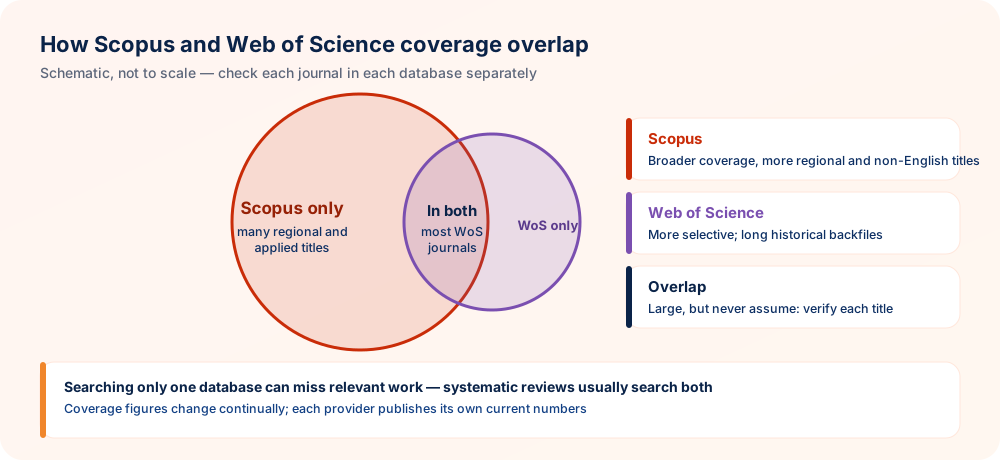
Nearly all journals in the Web of Science Core Collection are in Scopus too, and Scopus adds many more titles, particularly regional, applied, non-English and conference sources. A smaller group is in Web of Science but absent from Scopus. The practical lesson is never to assume a journal is in one database because it is in the other, so check each one separately. Record the result of each check as you go.
Within Web of Science: SCIE, SSCI, AHCI and ESCI
| Index | Covers | Note |
|---|---|---|
| Science Citation Index Expanded (SCIE) | Sciences | What most “SCI” requirements actually mean |
| Social Sciences Citation Index (SSCI) | Social sciences | Selective |
| Arts & Humanities Citation Index (AHCI) | Arts and humanities | Selective |
| Emerging Sources Citation Index (ESCI) | All disciplines | Belongs to the Core Collection but is neither SCIE nor SSCI |
From the 2023 release onward, Journal Citation Reports assigns a Journal Impact Factor to every Core Collection journal, ESCI and AHCI titles included. Where a rule requires “SCI” or “SCIE”, an ESCI journal might not be accepted, so ask when you are unsure.
Journal Metrics in Each Database
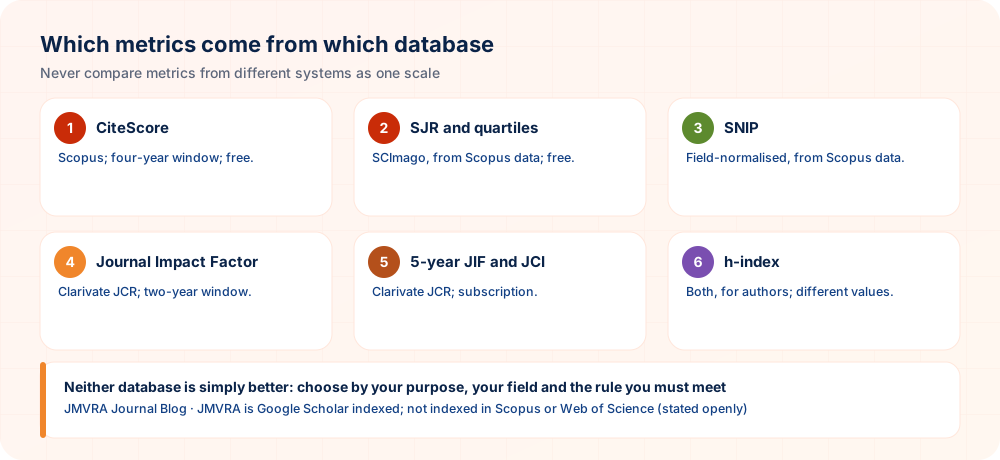
| Metric | Database | Window | Free to view? |
|---|---|---|---|
| CiteScore | Scopus | 4 years | Yes |
| SJR and quartiles | SCImago, from Scopus data | 3 years | Yes |
| SNIP | From Scopus data (CWTS) | 3 years | Yes |
| Journal Impact Factor | Web of Science (JCR) | 2 years | No |
| Five-year Impact Factor | Web of Science (JCR) | 5 years | No |
| Journal Citation Indicator | Web of Science (JCR) | 3 years, field-normalised | No |
| Author h-index | Both | Career | Scopus Preview free; WoS by subscription |
CiteScore compared with Impact Factor
- Time window: CiteScore looks at four years, whereas the Impact Factor looks at two.
- Document types: CiteScore counts identical peer-reviewed document types in both its numerator and denominator; the Impact Factor includes citations to every item but divides only by citable items.
- Availability: you can view CiteScore free on the Sources page, but the Impact Factor requires a JCR subscription.
- Standing: the Impact Factor has a long history and is frequently cited in rules; CiteScore is open about its method and easy to obtain.
Neither is “better”, since each measures something different on its own scale. Take a look at our metrics comparison guide.
Author Profiles and the h-index
Scopus builds author profiles on its own, and the documents, citations and h-index can be seen free through the Scopus Preview author lookup. Web of Science has researcher profiles, which took in the earlier Publons reviewer records. Because the two cover different sources, your h-index normally differs between them, so quote each figure with its source and date. See how to increase your h-index. Never combine the two numbers into a single value.
Verifying a Journal in Both Databases
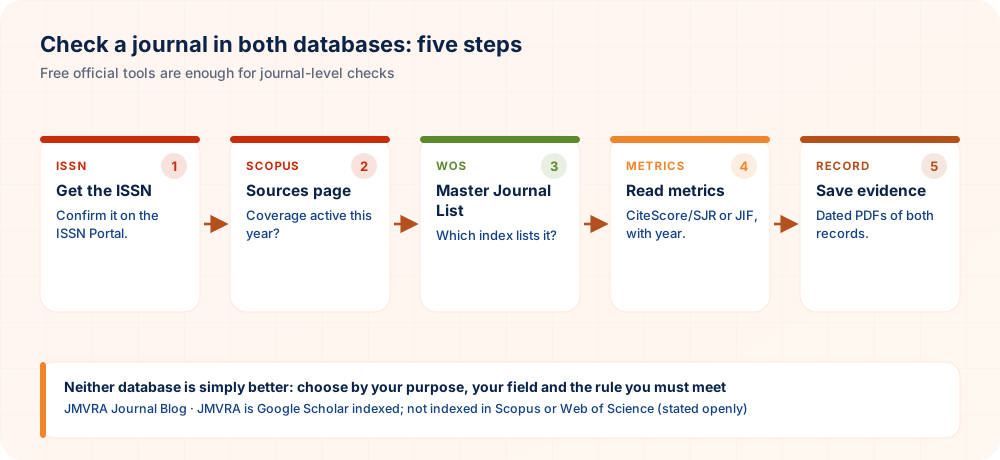
- Verify the ISSN on the ISSN Portal.
- Enter the ISSN on the Scopus Sources page and see whether coverage is active this year.
- Look it up in the Master Journal List to learn which Web of Science index includes it.
- Quote each metric with its year and category: CiteScore and SJR quartile through SCImago, and the JIF in JCR via your library.
- Keep dated proof of both records.
Our four-database checking guide also deals with DOAJ and PubMed.
Searching Each Database
If your institution gives you access, both databases allow exact searching, though the syntax differs:
| Search for | Scopus field code | Web of Science field tag |
|---|---|---|
| Topic (title, abstract, keywords) | TITLE-ABS-KEY() | TS= |
| Title only | TITLE() | TI= |
| Author | AUTH() or AU-ID() | AU= |
| Journal or source | SRCTITLE() | SO= |
| DOI | DOI() | DO= |
| Publication year | PUBYEAR | PY= |
Store every search string along with its date and the count of results, because systematic reviews have to report these. The Scopus search guide we wrote includes ready-to-use Scopus queries.
One Researcher, Two Profiles (Illustrative)
| Measure | Scopus | Web of Science |
|---|---|---|
| Indexed documents | 24 | 17 |
| Citations | 410 | 290 |
| h-index | 11 | 9 |
The gap arises from coverage and not from mistakes: Scopus may include conference papers and regional journals that Web of Science does not. State every figure with its source and date, for instance “h-index 11 (Scopus, October 2026); 9 (Web of Science, October 2026)”.
Reaching the Databases Through Your Institution
Institutions license both databases, frequently via libraries or consortia. When yours subscribes, log in from the campus network or through the library’s remote access. When it does not, the free tools (the Scopus Sources page, the Scopus Preview author look-up, the Master Journal List and SCImago) still settle most questions about a journal.
Choosing Between Scopus and Web of Science
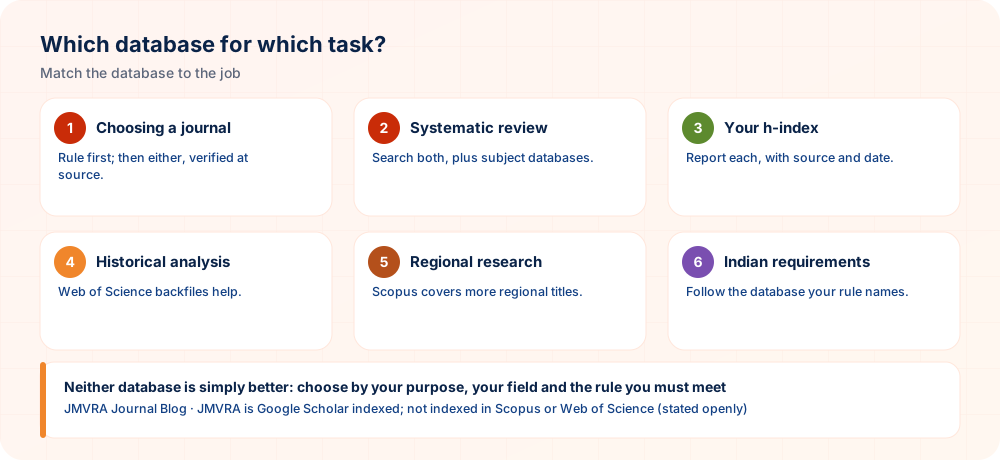
| Scenario | What to do |
|---|---|
| Picking a journal to publish in | Follow your rule; browse using SCImago or the Sources page; check in the database your rule specifies |
| Systematic review | Search both, along with subject databases like PubMed for medicine; keep a record of each search |
| Looking up your h-index | Look in both and report each with its source and date |
| Historical citation analysis | Web of Science backfiles often prove valuable |
| Regional or applied research | Scopus normally covers more of it |
| Bibliometric study | Decide by scope, or use both and cross-check |
Points for Researchers in India
- Go by your institution’s rule. PhD ordinances, appraisal criteria and funding bodies may specify Scopus, Web of Science, “SCI” or particular metrics.
- UGC-CARE is now archived. The former CARE Group II included Scopus and Web of Science journals, but the list is kept for reference only and does not imply present-day validation. Read our UGC CARE 2026 guide.
- NET and JRF are earned by passing an examination; publications do not count toward eligibility.
- NIRF and NAAC reports often use data taken from these databases, so accurate affiliations on your papers are important.
Strengths and Weaknesses
| Strengths | Weaknesses | |
|---|---|---|
| Scopus | Broader coverage; regional and non-English titles; free metrics; strong proceedings coverage; automatic author profiles | Shorter citation history; CiteScore less often named in rules than the JIF |
| Web of Science | Highly selective; Journal Impact Factor; long backfiles; established analytics | Narrower coverage; JIF behind a subscription; fewer regional and non-English titles |
Sources Beyond the Two Databases
Scopus and Web of Science are not the only places to look. Google Scholar gives very wide free coverage and author profiles; PubMed is vital for biomedicine; DOAJ lists open access journals; and numerous fields maintain their own specialist indexes. A well-rounded search strategy, and a well-rounded opinion of a journal, usually draws on more than one. Compare what each source says before deciding.
How JMVRA Fits In
Neither Scopus nor Web of Science indexes JMVRA. The journal is a low-cost, open access, peer-reviewed title found in Google Scholar, a workable option whenever your rule asks for a genuine peer-reviewed venue instead of membership of either database.
JMVRA, stated openly
Registered with Crossref and the ISSN Portal / ROAD and visible in Google Scholar, JMVRA is for now outside the indexes of Scopus, Web of Science and DOAJ.
- Review: transparent, double-blind peer review. Specialist reviewers assess your paper, and you receive the acceptance or rejection decision by email and WhatsApp.
- Fee: Indian authors pay ₹971 INR and foreign authors $41 USD, in each case only after acceptance.
- Access: CC BY 4.0 licensing keeps articles open, ISSN 2984-8911 identifies the journal, and Crossref DOI can be requested.
- Metric: an impact factor of 11.25 based on Google Scholar, which is not a JCR or Scopus metric.
Should you want a fuller picture, our comparison of Scopus, Web of Science and open access weighs all three routes against each other.
Share Your Research Through JMVRA
Submit your research to JMVRA for publication
JMVRA (ISSN 2984-8911) is a peer-reviewed, open access journal spanning many disciplines. Submission is free. Specialist reviewers assess your paper, and you receive the acceptance or rejection decision by email and WhatsApp.
- 1. Get ready by reading the guidelines
- 2. Submit online
- 3. Peer review
- 4. Decision by email & WhatsApp
- 5. Open-access publication
Your Comparison Checklist
- RuleThe database your institution or funder specifies
- IndexSCIE or ESCI, if Web of Science is required
- CoverageThe journal checked in each database on its own
- MetricsEach quoted with source, year and category
- h-indexGiven per database, with the date
- SearchUse both databases for systematic reviews
Practical Tips for Choosing Between Citation Databases
Different databases cover different material, so the right choice depends on the task in front of you. Use these ideas to decide calmly instead of defending one tool against another.
- Begin with your actual requirement. Ask whether your institution, funder or supervisor names a particular database, and read the exact wording. The requirement, not general reputation, should decide where you verify a journal.
- Search the same topic in both. Run an identical query in each database you can access and compare what appears. The differences quickly show which resource better represents your own field.
- Expect profiles to look different. Citation counts and author metrics vary because each database counts different sources. Never combine numbers from separate databases as if they came from a single system.
- Use your library's access wisely. Find out which resources your institution subscribes to, and ask the librarian for short training. Librarians often know features and shortcuts that save hours.
- Check journals directly at the source. To confirm that a journal is listed, use the database's own official lookup instead of a third-party summary. Direct checks are quicker and avoid outdated or manipulated claims.
Let your actual requirement decide, compare results yourself, and verify journal status only through each database's official pages.
Questions Researchers Often Ask
In Summary
The real question is not which database is better overall but which one is better for your task. Scopus brings broader coverage and free metrics; Web of Science brings selectivity, the Impact Factor and historical depth. Go with the database your rule names, use both for thorough searches, give metrics with their source and year, and check each journal at the official source.
Looking for a genuine, low-cost peer-reviewed route? Submit to JMVRA
JMVRA (ISSN 2984-8911) is a peer-reviewed, open access journal spanning many disciplines. Submission is free. Specialist reviewers assess your paper, and you receive the acceptance or rejection decision by email and WhatsApp.
- 1. Get ready by reading the guidelines
- 2. Submit online
- 3. Peer review
- 4. Decision by email & WhatsApp
- 5. Open-access publication
References and Sources
Five Checks in Brief
- RuleThe database that is required
- CoverageVerify each one separately
- IndexSCIE vs ESCI
- MetricsCiteScore/SJR or JIF
- EvidenceDated records
Related: Find Scopus journals · WoS quartiles · Scopus vs WoS vs DOAJ vs Google Scholar.
Ready to Publish? Submit to JMVRA
JMVRA is aligned with UGC's Suggested Parameters for Choosing Peer-Reviewed Journals.
JMVRA is a Transparent, Peer-Reviewed, Open Access Journal (Refereed Journal). Following the discontinuation of the UGC and UGC-CARE journal listing, and in alignment with the latest UGC-CARE recommendations and guidelines, JMVRA is aligned with UGC’s Suggested Parameters for Choosing Peer-Reviewed Journals.
Handy links within jmvra.org
Key Terms
Subjects and search phrases this article addresses.
Related Reading
Additional guides on Scopus, Web of Science and journal metrics.
Scopus, Web of Science, DOAJ & Google Scholar Compared
Read the guide RelatedChecking Scopus, WoS, DOAJ & PubMed for Free
Read the guide Related7 Ways to Find Scopus-Indexed Journals in 2026
Read the guide RelatedWeb of Science Quartiles Q1 to Q4 Explained
Read the guide RelatedScopus, Web of Science or Open Access: Which Fits?
Read the guide RelatedCiteScore vs Impact Factor vs SJR vs SNIP vs Google Scholar h-index
Read the guideKeep Reading on the JMVRA Blog
The JMVRA journal blog includes this guide, one of many practical pieces on publishing, indexing, metrics and research integrity, prepared so readers can verify them without any sales pitch.