
The h-index is among the figures most commonly used to sum up a research career. Hiring committees, grant panels and promotion boards consult it, and researchers measure themselves against their peers. Fortunately, you can raise it ethically by making genuine research easier to discover, read and cite. This guide covers what the h-index is, how to calculate and look it up — particularly in Google Scholar — and offers ten proven strategies, along with the way JMVRA uses Google Scholar metrics. Treat it as one signal among several, not a verdict on a researcher’s worth.
Understanding the h-index
The physicist Jorge E. Hirsch introduced the h-index in 2005, in the Proceedings of the National Academy of Sciences. A single figure captures both productivity (how many papers) and citation impact (how often those papers are cited).
- It needs both papers and citations: a pile of uncited papers, or a single famous one, will not lift it much.
- It can never be higher than your paper count.
- It generally goes up as time passes, although a platform can lower it when records are deleted or corrected.
If you want an easy primer, read what is the h-index.
Working Out Your h-index
- Sort your papers by number of citations, starting with the most cited.
- Give them ranks 1, 2, 3, 4…
- Locate the final rank at which a paper’s citation count still reaches or exceeds that rank. This rank equals your h-index.
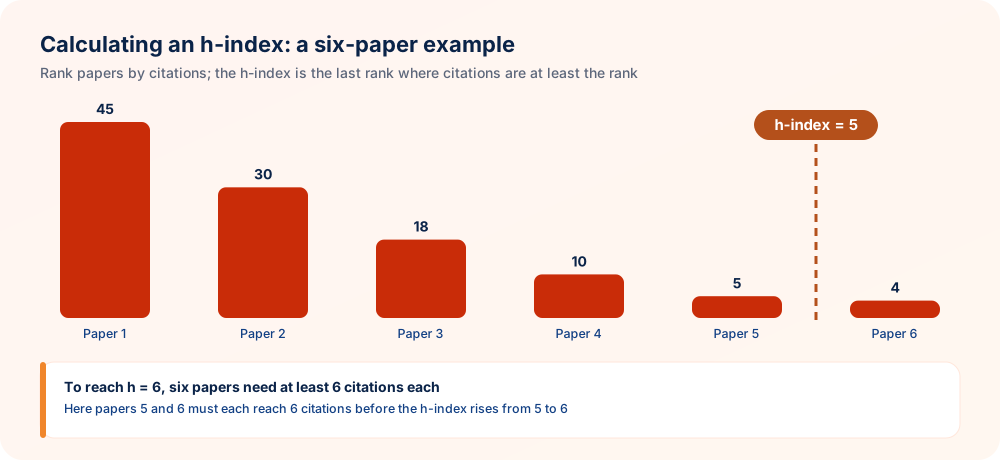
| Rank | Citations | Citations ≥ rank? |
|---|---|---|
| 1 | 45 | Yes |
| 2 | 30 | Yes |
| 3 | 18 | Yes |
| 4 | 10 | Yes |
| 5 | 5 | Yes |
| 6 | 4 | No — so h = 5 |
Places to Look Up Your h-index
| Platform | Cost | Coverage | Notes |
|---|---|---|---|
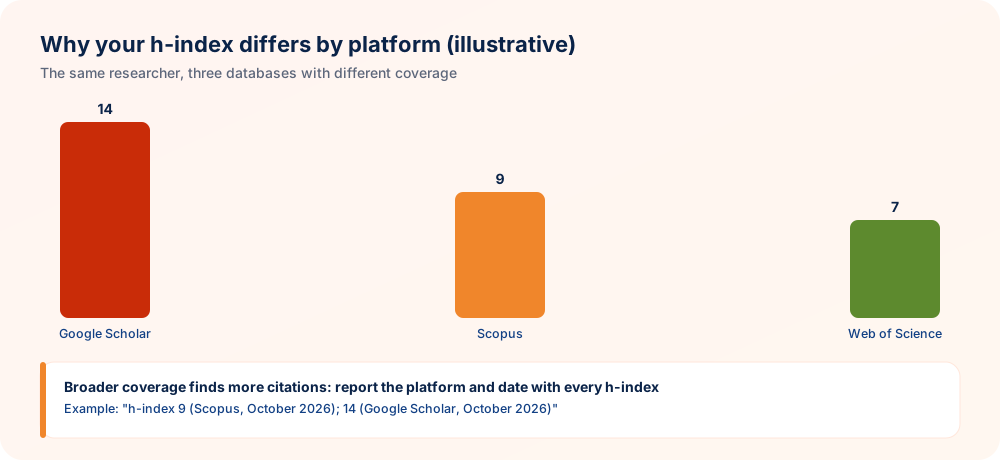
| Google Scholar | Free | Wide coverage: journals, books, theses, preprints and conference papers | Tends to give the top figure; you set up and keep the profile yourself |
| Scopus | Author look-up is free through Scopus Preview; complete access needs a subscription | Selected journals, book series and proceedings | Frequently used in formal evaluations; author profiles are generated automatically |
| Web of Science | Subscription | Selective Core Collection | Usually the smallest figure |
| Semantic Scholar | Free | Wide scope, particularly strong in computer science and biomedicine | Growing alternative |
| ResearchGate | Free | Papers you upload or link | Not official, though helpful for visibility |
Finding Your Google Scholar h-index Step by Step
- Set up your profile on Google Scholar, using your institutional email address to allow verification.
- Add your papers — Scholar proposes batches of articles, so check every one.
- Delete papers that belong to someone else and merge duplicate versions of a single paper.
- Pick your update settings — look over new articles before they are added to your profile, particularly if your name is a common one.
- Set the profile to public so that other people can discover your work.
- Review your numbers: the profile lists total citations, h-index and i10-index, both lifetime and for the latest years.
Connect your profile with your ORCID iD, and look at your Scopus profile using the free Scopus Preview author lookup. The metrics comparison guide on our site describes h5-index, i10-index and the remaining Google Scholar figures.
How to Judge a “Good” h-index
No universal benchmark exists. The ranges below are approximate figures commonly cited for career stages; they differ greatly by field, database and institution, and must never be treated as targets. Use such figures only to understand typical patterns, never to judge your own progress harshly.
| Career stage | Often-quoted range | Context |
|---|---|---|
| End of PhD | About 2–6 | Few papers so far, still gaining citations |
| Postdoctoral researcher | About 5–12 | Papers from PhD and postdoc work that are starting to be cited |
| Assistant professor | About 8–18 | Growing independent output |
| Associate professor | About 15–30 | A decade or more of steady output |
| Full professor | About 25–50+ | Long careers built on cited research |
Medical researchers frequently show higher h-indices than mathematicians or humanities scholars, since citation habits differ. Compare yourself only within your own sub-field, career stage and platform.
The Reason Every Step Is Tougher
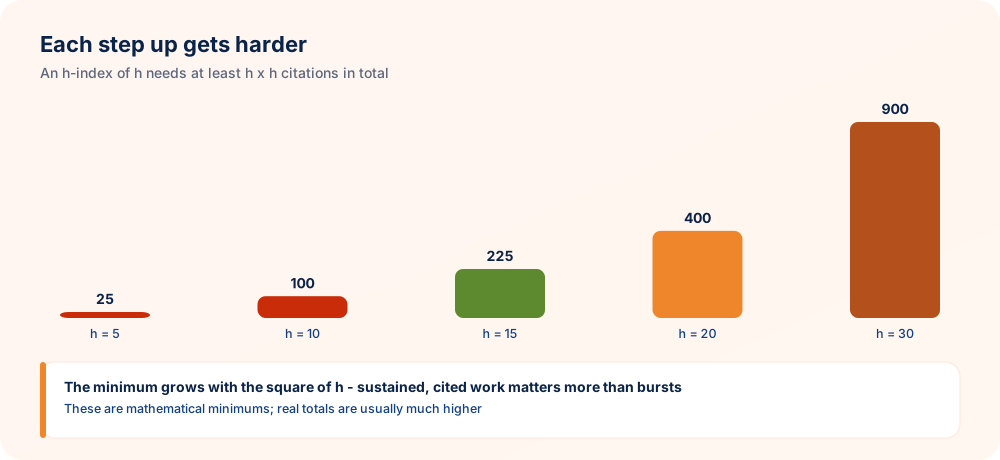
Going from an h-index of 3 to 4 requires your fourth paper to reach four citations, which can often happen within months. Going from 20 to 21 needs a 21st paper with 21 citations, and that may take years. This is intentional: the h-index credits steady, cited work, not short bursts of output.
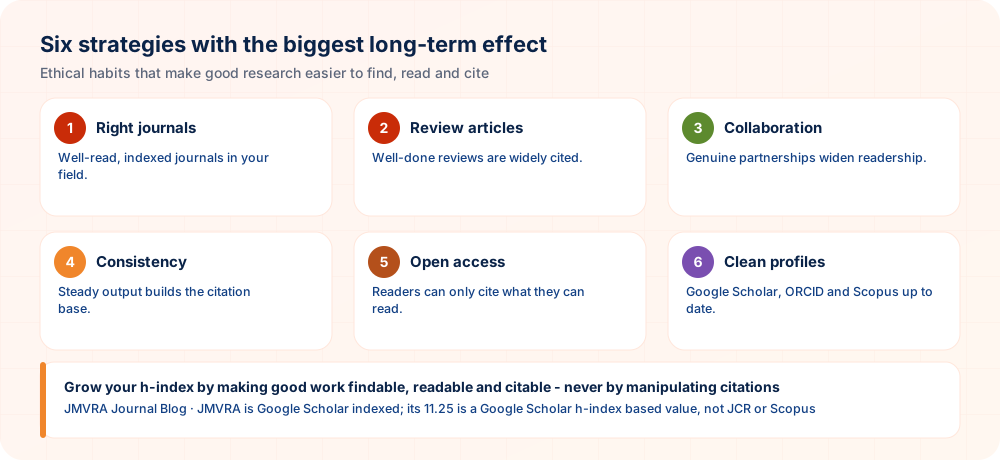
1. Choose Widely Read, Indexed Journals
Aim for the places your intended readers actually look. A paper counts towards a Scopus or Web of Science h-index only if the journal is covered by those databases, and towards a Google Scholar h-index only if Google Scholar can find it. Decide by fit first, then quality and indexing — our journal evaluation guide and Scopus quartile guide can help. Reading a few recent issues of a journal is a quick way to judge whether its readers match yours.
Impact: high — this determines who gets to see your work.
2. Author Review Articles
Good reviews frequently turn into go-to references for newcomers to a subject. Search for a gap in existing reviews, confirm the journal takes unsolicited reviews, and think about co-writing with a seasoned colleague. A systematic review built on a clear protocol is particularly valuable to other researchers.
Impact: high, provided the review is truly useful.
3. Tackle Questions Other Researchers Are Raising
Work on live questions tends to attract more readers, simply because more people are active there. This is not about following fads: it is about linking your study to the debates in your field and stating that link plainly in the title and abstract. A quick scan of recent conference themes and special-issue calls shows what your community currently cares about.
Impact: moderate to high.
4. Go for Open Access Publishing
Numerous studies find that freely available papers are read and cited more often, though how large the advantage is remains debated. The reasoning is straightforward: nobody can cite what they cannot read. Pick open access journals, or deposit accepted manuscripts in a repository where the publisher permits. Browse free-to-publish Scopus journals and open access medical journals.
Impact: moderate to high.
5. Improve Your Titles, Abstracts and Keywords
Search engines and databases depend on your title, abstract and keywords. Favour descriptive titles over clever ones, add the terms researchers type into searches, steer clear of unexplained acronyms in titles, and write an abstract that works as a self-contained summary of concrete findings. See our abstract writing guide for how. Ask a colleague outside your field to read the title; if the topic is unclear to them, revise it.
Impact: moderate — little effort, genuine gain in discoverability.
6. Collaborate Genuinely
Each co-author brings a separate network and set of readers. Real collaborations across institutions, disciplines and countries broaden who sees your work. All authors must contribute genuinely and meet the authorship criteria; listing names just to gain visibility is unacceptable.
Impact: high.
7. Maintain Complete, Tidy Profiles
Whenever databases cannot connect papers to you, citations go missing. Keep your Google Scholar, ORCID and Scopus author profiles current, merge duplicate entries, and write your name the same way every time. Our ORCID guide has details. Check your profiles after every new publication so small errors do not pile up unnoticed.
Impact: moderate — basic housekeeping that stops citations from slipping away.
8. Promote and Present Your Research
Send new papers to researchers who would benefit, post brief summaries with DOI links, and speak at seminars and conferences. Greater visibility helps suitable readers locate your work. Our citations guide offers a routine for the first month.
Impact: moderate to high.
9. Keep Publishing Steadily
The h-index favours sustained output. A regular flow of sound papers typically creates a stronger citation base than one burst followed by silence. Map out your pipeline a year or more ahead, combining original studies, reviews and collaborations. Even modest, regular progress on several manuscripts at once keeps the pipeline healthy when one paper stalls.
Impact: high — the strategy people value least.
10. Aim at a Global Readership
English is still the main language of international scholarly exchange, so English-language papers usually find the biggest readership. If English is not your first language, make use of language support and disclose any AI help as journals demand. Writing in other languages may still be the right call for regional or national readers.
Impact: high where global reach is the goal.
A Yearly h-index Check-Up
Each year, set aside an hour to go over your citation record:
- Tidy your profiles — add papers that are missing, merge duplicates and delete papers that are not yours.
- Record your figures — your Google Scholar h-index, i10-index and citations, plus your Scopus h-index, along with the date.
- Spot your “next h” papers — those sitting just under the h threshold; check they are open, findable and shared.
- See who cites you — they may become collaborators or readers of your next paper.
- Plan ahead for next year — manuscripts under way, a review you might write, conferences to attend and possible collaborations.
Presenting Your h-index in a CV or Appraisal File
| Do | Avoid |
|---|---|
| “h-index 11 (Google Scholar, October 2026); 8 (Scopus, October 2026)” | Just “h-index 11” without a source or date |
| Provide dated profile screenshots or PDFs on request | Screenshots that are edited or lack a date |
| Add context such as field, career stage and key papers | Measuring yourself against other disciplines |
| Report from the platform your rule specifies | Picking the largest figure without naming its source |
5 Things to Avoid
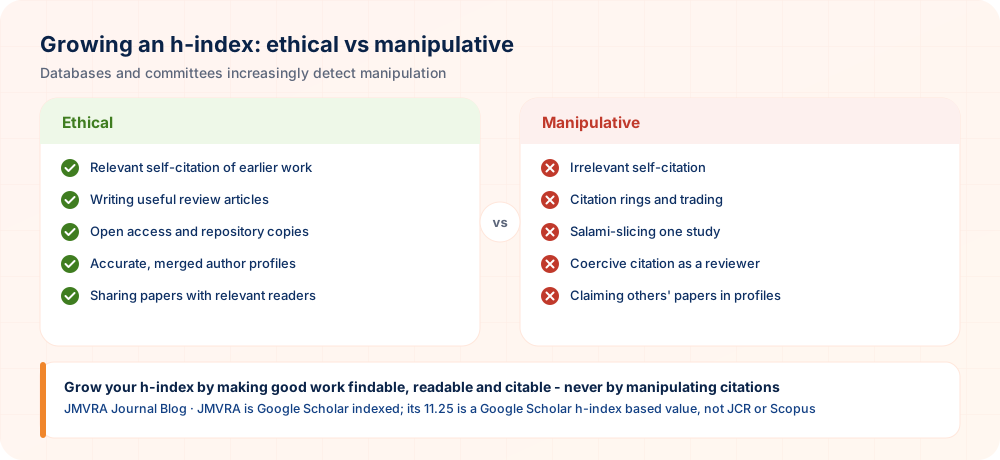
- Excessive self-citation: reference your own earlier work only where it is relevant; unusual citation patterns can get journals suppressed from Journal Citation Reports or reviewed again in Scopus.
- Citation rings or trading: arrangements to cite one another irrespective of relevance count as misconduct.
- Predatory or cloned journals: they harm your reputation, and neither Scopus nor Web of Science counts papers published there. Read our predatory journal checklist and journal hijacking guide.
- Salami-slicing: dividing one study into several thin papers increases paper count but seldom citations.
- Obsessing over the number: the DORA declaration cautions against leaning too heavily on any one metric. Quality research must come first.
What to Expect from the h-index in Each Discipline
| Field | Typical pattern |
|---|---|
| Medicine and biomedical sciences | Heavy citation and many co-authors; h-indices are generally higher |
| Engineering and computer science | Medium rates; conference papers carry great weight in computer science |
| Social sciences | Differs between disciplines; some cite a lot, others far less |
| Mathematics and physics | Fewer papers in certain areas and slower citation; citations last for a long time |
| Arts and humanities | Books and chapters count for more; citation metrics fit less well |
Make comparisons only inside your own sub-field, career stage and platform.
JMVRA’s Use of Google Scholar Metrics
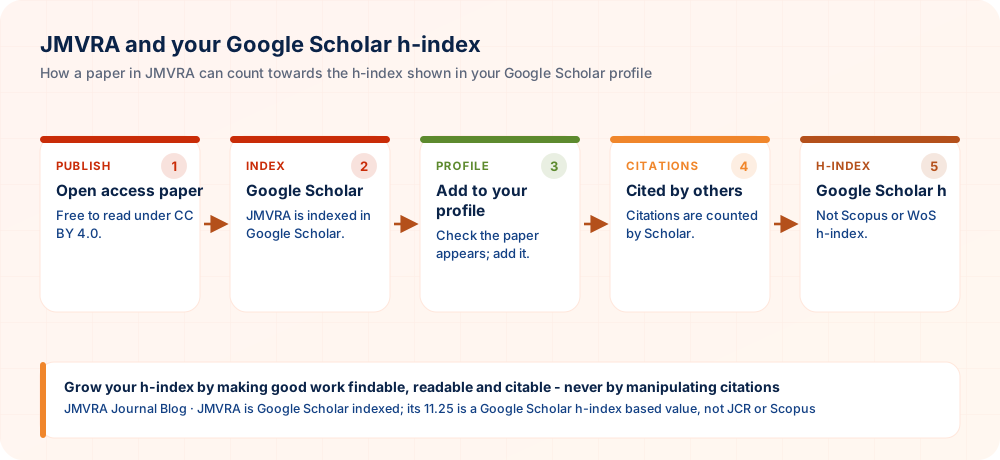
JMVRA is indexed in Google Scholar, and the impact factor it reports is derived from Google Scholar data. For authors, this means the following:
| Question | Answer |
|---|---|
| Can JMVRA be found in Google Scholar? | Yes. Google Scholar can surface JMVRA articles; confirm your paper shows up and then add it to your profile |
| Does a JMVRA paper add to my Google Scholar h-index? | Yes, as soon as the paper and its citations are part of your Google Scholar profile |
| Do papers published in JMVRA feed into a Scopus or Web of Science h-index? | No. Neither Scopus nor Web of Science indexes JMVRA, which means they hold none of its papers |
| What impact factor does JMVRA have? | 11.25 — a value based on the Google Scholar H-index |
| How is the figure worked out? | Taken from citation data accessible via Google Scholar and Semantic Scholar, across a two-year citation window, refreshed every year and counting self-citations |
| How should the figure be cited? | Present it only as a “Google Scholar-based Impact Factor”; it must never be passed off as a JCR Impact Factor or a Scopus CiteScore |
Where your institution accepts a Google Scholar h-index, a JMVRA paper can add to it once someone cites it. Where the rule demands a Scopus or Web of Science h-index, publish those papers in a journal indexed by the relevant database. Confirm the accepted source with your institution before choosing where to submit.
Share Your Research Through JMVRA
Bring your research to JMVRA
JMVRA (ISSN 2984-8911) is a peer-reviewed, open access journal spanning many disciplines. Submission is free. Specialist reviewers assess your paper, and you receive the acceptance or rejection decision by email and WhatsApp.
- 1. Prepare according to the guidelines
- 2. Submit online
- 3. Peer review
- 4. Decision by email & WhatsApp
- 5. Publish with open access
A Checklist for Your h-index
- Profiles cleanGoogle Scholar, ORCID and Scopus kept current
- Platform statedh-index given together with its source and date
- Right journalsWidely read, and indexed wherever your rule requires
- Findable papersTitles, abstracts and keywords that are clear
- Open copiesOpen access, or repository versions where allowed
- EthicsAvoid rings, coercion and irrelevant self-citation
Building a Sustainable Research Record Behind Your h-index
An h-index is a lagging summary of long-term work, so the habits that improve it are mostly about steady, honest research practice. Treat the number as a by-product, never as a target.
- Plan a coherent research theme. Papers that build on one another attract readers who follow your thread. Choose a focused theme and extend it deliberately instead of scattering small unrelated outputs across many topics.
- Compare like with like. Citation habits differ greatly between disciplines and career stages. Judge your record against peers in your own field and seniority, and avoid comparing yourself with distant specialisms.
- Audit your profile for duplicates. Merge duplicate entries and remove papers that are not yours in each profile you maintain. Different tools may show different values, so note which source you quote.
- Revisit older papers. A strong earlier study can be refreshed through a follow-up, a short commentary or a review that places it in current context, helping new readers discover the original.
- Value quality over quantity. A smaller number of careful, well-reported studies usually serves your standing better than rushed output. Reviewers, funders and hiring panels notice substance before they notice any index.
Concentrate on rigorous, connected research and tidy profiles, and let any index reflect your work rather than drive your decisions.
Questions Researchers Often Ask
In Summary
Raising your h-index has nothing to do with shortcuts or gaming the system. It comes from strategic, ethical decisions — where you publish, how clearly you write, whom you collaborate with and how openly you share — so that good research reaches those who will build on it. Keep profiles tidy, give your h-index together with platform and date, and remember it is an instrument, not an aim.
Have a manuscript to share? Submit it to JMVRA
JMVRA (ISSN 2984-8911) is a peer-reviewed, open access journal spanning many disciplines. Submission is free. Specialist reviewers assess your paper, and you receive the acceptance or rejection decision by email and WhatsApp.
- 1. Prepare according to the guidelines
- 2. Submit online
- 3. Peer review
- 4. Decision by email & WhatsApp
- 5. Publish with open access
References and Sources
- Hirsch, J. E. (2005). An index to quantify an individual’s scientific research output. Proceedings of the National Academy of Sciences, 102(46).
- Google Scholar
- Scopus Preview author lookup
- ORCID
- DORA
The Five Principles in Brief
- FindableTitles, abstracts and keywords that are clear
- ReadableA repository copy or open access
- AttributableTidy Google Scholar, ORCID and Scopus profiles
- SharedReaching the appropriate readers
- SustainedRegular, authentic output
Related: What is the h-index? · Metrics compared · Submit Paper.
Ready to Publish? Submit to JMVRA
JMVRA is aligned with UGC's Suggested Parameters for Choosing Peer-Reviewed Journals.
JMVRA is a Transparent, Peer-Reviewed, Open Access Journal (Refereed Journal). Following the discontinuation of the UGC and UGC-CARE journal listing, and in alignment with the latest UGC-CARE recommendations and guidelines, JMVRA is aligned with UGC’s Suggested Parameters for Choosing Peer-Reviewed Journals.
Related pages on jmvra.org
Key Terms
Subjects and search phrases this article addresses.
Related Reading
Additional guides covering h-index, citations and research metrics.
The h-index Explained With Simple Examples
Read the guide RelatedCiteScore, Impact Factor, SJR, SNIP and Google Scholar h-index Compared
Read the guide Related15 Ethical Ways to Grow Your Paper's Citations
Read the guide RelatedWhere Does JMVRA’s 11.25 Impact Factor Come From? The Google Scholar H-Index Explained
Read the guide RelatedORCID iD: The Researcher ID Everyone Needs
Read the guide RelatedA Walkthrough for Getting Your Research Paper Indexed in Google Scholar
Read the guideKeep Reading on the JMVRA Blog
Published on the JMVRA journal blog, this guide gives practical direction on publishing, indexing, metrics and research integrity, with a focus on what can be verified instead of on promotion.