
Open access has changed the way clinical research is published, read and cited. A large number of major funders now expect it, and clinicians, patients and policymakers lean more and more on studies available without a subscription. The difficulty lies in finding a journal with the right mix of scope, credibility, licence and cost.
This list serves as a reference and not an endorsement: journal names appear as plain text, fees are those reported in March 2026, and each detail ought to be confirmed at the official source prior to submission.
What Does Open Access Publishing Mean in Medicine?
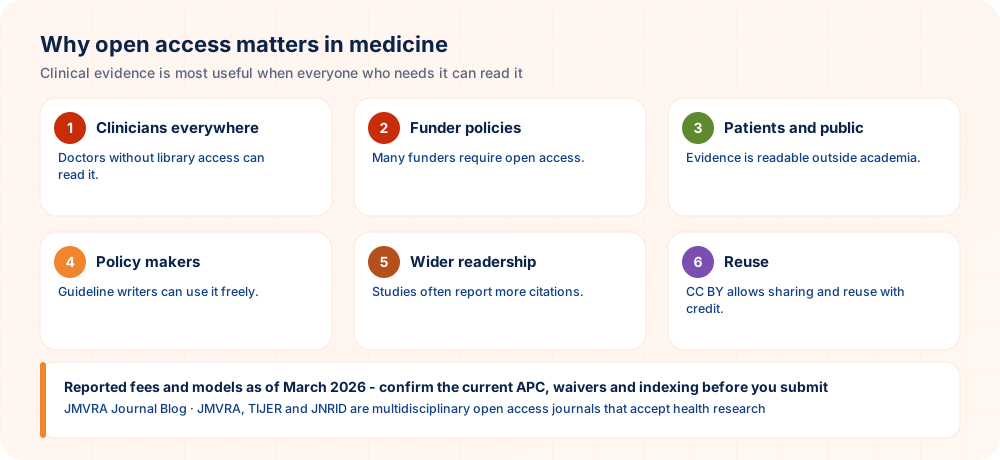
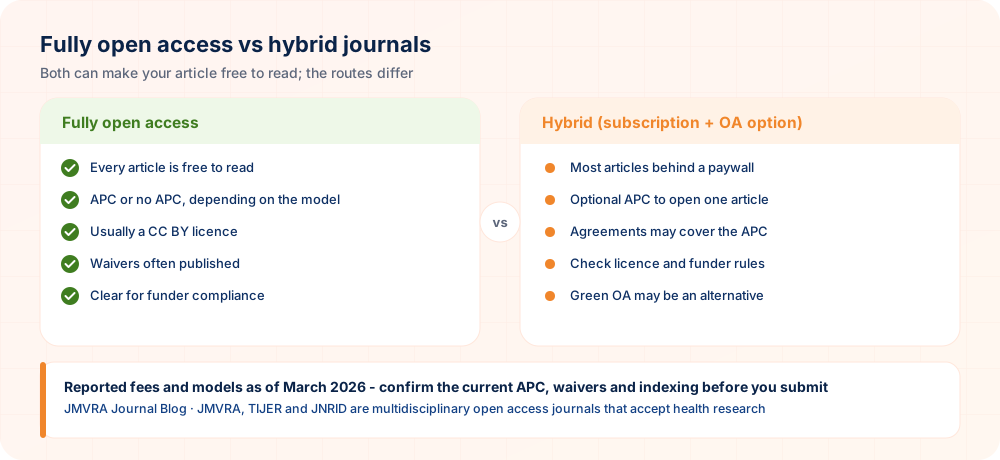
Open access (OA) means anyone can read, download and share published articles at no cost, typically under a Creative Commons licence that also permits reuse with attribution. This is particularly significant in medicine, as it allows doctors, researchers, patients and policymakers worldwide to see the newest clinical evidence whatever their library can afford. When you choose a licence, read what reuse it allows so your work can travel as far as you intend.
Kinds of Open Access in Medical Publishing
| Type | How it works | Who pays |
|---|---|---|
| Gold open access | Articles are available free on the journal’s site straight away | Generally the author, funder or institution, by way of an APC |
| Diamond open access | Articles are free at once, with no fee for authors | The publisher, a society or an institution |
| Green open access | The accepted manuscript is placed in a repository like PubMed Central, occasionally following an embargo | Usually no fee |
| Hybrid open access | A subscription journal makes single articles open in return for a fee | The author, or an agreement, covers that article |
To compare them in more depth, see gold vs green vs diamond open access.
The Value of Open Access for Medical Research
- Broader audience: numerous studies find that open articles are read and cited more often, although the size of that benefit differs and remains debated.
- Funder policies: numerous large research funders maintain open access policies that frequently call for a CC BY licence or repository deposit. Failing to comply can influence later funding.
- Equity in global health: clinicians working in low- and middle-income settings often have no subscriptions, and open access gives them the same evidence everyone else reads.
- Policy and practice: public health officials and guideline writers can draw straight on research that is openly available.
- Rolling publication: numerous OA journals put articles online the moment they are ready instead of holding them for print issues.
Network Journals That Accept Medical and Health Papers
Not every clinical manuscript needs a specialist title with a four-figure APC. A clinical audit, a hospital-based cross-sectional survey, a nursing or pharmacy study, a public health analysis or a student dissertation often fits a multidisciplinary journal well, provided the journal is open access, peer-reviewed and honest about its indexing. Our network has three such journals, and all of them consider medical and allied health work alongside other fields:
JMVRA, TIJER and JNRID at a glance
All three are multidisciplinary, open access, peer-reviewed and published monthly. They differ mainly in age, fee and where you submit.
- JMVRA — Journal of Modern and Versatile Research Approach: ISSN 2984-8911, publishing since June 2023, impact factor 11.25 (calculated by Google Scholar). Fee ₹971 INR for Indian authors or $41 USD for international authors, due only after acceptance. Submit through jmvra.org.
- TIJER — TIJER – International Research Journal: ISSN 2349-9249, established 2014, described as a High Impact Factor journal. Low-cost fee of ₹970 (Indian) or $50 (international). Website text: tijer.org; submission route: researchwave.org.
- JNRID — Journal of Novel Research and Innovative Development: ISSN 2984-8687, established 2023, described as a High Impact Factor journal. Low-cost fee of ₹970 (Indian) or $50 (international). Website text: jnrid.org; submission route: researchwave.org.
| Point to compare | JMVRA | TIJER | JNRID |
|---|---|---|---|
| Indian author fee | ₹971 INR | ₹970 | ₹970 |
| International author fee | $41 USD | $50 | $50 |
| Established | June 2023 | 2014 | 2023 |
| ISSN | 2984-8911 | 2349-9249 | 2984-8687 |
| Impact factor wording | 11.25 (calculated by Google Scholar) | High Impact Factor | High Impact Factor |
| UGC wording | Aligned with UGC’s Suggested Parameters for Choosing Peer-Reviewed Journals | UGC CARE Approved, Transparent Peer-Reviewed (Refereed) Journal as per new UGC Notification | UGC CARE Approved, Transparent Peer-Reviewed (Refereed) Journal as per new UGC Notification |
| Where to submit | submitpaper.php | researchwave.org | researchwave.org |
For an Indian author the fee gap is a single rupee, so choose on fit and track record rather than price. For an international author JMVRA costs $9 less ($41 USD against $50). TIJER has the longest publishing history of the three (since 2014), which some review committees like to see; JMVRA and JNRID are newer titles from 2023. All three are general, multidisciplinary titles rather than specialist medical journals, so if your institution or funder demands MEDLINE, PubMed Central or Scopus coverage, look up the exact record in the NLM Catalog or on the Scopus Sources page before relying on any journal, or choose from the tiered list below.
How We Put This List Together
The 15 journals listed below are taken from a widely circulated list of open access medical journals, with fees as reported in March 2026. We arranged them into reported APC tiers, from free to premium, and put them in alphabetical order inside each tier. For each we give the publisher, type, focus, ISSN as listed and the reported APC.
Impact factors, CiteScores, SJR values and quartiles are deliberately left out: they shift annually, vary by category and database, and are best checked at their official sources. Fees likewise change and depend on waivers and agreements.
The Listing: 15 Open Access Medical Journals Sorted by Reported APC
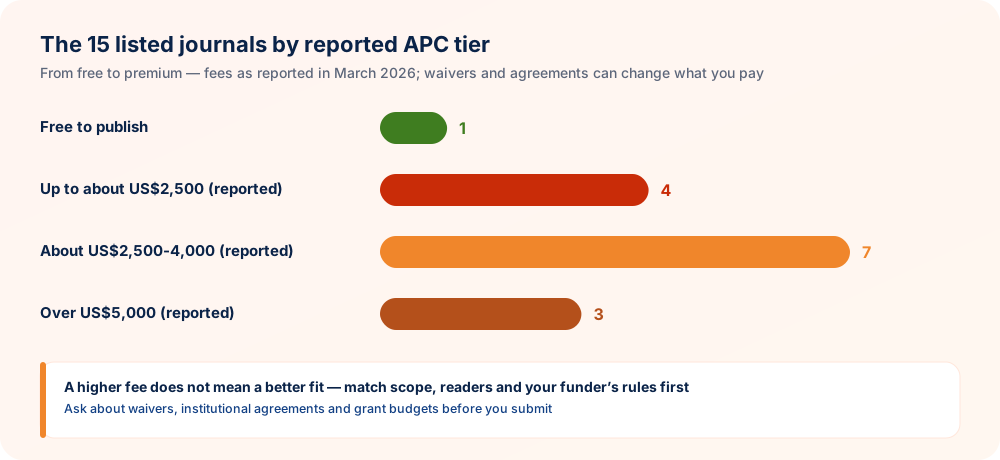
Navigate to the tier: No charge to publish · Costing up to about $2,500 USD (reported) · Around $2,500 USD–4,000 (reported) · More than $5,000 USD (reported).
Free to publish (1)
| Journal | Publisher | Type | Focus | ISSN (as listed) | Reported APC |
|---|---|---|---|---|---|
| Cureus | Springer Nature | General medical | Every specialty, including case reports and reviews | 2168-8184 | No APC |
Up to about $2,500 USD (reported) (4)
| Journal | Publisher | Type | Focus | ISSN (as listed) | Reported APC |
|---|---|---|---|---|---|
| eLife | eLife Sciences Publications | Life sciences and biomedicine | Biomedical research accompanied by public review assessments | 2050-084X | About $2,500 |
| Medicine | Wolters Kluwer | General medical | Systematic reviews and clinical research | 0025-7974 | About $1,900 |
| PLOS ONE | PLOS | Multidisciplinary (includes medicine) | Research of sound methodology across every field | 1932-6203 | About $2,290; waivers |
| Scientific Reports | Springer Nature | Multidisciplinary (includes medicine) | Clinical and natural sciences | 2045-2322 | About $2,490 |
About $2,500 USD–4,000 (reported) (7)
| Journal | Publisher | Type | Focus | ISSN (as listed) | Reported APC |
|---|---|---|---|---|---|
| BMC Medicine | Springer Nature (BioMed Central) | General medical | Every specialty, plus translational and public health | 1741-7015 | About $3,890 |
| BMJ Open | BMJ Publishing Group | General medical | Every discipline, including protocols and negative results | 2044-6055 | About £2,163 |
| BMJ Open Diabetes Research & Care | BMJ Publishing Group | Specialty | Diabetes and endocrinology | 2052-4897 | About £2,163 |
| Frontiers in Medicine | Frontiers Media | General medical | Every specialty, along with translational medicine | 2296-858X | About $2,950 |
| International Journal of Surgery | Wolters Kluwer | Specialty | Trials and reviews in surgical specialties | 1743-9191 | About $3,900 |
| JAMA Network Open | American Medical Association | General medical | Health policy and clinical research | 2574-3805 | About $3,500 |
| Journal of Medical Internet Research (JMIR) | JMIR Publications | Specialty | Informatics, eHealth and digital health | 1438-8871 | About $2,995 |
Over $5,000 USD (reported) (3)
| Journal | Publisher | Type | Focus | ISSN (as listed) | Reported APC |
|---|---|---|---|---|---|
| Nature Communications | Springer Nature | Multidisciplinary (includes medicine) | Natural sciences, clinical research among them | 2041-1723 | About $6,790 |
| PLOS Medicine | PLOS | General medical | Epidemiology, policy and global health | 1549-1676 | About $6,460; waivers |
| The Lancet Digital Health | Elsevier | Specialty | AI in medicine and digital health | 2589-7500 | About $5,900 |
The fees shown were reported in March 2026; prices differ by article type and shift over time. Journal names appear as plain text for reference only, and JMVRA neither links to nor endorses outside journals.
What Every Group Provides
Free to publish
The one free choice here is a large general medical journal covering many specialties, including case reports and reviews, with no APC. Free journals work well for researchers who lack funding, as long as scope and indexing fit their needs; see our free-to-publish Scopus journals list. Free does not mean unselective, so still read the journal’s aims and recent articles before sending a manuscript.
Costing up to about $2,500 USD
Here you will find large multidisciplinary mega-journals that assess methodological soundness instead of perceived novelty, a general medical journal, and a biomedical journal known for releasing public review assessments alongside its articles.
Around $2,500 USD–4,000
This tier holds a few well-known general medical titles together with specialty journals in surgery, diabetes and digital health. Certain ones accept study protocols, negative results and large observational studies, so review each journal’s article types.
Over $5,000 USD
The priciest tier contains a selective general medical journal centred on global health, a digital health title belonging to a major medical journal family, and a large multidisciplinary journal. Costs can be lowered through waivers and institutional agreements.
Picking the Right Journal
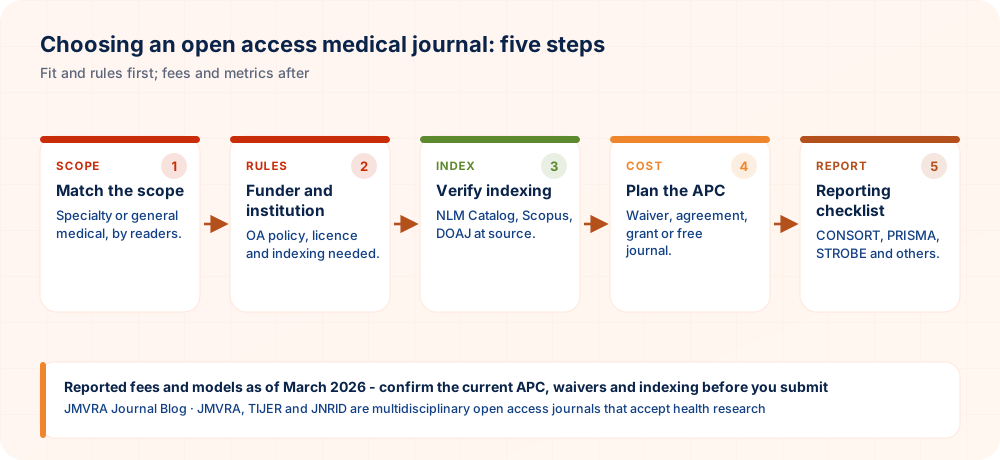
- Fit your research to the scope. Work out whether a general medical journal or a specialty one reaches the readers who need your findings; a mismatch in scope often leads to desk rejection.
- Know your obligations. Study what your funder’s open access policy and your institution demand, including licence and indexing.
- Confirm indexing directly with the databases: the NLM Catalog for MEDLINE status, Scopus for coverage, and DOAJ for open access titles.
- Budget for the fee: consider waivers, agreements, grant funds, or a journal that is free or inexpensive.
- Weigh the schedule by looking at whatever review and publication times the journal reports itself.
- Check the licence: CC BY is required by many funders.
These checks are covered step by step in our guide to evaluating a high-impact journal.
Covering the APC: Waivers, Agreements and Grants
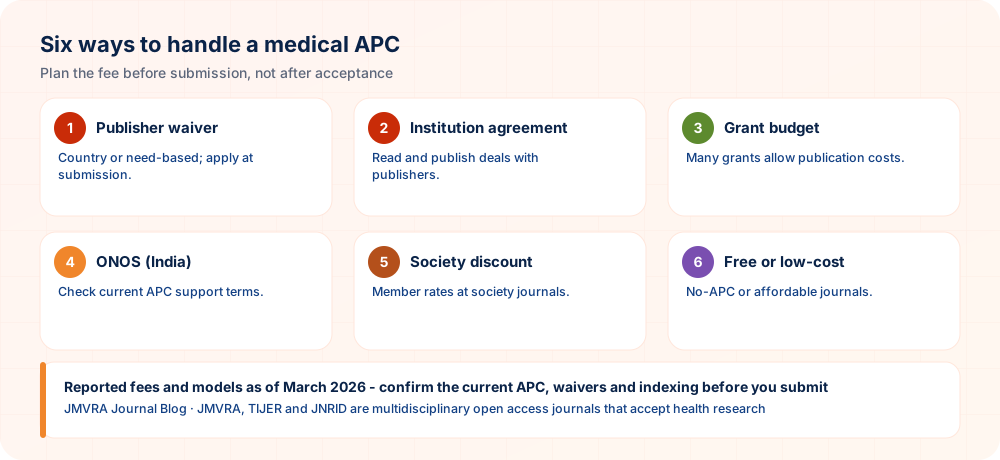
- Waivers: a number of OA publishers grant full or partial waivers according to country or financial need; eligibility lists vary and many leave out India, so read the policy and apply when you submit.
- Institutional agreements: certain institutions hold deals with publishers that pay or reduce APCs, so enquire at your library.
- Grants: publication charges are permitted under many research grants, so read your sanction letter.
- ONOS (India): APC support has been announced together with reading access; the latest terms are in our ONOS guide.
- Free or low-cost journals: if none of the routes works, pick a journal with a fee you can afford.
Do not take for granted that a waiver or agreement covers you; get written confirmation before submitting.
Verifying Medical Journals
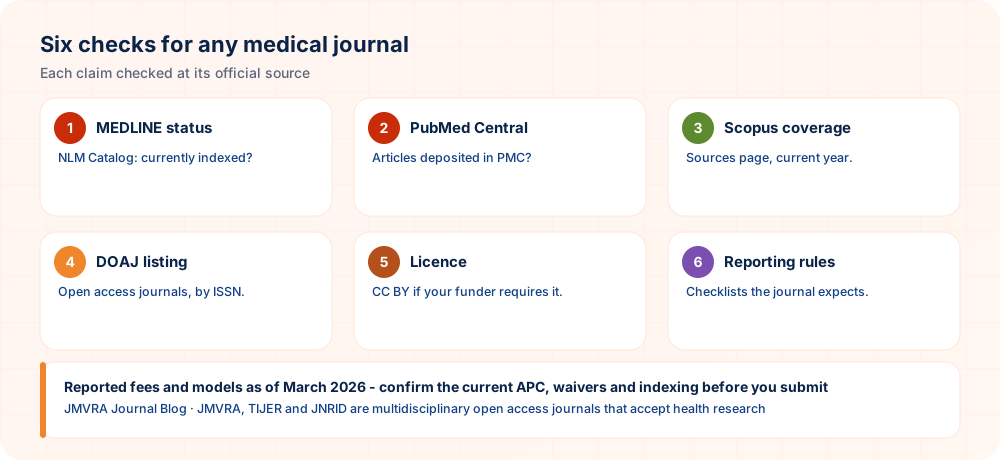
With medical journals, the key check is frequently MEDLINE status in the NLM Catalog: appearing in PubMed through PubMed Central deposits is not equivalent to being indexed for MEDLINE. Verify Scopus coverage on the Sources page as well and, for open access journals, the DOAJ record. Each step is explained in our database checking guide.
Reporting Guidelines for Manuscripts in Medicine
Medical journals generally want manuscripts to follow the reporting guideline for their study design — CONSORT for randomised trials, PRISMA for systematic reviews, STROBE for observational studies and CARE for case reports, for instance. These guidelines are gathered by the EQUATOR Network. Using the correct checklist eases peer review and makes your paper more useful to readers. Our abstract writing guide also covers structured abstracts.
Types of Articles in Medical Journals
| Article type | What it is | Tip |
|---|---|---|
| Original research | A complete account of a new study | Apply the reporting guideline that matches your design |
| Case report or case series | A thorough description of one patient or a small number | Secure written consent and follow the CARE guideline |
| Systematic review and meta-analysis | An organised synthesis of studies that already exist | Where possible, register the protocol and follow PRISMA |
| Study protocol | A study plan written before any results exist | Protocols are published by some journals, so check the scope |
| Narrative review | A specialist’s overview of a subject | Frequently by invitation, so find out whether unsolicited reviews are welcome |
| Letter or short communication | A short report or commentary | Look at the limits on words and references |
Key Ethics Requirements for Medical Papers
- Approval from an ethics committee or institutional review board, quoting the approval number
- Participants’ informed consent, plus separate consent to publish case details that could identify them
- Where required, registration of the clinical trial in a recognised registry prior to enrolment
- Statements on conflicts of interest and funding from each author
- A statement on data availability that respects patient privacy
- Authorship satisfying recognised criteria, with other contributors acknowledged
- Responsible, openly declared use of AI tools — read our AI ethics guide
Funder Compliance and Licences
| Licence | What readers may do | Notes |
|---|---|---|
| CC BY | Anyone may reuse and adapt it, commercial use included, provided credit is given | Frequently a funder requirement |
| CC BY-NC | May be shared and adapted for non-commercial use, with attribution | A number of funders reject it |
| CC BY-NC-ND | May be shared without changes, for non-commercial use, with attribution | Among common CC licences, the strictest |
Steering Clear of Predatory Medical Journals
- Unrequested emails full of praise, urging you to submit in a hurry.
- Pledges of acceptance in a matter of days or “guaranteed publication”.
- Claims of indexing that you are unable to verify in the NLM Catalog, Scopus or DOAJ.
- Editorial board members you cannot check against institutional web pages.
- Requests for money ahead of peer review, above all into personal accounts.
- A site that differs from the official record — it may be a clone; read about journal hijacking.
Bear in mind that some genuine open access journals are missing from DOAJ; being listed there is strong evidence of quality, yet being absent does not by itself show a fault. Try our predatory journal checklist.
Where JMVRA, TIJER and JNRID Belong
Where your medical paper depends on a certain database or quartile, pick a journal you have personally checked against that need. Should you want an inexpensive, open access, peer-reviewed outlet — say for a case series, clinical audit, allied health study or student project — our network offers three multidisciplinary options:
JMVRA
A peer-reviewed, open access, multidisciplinary monthly journal (ISSN 2984-8911, since June 2023). The fee is ₹971 INR for Indian authors or $41 USD for foreign authors, payable only after acceptance. Submit to JMVRA.
TIJER
TIJER – International Research Journal (ISSN 2349-9249), multidisciplinary and monthly, with a low-cost fee of ₹970 (Indian) or $50 (international). Website: tijer.org. Submission route.
JNRID
Journal of Novel Research and Innovative Development (ISSN 2984-8687), multidisciplinary and monthly, with a low-cost fee of ₹970 (Indian) or $50 (international). Website: jnrid.org. Submission route.
Which one suits which author?
- Undergraduate or postgraduate medical, nursing or pharmacy students publishing a first project: any of the three works; Indian authors pay virtually the same (₹970 or ₹971 INR), so pick the journal whose recent issues contain papers closest to yours.
- PhD scholars and faculty who must explain a journal choice to a committee: compare the UGC wording on each site, verify the ISSN on portal.issn.org, and note that TIJER has the longest record (since 2014).
- International authors paying in dollars: JMVRA’s $41 USD is the lowest fee of the three; TIJER and JNRID charge $50.
- Anyone needing MEDLINE or Scopus for a promotion, grant or thesis rule: confirm that requirement first and use the tiered list above if a multidisciplinary title will not satisfy it.
JMVRA, stated openly
JMVRA appears in Google Scholar and is registered with Crossref and the ISSN Portal / ROAD; it is not currently indexed in Scopus, Web of Science or DOAJ.
- Review: transparent, double-blind peer review. Specialist reviewers assess your paper, and you receive the acceptance or rejection decision by email and WhatsApp.
- Access: the journal is free to read under CC BY 4.0, carries ISSN 2984-8911, and supplies a Crossref DOI when asked.
Want to submit your research?
Submission to JMVRA is free. Specialist reviewers assess your paper, and you receive the acceptance or rejection decision by email and WhatsApp. The fee of ₹971 INR (Indian) or $41 USD (foreign) applies only after acceptance. TIJER and JNRID, the other two journals in our network, also take health papers at ₹970 / $50 through researchwave.org.
Your Checklist for Medical OA Publishing
- Scope fitA general or specialty journal whose readers match yours
- Funder rulesOA policy and licence terms satisfied
- IndexingMEDLINE, Scopus or DOAJ status checked at the source
- APC planA waiver, agreement, grant or low-cost journal
- ReportingCorrect checklist applied
- IdentityOfficial website and ISSN verified
Clinical Author Safeguards When Selecting an Open Access Journal
Medical papers influence patient care and training, so extra caution is sensible when you choose where to publish. These safeguards support responsible decisions for clinicians and healthcare researchers.
- Confirm ethics paperwork first. Locate your committee approval letter and consent forms before drafting, and make sure the manuscript describes them accurately. A journal cannot repair missing approvals after the study is over.
- Follow the right reporting guideline. Pick the checklist that matches your design, such as one for trials or observational studies, and complete it honestly. Editors use these checklists to judge whether essentials are present.
- Protect patient identity. Remove names, hospital numbers and recognisable images unless you hold explicit written permission. Even small details in a case description can reveal a person to those who know them.
- Read waiver terms before applying. Check who qualifies for fee reductions and what evidence is needed. Applying after acceptance can be too late, so raise the question while selecting the journal.
- Check licence and funder alignment. Compare the journal's reuse licence with your funder's or institution's expectations. A mismatch may stop you from depositing the paper where your sponsor requires.
Put ethics, reporting standards and patient privacy ahead of convenience when choosing any open access medical outlet.
Questions Researchers Often Ask
In Summary
Open access medical publishing has choices for any budget and specialty, ranging from free general medical journals to prestigious titles with hefty fees. Begin with fit — scope, readership and funder rules — then check indexing at its source, budget for the APC and follow the relevant reporting guideline. Keeping notes on each check makes later reporting to your institution much easier.
If you want an affordable, peer-reviewed open access outlet for clinical, public health and allied health research, compare the three multidisciplinary journals in our network: JMVRA at ₹971 INR / $41 USD, and TIJER and JNRID at ₹970 / $50 each. Read a few recent articles in each, confirm the ISSN on the ISSN Portal, and submit to one journal at a time.
Ready to send in your paper?
Submission to JMVRA is online and free. Specialist reviewers assess your paper, and you receive the acceptance or rejection decision by email and WhatsApp. The fee of ₹971 INR (Indian authors) or $41 USD (foreign authors) applies only after acceptance.
References and Sources
Selecting a Medical OA Journal
- ScopeGeneralist or specialist
- RulesFunder OA policy and licensing
- IndexingNLM Catalog, Scopus, DOAJ
- CostWaiver, deal or grant
- ReportingCONSORT, PRISMA, STROBE
Related: Our journal network · Free-to-publish Scopus journals · Gold vs green vs diamond OA.
Ready to Publish? Submit to JMVRA
JMVRA is aligned with UGC's Suggested Parameters for Choosing Peer-Reviewed Journals.
JMVRA is a Transparent, Peer-Reviewed, Open Access Journal (Refereed Journal). Following the discontinuation of the UGC and UGC-CARE journal listing, and in alignment with the latest UGC-CARE recommendations and guidelines, JMVRA is aligned with UGC’s Suggested Parameters for Choosing Peer-Reviewed Journals.
Pages worth visiting on jmvra.org
Key Terms
Subjects and search phrases this article addresses.
Related Reading
Further guides on open access, charges and checking medical journals.
50 No-APC Scopus Journals for 2026 by Field
Read the guide RelatedChecking Scopus, WoS, DOAJ & PubMed for Free
Read the guide RelatedGold, Green & Diamond Open Access Compared
Read the guide RelatedHow to Evaluate a High-Impact Q1 Journal Before You Submit
Read the guide RelatedThe Whole Red-Flag List for Predatory Journals
Read the guide RelatedAbstract Writing Guide 2026: Structure & Samples
Read the guideKeep Reading on the JMVRA Blog
As part of the JMVRA journal blog, this guide shares practical help on publishing, indexing, metrics and research integrity, and is written to be verifiable rather than promotional.