
A well-structured, correctly formatted research paper is simpler to review, simpler to read and much less likely to be sent back before review. This guide walks through the standard research paper format section by section, with examples, the formatting conventions journals expect, frequent mistakes, and ways to follow a journal’s own author guidelines.
Understanding Research Paper Format
Research paper format combines two elements: the structure of the paper — which sections it has and their order — and the formatting — the visual and technical rules covering headings, fonts, spacing, numbering, tables, figures and references. Structure lets readers locate information quickly, while formatting tells editors you have respected their journal’s rules. Both differ a little between journals and disciplines, so this guide presents the common standard and then explains how to adapt it.
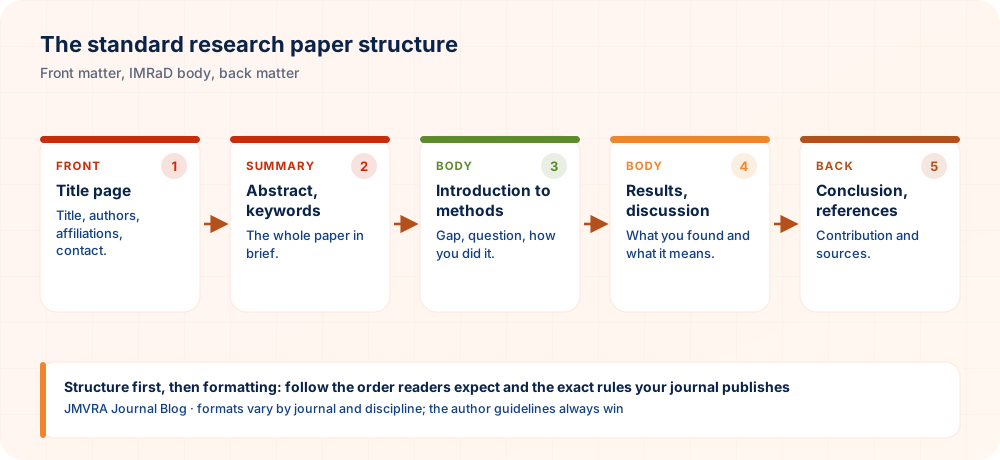
The Standard Layout of a Research Paper
| Section | Purpose | Typical length |
|---|---|---|
| Title page | Title, author names, affiliations, corresponding author | 1 page or header |
| Abstract | Summary of problem, method, results, conclusion | 150–300 words (journal-specific) |
| Key Terms | Search terms for indexing and discovery | 4–6 terms |
| Introduction | Context, research gap, objectives | 10–15% of the paper |
| Literature review | Prior work by theme (sometimes inside the introduction) | Varies by discipline |
| Methodology | Design, sample, tools, analysis | 15–20% |
| Results | Findings with tables and figures | 20–25% |
| Discussion | Interpretation, comparison, limitations | 20–25% |
| In Summary | Contribution and implications | 1–3 paragraphs |
| References | Every cited source, one style | As needed |
| Declarations and appendices | Ethics, conflicts, funding, data, AI use; supplementary material | As required |
These proportions serve as a rough guide for empirical papers, whereas reviews, theoretical papers and case studies follow different organisation.
Writing a Research Paper Title
- Be specific: mention the topic, the population or setting, and preferably the method or finding.
- Be searchable: choose the words researchers would enter in a search engine.
- Be concise: frequently fewer than about 15 words; skip “A study on…”.
| Weak | Stronger |
|---|---|
| A Study of Mobile Phones and Students | Smartphone Use and Sleep Quality Among Undergraduate Students: A Cross-Sectional Survey |
| Water Quality Analysis | Seasonal Variation in Groundwater Nitrate Levels in Semi-Arid Farming Villages |
Abstracts and Keywords: Requirements and Examples
An abstract stands alone as a summary: brief background (one or two sentences), objective, method, key results with numbers, and conclusion. Word limits are common, and certain journals insist on a structured abstract with headings. Select four to six keywords that add something beyond the title. Detailed guidance: how to write a research paper abstract. Drafting the abstract last, when the findings are settled, keeps it accurate.
The Introduction, Literature Review and Research Objectives
The introduction narrows from the broad context to the specific gap and finishes with clear objectives or questions. In many journals the literature review is part of the introduction; in others, and in theses, it forms a separate section arranged by theme. Phrase objectives as specific aims that can be answered. See Writing a Literature Review for Your Paper.
Methodology, Results and Discussion in a Research Paper
- Methodology: the design, participants or materials, how data were collected and analysed, and ethics — detailed enough that the study could be repeated.
- Results: findings presented in the order of your objectives, using tables and figures and no interpretation.
- Discussion: the meaning of the results, comparison with other studies, limitations and implications.
For help writing each section, see the IMRaD writing guide.
Composing the Conclusion and References
The conclusion gives the contribution and its implications in a few sentences and adds no new data. The reference list must contain every cited source, in a single style, with full details and DOIs where available. Each in-text citation must correspond to an entry, and each entry to a citation. See APA format and IEEE format.
Handling Tables, Figures, Citations and Appendices
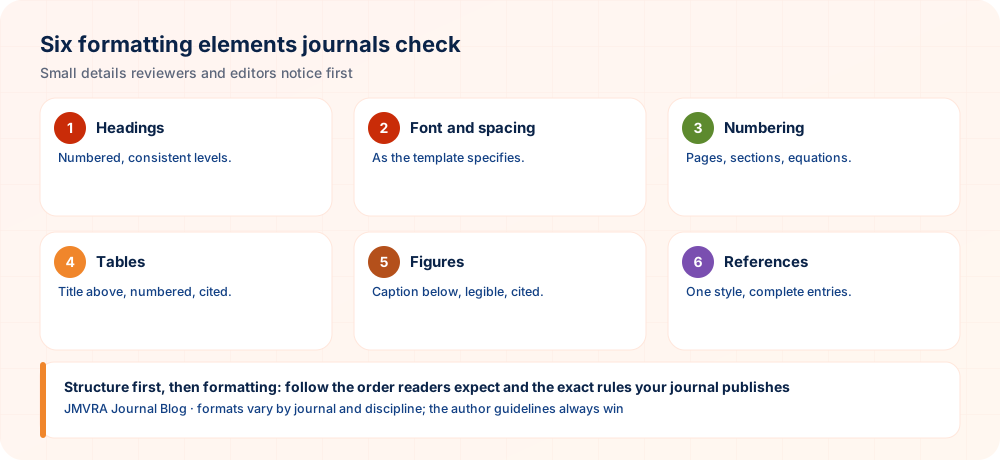
| Element | Common convention | Check |
|---|---|---|
| Headings | Numbered levels: 1, 1.1, 1.1.1 | Same style throughout |
| Tables | Number and title above the table; units in headers | Cited in the text before they appear |
| Figures | Number and caption below; legible labels | Resolution and file type as requested |
| Equations | Numbered on the right: (1), (2) | Symbols defined at first use |
| In-text citations | Author–date or numbered, per journal | One style only |
| Appendices | Labelled A, B, C; referred to in the text | Only material that supports the paper |
A Full Outline as a Research Paper Format Example
Below is how a short empirical paper could be laid out, based on an invented study. Adjust the headings and numbering to suit your journal.
| Part | Example heading or content |
|---|---|
| Title | Smartphone Use and Sleep Quality Among Undergraduate Students: A Cross-Sectional Survey |
| Authors and affiliations | Names, departments, institutions, corresponding author email, ORCID iDs |
| Abstract (about 200 words) | Background, objective, method (survey of 420 students), results (key associations with numbers), conclusion |
| Key Terms | sleep quality; smartphone use; undergraduate students; screen time; cross-sectional survey |
| 1. Introduction | 1.1 Background · 1.2 Research gap · 1.3 Objectives |
| 2. Literature Review | 2.1 Screen time and sleep · 2.2 Student populations · 2.3 Gaps |
| 3. Methodology | 3.1 Design and sample · 3.2 Instruments · 3.3 Analysis · 3.4 Ethics |
| 4. Results | 4.1 Sample profile (Table 1) · 4.2 Main associations (Table 2, Figure 1) |
| 5. Discussion | 5.1 Interpretation · 5.2 Comparison with other studies · 5.3 Limitations |
| 6. Conclusion | Contribution and recommendations in two paragraphs |
| Declarations | Ethics approval, consent, conflicts of interest, funding, data availability, AI use |
| References | All cited sources in the journal’s style, with DOIs |
| Appendix A | Survey questionnaire |
Both the figures and the study are made up purely for illustration.
Frequent Research Paper Formatting Errors
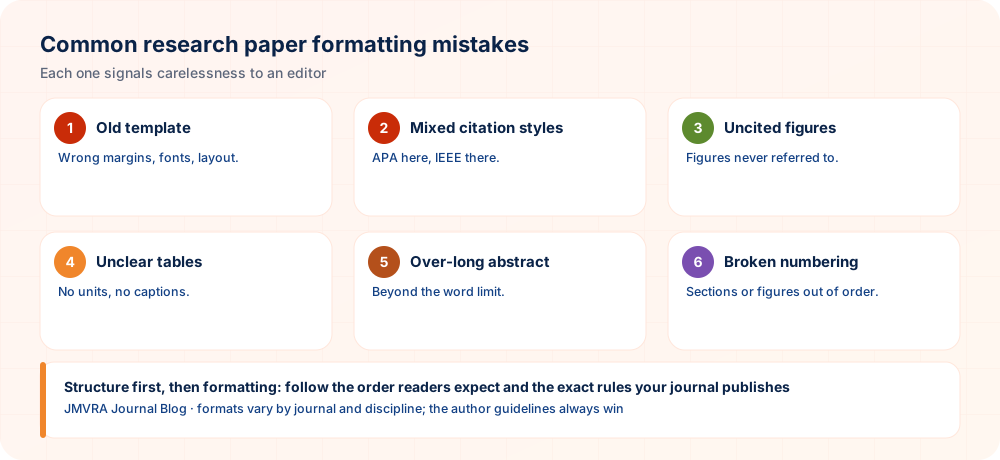
- Relying on an outdated or generic template in place of the journal’s current one.
- Combining citation styles, or leaving citations without matching references.
- Tables and figures that go uncited or lack units and captions.
- Abstracts and papers that exceed the word limit.
- Heading levels and numbering that are inconsistent.
Following a Journal’s Own Author Guidelines
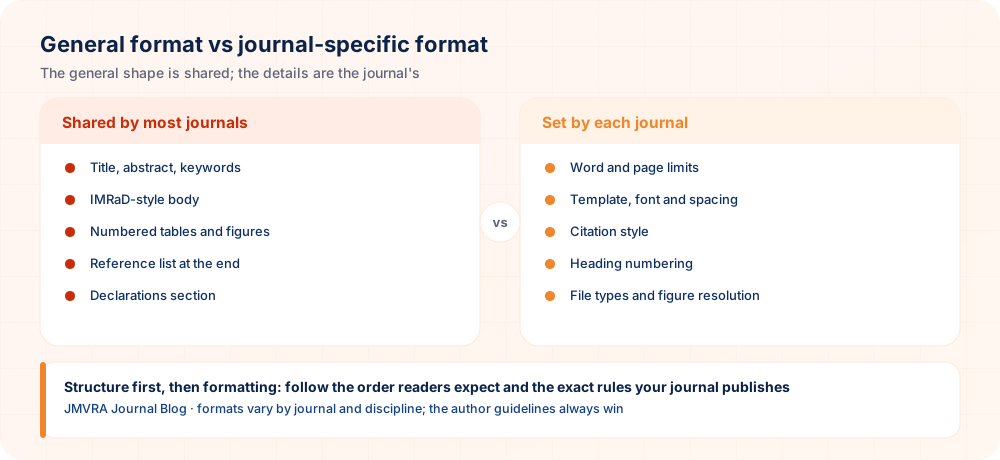
- Obtain the journal’s up-to-date template and author guidelines prior to formatting.
- Take note of word limits, section names, citation style and file requirements.
- Apply the template to your paper, then check each element against the guidelines.
- Have a co-author proofread the formatting with fresh eyes.
Formatting for JMVRA
While preparing the manuscript, follow the JMVRA publication guidelines and use the journal template and forms. A Word or PDF file can then go in through the online submission form. Also see the research paper submission checklist and cover letter templates.
JMVRA in brief
- Review: transparent, double-blind peer review, normally by at least two subject experts. Specialist reviewers assess your paper, and you receive the acceptance or rejection decision by email and WhatsApp.
- Fee: Submitting and reviewing cost nothing; after acceptance, Indian authors pay ₹971 INR and foreign authors $41 USD.
- Access: open access, free to read (CC BY 4.0); ISSN 2984-8911; a new issue every month; submit when you are ready; Crossref DOI on request.
- Indexing: JMVRA appears in Google Scholar and is registered with Crossref and the ISSN Portal / ROAD; it is not currently indexed in Scopus, Web of Science or DOAJ.
Share Your Research Through JMVRA
Bring your research to JMVRA
JMVRA (ISSN 2984-8911) is a peer-reviewed, open access journal spanning many disciplines. Submission is free. Specialist reviewers assess your paper, and you receive the acceptance or rejection decision by email and WhatsApp.
- 1. Prepare according to the guidelines
- 2. Submit online
- 3. Peer review
- 4. Decision by email & WhatsApp
- 5. Publish with open access
Your At-a-Glance Checklist
- StructureAll standard sections present
- TemplateCurrent journal template used
- LimitsWord and page limits met
- VisualsTables and figures numbered and cited
- CitationsOne style, every reference matched
- DeclarationsEthics, conflicts, funding, AI
Practical Tips for Formatting a Manuscript Cleanly
Good formatting never rescues weak research, but poor formatting can distract reviewers from strong work. These practical habits make your manuscript tidy, consistent and easy to review.
- Use a template from the start. If the journal supplies a manuscript template, write inside it from the first draft. Pasting text into a template later often breaks styles, numbering and spacing in unexpected ways.
- Apply built-in heading styles. Use your word processor's heading styles instead of manually enlarging text. Consistent styles keep the hierarchy clear and let you rearrange sections without rebuilding the layout.
- Number figures and tables in order. Cite each figure and table in the text in the sequence they appear, and give each a clear caption that makes sense on its own. Orphan visuals confuse readers.
- Check image quality and readability. Zoom into every chart and photograph to confirm labels, units and legends remain legible at print size. Fuzzy images and tiny fonts are among the most frequent reasons for returned files.
- Run a final consistency sweep. Search for variations in spelling, abbreviations, units and capitalisation, then make them uniform. A final pass by a colleague who has not seen the draft often catches what you cannot.
Format as you write, follow the journal's layout instructions exactly, and finish with a careful consistency check before uploading.
Questions Researchers Often Ask
In Summary
Format means structure combined with formatting. Order the standard sections as readers expect, choose a specific title, write an abstract that stands alone, keep tables, figures, equations and citations uniform, and above all follow the target journal’s current template and author guidelines. Reviewers can then concentrate on your research.
Paper formatted and ready? Submit it to JMVRA
JMVRA (ISSN 2984-8911) is a peer-reviewed, open access journal spanning many disciplines. Submission is free. Specialist reviewers assess your paper, and you receive the acceptance or rejection decision by email and WhatsApp.
- 1. Prepare according to the guidelines
- 2. Submit online
- 3. Peer review
- 4. Decision by email & WhatsApp
- 5. Publish with open access
References and Further Resources
Format at a Glance
- FrontTitle, abstract, keywords
- BodyIntroduction to discussion
- BackConclusion, references
- FormatTemplate and conventions
- CheckJournal guidelines
Related: Submission checklist · APA format guide · Submit Paper.
Ready to Publish? Submit to JMVRA
JMVRA is aligned with UGC's Suggested Parameters for Choosing Peer-Reviewed Journals.
JMVRA is a Transparent, Peer-Reviewed, Open Access Journal (Refereed Journal). Following the discontinuation of the UGC and UGC-CARE journal listing, and in alignment with the latest UGC-CARE recommendations and guidelines, JMVRA is aligned with UGC’s Suggested Parameters for Choosing Peer-Reviewed Journals.
Related pages on jmvra.org
Key Terms
Subjects and search phrases this article addresses.
Related Reading
Further guides on writing and formatting your paper.
Submitting a Research Paper: Checklist & Tips
Read the guide RelatedWriting an IMRaD Paper Journals Accept (2026)
Read the guide RelatedFormatting a Manuscript for Submission
Read the guide RelatedHow to Publish a Research Paper – Complete Stage-by-Stage Guide to Research Paper Publication
Read the guide RelatedJournal Cover Letters Editors Actually Read (2026)
Read the guide RelatedAPA 7th Edition Paper Format: Step-by-Step Setup
Read the guideKeep Reading on the JMVRA Blog
Published on the JMVRA journal blog, this guide gives practical direction on publishing, indexing, metrics and research integrity, with a focus on what can be verified instead of on promotion.