
Seeing strong letters is the fastest route to writing one. Here you will find a reusable template and six full example research paper cover letters for different scenarios — an original article, a student paper, an interdisciplinary study, an extended conference paper, a special issue submission and a short communication — together with a weak-to-strong rewrite and brief editor-note samples for online forms.
Understanding a Journal Submission Cover Letter
A research paper cover letter is a brief note to the journal editor sent with your manuscript. It explains what you are submitting, why the work is significant, why it suits this journal, and confirms the declarations the journal requires. For the full method and three reusable templates, see our complete cover letter guide; this page concentrates on worked examples for different situations.
Reasons Editors Ask for Cover Letters
- So they can judge fast whether the paper suits the journal.
- So the contribution is clear in everyday language.
- To verify originality, exclusivity, authorship and ethics.
- To be alerted to anything unusual, such as a conference version, a special issue or suggested reviewers.
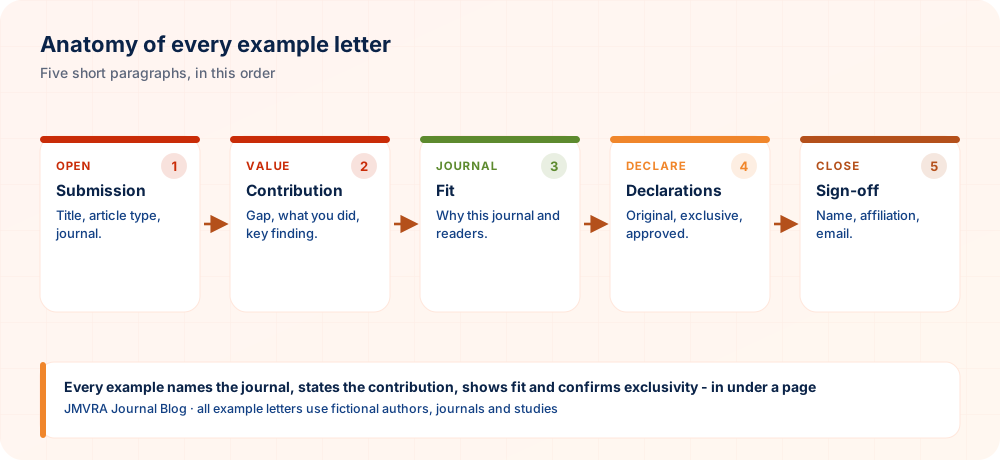
Key Elements of a Cover Letter
| Component | What to write |
|---|---|
| Submission statement | Title, article type and journal name |
| Contribution | The gap, what you did, and the key finding in one or two sentences |
| Fit | Why this journal’s scope and readers |
| Declarations | Original, not under review elsewhere, approved by all authors, conflicts, ethics, data |
| Sign-off | Corresponding author’s name, affiliation, email, ORCID iD |
Journal Submission Cover Letter Template
Dear Dr [Editor’s name],
Kindly consider our manuscript, “[Title]”, as a [article type] for [Journal name].
[One-sentence gap.] We [what you did, including the main sample or method] and found [key finding]. [Why it matters.]
The manuscript matches [Journal]’s focus on [specific scope] and should appeal to [readers].
The manuscript is original, is not being considered elsewhere, and all authors have approved it. [Conflicts, ethics, data and AI statements.]
Sincerely,
[Name, position, department, institution, email, ORCID iD]
Six Sample Cover Letters
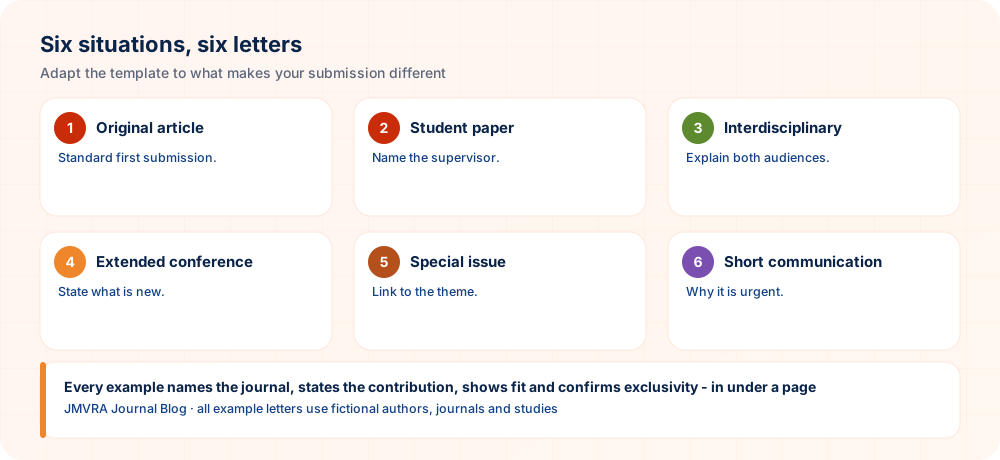
All six examples feature fictional authors, journals and studies. Note how each one adjusts the same five components to suit its situation.
Example 1: Original research article (initial submission)
Dear Dr Rao,
For the Journal of Example Environmental Studies, we offer a Research Article entitled “Seasonal Variation in Groundwater Nitrate in Semi-Arid Farming Villages”.
Nitrate contamination in village wells is widely reported, yet seasonal patterns in semi-arid farming areas are seldom measured. Sampling 48 wells across 12 months showed nitrate reaching its highest point once the principal fertiliser season ended, with a third of wells above drinking-water guidelines.
The study matches the journal’s emphasis on rural water quality and extends recent groundwater monitoring work published there. Researchers and district water planners should find it useful.
The manuscript is original, is not being considered by another journal, and all authors approve it. We declare that we have no conflicts of interest. Data can be shared if reasonably requested.
Sincerely,
Dr A. Kumar (corresponding author), Department of Environmental Science, Example University · [email protected]
Example 2: Paper from a student or project
Dear Editor,
Our submission is “A Low-Cost Soil Moisture Sensor for Small Farms: Design and Field Test”, a Research Article. It originates in a final-year engineering project under the supervision of Dr P. Shah (co-author).
We built a sensor costing less than a tenth of commercial units and trialled it on three farms for eight weeks; its readings closely matched a reference instrument.
The paper fits the journal’s applied engineering scope and could assist agricultural projects with small budgets.
The work is original and has not been submitted elsewhere; every author, our supervisor included, approves the submission. There are no conflicts of interest.
Yours sincerely,
R. Patel, B.E. student, Example Institute of Technology · [email protected]
Example 3: Interdisciplinary study
Dear Professor Iyer,
Our manuscript, “Mobile Banking Adoption and Household Savings Among Women Self-Help Groups”, is submitted with pleasure to the Journal of Example Development Studies.
The study bridges economics and social research: a survey of 412 members plus 20 interviews indicate that adopting mobile banking is associated with higher regular savings, with group trust as the mediator.
As the journal publishes interdisciplinary work on financial inclusion, we expect it to reach development economists and practitioners alike.
The manuscript is original and is not under review elsewhere. The Example University Ethics Committee granted ethics approval (no. EU/2025/114), and participants gave informed consent. There are no conflicts of interest.
Sincerely,
Dr M. Fernandes, School of Social Sciences, Example University
Example 4: Expanded version of a conference paper
Dear Dr Chen,
We are submitting “Lightweight Intrusion Detection for IoT Gateways”, an expanded version of the paper we presented at the Example Conference on Networks 2025.
Relative to the conference paper, the manuscript contributes a new dataset, two extra baseline models, an energy-consumption analysis and a thorough discussion of limitations; we estimate that more than half the content is new.
The manuscript cites the conference paper, and a copy is attached for the editor to consult. The journal’s policy on extended conference papers has been observed.
Every author approves the submission; there are no conflicts of interest.
Sincerely,
Dr S. Nair, Department of Computer Engineering, Example University
Example 5: Submission to a special issue
Dear Guest Editors,
We would like “Teacher Readiness for AI Tools in Secondary Schools” to be reviewed as part of the “Artificial Intelligence in Education” special issue.
The paper presents a survey of 280 teachers and finds training gaps that predict low readiness, speaking directly to the special issue’s theme of teacher preparation.
The manuscript is original and not being considered anywhere else, and all authors have approved it. None of us has a conflict of interest involving the guest editors.
Sincerely,
Dr K. Banerjee, Department of Education, Example University
Example 6: Short communication
Dear Editor,
We submit a Short Communication, “Early Evidence of Heat Stress Among Street Vendors in Coastal Cities”.
A rapid survey of 150 vendors during a heatwave found that two-thirds reported heat-stress symptoms while few had shade or water available. These early findings, we believe, deserve quick dissemination to inform municipal heat plans.
The work is original and stays inside the word limit the journal sets for short communications. Every author approves, and no conflicts of interest exist.
Sincerely,
Dr L. D’Souza, Department of Public Health, Example University
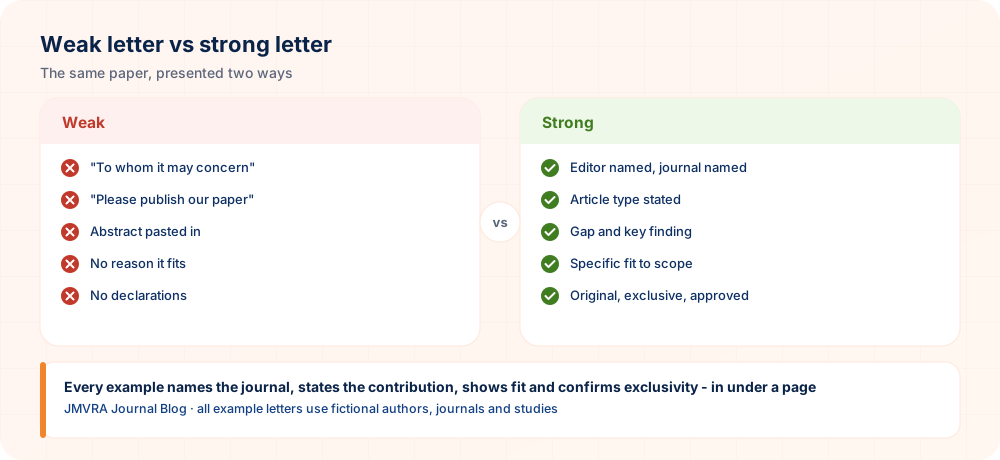
Rewriting a Weak Letter
| Weak version | Strong version |
|---|---|
| “To whom it may concern, kindly publish our research paper on water quality. This research is very important.” | “Dear Dr Rao, I would like to put forward a Research Article, ‘Seasonal Variation in Groundwater Nitrate in Semi-Arid Farming Villages’. Over 12 months, 48 wells were sampled, and a third of them showed nitrate peaking once the fertiliser season passed…” |
Declaring Originality and Exclusive Submission
Say that the manuscript is original, has not been published before, and is not being considered elsewhere. Mention any overlapping preprint, conference version or thesis, as in Example 4. Never submit to two journals simultaneously. Being upfront about overlap protects you if an editor later notices similar text.
Reviewer Suggestions and Conflicts of Interest
Propose reviewers only when the journal requests it, and choose independent experts with institutional email addresses and no conflicts. Declare your own conflicts of interest, or say that you have none.
Frequent Cover Letter Errors
- Impersonal greetings and the wrong journal or editor name.
- Pasting in the abstract rather than explaining why the work matters.
- No explanation of why the paper suits this journal.
- Absent declarations, or novelty claims you have not verified.
- Letters that run past one page.
Brief Notes for Online Submission Forms
Some systems offer a text box in place of a letter. JMVRA’s online form includes an optional Note for Editor field limited to 500 characters. Here are three compact examples:
| Situation | Example note |
|---|---|
| Original article | “Original research article on seasonal nitrate in the groundwater of semi-arid villages (48 wells, 12 months). Not being reviewed elsewhere; approved by all authors; no conflicts. Ethics not applicable (no human participants). Data provided on request.” |
| Student paper | “Paper from a final-year project that produced a cheap soil moisture sensor; co-author Dr P. Shah was the supervisor. Original, not submitted anywhere else; every author approves; no conflicts. AI was used only to edit the language, as declared before the references.” |
| Thesis-based paper | “Research article based on the first author’s PhD thesis, Chapter 3 (cited in the paper). Not being reviewed elsewhere; approved by all authors; no conflicts. Ethics approval no. EU/2025/114.” |
Last Checks Prior to Uploading
- The editor’s name and journal name are right
- Title and article type agree with the manuscript
- Contribution and fit are stated specifically
- All declarations included
- One page, proofread
Afterwards, go through the pre-submission checklist.
JMVRA in brief
- Review: transparent, double-blind peer review, normally by at least two subject experts. Specialist reviewers assess your paper, and you receive the acceptance or rejection decision by email and WhatsApp.
- Fee: An author based in India pays ₹971 INR, one based abroad pays $41 USD, and both pay only once the paper is accepted; submission and review carry no fee.
- Access: open access under CC BY 4.0; ISSN 2984-8911; a monthly issue; manuscripts accepted throughout the year; you can request a Crossref DOI.
- Indexing: JMVRA appears in Google Scholar and is registered with Crossref and the ISSN Portal / ROAD; it is not currently indexed in Scopus, Web of Science or DOAJ.
Share Your Research Through JMVRA
Publish your findings in JMVRA
JMVRA (ISSN 2984-8911) is a peer-reviewed, open access journal spanning many disciplines. Submission is free. Specialist reviewers assess your paper, and you receive the acceptance or rejection decision by email and WhatsApp.
- 1. Draft in line with the guidelines
- 2. Submit online
- 3. Peer review
- 4. Decision by email & WhatsApp
- 5. Make it open access
Your At-a-Glance Checklist
- NameEditor and journal correct
- TypeArticle type stated
- ContributionGap and key finding
- FitSpecific to scope
- DeclareOriginal, exclusive, approved
- ShortOne page
Practical Tips for Writing a Persuasive Cover Letter
A cover letter is often the first thing an editor reads, so it should help a busy person decide quickly. These tips keep yours concise, honest and tailored to the journal you are approaching.
- Name the contribution in plain words. State in a sentence or two what gap your study fills and what it adds. Avoid copying the abstract; the letter should explain why the work matters, not repeat what it contains.
- Show why this journal suits you. Mention how your topic connects to the journal's scope or readership, using specifics from its aims statement. Generic flattery is easy to spot and does little to persuade.
- Address the editor properly. Look up the correct editor's name where it is available and use a respectful greeting. A letter sent to nobody in particular suggests the same message went to many journals.
- Disclose what the editor must know. Mention related submissions, prior presentations, funding or competing interests in a straightforward way. Early disclosure builds trust, whereas discovered omissions create doubt about the whole manuscript.
- Proofread it like the manuscript. Read the letter aloud, check the journal and paper titles for exactness and confirm contact details. Small slips in a short letter look especially careless.
Keep the letter short, specific and truthful, and let it show the editor why your paper belongs in their journal.
Questions Researchers Often Ask
In Summary
A research paper cover letter is brief yet strategic: name the journal and article type, state your contribution, demonstrate fit, include every declaration and close clearly. Treat the template and six examples as models, adjust them to your circumstances, and limit the letter to one page. Reading it aloud once usually exposes clumsy phrasing that silent proofreading misses.
Ready for publication? Submit your manuscript to JMVRA
JMVRA (ISSN 2984-8911) is a peer-reviewed, open access journal spanning many disciplines. Submission is free. Specialist reviewers assess your paper, and you receive the acceptance or rejection decision by email and WhatsApp.
- 1. Draft in line with the guidelines
- 2. Submit online
- 3. Peer review
- 4. Decision by email & WhatsApp
- 5. Make it open access
References and Further Resources
Cover Letter Overview
- SubmitTitle, type, journal
- ContributeGap and finding
- FitScope and readers
- DeclareOriginal, exclusive
- SignContact details
Related: Complete guide · Submission checklist · Submit Paper.
Ready to Publish? Submit to JMVRA
JMVRA is aligned with UGC's Suggested Parameters for Choosing Peer-Reviewed Journals.
JMVRA is a Transparent, Peer-Reviewed, Open Access Journal (Refereed Journal). Following the discontinuation of the UGC and UGC-CARE journal listing, and in alignment with the latest UGC-CARE recommendations and guidelines, JMVRA is aligned with UGC’s Suggested Parameters for Choosing Peer-Reviewed Journals.
Quick links across jmvra.org
Key Terms
Subjects and search phrases this article addresses.
Related Reading
Further guides for preparing your submission.
Journal Cover Letters Editors Actually Read (2026)
Read the guide RelatedSubmitting a Research Paper: Checklist & Tips
Read the guide RelatedResearch Paper Structure & Formatting Guidelines
Read the guide RelatedHow to Publish a Research Paper: Start to Finish
Read the guide RelatedResponding to Reviewer Comments: Letter Templates
Read the guide RelatedCommon Rejection Reasons and How to Avoid Them
Read the guideKeep Reading on the JMVRA Blog
Our JMVRA journal blog carries this guide along with other practical advice on publishing, indexing, metrics and research integrity, all written so that claims can be verified and nothing is promotional.