
What indexes, search engines and citation databases actually consume is article metadata. One incorrect field on a journal site can be copied into every service that harvests it. Here is a checklist of required article fields, persistent identifiers, Google Scholar citation meta tags (with an example), landing-page rules, other formats including Dublin Core, schema.org, OAI-PMH, Crossref XML and JATS, and an approach to auditing your metadata.
Why a Checklist
Your journal article metadata, and not the PDF, is what indexes, search engines, citation databases and reference managers read. A field that is wrong or absent on your site stays wrong in every place that copies it. Earlier guides cover why metadata matters (journal article metadata and DOI, ISSN and metadata); this one is a hands-on checklist of the fields and formats a journal ought to produce.
The Core Fields
| Field | Required? | Quality tip |
|---|---|---|
| Article title | Yes | Standard capitalisation; no closing punctuation |
| Authors | Yes | Full names in sequence, in a consistent format; ORCID iDs |
| Affiliations | Recommended | Names of institutions, with ROR IDs when available |
| Abstract | Recommended | Plain text rather than images; identical to the article |
| Key Terms | Recommended | Specific terms rather than repetitions of the title |
| Journal title and ISSN | Yes | Exactly as registered |
| Volume, issue and pages or article number | Yes | Matches the PDF |
| Publication date | Yes | Online publication date; the same everywhere |
| DOI | If registered | Complete https://doi.org/ link shown on the page |
| Licence | Recommended | Licence URL, for example CC BY 4.0 |
| References | Recommended | Structured and carrying DOIs in Crossref deposits |
| Funding | If applicable | Names of funders and award numbers |
Persistent Identifiers
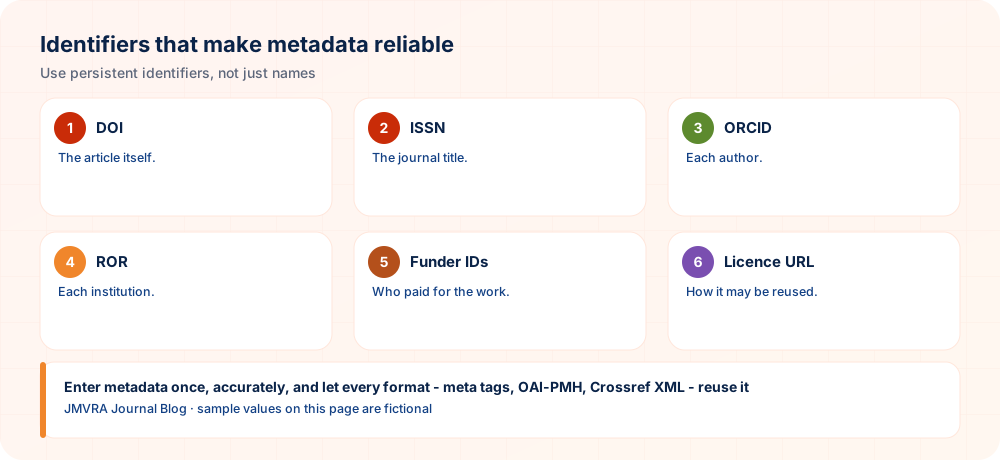
A name can be ambiguous; an identifier cannot. Assign a DOI to each article, an ISSN to the journal, an ORCID iD to each author (see ORCID iD for researchers), a ROR ID to each institution, and identifiers for funders and licence URLs. Verify that every identifier resolves to the right record before publishing.
Meta Tags for Google Scholar Citations
The inclusion guidelines from Google Scholar suggest Highwire Press-style citation_ meta tags within the <head> of every article page. Here is a made-up example:
<meta name="citation_title" content="Groundwater Nitrate in Semi-Arid Villages">
<meta name="citation_author" content="Rao, Anil">
<meta name="citation_author" content="Mehta, Sara">
<meta name="citation_publication_date" content="2026/10/10">
<meta name="citation_journal_title" content="Journal of Example Studies">
<meta name="citation_issn" content="0000-0000">
<meta name="citation_volume" content="14">
<meta name="citation_issue" content="10">
<meta name="citation_firstpage" content="45">
<meta name="citation_lastpage" content="60">
<meta name="citation_pdf_url" content="https://journal.example.org/papers/JES2610045.pdf">
Give each author their own citation_author tag, in sequence. Values need to agree with what appears on the page and in the PDF.
Rules for Article Landing Pages
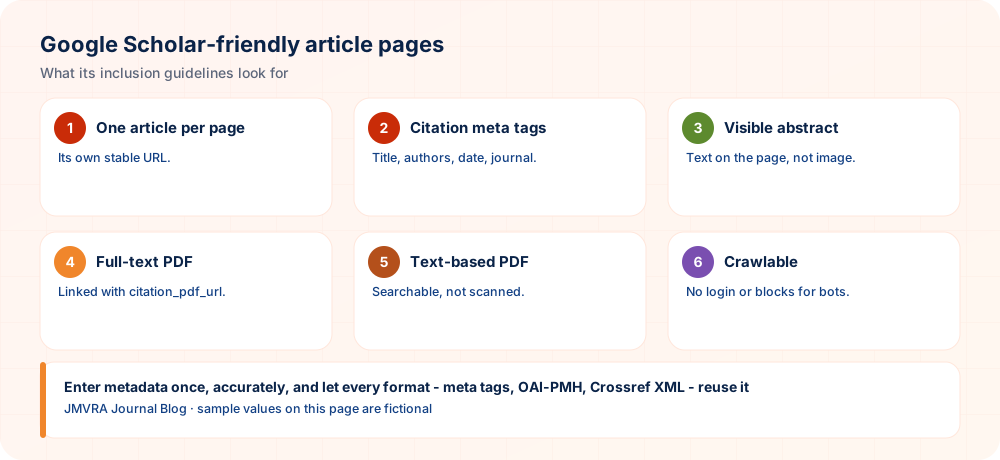
Every article needs a stable page of its own showing the title, authors, abstract and a link to the full text. Make PDFs text-based rather than scanned images, and let robots crawl both article pages and PDFs. See Google Scholar indexing.
Other Metadata Formats
| Format | Where | Read by |
|---|---|---|
| Dublin Core meta tags (DC.*) | Article page head | Certain search engines and repositories |
| schema.org ScholarlyArticle (JSON-LD) | Article page | General search engines |
| OAI-PMH (oai_dc among others) | An endpoint hosted on your site | Indexes, aggregators, repositories |
| Crossref XML | Deposited to Crossref | Crossref plus everything that builds on it |
| JATS XML | Full-text archives or deposits | Archives and certain indexes |
With OAI-PMH, services can collect your metadata automatically, and OJS includes it as standard. To learn about JATS, read what JATS XML is; for Crossref deposits, read Crossref DOI registration for journals.
One Source of Truth
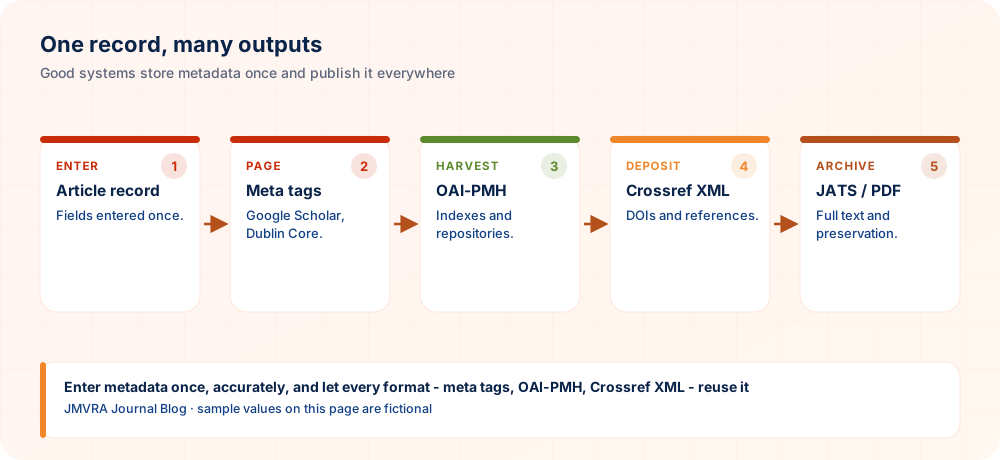
Enter each article’s metadata one time in your journal system and produce every output from it: page tags, OAI-PMH, Crossref XML. Mismatches arise when values are copied by hand into several places.
Common Metadata Errors
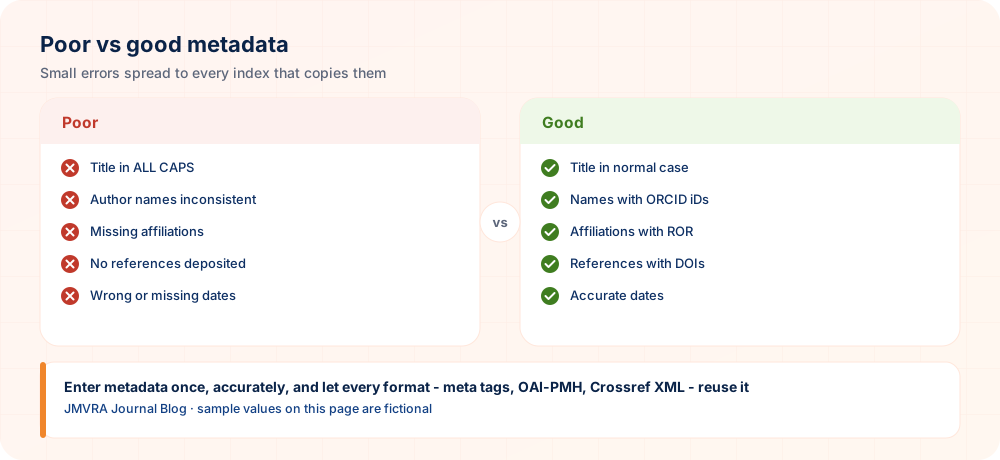
- Titles in capital letters, or showing visible HTML codes.
- Authors listed one way on the page and another in the PDF and the deposit.
- Page numbers or dates differing from the PDF.
- Abstracts absent from the page, or displayed only as an image.
- References that were never deposited, leaving citations unlinked.
Carry Out a Metadata Audit
- Selectten recent articles
- View the sourceand inspect the citation tags
- Comparetags, page and PDF
- Testevery DOI through doi.org
- Pullrecords from your OAI-PMH endpoint
- Correcterrors in the source record
What Authors Can Do
Authors can help at submission by using the same full name every time, adding ORCID iDs, stating affiliations correctly, and supplying a tidy abstract and a complete reference list with DOIs. See how to write references. Doing this once, carefully, saves corrections later.
Metadata at JMVRA
Each JMVRA article has its own page and is indexed in Google Scholar, while Crossref DOIs can be requested. Anyone running a journal can read the JMVRA network’s new journal guide for DOIs and set-up.
JMVRA in brief
- Review: transparent, double-blind peer review, normally by at least two subject experts. Specialist reviewers assess your paper, and you receive the acceptance or rejection decision by email and WhatsApp.
- Fee: The charge of ₹971 INR (Indian authors) or $41 USD (foreign authors) falls due on acceptance; submitting a paper and having it reviewed cost nothing.
- Access: open access under CC BY 4.0; ISSN 2984-8911; issued monthly; papers welcome at any time; Crossref DOI on request.
- Indexing: JMVRA appears in Google Scholar and is registered with Crossref and the ISSN Portal / ROAD; it is not currently indexed in Scopus, Web of Science or DOAJ.
Share Your Research Through JMVRA
Place your research in JMVRA
JMVRA (ISSN 2984-8911) is a peer-reviewed, open access journal spanning many disciplines. Submission is free. Specialist reviewers assess your paper, and you receive the acceptance or rejection decision by email and WhatsApp.
- 1. Set up your paper using the guidelines
- 2. Submit online
- 3. Peer review
- 4. Decision by email & WhatsApp
- 5. Finish with open access publication
Your At-a-Glance Checklist
- FieldsFull and correct
- IDsDOI, ORCID, ROR
- Tagscitation_ in head
- PageSingle article, permanent URL
- OAI-PMHHarvestable
- AuditCompare with the PDF
Preparing Clean Article Metadata Before Your Paper Goes Live
Good metadata decides whether readers and search engines can find your article. Authors can improve it greatly with a few careful checks during submission and proof stages.
- Spell your name consistently. Use the same form of your name, affiliation and email in every paper. Consistency allows citation systems to group your work correctly under one author profile.
- Register a persistent author identifier. Create a researcher identifier and add it to your submission. It separates you from authors with similar names and travels with your work across platforms.
- Write a searchable title and abstract. Place the main concepts early in the title and keep the abstract self-contained. Clear wording helps both people and indexing software understand what the article offers.
- Check proofs for metadata errors. When proofs arrive, inspect the title, author order, affiliations and keywords, not just the body text. Correcting an error now is easier than requesting a correction later.
Keep names, identifiers, keywords and affiliations accurate and consistent, and verify them carefully at proof stage.
Questions Researchers Often Ask
In Summary
How far your articles reach depends on their metadata. Record complete and correct fields with persistent identifiers, publish them as meta tags on stable article pages, make them available through OAI-PMH and Crossref, keep a single source of truth, and audit it on a schedule. Minor corrections at the source lift discovery on every platform. A short recurring check catches drift before it spreads.
Prepared your paper? Submit it to JMVRA today
JMVRA (ISSN 2984-8911) is a peer-reviewed, open access journal spanning many disciplines. Submission is free. Specialist reviewers assess your paper, and you receive the acceptance or rejection decision by email and WhatsApp.
- 1. Set up your paper using the guidelines
- 2. Submit online
- 3. Peer review
- 4. Decision by email & WhatsApp
- 5. Finish with open access publication
References and Further Resources
Metadata Quick View
- FieldsComplete
- IDsPersistent
- Tagscitation_*
- HarvestOAI-PMH
- AuditRegularly
Related: Why metadata matters · JATS XML · Submit Paper.
Ready to Publish? Submit to JMVRA
JMVRA is aligned with UGC's Suggested Parameters for Choosing Peer-Reviewed Journals.
JMVRA is a Transparent, Peer-Reviewed, Open Access Journal (Refereed Journal). Following the discontinuation of the UGC and UGC-CARE journal listing, and in alignment with the latest UGC-CARE recommendations and guidelines, JMVRA is aligned with UGC’s Suggested Parameters for Choosing Peer-Reviewed Journals.
Where to go next on jmvra.org
Key Terms
Subjects and search phrases this article addresses.
Related Reading
Further guides covering metadata, indexing and journal websites.
The Importance of Journal Article Metadata: Title, Authors, Abstract, DOI and References
Read the guide RelatedHow DOI, ISSN & Metadata Drive Citations
Read the guide RelatedJATS XML: Why Article Markup Matters
Read the guide RelatedA Step-by-Step Guide to Making Your Research Paper Discoverable in Google Scholar
Read the guide RelatedPages Every Academic Journal Website Needs
Read the guide RelatedIndexing a New Journal: The Realistic Order
Read the guideKeep Reading on the JMVRA Blog
Find this guide on the JMVRA journal blog, a collection of practical guidance on publishing, indexing, metrics and research integrity that favours verifiable content over promotion.