
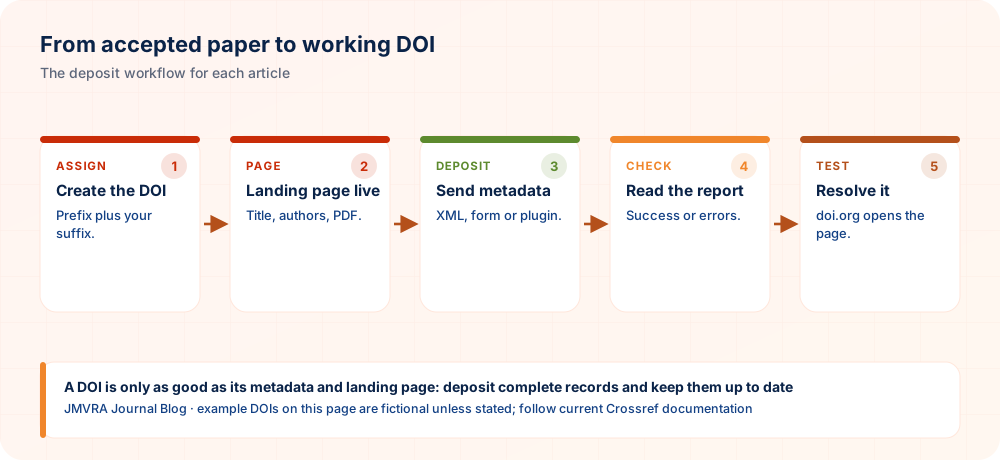
Obtaining a Crossref prefix is just the first step. After that, each article needs a DOI deposited with full metadata, a working landing page, a reviewed submission report and updates whenever details change. This guide covers Crossref DOI registration for journals once you hold a prefix: suffix schemes, required metadata, deposit methods, error reports, updates, member obligations and costs. Planning your workflow before the first deposit saves repeated corrections later.
The Starting Point of This Guide
How to obtain a Crossref DOI prefix, whether directly or through a sponsor member, is explained in how a journal gets Crossref DOIs and the start a new journal and Crossref DOI guide. This guide picks up right afterwards: with a prefix in hand, you now need to register DOIs properly for each article, keep them resolving and fulfil Crossref’s obligations.
Parts of a DOI for Journals
Every DOI consists of a prefix (given to your organisation and starting with 10.) and a suffix (which you decide). A journal prefix could resemble 10.5555, which is Crossref’s documented test prefix. Readers should always be shown the complete link form: https://doi.org/10.xxxxx/suffix. See DOI for research papers.
Step 1: Pick a Suffix Scheme
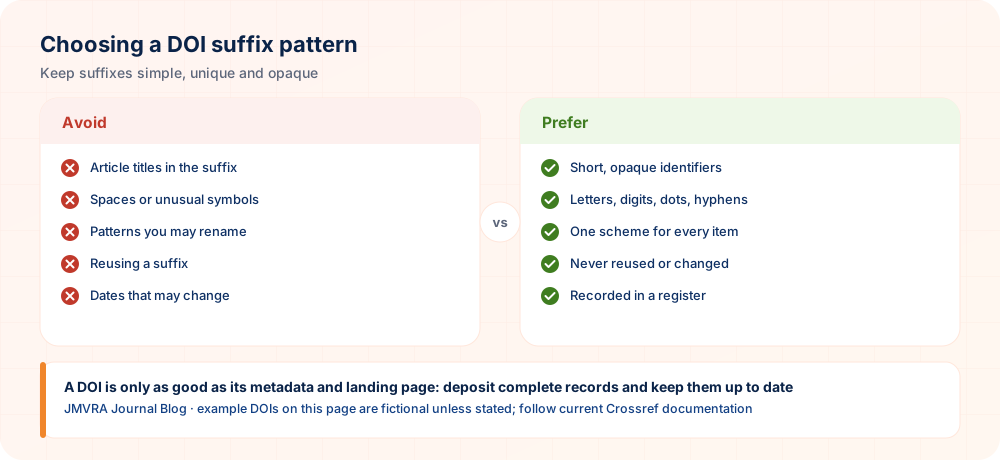
Settle on one scheme before the first deposit, for instance journalabbr.2026.0001 (fictional). Maintain a register of every DOI issued. A DOI must never be reused or assigned to different content, even when a paper is withdrawn.
Step 2: Assemble Complete Metadata
| Field | Notes |
|---|---|
| Journal title, ISSN | Precisely as registered, with both online and print ISSNs where they exist |
| Article title | Final published title |
| Contributors | Every author in sequence, with ORCID iDs and affiliations when available |
| Publication date | The online date, and the print date if one applies |
| Volume, issue and page range or article number | Matching what the article page shows |
| The DOI together with its resource URL | The landing page that the DOI is meant to open |
| Abstract, licence, references | Highly advisable to aid discovery and reuse |
| Funding information | Funder names and grant numbers where relevant |
More complete metadata makes articles easier to discover. See the journal article metadata checklist.
Step 3: Select a Deposit Method
| Method | Suits | Watch out for |
|---|---|---|
| Web deposit form | Small journals depositing a few articles at once | Manual typing errors |
| XML upload | Batch deposits with complete control over fields | Valid schema and correct encoding |
| A plugin for journal software (e.g. OJS) | Journals that already run on OJS or similar | Setting up the plugin and its credentials |
| Via a service provider | Journals that lack technical staff | Who owns the records and keeps them up to date |
Current tools are listed in the Crossref documentation.
Step 4: Put the Landing Page Live First
The URL behind a DOI has to open a working article landing page that shows at minimum the title, authors, journal and DOI, along with access to the full text or abstract. Never point DOIs to a PDF file or to the journal homepage. A stable, permanent URL structure reduces the chance of broken links as the site grows.
Step 5: Review Each Submission Report
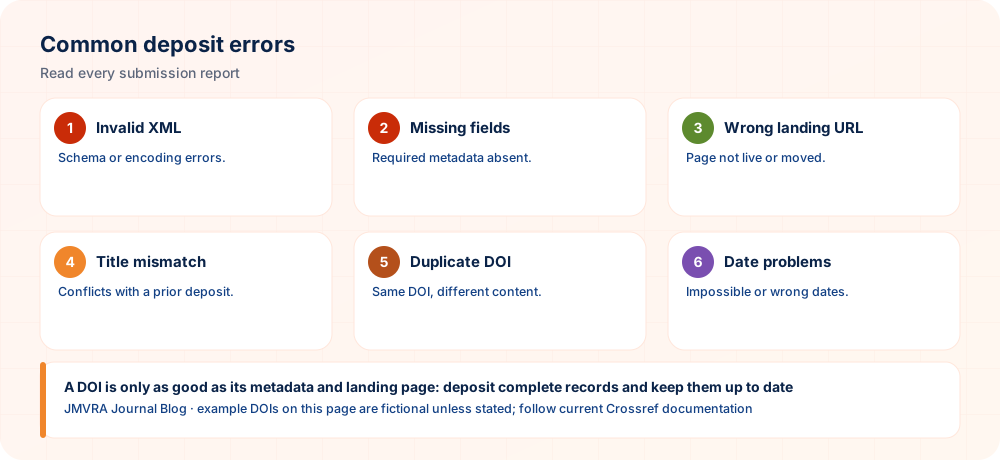
Every deposit produces a Crossref report, and the deposit counts as unfinished until that report says it succeeded. Fix whatever errors appear, redeposit, and then confirm that the DOI works at doi.org. See how to check a DOI works.
Updating and Correcting Your Records
- To fix metadata, redeposit the complete record under the same DOI with the amended fields.
- When the website is moved or redesigned, update every resource URL so that DOIs continue to resolve.
- Corrections and retractions receive separate notices and metadata; see corrections and retractions.
Crossref Member Obligations
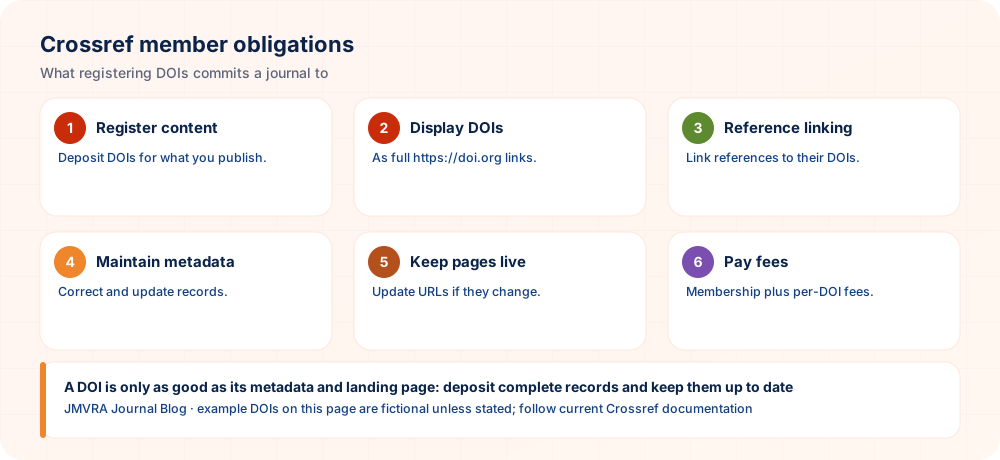
Joining Crossref carries responsibilities: register the content you publish, show DOIs as links, connect references to their DOIs wherever possible, keep metadata and landing pages current, and pay membership and registration fees. Sponsored members are bound by the same obligations as all other members.
Costs to Plan For
| Item | Amount |
|---|---|
| Crossref membership | A yearly fee based on revenue tier, beginning at $200 (see Crossref fees) |
| Content registration | $1 for each current-year journal article DOI, and $0.15 for back-file content |
| Through a sponsor | The sponsor settles Crossref’s charges and typically bills the journal for the service |
| Time from staff or a service provider | Metadata preparation, deposits, checks and updates |
Look at Crossref’s fees page for up-to-date figures before you budget.
Mistakes to Avoid
- Printing a DOI on the PDF when it was never deposited.
- Altering URLs without updating Crossref, which breaks DOIs.
- Depositing bare-minimum metadata that omits references, abstracts or ORCID iDs.
- Assigning an existing DOI to a different article.
- Overlooking submission reports and conflict notices.
Support Available Through the JMVRA Network
JWDOI (jwdoi.org) helps journals obtain a DOI prefix through a Crossref sponsor member and supports their deposits, drawing on many years of journal publishing experience. Its published rates are ₹3,990 for prefix setup (waived with JWJMS hosting), ₹4,375 for 25 DOIs or ₹10,500 for 70 DOIs, with 18% GST on top. Refer to the Crossref DOI guide for new journals. For DOIs on JMVRA articles, see JMVRA DOI services.
JMVRA in brief
- Review: transparent, double-blind peer review, normally by at least two subject experts. Specialist reviewers assess your paper, and you receive the acceptance or rejection decision by email and WhatsApp.
- Fee: Indian authors pay ₹971 INR and foreign authors $41 USD, but only after a paper has been accepted; there is no charge to submit or to be reviewed.
- Access: papers are open access under CC BY 4.0; the ISSN is 2984-8911; a new issue comes out monthly; you may submit whenever you like; a Crossref DOI is available if you ask.
- Indexing: JMVRA appears in Google Scholar and is registered with Crossref and the ISSN Portal / ROAD; it is not currently indexed in Scopus, Web of Science or DOAJ.
Share Your Research Through JMVRA
Get your research published in JMVRA
JMVRA (ISSN 2984-8911) is a peer-reviewed, open access journal spanning many disciplines. Submission is free. Specialist reviewers assess your paper, and you receive the acceptance or rejection decision by email and WhatsApp.
- 1. Follow the guidelines when preparing
- 2. Submit online
- 3. Peer review
- 4. Decision by email & WhatsApp
- 5. Go live in open access
Your At-a-Glance Checklist
- SuffixA single opaque scheme
- PageOnline prior to deposit
- MetadataComplete fields
- ReportSuccess confirmed
- ResolveChecked at doi.org
- UpdateWhenever something changes
Practical Tips for Running a Journal DOI Deposit Workflow
Registering identifiers is routine work for editors, yet small slips can leave broken links for years. These working habits suit editorial teams who handle deposits themselves or through a technical partner.
- Test with a sample batch. Before depositing a whole issue, send a small sample through the testing environment if one is offered. Mistakes in markup are far cheaper to correct before real records exist.
- Keep a deposit register. Maintain a spreadsheet that lists each article, its identifier, the deposit date and the result. When a reader reports a dead link, you can trace the problem in minutes.
- Match metadata to the published page. Titles, author names and affiliations in the deposit should read exactly as they appear on the article page. Differences confuse indexing services and create duplicate records.
- Assign a backup person. Name a second editor who knows the login, the contact address and the renewal routine. Journals often lose control of records when the only trained person leaves.
- Review error reports promptly. Read each response message after every deposit and fix warnings as well as outright errors. Unattended warnings tend to build up into a messy, inconsistent archive.
Treat identifier registration as a checked, documented process with a named owner, never as a last-minute upload.
Questions Researchers Often Ask
In Summary
DOI registration is a continuing duty rather than a single job. Pick a stable suffix scheme, put landing pages online first, deposit full metadata, check each submission report, test that links resolve, and revise records whenever details or URLs change. If handled well, your DOIs keep every article findable and citable for decades. A simple log of every deposit makes later corrections much easier.
Want to get published? Send your paper to JMVRA
JMVRA (ISSN 2984-8911) is a peer-reviewed, open access journal spanning many disciplines. Submission is free. Specialist reviewers assess your paper, and you receive the acceptance or rejection decision by email and WhatsApp.
- 1. Follow the guidelines when preparing
- 2. Submit online
- 3. Peer review
- 4. Decision by email & WhatsApp
- 5. Go live in open access
References and Further Resources
A Quick View of DOI Registration
- SuffixOpaque, unique
- PageLive first
- DepositComplete metadata
- ReportCheck it
- MaintainUpdate records
Related: Getting a prefix · Start a journal · Submit Paper.
Ready to Publish? Submit to JMVRA
JMVRA is aligned with UGC's Suggested Parameters for Choosing Peer-Reviewed Journals.
JMVRA is a Transparent, Peer-Reviewed, Open Access Journal (Refereed Journal). Following the discontinuation of the UGC and UGC-CARE journal listing, and in alignment with the latest UGC-CARE recommendations and guidelines, JMVRA is aligned with UGC’s Suggested Parameters for Choosing Peer-Reviewed Journals.
Helpful pages on jmvra.org
Key Terms
Subjects and search phrases this article addresses.
Related Reading
Further guides covering DOIs, Crossref and metadata.
How Journals Obtain Crossref DOIs
Read the guide RelatedA Checklist for Confirming That a Journal DOI Resolves and Its Metadata Is Correct
Read the guide RelatedCrossref DOI or Repository DOI: Which Fits Your Paper?
Read the guide RelatedFinding and Verifying a Research Paper's DOI
Read the guide RelatedHow DOI, ISSN & Metadata Drive Citations
Read the guide RelatedCrossref & DataCite DOIs: What a DOI Is and How to Deposit and Resolve It
Read the guideKeep Reading on the JMVRA Blog
This guide belongs to the JMVRA journal blog, which offers practical advice on publishing, indexing, metrics and research integrity, written to be checkable instead of promotional.