

Some of the most useful studies today sit between departments, such as machine learning applied to crop yields, behavioural economics in public health, or IoT for water management. Such innovative, multidisciplinary work is valuable, yet it is harder to place, since specialist journals may regard it as “not quite our field”. This overview explains what makes work truly multidisciplinary, how to write it for readers from mixed backgrounds, and why multidisciplinary journals are frequently its natural home. Knowing this early helps you pick a journal that reads your work in full rather than only at its edges.
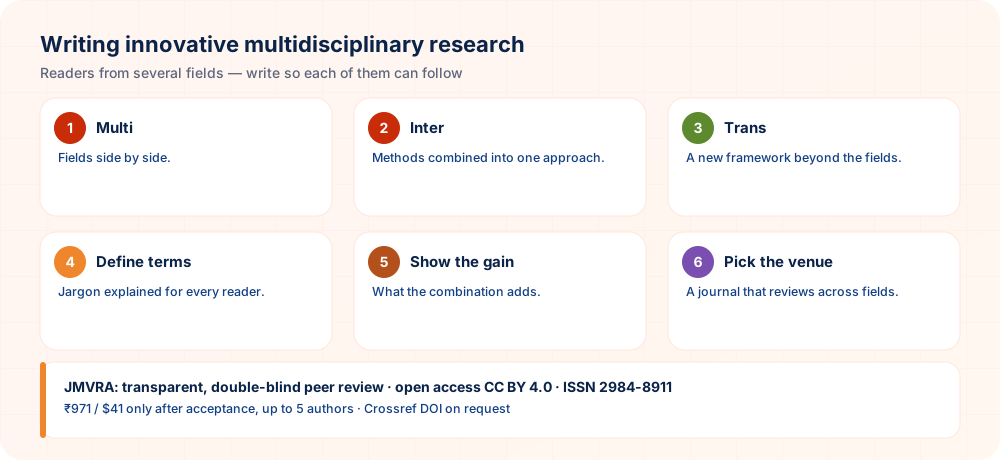
Comparing Multi-, Inter- and Transdisciplinary Research
| Term | Meaning | Example |
|---|---|---|
| Multidisciplinary | Each discipline adds its own perspective | An environmental study whose chemistry and economics parts are written separately |
| Interdisciplinary | Methods and concepts are blended between fields | A model that joins hydrology with machine learning |
| Transdisciplinary | Academics and partners outside academia build knowledge together | A public-health initiative run with community groups |
When Research Counts as “Innovative”
- Either an unasked question or a familiar one explored in a fresh context
- A technique taken from a different discipline that cracks a persistent problem
- Fresh data that shifts existing understanding
- A workable solution backed by measured outcomes in real settings
Writing for an Audience Across Disciplines
- Explain each term once, in plain words. What is routine for an engineer might be unfamiliar to an economist.
- Justify every field involved. Make clear what each discipline brings.
- Pick a single, clear structure. IMRaD suits the majority of fields.
- Describe methods in full. Readers cannot take for granted norms from a field they do not know.
The Review of Such Work at Multidisciplinary Journals
Editors commonly invite reviewers from every field involved, or one reviewer who spans them. Comments may come from varied angles and occasionally conflict, so respond to each separately and describe how you weighed them against each other. A calm, point-by-point response letter helps the editor see that you took every viewpoint seriously.
The Best Home for This Kind of Work
Multidisciplinary journals
A wide scope together with reviewers from various disciplines.
Applied specialist journals
When a single field clearly carries the contribution.
Interdisciplinary society journals
Cases where a bridging field between two areas has established journals of its own.
Drafting an Abstract for a Two-Field Readership
A sample for a study that spans fields:
Spotting crop disease on smallholder farms depends on visual checks, which are slow and prone to error. We trained a lightweight convolutional neural network — a machine-learning model for images — using 12,400 field photographs of tomato leaves from three Indian states. Running on a mobile phone without internet access, the model recognised six common diseases with 94% accuracy. This approach could offer farmers a same-day diagnosis at negligible cost.
Observe how the technical term is explained in a single phrase and how the final sentence states a practical result; each helps readers who are not from computing.
The 10 Most-Searched Questions on This Topic
Here are the ten questions researchers search for most on this subject, each with a direct answer.
international journal for innovative research in multidisciplinary field
A journal covering many disciplines that publishes original cross-field studies from across the globe.
multidisciplinary research meaning
Studies that draw on multiple disciplines, with each adding its own viewpoint.
interdisciplinary vs multidisciplinary
Interdisciplinary work merges methods from different fields, whereas multidisciplinary work keeps them next to each other.
transdisciplinary research
Studies developed jointly with partners outside academia to tackle practical problems.
innovative research paper topics
Problems in one field that are resolved using a method or data from another.
how to write interdisciplinary paper
Clarify terminology, state what each field contributes, adopt a clear structure and report methods completely.
multidisciplinary journal review process
Reviewers who come from varied fields or who combine several areas of expertise.
publish interdisciplinary research
Aim for multidisciplinary or bridging journals whose readers appreciate the blend of fields.
applied research journal
Journals that emphasise real-world application and measurable results.
cross disciplinary research examples
Examples include AI for farming, economics applied to health, and IoT for managing water.
How JMVRA Fits In
JMVRA is a Transparent, Peer-Reviewed, Open Access Journal (Refereed Journal). Following the discontinuation of the UGC and UGC-CARE journal listing, and in alignment with the latest UGC-CARE recommendations and guidelines, JMVRA is aligned with UGC’s Suggested Parameters for Choosing Peer-Reviewed Journals. UGC public notice (PDF)
JMVRA began as a multidisciplinary journal and invites innovative work that spans fields, assigning reviewers according to each paper’s subject areas.
- ISSN
- 2984-8911 (online) · publishing since June 2023
- Issues
- Monthly issues across many disciplines
- Review
- Two-way anonymous review by specialists
- Access
- Free to read, CC BY 4.0 licence
- Fee
- ₹971 INR for Indian and $41 USD for foreign authors, due only after acceptance
- DOI
- Crossref — available as an optional extra
- Indexing
- Present in Google Scholar; not present in Scopus, Web of Science or DOAJ
- Impact factor
- 11.25, derived from Google Scholar data
Screening begins the moment a paper arrives and each decision is sent as soon as it is reached, yet JMVRA never promises a set number of days: actual review time depends on the reviewers and on how much revision the paper needs.
At-a-Glance Checklist
- Type of integration namedWhether multi, inter or trans
- Terminology explainedCovering every field
- Methods backed upAcross all disciplines
- Contribution spelled outThe new element
- Wide journal scopeReview across disciplines
Assembling a Multidisciplinary Research Team
Shared question
Settle on the problem first, then select methods.
Common vocabulary
Pin down words whose meaning varies from one field to another.
Clear roles
Assign who takes charge of each part and who drafts each section.
Fair credit
Settle authorship and author order at an early stage.
Getting Ready for Reviewers Across Disciplines
- Describe the methods of every field — reviewers probably know only one of them
- Defend the integration — demonstrate what joining the approaches gains
- Write in accessible language — steer clear of jargon that just one field follows
- Propose fitting reviewers — people with matching expertise, if the journal welcomes suggestions
Collaboration Tips for Innovative Multidisciplinary Research Projects
Work that crosses disciplinary boundaries succeeds when collaborators understand each other before they write together. These habits help teams from different fields build a shared project and a shared paper.
- Agree on key terms together. The same word can mean different things in different fields. Make a short glossary early so everyone uses vocabulary consistently in data collection, analysis and writing.
- Name each partner's contribution. State clearly what each discipline brings to the question. Explicit roles prevent disputes later and help readers see why the combination is valuable.
- Respect different evidence standards. Fields judge proof differently, from experiments to case studies. Discuss early how your combined study will justify its conclusions so that no partner feels sidelined.
- Test your draft on an outsider. Ask a researcher from a neighbouring field to read the introduction. If they cannot see the question or the benefit, the framing needs work.
- Agree authorship before writing. Discuss author order, corresponding responsibilities and credit while goodwill is high. Early clarity prevents friction when the manuscript is nearly ready.
Build shared language and clear roles at the start, so that the final paper reads as one coherent study.
Questions Researchers Often Ask
The Parts of a Research Paper
Usual proportions for an empirical paper — guidance rather than a fixed rule.
- BackgroundUse 1–2 sentences to point out the gap.
- ObjectiveSay what question or hypothesis you set out to answer.
- MethodsOutline the study design, data sources and tools.
- ResultsMain outcomes, quantified.
- In SummaryWhat it means.
- Key Terms4–6 searchable terms.
Leave the abstract until last: about 150–250 words is enough for all five parts. Complete rules appear in JMVRA Publication Guidelines.
Ready to Publish? Submit to JMVRA
JMVRA is aligned with UGC's Suggested Parameters for Choosing Peer-Reviewed Journals.
JMVRA is a Transparent, Peer-Reviewed, Open Access Journal (Refereed Journal). Following the discontinuation of the UGC and UGC-CARE journal listing, and in alignment with the latest UGC-CARE recommendations and guidelines, JMVRA is aligned with UGC’s Suggested Parameters for Choosing Peer-Reviewed Journals.
Pages worth visiting on jmvra.org
Key Terms
Subjects and search phrases this article addresses.
Related Reading
Further reading on the same theme from the JMVRA blog.
Reading a Turnitin Similarity Report Correctly
Read the guide RelatedPublishing Services: Legitimate Help vs Red Flags
Read the guide RelatedTypes of Research Journals and Articles
Read the guide RelatedFormatting a Manuscript for Submission
Read the guide RelatedJournal Finder — Quickly Find a Dependable, Low-Cost, UGC CARE-Aligned Journal
Read the guide RelatedAbstract Writing: What Every Sentence Must Do
Read the guideKeep Reading on the JMVRA Blog
As part of the JMVRA journal blog, this guide shares practical help on publishing, indexing, metrics and research integrity, and is written to be verifiable rather than promotional.