
Editors increasingly check ethics before they check science. A paper with human participants, patient records or animals can be returned unread if it lacks a clear statement on ethics approval and informed consent, and approval cannot be obtained after the fact. This guide explains who reviews research, when approval or an exemption is needed, what valid consent involves, how to deal with vulnerable groups, retrospective data and anonymisation, and how to word the ethics statement, with attention to India’s ICMR guidelines.
Why journals ask about ethics
A journal that publishes unethical research shares responsibility for it. That is why the ICMJE recommendations, the World Medical Association’s Declaration of Helsinki and COPE guidance all expect authors to state that studies involving people were reviewed by an independent ethics committee and that participants gave informed consent, or that a committee formally waived it.
Editors cannot inspect your fieldwork, so the ethics statement is their evidence. They look for four things:
- the name of the committee and the institution it belongs to;
- the approval or reference number and date;
- the type of consent obtained (written, oral, electronic) or the reason it was waived;
- for clinical trials, the registration number.
Vague statements such as “ethical norms were followed” are a common reason for papers being returned before review. Journal policies on this are usually set out alongside authorship and plagiarism rules, as in the JMVRA ethics policy.
IRB, IEC, REC: who reviews research
Different countries use different names for the same body. In the United States it is an Institutional Review Board (IRB); in India an Institutional Ethics Committee (IEC); in the UK and Europe a Research Ethics Committee (REC). Animal research has its own committees, such as the Institutional Animal Ethics Committee (IAEC) in India.
In India, the ICMR National Ethical Guidelines for Biomedical and Health Research Involving Human Participants (2017) set out how committees should be constituted and how they review studies. Committees reviewing biomedical and health research are expected to register with the Department of Health Research, and committees reviewing clinical trials of drugs must also register with the Central Drugs Standard Control Organisation under the New Drugs and Clinical Trials Rules, 2019. Animal experiments fall under the Committee for Control and Supervision of Experiments on Animals (CCSEA).
Three rules hold almost everywhere:
- Approval must come before recruitment or data collection begins.
- Significant changes to the protocol, tools or consent forms need an amendment approval.
- Multi-centre studies may need approval from each site’s committee, unless a recognised common review arrangement applies.
When approval is needed and when it may be exempt
The table shows typical routes under the ICMR system of exemption, expedited review and full committee review. Your committee decides the category for your study, not you.
| Type of research | Usual route | Notes |
|---|---|---|
| Clinical trial or intervention study | Full committee review | Trial registration (e.g. CTRI in India) before enrolment |
| Survey or interviews on sensitive topics | Full or expedited review | Mental health, sexuality, illegal behaviour, workplace power |
| Anonymous survey of adults on non-sensitive topics | Expedited review or exemption | Committee must confirm; keep the letter |
| Retrospective review of patient records | Expedited review, often with consent waiver | Waiver must be granted by the committee |
| Analysis of public, anonymised datasets | Often exempt | Check data-use terms and linkage risks |
| Case report of one patient | Institutional policy varies | Written consent for publication is still required |
| Animal experiments | IAEC approval | Report under ARRIVE guidelines |
Research with no human participants, identifiable data or animals, such as theoretical, engineering or literature-based work, normally needs no approval; say so in one sentence if the journal asks.
Exemption is a committee decision, not a self-assessment
The most common ethics problem in student and early-career papers is a self-declared exemption: the author decides that a short questionnaire is “minimal risk” and skips review. Editors increasingly reject that reasoning. Under the ICMR guidelines, even studies that qualify for exemption are submitted to the committee, which records that decision.
Ask for a written exemption letter whenever you believe review is not required; it gives you the reference number journals ask for. Common grounds for exemption include research on publicly available information, anonymised secondary data with no possibility of re-identification, and quality-improvement or programme evaluation with no added risk, but definitions differ between institutions and countries.
Be especially careful when:
- participants are your own students, patients or employees, because they may feel unable to refuse;
- you plan to publish quotations, photographs or video;
- data could be linked with other sources to identify people;
- findings could harm a community, institution or group if made public.
In these situations a full or expedited review is usually expected, even if the study looks simple.
What valid informed consent involves
Informed consent is a process, not a signature. Participants must receive information they understand, have time to decide and remain free to withdraw. A participant information sheet and consent form usually cover:
- the purpose of the study, who is conducting and funding it, and why the person was invited;
- what participation involves, how long it takes and any risks, discomforts or benefits;
- that participation is voluntary and withdrawal is possible without penalty;
- how data will be stored, kept, shared or reused;
- contact details for the researcher and the ethics committee.
Use plain language and the participant’s own language; in India this often means translated and back-translated forms in regional languages. Written consent is the norm; oral consent with a witness may be approved where literacy is low, and online surveys can use an electronic consent screen before the first question. For certain clinical trials, Indian regulations also require audio-visual recording of the consent process.
Distinguish consent to participate from consent for publication: case reports, images and identifying narratives need specific consent to publish.
Research with vulnerable groups
Some participants need extra protection because their capacity to consent is limited or because they may feel pressured. Committees look closely at research involving:
- Children and adolescents: consent from a parent or legal guardian plus the child’s own assent. The ICMR guidance describes age-appropriate assent from about seven years, with written assent for older children.
- Adults with impaired decision-making capacity: consent from a legally authorised representative, with the person’s assent where possible.
- Students, employees, prisoners and patients of the researcher: recruitment by someone without authority over them, and assurance that refusal has no consequences.
- Tribal and marginalised communities: community engagement or permission from community leaders in addition to individual consent, never instead of it.
- Pregnant women, refugees and people in crisis.
In your manuscript, explain the safeguards rather than simply listing the group. For example, a teacher surveying their own class might state that a colleague distributed and collected anonymous questionnaires after grades were finalised. Reviewers in education and the social sciences pay close attention to these power relationships, as our guide to publishing social science research notes.
Retrospective records and secondary data
Studies of existing records, such as hospital files, school results or registry data, rarely allow consent from every person. Committees can grant a waiver of consent, typically when the research carries no more than minimal risk, obtaining consent is impracticable, privacy is protected and the waiver will not adversely affect participants’ rights. The waiver is the committee’s decision and should be mentioned in your ethics statement.
Keep three points in mind:
- Retrospective data is not retrospective approval. You may analyse old records, but the approval must be obtained before you begin the analysis. Most journals and committees do not accept approval granted after a study is finished.
- Institutional permission is separate from ethics approval. A hospital or school may also need to authorise access to its records.
- Data protection law applies. Consider India’s Digital Personal Data Protection Act, 2023, or the GDPR for European data, especially when data cross borders or are shared publicly.
When you write your data availability statement, explain any ethical or legal limits on sharing.
Anonymisation in text, tables and images
Removing names is not enough. People can be identified indirectly through combinations of age, occupation, village, rare diagnosis, dates or distinctive quotations. Before publication:
- Replace names with codes (P01, T-12) and remove exact dates, addresses, hospital numbers and small place names.
- Combine small categories in tables; a cell with one or two people in a small community can reveal identities.
- Edit quotations to remove names of places, colleagues and events, without changing meaning.
- For photographs, scans and video, obtain written consent for publication. The ICMJE notes that masking the eye region is inadequate protection of anonymity.
- Remove metadata from images and supplementary files, such as patient details in DICOM headers or author names in spreadsheets.
Distinguish anonymised data, where re-identification is not reasonably possible, from pseudonymised or coded data, where a key still exists. Say which one you share, and keep any key securely under the conditions your committee approved.
Writing the ethics statement
Place a short statement in the Methods section and, if the journal has one, in a separate “Ethics approval and consent” declaration. Be specific and match the wording to your approval letter.
Avoid empty phrases such as “all ethical guidelines were followed” or “ethical clearance was taken”. Name the committee, give the number, and describe the consent. Our guide to writing the methods section shows where this fits in the overall structure.
Non-medical research, missing committees and blinded review
Researchers in education, management, commerce, engineering and the humanities often work in institutions without an ethics committee. Options include asking a nearby university or college with a committee to review the study, or approaching a registered independent ethics committee. If neither was possible, do not invent approval. State honestly how participants were informed, how consent was recorded, how anonymity was protected and why formal review was unavailable. Some journals accept this for minimal-risk work; others do not.
Online research raises its own questions. Scraping social media posts, analysing forum discussions or using AI tools on participant data can identify people and may breach platform terms; treat them as human-participant research unless your committee says otherwise.
For double-blind peer review, the committee’s name can reveal your institution. If you submit to JMVRA, which uses double-blind review, write “[name blinded for review]” in the anonymised manuscript and give the full details on the title page or in the declarations you upload through the online submission form.
What happens when ethics information is missing or doubtful
Editors usually handle ethics gaps in steps. At screening, a missing statement leads to a request for details or a return without review. If the description looks inconsistent, for example an approval date after the data collection period, the editor may ask for a copy of the approval letter and the consent form. Keep these documents, in English or with a translation, for several years after publication.
When problems surface after publication, journals follow procedures based on COPE guidance. They may contact the author’s institution, publish an expression of concern, or retract the article if approval was never obtained, consent was not valid or participants were put at risk. A retraction for ethics reasons is difficult to reverse and follows the paper permanently; see corrections, retractions and expressions of concern.
Prevention is simplest: apply before collecting data, keep every letter and amendment, and use only approved consent forms. The journal’s policies set out what it expects, so read them before submission.
Quick Checklist
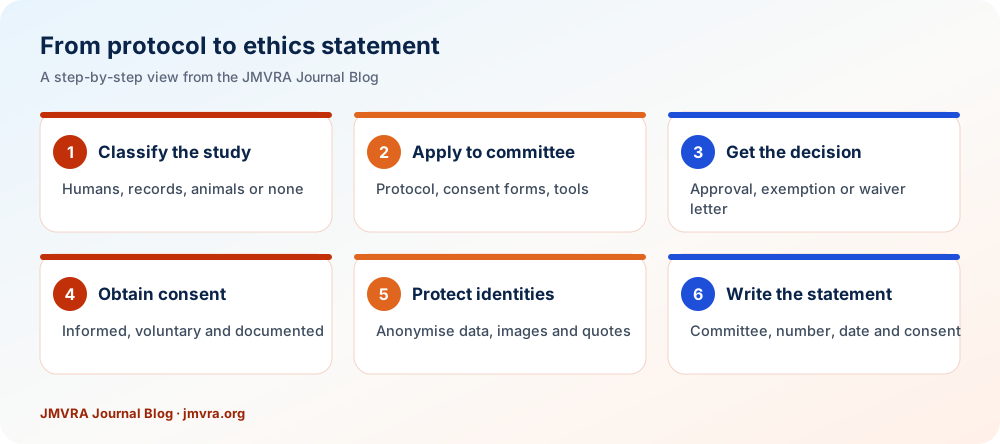
- Classify the studyHuman, records, animal or no participants
- Apply before startingApproval or exemption letter before data collection
- Consent properlyClear information, own language, freedom to withdraw
- Protect the vulnerableAssent, proxies and independent recruiters
- Anonymise fullyCodes, merged cells, edited quotes, image consent
- State it preciselyCommittee, reference number, date and consent type
Practical tips for ethics paperwork
Most ethics problems in submitted papers come from timing and documentation rather than bad intentions.
- Build ethics time into your plan. Committees often meet monthly. Allow several weeks for review and revisions before your planned start date.
- Keep one ethics folder. Store the application, approval letter, amendments, consent templates and translations together for every project.
- Match the paper to the protocol. Report the sample, tools and procedures that were approved; if they changed, mention the approved amendment.
- Ask for consent to publish early. Include publication of anonymised quotes or images in the original consent form instead of tracing participants later.
- Translate the letter if needed. Editors may request the approval letter; keep an English translation ready if it was issued in another language.
Get approval before you start, document consent carefully, protect identities, and state all of it precisely in the paper.
Questions Researchers Often Ask
In Summary
Ethics approval and informed consent are conditions of publication, not paperwork to add at the end. Classify your study early, let a committee decide whether it needs full review, expedited review or exemption, and obtain that decision before collecting data. Give participants clear information in their own language, add protections for vulnerable groups, and anonymise text, tables and images thoroughly. Then write a precise statement naming the committee, reference number, date and consent type. Keep every document, because editors may ask for it, and your paper will move through review without avoidable ethics queries.
Ready to send in your paper?
Online submission to JMVRA is free of charge. Papers are screened first and then go through transparent, double-blind peer review; ₹971 INR (Indian authors) or $41 USD (foreign authors) is due only after acceptance. Retain every confirmation email for your records.
References and Sources
Taking a Draft Through to a Published Paper
- PrepareStick to the template and author guidelines
- Submit onlineCosts nothing; write down your paper ID
- ScreeningSubject scope, declarations and similarity below 15%
- Double-blind reviewDecision by email and WhatsApp
- AcceptedThe ₹971 INR / $41 USD fee becomes due, and the paper is then published in open access
Details are available under Publication guidelines · Peer review · Publication charges.
Ready to Publish? Submit to JMVRA
JMVRA is aligned with UGC's Suggested Parameters for Choosing Peer-Reviewed Journals.
JMVRA is a Transparent, Peer-Reviewed, Open Access Journal (Refereed Journal). Following the discontinuation of the UGC and UGC-CARE journal listing, and in alignment with the latest UGC-CARE recommendations and guidelines, JMVRA is aligned with UGC’s Suggested Parameters for Choosing Peer-Reviewed Journals.
More useful pages at jmvra.org
Key Terms
Subjects and search phrases this article addresses.
Related Reading
More JMVRA guides that pair well with this one.
Keep Reading on the JMVRA Blog
You are reading part of the JMVRA journal blog, a source of hands-on guidance about publishing, indexing, metrics and research integrity that aims to be verifiable, not promotional.