
Journals and funders increasingly want to know where the data behind your findings can be found. A data availability statement gives that answer in just a few lines. This guide shows how to write one, with six ready-to-use templates, worked examples, advice on choosing a repository, the FAIR data principles, handling restricted data and avoiding weak “on request” statements.
Understanding the Data Availability Statement
A research data availability statement is a brief section of a paper that explains to readers where the data underlying the findings are located and on what conditions, or why sharing is impossible. It normally sits after the main text, close to the funding and conflict-of-interest statements. Numerous journals and funders now demand one, even where depositing the data itself is voluntary.
The Reason Journals Request One
- Verification: results can be checked and repeated by other researchers.
- Reuse: existing data can address fresh questions without collecting more.
- Transparency: readers learn what evidence exists, even when access is restricted.
- Funder rules: numerous funders anticipate data sharing plans and statements.
Six Statement Templates
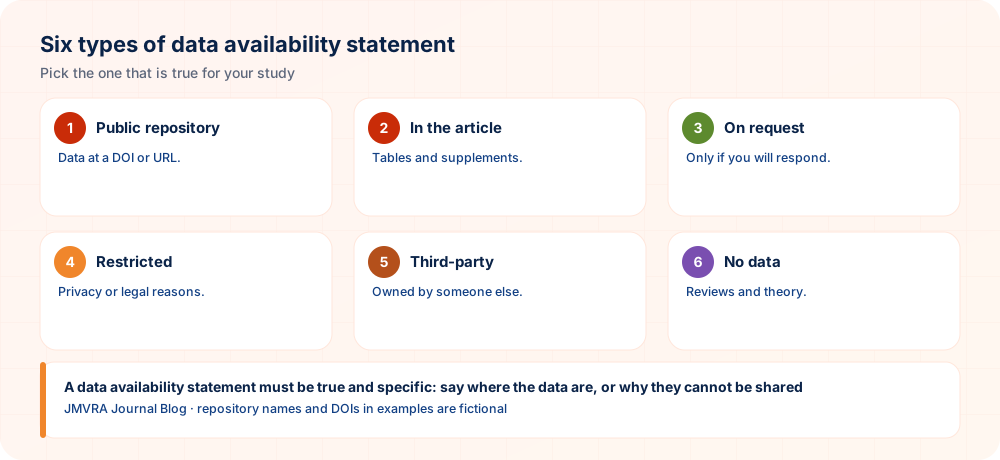
Select the template that is true for your study, complete the brackets and adjust the wording where necessary. These six types follow the JMVRA data availability policy:
| Type | Template |
|---|---|
| Public repository | “The data supporting this study are openly available in [repository] at [DOI or URL].” |
| In the article | “All data generated or analysed during this study are included in this published article and its supplementary files.” |
| On request | “The data supporting this study are available from the corresponding author on reasonable request.” |
| Restricted | “Data are not publicly available because they contain information that could compromise participant privacy. De-identified data may be available from [contact] subject to [conditions].” |
| Third-party data | “The data were obtained from [source] and are available at [URL] with the permission of [owner].” |
| No data | “No new data were created or analysed in this study.” |
Worked Examples
| Study | Statement |
|---|---|
| Water-quality measurements from the field | The water-quality data supporting this study are openly available in the Example Data Repository at https://doi.org/10.12345/edr.5678, under a CC BY 4.0 licence. |
| Interviews with patients | Interview transcripts are not publicly available because participants did not consent to public sharing. Anonymised excerpts are available from the corresponding author for research purposes, subject to ethics committee approval. |
| Study based on a government dataset | The data were obtained from the Example National Survey and are available at https://example.org/survey with the permission of the Example Statistics Office. Analysis code is available at https://doi.org/10.12345/code.910. |
| Review article | No new data were created or analysed in this study. |
Choosing a Repository
Start with a subject repository common in your field, then an institutional repository, and after that a reputable general-purpose repository. Check for persistent identifiers (DOIs), clear licences, long-term preservation and, when needed, controlled access. The re3data registry can help you locate repositories by subject. Settling on one trusted home for your files is better than scattering them across many sites.
FAIR Data Principles
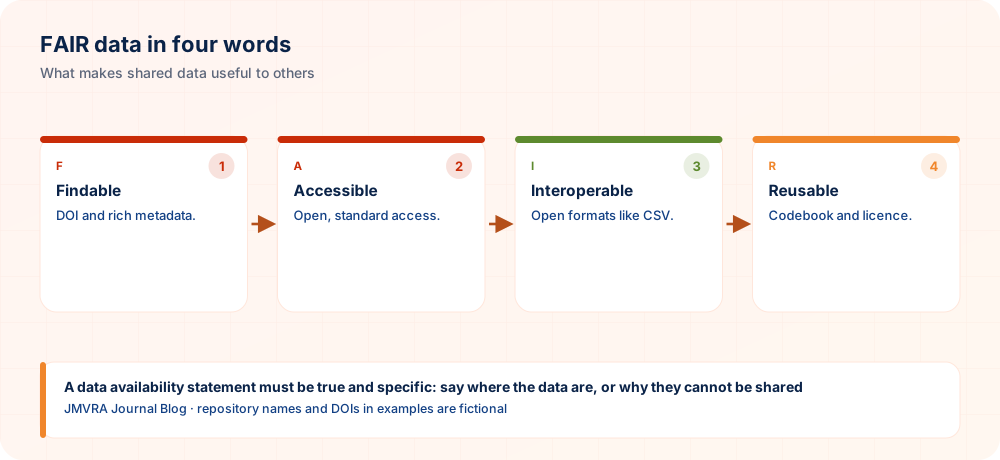
The FAIR principles describe data that are Findable, Accessible, Interoperable and Reusable. To follow them, deposit with a DOI and rich metadata, choose open formats (CSV instead of proprietary binaries), describe the variables and methods in a codebook, and add an unambiguous licence like CC0 or CC BY.
If the Data Cannot Be Shared
| Justified reason for restricting | What to do instead |
|---|---|
| Participant data that is personal or identifiable | Provide an aggregated or de-identified version |
| Participants did not consent to sharing | Provide the metadata and codebook, and describe how to gain access |
| Limits set by commercial or contractual terms | State who owns the data and how others may apply |
| Protected sites or endangered species | Share generalised locations |
| Sensitive for legal or security reasons | Deposit in a repository with controlled access |
Protecting participants always outranks openness. Restrictions that are stated clearly and honestly are fine, but vague ones are not.
Trouble with the “On Request” Statement
“Available on reasonable request” is the weakest choice, since requests frequently go unanswered once email addresses change or authors move on. Rely on it only if you will really reply, provide a lasting contact (a role email or institutional address) and, whenever possible, favour a repository instead.
Comparing Weak and Strong Statements
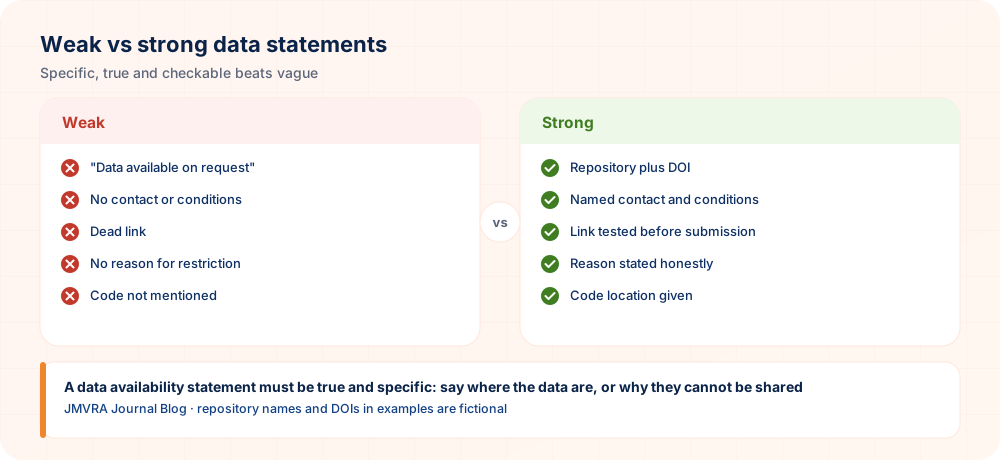
Click through every link before you submit, confirm that the repository record is public (or embargoed until publication), and verify that the statement agrees with the methods section. A colleague opening the links on another device is a quick extra test.
Sharing Code, Materials and Protocols
Analysis code seldom raises sensitivity concerns and greatly helps reproducibility. Place it in a public code repository or deposit it with a DOI, and refer to it in the statement. Supplementary files can carry questionnaires, protocols and materials.
Getting Your Data Ready to Share
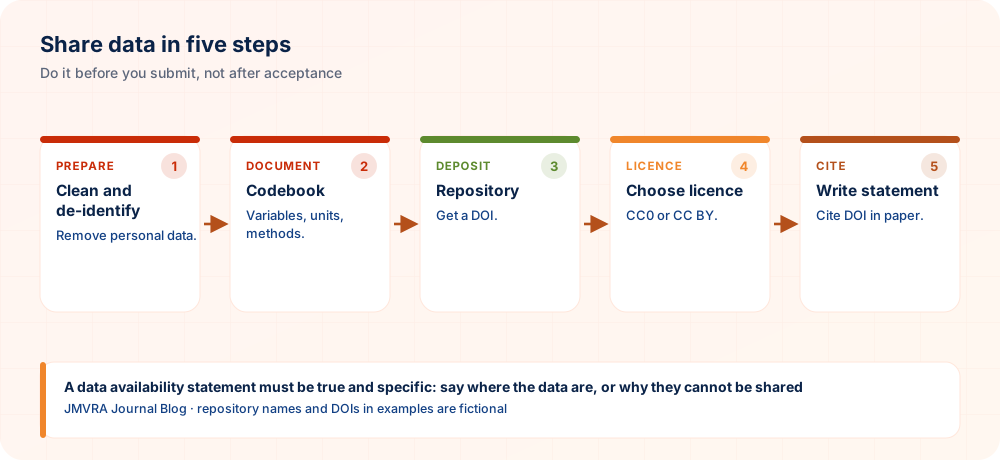
Think about sharing from day one: consent forms should permit it, and files should be kept tidy as the work proceeds. Before you deposit, strip direct identifiers, examine indirect ones, write a README and codebook, and select a licence. Reviewing the folder as an outsider would often reveals gaps you had missed.
JMVRA’s Approach to Data Availability
According to JMVRA’s data availability policy, authors are encouraged but not required to share data, yet a data availability statement is compulsory. Choose one of the six templates above, apply FAIR practice wherever you share, and be honest about restrictions. Put the statement where the journal template and guidelines indicate.
JMVRA in brief
- Review: transparent, double-blind peer review, normally by at least two subject experts. Specialist reviewers assess your paper, and you receive the acceptance or rejection decision by email and WhatsApp.
- Fee: Nothing is charged for submitting or reviewing a paper. Once it is accepted, Indian authors are billed ₹971 INR and foreign authors $41 USD.
- Access: free for all to read (CC BY 4.0). ISSN 2984-8911, published on a monthly schedule, with submissions open all the time; ask for a Crossref DOI when you want one.
- Indexing: JMVRA appears in Google Scholar and is registered with Crossref and the ISSN Portal / ROAD; it is not currently indexed in Scopus, Web of Science or DOAJ.
Share Your Research Through JMVRA
Place your research in JMVRA
JMVRA (ISSN 2984-8911) is a peer-reviewed, open access journal spanning many disciplines. Submission is free. Specialist reviewers assess your paper, and you receive the acceptance or rejection decision by email and WhatsApp.
- 1. Set up your paper using the guidelines
- 2. Submit online
- 3. Peer review
- 4. Decision by email & WhatsApp
- 5. Finish with open access publication
Your At-a-Glance Checklist
- TrueSelect the honest template
- SpecificGive repository and DOI
- RestrictionsExplain why, add a contact
- CodeLocation given
- LinksTested
- ConsentAllows sharing
Practical Tips for Writing a Data Availability Statement
A good statement tells readers exactly where your data are and how to reach them. Use these habits while drafting, so the statement is accurate and easy to check when reviewers read it.
- Write it while collecting data. Decide early where files will be stored and who may see them. Drafting the statement during the project avoids vague promises made in a rush at submission.
- Name the exact location. Give the repository, the record title and a persistent link rather than saying data are available online. A reader should reach the right dataset without searching or guessing.
- Explain any restriction plainly. If consent forms, privacy or commercial agreements prevent open sharing, say which rule applies and who decides on access. Honest reasons are respected far more than silence.
- Describe file formats and documentation. Include a short readme that explains column names, units, missing values and software needed. Data nobody can interpret do little good, even when technically open.
- Check the statement before resubmission. Whenever you revise the paper, confirm that every dataset mentioned still exists, opens correctly and matches the version analysed in the final manuscript.
Make your statement specific, verifiable and honest about limits, so that anyone can locate the data you describe.
Questions Researchers Often Ask
In Summary
The best data availability statements are brief, truthful and precise. Settle your sharing plan early, deposit data and code with DOIs where possible, document them properly, restrict access only for real reasons and state those plainly, and check each link before you submit. Statements this clear make your research simpler to trust and reuse.
Prepared your paper? Submit it to JMVRA today
JMVRA (ISSN 2984-8911) is a peer-reviewed, open access journal spanning many disciplines. Submission is free. Specialist reviewers assess your paper, and you receive the acceptance or rejection decision by email and WhatsApp.
- 1. Set up your paper using the guidelines
- 2. Submit online
- 3. Peer review
- 4. Decision by email & WhatsApp
- 5. Finish with open access publication
References and Further Resources
Data Statements in Brief
- ChooseTrue template
- DepositRepository + DOI
- DocumentCodebook
- RestrictHonestly
- TestEvery link
Related: JMVRA data policy · Methodology · Submit Paper.
Ready to Publish? Submit to JMVRA
JMVRA is aligned with UGC's Suggested Parameters for Choosing Peer-Reviewed Journals.
JMVRA is a Transparent, Peer-Reviewed, Open Access Journal (Refereed Journal). Following the discontinuation of the UGC and UGC-CARE journal listing, and in alignment with the latest UGC-CARE recommendations and guidelines, JMVRA is aligned with UGC’s Suggested Parameters for Choosing Peer-Reviewed Journals.
Where to go next on jmvra.org
Key Terms
Subjects and search phrases this article addresses.
Related Reading
Further guides for writing transparent, well-prepared research papers.
Research Methodology: Types, Methods & Examples
Read the guide RelatedResearch Paper Structure & Formatting Guidelines
Read the guide RelatedCopyright & Licences in Academic Publishing
Read the guide RelatedSubmitting a Research Paper: Checklist & Tips
Read the guide RelatedFinding and Verifying a Research Paper's DOI
Read the guide RelatedCorrections, Retractions & Expressions of Concern
Read the guideKeep Reading on the JMVRA Blog
Find this guide on the JMVRA journal blog, a collection of practical guidance on publishing, indexing, metrics and research integrity that favours verifiable content over promotion.