

Researchers, PhD students and academics have all heard of the “Impact Factor”, but few know precisely what it measures, how it is worked out and what it fails to reveal. The Journal Impact Factor is among the most widely used and most misunderstood figures in academic publishing. This guide sets out the formula with a worked example, explains what is counted, shows how to look up a journal’s value, covers its limitations, compares it with CiteScore and SJR, and describes how to interpret journal-specific metrics such as JMVRA’s Google Scholar-based 11.25.
Defining the Impact Factor
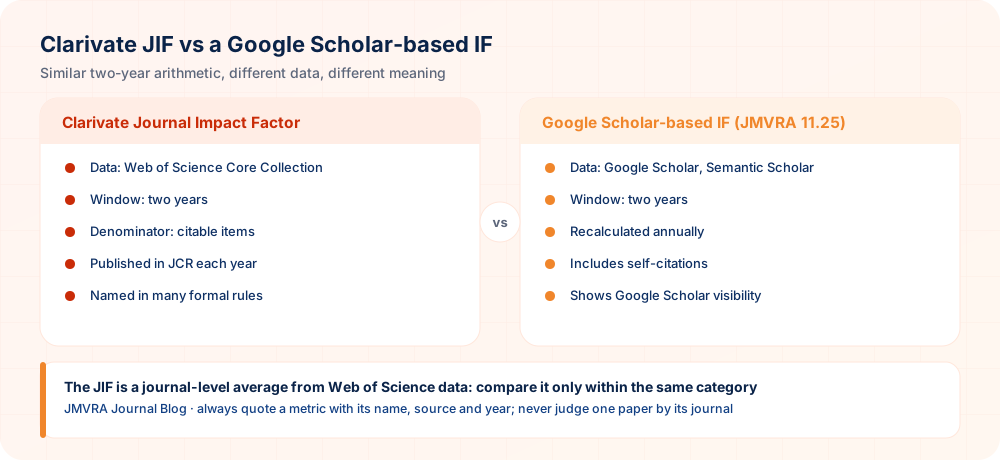
The Impact Factor (IF), correctly named the Journal Impact Factor (JIF), gauges how frequently a journal’s typical recent item was cited in a given year. A higher JIF indicates that its recent items drew more citations on average, which generally points to visibility in its field. Remember that visibility is only one aspect of quality, so read the figure alongside the journal’s scope and policies.
| Fact | Detail |
|---|---|
| Origin | Suggested in 1955 by Eugene Garfield, who founded the Institute for Scientific Information (ISI); Journal Citation Reports started in the 1970s |
| Owner today | Clarivate, current owner of the former ISI and of Web of Science |
| Where published | Journal Citation Reports (JCR), issued annually, typically in about June |
| Data year | Every release draws on citations counted in the preceding calendar year |
| Coverage | Journals covered by the citation indexes of the Web of Science Core Collection: SCIE, SSCI, AHCI and ESCI |
| Precision | Displayed with one decimal place in recent JCR editions |
| Access | JCR is a paid subscription product, normally accessed through university libraries |
No Clarivate JIF exists for a journal outside the Web of Science Core Collection. That fact alone tells you nothing about quality, because many genuine journals are indexed elsewhere or not at all, and some publish other metrics that are clearly labelled. Judge such journals on their editorial practice and transparency rather than on one missing number.
The Calculation Behind the Impact Factor
JIF (year N) = citations received in year N by items published in years N−1 and N−2 ÷ number of citable items published in years N−1 and N−2.
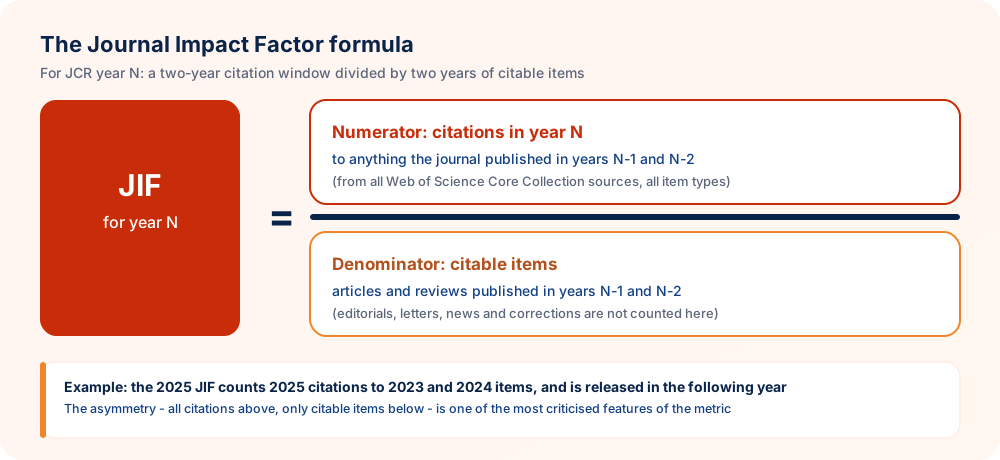
Web of Science supplies both figures: citations are taken from every Core Collection source, and the items counted are the ones the journal published during the two preceding years.
A Step-by-Step Worked Example
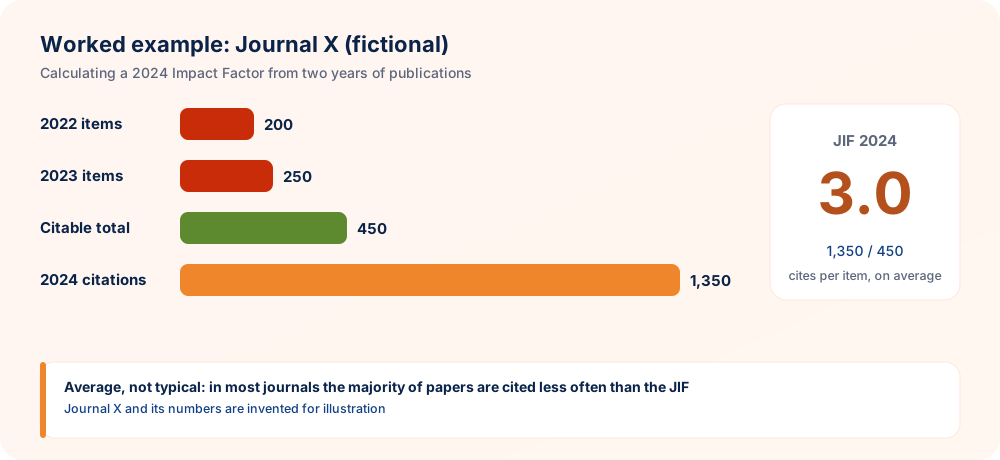
- Tally the citable items. Fictional Journal X had 200 citable items in 2022 and 250 in 2023, which makes 450 altogether.
- Tally the citations. During 2024, Web of Science sources cited the 2022 and 2023 content of Journal X a total of 1,350 times.
- Divide. JIF 2024 = 1,350 ÷ 450 = 3.0.
- Interpret. Each recent item was cited three times on average in 2024, although most individual papers received fewer citations than that (see the limitations below).
| Item | Value |
|---|---|
| Citable items, 2023 + 2024 | 180 + 220 = 400 |
| Citations in 2025 to 2023–2024 content | 1,000 |
| JIF 2025 | 1,000 ÷ 400 = 2.5 |
What Qualifies as a Citable Item?
| Part | What is counted |
|---|---|
| Denominator (citable items) | Research articles and reviews, which Clarivate classes as citable items |
| Left out of the denominator | Editorials, letters, news pieces, corrections and meeting abstracts |
| Numerator (citations) | Citations to any item the journal published in those two years, editorials and letters included |
Because of this imbalance, citations to non-citable items increase the numerator while leaving the denominator unchanged. That is one reason the JIF draws criticism and one reason Clarivate examines unusual citation patterns. Knowing this helps you read any quoted value with appropriate caution.
The 5-Year JIF, JIF Without Self-Cites and the JCI
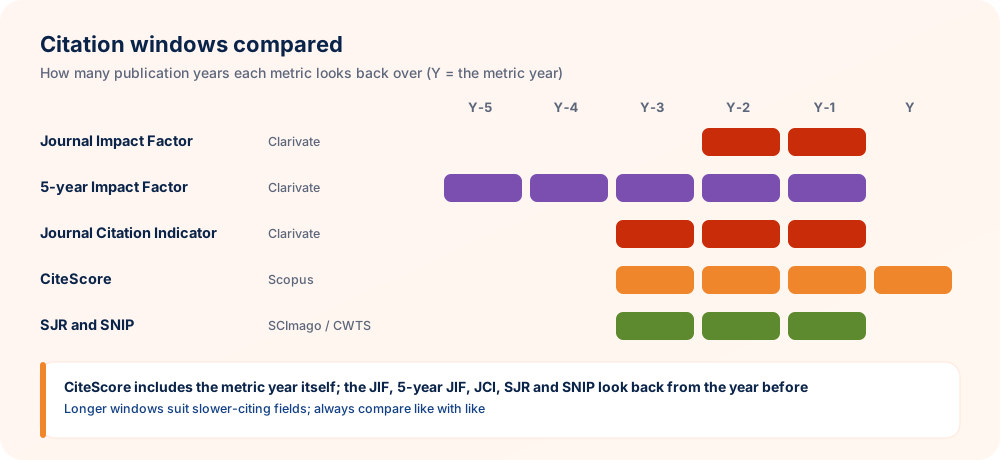
- 5-year Impact Factor: the identical calculation stretched across five earlier years, dividing citations in year N to items from N−1 to N−5 by the citable items of those years. It suits fields where citations accumulate slowly.
- JIF without self-cites: JCR additionally reports the value after removing the journal’s citations to itself, which helps reveal heavy self-citation.
- Journal Citation Indicator (JCI): a Clarivate metric normalised by field, in which 1.0 stands for the world average of the category, designed for comparisons between fields.
- JIF quartile and percentile: the position of a journal within its Web of Science category, where Q1 is the highest quarter.
What Counts as a Good Impact Factor?
No single answer applies, since citation habits differ greatly from one field to another. Journals in medicine and the life sciences usually show higher values than those in mathematics, engineering or the humanities, so a JIF that is excellent in one category may be merely average in another.
- Compare inside the category: rely on the journal’s JIF quartile or percentile within its Web of Science category rather than the raw figure.
- Study the trend: a value that holds steady over several years tells you more than a single high year.
- See what your rule requires: certain institutions specify quartiles, others specify databases, and a few ask only for genuine peer review.
- Keep the purpose in mind: suitability and readership count for more than a decimal place; read how to choose the right journal.
JCR values run from far below 1 to several hundred for a few exceptional review titles, which makes any single “good” threshold meaningless. Scopus Q1–Q4 explained describes quartiles, and the same idea holds for JIF quartiles.
Checking a Journal’s Impact Factor
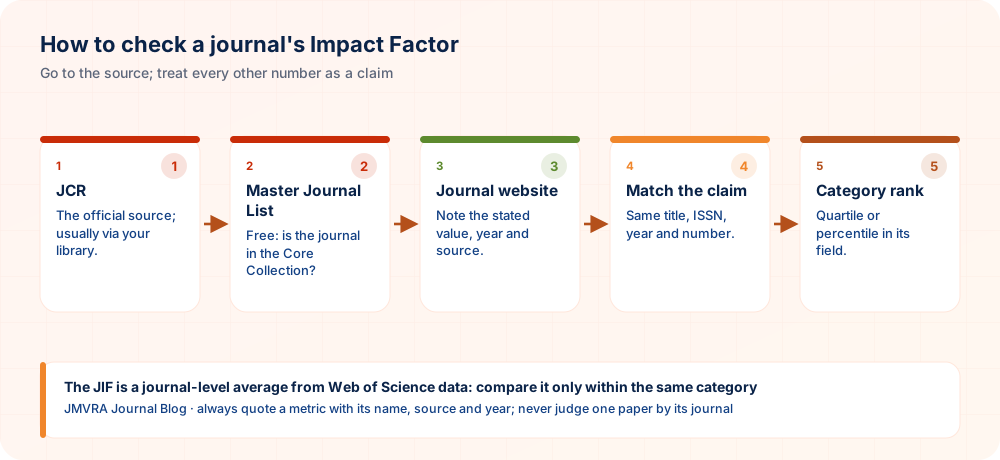
- Journal Citation Reports: the official source, searchable by title or ISSN. Your institution’s library normally provides access.
- Master Journal List: use this free tool to learn if a journal belongs to the Web of Science Core Collection, and which index lists it.
- The journal’s own website: numerous journals show their value there. Write down the year and the named source, then verify it in JCR.
- No-cost Scopus-based options: SCImago (SJR and quartiles) and the Scopus Sources page (CiteScore) can both be used at no charge, but each reports a different metric from the JIF.
Recognising Misleading Impact Factor Claims
A legitimate metric always states its source, year and method. Be careful when a journal:
- labels an unexplained number as its “Impact Factor” and suggests Clarivate produced it although it is absent from JCR;
- displays a value that differs from JCR for the identical title, ISSN and year;
- is unable to say who calculated the figure, from which data, or across which time window.
A journal-specific metric that is clearly labelled, such as a Google Scholar-based impact factor, is not misleading as long as its source and method are given; it just measures something other than the JIF. See our journal verification checklist.
Limitations and Criticisms
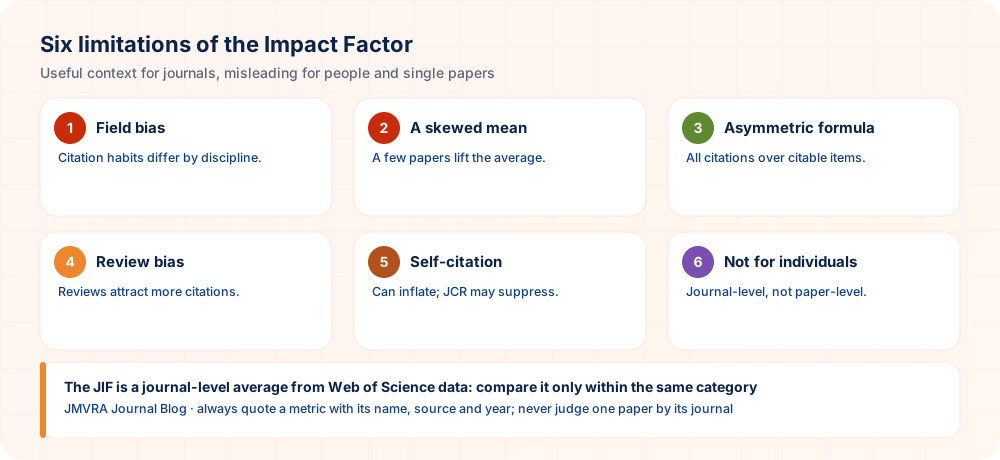
- Field bias: disciplines cite in different ways, so comparing across fields has no meaning.
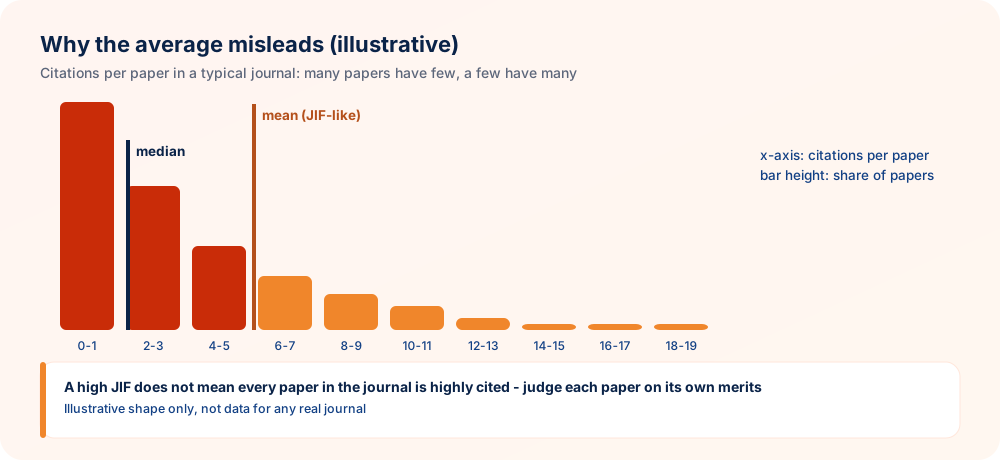
- Skewed distribution: the JIF is an average, pulled up by a few heavily cited papers while most papers receive fewer citations.
- Asymmetric formula: the numerator includes every citation, while the denominator includes just citable items.
- Review bias: review articles gather more citations, giving journals rich in reviews a tendency to score higher.
- Self-citation and citation stacking: both can inflate values, and Clarivate may suppress a journal’s JIF when citation patterns look anomalous.
- Not meant for individuals: it characterises journals and says nothing about the quality of one article or researcher.
- Document classification: choices about which items count as “citable” can alter the values.
- Two-year window: inadequate for fields that cite slowly, where the 5-year JIF is of help.
Impact Factor Compared with Other Journal Metrics
| Metric | Provider (data) | Window | Free to view? | Best use |
|---|---|---|---|---|
| Journal Impact Factor | Clarivate (Web of Science) | 2 years | No (JCR subscription) | Rules naming JIF or SCI/SSCI |
| 5-year Impact Factor | Clarivate (Web of Science) | 5 years | No (JCR) | Slower-citing fields |
| Journal Citation Indicator | Clarivate (Web of Science) | 3 years | No (JCR) | Field-normalised comparison |
| Eigenfactor and Article Influence | Clarivate (Web of Science) | 5 years | Within JCR | Network influence; Article Influence is per-article |
| CiteScore | Elsevier (Scopus) | 4 years, same years for citations and documents | Yes | Scopus-based comparison |
| SJR | SCImago (Scopus data) | 3 years | Yes | Prestige-weighted ranking and quartiles |
| SNIP | CWTS (Scopus data) | 3 years | Yes | Comparison across fields |
| h5-index | Google Scholar Metrics | 5 years | Yes | Visibility in Google Scholar |
| h-index | Several databases | Whole record | Varies | Long-term impact of a journal or author |
In CiteScore, the numerator as well as the denominator takes in articles, reviews, conference papers, data papers and book chapters, all of them peer-reviewed document types. You can read a full side-by-side in CiteScore, Impact Factor, SJR, SNIP and h-index compared.
DORA and the Responsible Use of Metrics
Launched in 2012 and signed by thousands of organisations and individuals, the San Francisco Declaration on Research Assessment (DORA) advises against using journal-based metrics like the JIF as a stand-in for the quality of single articles, for judging an individual scientist’s contributions, or in hiring, promotion or funding decisions.
Since many institutions continue to use the JIF in assessment, understanding it is worthwhile. Treat it as background on journals, together with the substance of the work, article-level citations and other indicators.
JMVRA’s 11.25 as a Google Scholar-Based Impact Factor
JMVRA states an impact factor of 11.25. So there is no confusion about what it is and how it is counted:
| Question | Answer |
|---|---|
| Which type of metric is it? | An impact factor drawn from Google Scholar data, which is neither a Clarivate JCR Impact Factor nor a Scopus CiteScore |
| Which data is used? | Citation data obtainable via Google Scholar and Semantic Scholar |
| Which window? | A citation window of two years |
| How frequently is it updated? | Recalculated annually |
| Do self-citations count? | Yes, which is the normal practice for most citation-based indicators |
| What explains a fairly high value? | Google Scholar’s wider source coverage, together with a large open access archive that has grown since June 2023 |
| How should the figure be cited? | Always labelled as a “Google Scholar-based Impact Factor” |
JMVRA in brief
- Review: transparent, double-blind peer review. Specialist reviewers assess your paper, and you receive the acceptance or rejection decision by email and WhatsApp.
- Fee: Authors from India pay ₹971 INR and foreign authors pay $41 USD, and the payment is due only after acceptance; submitting costs nothing.
- Access: open access under CC BY 4.0, with ISSN 2984-8911 on every article; a Crossref DOI may be requested.
Share Your Research Through JMVRA
Get your research published in JMVRA
JMVRA (ISSN 2984-8911) is a peer-reviewed, open access journal spanning many disciplines. Submission is free. Specialist reviewers assess your paper, and you receive the acceptance or rejection decision by email and WhatsApp.
- 1. Follow the guidelines when preparing
- 2. Submit online
- 3. Peer review
- 4. Decision by email & WhatsApp
- 5. Go live in open access
Your At-a-Glance Checklist
- Identify itIs it JIF, CiteScore, SJR or another measure?
- Trace itWho computed it, and from what data?
- Timestamp itWhich JCR edition or metric year applies?
- Rank itIts quartile or percentile within the subject category
- Check itConfirm it in JCR or the official source
- Apply it fairlyFor journals only, never for individual papers or people
Using Impact Factor Sensibly When Selecting a Journal
A metric can help you compare journals, but only when you understand its limits. These suggestions show how to use impact figures as one small input within a broader, fairer assessment of quality.
- Check who produced the figure. Different providers use different methods and data sources. Find out which organisation calculated a quoted figure, and be cautious if the journal does not explain its method.
- Compare within the same field. Citation habits differ greatly between disciplines, so a value that seems modest in one field may be strong in another. Compare only journals that serve similar research communities.
- Look beyond the journal average. A journal-level number says little about any single article. Read your own target papers, and consider the downloads, reuse and discussion your article might realistically earn.
- Balance metrics with editorial quality. Review speed, clear reviewer feedback, ethical practice and discoverability all influence your experience. Weigh these alongside any numerical indicator before making your final choice.
- Describe metrics honestly in your CV. When listing publications, state the source of any metric you mention, and avoid implying it measures your individual work. Honest description builds trust with appraisal and hiring panels.
Treat impact figures as a rough guide that needs context, and decide on the journal by fit, integrity and the quality of its editorial process.
Questions Researchers Often Ask
In Summary
Among the best-known metrics in academic publishing, the Journal Impact Factor still carries well-documented limitations. It gives a journal’s average two-year citation rate from Web of Science data, differs greatly between fields, and must never be applied to assess one paper or one researcher. Quote any metric together with its name, source and year, compare only within categories, and combine several indicators — including clearly labelled journal-specific measures such as JMVRA’s Google Scholar-based 11.25. A brief note on how a number was obtained makes your claims easier for others to check.
Want to get published? Send your paper to JMVRA
JMVRA (ISSN 2984-8911) is a peer-reviewed, open access journal spanning many disciplines. Submission is free. Specialist reviewers assess your paper, and you receive the acceptance or rejection decision by email and WhatsApp.
- 1. Follow the guidelines when preparing
- 2. Submit online
- 3. Peer review
- 4. Decision by email & WhatsApp
- 5. Go live in open access
References and Sources
The Impact Factor in Brief
- CountCitations received in year N
- ForItems from N−1 and N−2
- DivideBy the citable items
- RankQuartile within the category
- Use fairlyFor journals, not individuals
See also: Metrics compared · JMVRA’s 11.25 explained · Submit Paper.
Ready to Publish? Submit to JMVRA
JMVRA is aligned with UGC's Suggested Parameters for Choosing Peer-Reviewed Journals.
JMVRA is a Transparent, Peer-Reviewed, Open Access Journal (Refereed Journal). Following the discontinuation of the UGC and UGC-CARE journal listing, and in alignment with the latest UGC-CARE recommendations and guidelines, JMVRA is aligned with UGC’s Suggested Parameters for Choosing Peer-Reviewed Journals.
Helpful pages on jmvra.org
Key Terms
Subjects and search phrases this article addresses.
Related Reading
Further guides on journal metrics and citations.
CiteScore, Impact Factor, SJR, SNIP & h-index Compared
Read the guide RelatedWhy Is JMVRA's Impact Factor 11.25? Google Scholar H-Index Explained
Read the guide RelatedScopus Quartiles Q1 to Q4: Meaning & Free Check
Read the guide RelatedGrow Your h-index Ethically: 10 Strategies
Read the guide RelatedUnderstanding JMVRA's 11.25 Impact Factor
Read the guide Related10 Steps to the Right Journal for Your Paper
Read the guideKeep Reading on the JMVRA Blog
This guide belongs to the JMVRA journal blog, which offers practical advice on publishing, indexing, metrics and research integrity, written to be checkable instead of promotional.