
Do you need Scopus or Web of Science journals while based in Niger? When we looked, neither database listed a journal published in Niger that we could confirm, which means indexed publishing relies on francophone, African and international titles. Here we explain how to locate and verify them. Begin with your field and your funder's requirements before chasing any particular database.
Scopus and Web of Science: The Essentials
Elsevier’s Scopus is a selective abstract and citation database. CiteScore is derived from it, and it is the data behind SCImago Journal Rank (SJR). Web of Science, a Clarivate product, has a Core Collection of SCIE (sciences), SSCI (social sciences), AHCI (arts and humanities) and ESCI (emerging sources); Journal Citation Reports is where the Journal Impact Factor is published. Both databases re-assess journals and can discontinue them. See Scopus explained and Web of Science explained for more. A journal’s current status is best confirmed from the database record itself.
| Term | What it is | Where to check |
|---|---|---|
| Scopus | A selective abstract and citation database run by Elsevier | Scopus Sources |
| SCIE | Science Citation Index Expanded — Web of Science’s index centred on the sciences | Master Journal List |
| SSCI | Social Sciences Citation Index — Web of Science’s index centred on the social sciences | Master Journal List |
| AHCI | Arts & Humanities Citation Index — Web of Science’s index centred on the humanities | Master Journal List |
| ESCI | Emerging Sources Citation Index — journals in Web of Science that have cleared a quality check | Master Journal List |
| Journal Impact Factor | A citation average over two years; the 2023 release extended it to every Web of Science Core Collection journal | Journal Citation Reports |
| CiteScore | Average citations across four years, provided for journals indexed in Scopus | Scopus Sources |
| SJR | SCImago Journal Rank — built from Scopus data, with extra weight for prestigious sources | SCImago |
| Quartile (Q1–Q4) | A journal’s rank within one subject category during one year | JCR or SCImago |
As a 2025 study of Scopus-indexed journals in Africa shows, the continent's indexed journals cluster in a handful of countries. Researchers in Niger therefore turn to indexed journals elsewhere in Africa, francophone journals in Europe and Canada, and international journals in their field, frequently with partners overseas.
Where Niger Stands Today on Scopus and Web of Science Journals
Research on the Sahel covering agriculture, climate, health and the social sciences is published across numerous indexed international journals; browse by subject and read recent articles to pick the best fit.
More journals worth noting (whether they are indexed in Scopus or Web of Science is unconfirmed)
| Journal | Publisher | Reported coverage |
|---|---|---|
| Revue Nigérienne des Sciences Sociales (RENISS) | LERSA, Abdou Moumouni University, Niamey | Open access; follows CAMES article standards |
| Annales de l’Université Abdou Moumouni | Abdou Moumouni University, Niamey | University journal; check indexing |
| Environnement et Dynamique des Sociétés | Abdou Moumouni University, Niamey | Semi-annual thematic journal; check indexing |
Checked 4 October 2026. “Reported” means the journal or publisher says so; we have not independently confirmed it.
Indexing Verification Checklist
- Get the ISSNCopy the print ISSN and the online ISSN from the journal’s official website
- Scopus SourcesSearch the ISSN and confirm the status and the years of coverage
- Master Journal ListSearch the ISSN and record whether it is SCIE, SSCI, AHCI or ESCI
- Still listed?Check Scopus’s discontinued titles list for the journal
- Keep evidenceScreenshots bearing dates, for your promotion or grant file
International Publishing Options From Niger
Because few journals published in Niger sit in Scopus or Web of Science, researchers needing indexed outlets mostly submit abroad too — to African regional titles, society journals and the major international publishers. A 2025 study of Scopus coverage in Africa (Kanyika & Kim) calls this a “continued struggle”: African journals in Scopus keep growing in number, but only slowly.
Three things deserve a check before you pick an international journal: the article processing charge (APC), and whether the publisher grants waivers or discounts to authors in lower- and middle-income countries; whether your institution or funder pays APCs; and whether your field has a diamond open access journal (free to read and to publish) — DOAJ can filter by “without fees”. Co-authors and project funders may cover publication costs, so settle this before you submit.
Quartiles, Impact Factor and Top-Tier Journals
The three most widely used measures are the Journal Impact Factor (from Clarivate, a two-year window, only for Web of Science journals), CiteScore (from Scopus, four years) and SJR (from SCImago, weighted, using Scopus data). Q1–Q4 quartiles show where a journal stands in one subject category in one year. None of them says anything about the quality of one article. Read them as background and never as a judgement on your own paper.
Most researchers in Niger will find the highest-impact venues in their discipline among international journals rather than local ones. Search them by subject category in Journal Citation Reports, Scopus Sources or SCImago, then read recent articles to judge the match. Our guide to finding high impact factor journals walks through the method one step at a time.
Picking an Indexed Journal for Your Subject
| Field | Niger-published journals | Then search |
|---|---|---|
| Agriculture & environment | Annales (Series A); EDS (check indexing) | Scopus agricultural and environmental sciences |
| Health | Annales (Series A) (check indexing) | African and francophone medical journals; Scopus medicine |
| Social sciences | RENISS (check indexing) | Francophone SSCI and Scopus journals |
| Humanities & history | Annales (Series B) (check indexing) | AHCI and Scopus humanities |
| Science & engineering | None confirmed in Niger | SCIE and Scopus |
Publishing in French
French is a principal research language in Niger. Writing in French need not limit international visibility, because Scopus and Web of Science cover French-language journals, notably in the humanities, social sciences, law and medicine, and most expect English titles and abstracts. Confirm the following before submitting:
- its language policy, including whether bilingual papers are accepted;
- whether abstracts and keywords are provided in English;
- whether your intended community is among its audience.
Printing one study twice in two languages without each journal’s explicit consent counts as duplicate publication.
Getting Your Paper Ready for an Indexed Journal
Indexed journals get a large number of submissions, and editors reject a big proportion outright, more often for poor fit or presentation than for flawed science. These steps raise your chances:
- Lead with your contribution. In the abstract and the end of the introduction, set out what is new and why it matters beyond your local context.
- Engage with the journal’s current conversation. Cite up-to-date literature and, where suitable, articles the target journal has previously published.
- Do not leave gaps in your methods. Follow the reporting standard for your design, such as CONSORT, PRISMA or STROBE, so that reviewers can weigh the rigour.
- Write a tailored cover letter. Say in a few words why the paper suits this journal’s audience.
Frequent Mistakes With Indexed Journals
- Treating a homepage logo as evidence when the database record is what counts.
- Leaving the index unspecified: “Web of Science” may stand for SCIE, SSCI, AHCI or ESCI.
- Overlooking a removal: a journal that was indexed a year ago might not be today.
- Depending on a number alone: if the scope is a poor match, the paper will soon be rejected.
How JMVRA suits authors in Niger
Based in India, JMVRA (ISSN 2984-8911) is an international open access journal covering many disciplines. It is not a Nigerien journal, but it accepts papers from authors in Niger. JMVRA is not in Scopus or Web of Science; it serves authors who want an affordable, peer-reviewed open access journal rather than an indexed one.
- Fee: foreign authors pay $41 USD only after acceptance, and the fee extends to up to 5 authors.
- Review: peer review is double-blind and transparent, carried out by subject experts, with similarity held below 15%.
- Access: free to read under CC BY 4.0; a Crossref DOI can be requested.
- Indexing, stated openly: Google Scholar lists the journal, whereas Scopus, Web of Science and DOAJ do not.
Submission Pack for Niger-Based Authors Targeting Indexed Journals
| Item | Tip |
|---|---|
| Manuscript | Using the journal’s template, including an English title, abstract and keywords |
| Cover letter | States the journal fit and the value of the work for readers outside Niger |
| ORCID iDs | Supplied per author to preserve record accuracy |
| Approvals | Proof of ethics clearance, plus any research permit Niger requires |
| Data availability statement | How to locate the data, or why it cannot be made available |
Working With International Collaborators From Niger
Regional collaborators
Shared projects across francophone West Africa pool data, methods and reviewers.
Researchers in the diaspora
Nigerien researchers based overseas make natural co-authors and mentors.
Co-supervision
A thesis with several supervisors leads to co-authored papers.
Agreeing authorship
Settle roles, author order and data ownership in writing before you begin.
Practical Tips for Researchers in Niger Choosing Journals
Researchers in Niger frequently write in French and collaborate with regional and international partners. These suggestions focus on realistic planning, clear communication and careful evaluation of any journal you are considering.
- Start with regional partners. Joint work with universities in neighbouring countries can strengthen both data and writing. Agree responsibilities in writing, including who handles correspondence with the journal.
- Keep connectivity in mind. Save drafts in more than one place and submit files in standard formats. Unstable internet is easier to manage when documents are small, backed up and ready to upload at short notice.
- Choose the French or English route consciously. Publishing in French reaches regional readers, while English may reach a broader audience. Pick the language that serves your argument and your field, then keep the whole submission consistent.
- Use plain, structured abstracts. State the problem, the method, the main finding and its limits in simple sentences. Clear abstracts travel well across languages and help readers decide quickly whether to read further.
- Be cautious with unsolicited invitations. Treat emails promising fast acceptance with suspicion. Look up the journal independently, read its policies and ask a trusted colleague before sharing a manuscript or making any payment.
Plan with regional partners, protect your files against technical interruptions, and verify every journal independently before trusting its promises.
Questions Researchers Often Ask
Summary and What to Do Next
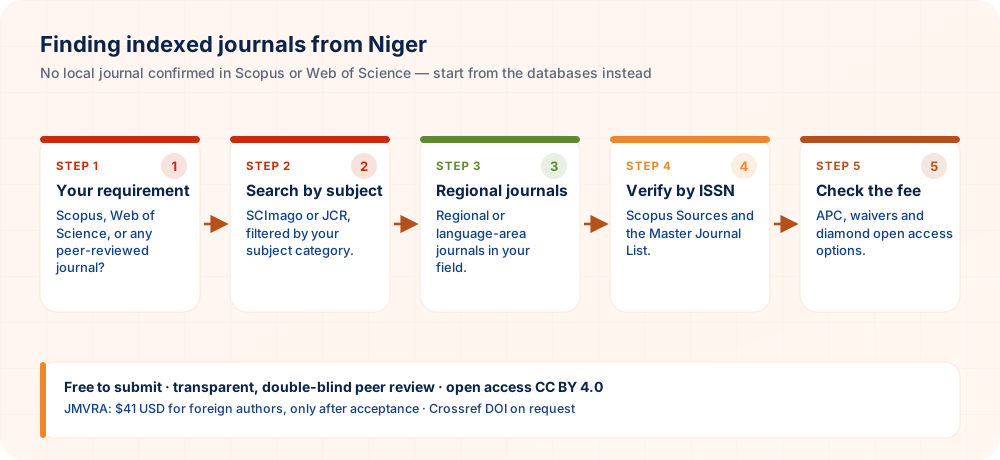
Indexed publication from Niger means choosing carefully among francophone, African and international journals. Verify by ISSN and budget costs early.
- Decide from your institution’s rule if it wants Scopus, Web of Science, a quartile or some other index.
- Prepare a shortlist for your discipline from the tables above and from international databases.
- Check each title by its ISSN and keep a record of what you find.
- Non-indexed options appear in the list of research journals in Niger.
Ready to send in your paper?
Submission to JMVRA is online and free. Review always comes first; the $41 USD publication fee applies only after your paper is accepted.
Related searches
Readers in Niger who use this guide often search too for affordable open access journals, high impact factor journals, Scopus and Web of Science indexed journals, paper publication fees and journal publication in Niger. The following guides address those topics:
- Low-cost journal publication in Niger
- High impact factor journals in Niger
- Research journals in Niger
- How a low-fee journal is funded
- Locating high impact factor journals
- How to choose a journal
- Checking an indexing claim yourself
- Recognising a predatory journal
- Publishing with JMVRA from outside India
- JMVRA publication charges
References and Sources
Checked on 4 October 2026. Indexing status can change, so confirm it before submitting.
- SCImago journal rankings — Niger
- CAMES
- Kanyika & Kim (2025), Continued struggle: the growth of Scopus-indexed journals in Africa
- Discoverability of African journals by Google Scholar and inclusion in Scopus (PMC)
- Scopus Sources
- Clarivate Master Journal List
- ISSN Portal
- SCImago Journal & Country Rank
- Journal Citation Reports
JMVRA as a Route to Publication From Niger
- Submit onlineWherever you live; there is no fee to submit
- Pre-reviewScope assessment and similarity (below 15%)
- Double-blind reviewThe paper goes to field experts, and the decision follows by email
- Accepted — $41 USDOne charge applies to up to 5 authors
- PublishedPublicly accessible under CC BY 4.0
Details: Publication charges · Peer review · Advice for authors outside India.
Ready to Publish? Submit to JMVRA
JMVRA is aligned with UGC's Suggested Parameters for Choosing Peer-Reviewed Journals.
JMVRA is a Transparent, Peer-Reviewed, Open Access Journal (Refereed Journal). Following the discontinuation of the UGC and UGC-CARE journal listing, and in alignment with the latest UGC-CARE recommendations and guidelines, JMVRA is aligned with UGC’s Suggested Parameters for Choosing Peer-Reviewed Journals.
Where to go next on jmvra.org
Key Terms
Subjects and search phrases this article addresses.
Related Reading
Additional guides for researchers in Niger, and for choosing a journal.
Affordable Journal Publication in Niger
Read the guide RelatedHigh-Impact Journals for Researchers in Niger
Read the guide RelatedResearch Journals in Niger: Local & Regional
Read the guide RelatedResearch Journals in the DR Congo: 2026 Guide
Read the guide RelatedA Researcher’s Verified Guide to Journals in Nigeria
Read the guide RelatedWhat International Authors Should Know About JMVRA
Read the guide RelatedChecking a Journal’s Indexing Claims
Read the guideKeep Reading on the JMVRA Blog
Find this guide on the JMVRA journal blog, a collection of practical guidance on publishing, indexing, metrics and research integrity that favours verifiable content over promotion.