
Are you searching for high impact factor journals in Niger? Promotions and grants frequently hinge on impact factors, quartiles and rankings, yet these figures are simple to misunderstand and even to counterfeit. Here you will find what the principal metrics mean, ways to steer clear of fake impact factors, the journals published in Niger that report international indexing, and a stepwise approach for locating the highest-impact titles in your discipline. The guide is aimed at researchers in Niamey, Niger; Zinder, Niger; Maradi, Niger; Tahoua, Niger.
What a High Impact Factor Actually Tells You
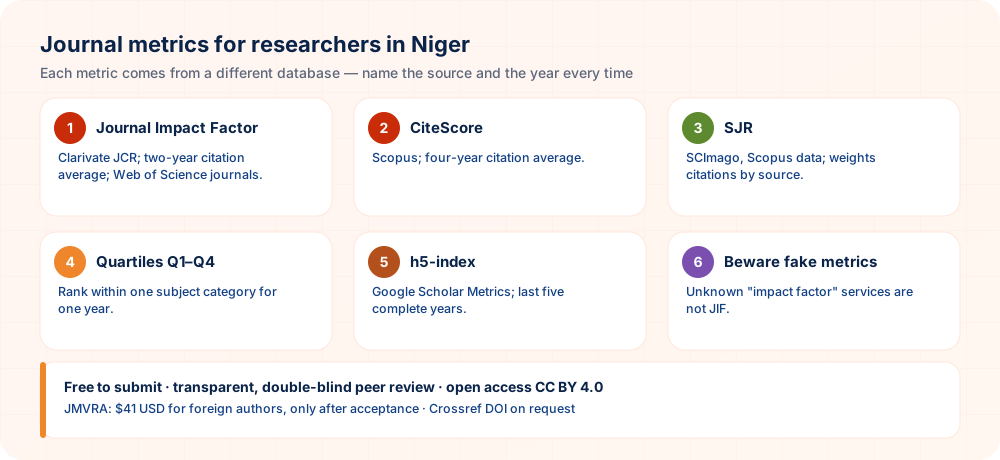
Impact metrics total up a journal's citations in a set period. The Journal Impact Factor uses two years of Web of Science data; CiteScore uses four years of Scopus data; SJR gives a citation more weight if it comes from a more prestigious journal. Because fields cite differently, compare journals only within the same subject category, as a reader in Niger should.
| Metric | Data source | Window | Where to check |
|---|---|---|---|
| Journal Impact Factor | Web of Science (Clarivate) | 2 years | Journal Citation Reports |
| CiteScore | Scopus (Elsevier) | 4 years | Scopus Sources |
| SJR | Scopus data, SCImago | Spanning 3 years and weighted for prestige | SCImago Journal & Country Rank |
| Quartile (Q1–Q4) | JCR or SCImago | Single-year, single-category measure | JCR or SCImago |
| h5-index | Google Scholar Metrics | 5 years | Google Scholar Metrics |
Invented Impact Factors and Misleading Metrics
Many websites sell or hand out “impact factors” that have nothing to do with Clarivate's Journal Impact Factor. If a journal promotes a big number from an unrecognised service, or claims a JIF but is not in the Master Journal List, it is misleading you. Three checks apply: the database, the year, and whether the database's own site confirms the figure.
Indexed Journals From Niger
Browse SCImago or Journal Citation Reports by subject category to identify high-impact journals that carry research from your region, and then go through some recent articles to judge whether they fit. Keep brief notes on scope, article types and review style for each candidate.
- Search by topic and country: use Scopus or Google Scholar to find recent articles on Niger within your field, then record which indexed journals carried them.
- Look regionally: titles centred on your region or language community tend to welcome local data and grasp the setting behind it.
- Draw on collaborators: co-authors overseas can suggest fitting journals and split expenses when necessary.
- Verify each metric at its source prior to depending on it in a promotion or grant dossier.
Niger’s Online Journals and Platforms
E-journals are now the usual format for journals in Niger. The services below help you discover them, weigh them against one another and verify their standing:
- CAMES — The African and Malagasy Council for Higher Education. Niger belongs to it as a member state, and its procedures influence academic assessment across francophone Africa.
- DICAMES — The open scientific repository of CAMES, holding theses and articles from member universities.
- African Journals Online (AJOL) — A non-profit site for peer-reviewed African journals, with free abstracts and quite a few fully open access titles.
- Directory of Open Access Journals — Look up open access journals that satisfy DOAJ’s criteria, narrowing results by publisher country (Niger) or by “without fees”.
- SCImago country rankings — Journal rankings built on Scopus and limited to titles published in Niger, showing quartiles and SJR.
- ISSN Portal — Match the exact title, ISSN and publishing country of any journal under consideration with its portal record.
Being listed on a platform or in a directory does not itself show high impact or international indexing; check each journal in the citation databases.
Locating Top-Tier Journals in Your Field
- Pick the subject category for your field, the same one used by JCR and SCImago.
- In JCR or SCImago, open the category's journal list and sort by the metric your requirement names.
- Read three recently published articles from every shortlisted journal to see whether your work fits.
- Check the current year's metric and quartile at the original source.
- Before submitting, check the fees, open access options and any waivers.
| Field | Journals based in Niger | Then search |
|---|---|---|
| Agriculture & environment | Annales (Series A); EDS (check indexing) | Scopus agricultural and environmental sciences |
| Health | Annales (Series A) (check indexing) | African and francophone medical journals; Scopus medicine |
| Social sciences | RENISS (check indexing) | Francophone SSCI and Scopus journals |
| Humanities & history | Annales (Series B) (check indexing) | AHCI and Scopus humanities |
| Science & engineering | None confirmed in Niger | SCIE and Scopus |
Open Access, Costs and Impact
In many high-impact journals, open access is available for an article processing charge; a few are diamond open access, and numerous subscription journals charge authors nothing. The gain is a wider readership, above all where libraries cannot afford subscriptions, yet citation effects differ by field. Never pay a large APC just for impact.
- Deal with the fee before you shortlist, along with the metric and the fit.
- Explore waivers: lots of publishers provide them to researchers in lower- and middle-income countries.
- Consider self-archiving: if the journal's policy permits, you can put the accepted manuscript into a repository for free.
- Check with your library to learn if an agreement with the publisher pays for, or reduces, the APC for authors in Niger.
A Practical Path to High-Impact Publication
Impact is created by the quality and reach of the study, not by the journal alone. Accumulate peer-reviewed papers matched to their journals, partner with collaborators who add expertise, and save your strongest, most generalisable results for the highest-impact titles in your field.
- Lift the quality of the study: clarity of the question, soundness of the design, adequacy of the sample and full reporting all count.
- Give it an international angle: show what readers beyond Niger can take away from the work.
- Collaborate when it brings in extra expertise or data.
- Answer reviewer comments fully — most high-impact papers need revision.
Preparing to Submit to a Top-Tier Journal
- Category matchThe subject category of the journal suits your paper
- Metric verifiedJIF or quartile looked up through JCR or SCImago for this year
- Suitability checkedThree recent articles read; your paper fits with them
- Fees confirmedAPC, waivers and open access options clarified
- Second choice setA credible backup journal picked well in advance
How JMVRA suits authors in Niger
Based in India, JMVRA (ISSN 2984-8911) is an international open access journal covering many disciplines. It is not a Nigerien journal, but it accepts papers from authors in Niger. JMVRA does not have a Clarivate impact factor; it is a good fit for papers that need an affordable, peer-reviewed open access home rather than a Scopus or WoS-indexed one.
- Fee: Foreign authors are asked for $41 USD only upon acceptance, and it covers as many as 5 authors.
- Review: transparent double-blind review by subject peers; similarity must be under 15%.
- Access: open access at no cost to readers, licensed CC BY 4.0; a Crossref DOI can be requested.
- Honest indexing note: you can find the journal in Google Scholar, but it is not in Scopus, Web of Science or DOAJ.
A Phased Path Toward High-Impact Journals From Niger
| Stage | Goal |
|---|---|
| First papers | Solid research, carefully reported and placed in legitimate peer-reviewed journals |
| Building | Joint work across francophone West Africa, bigger samples and sturdier methods |
| Targeting | Use JCR or Scopus to confirm that a journal ranks Q1 or Q2 in your subject category |
| Sustaining | Steady focus on one research theme, plus data sharing and reviewing for journals |
The Role of Metrics in Niger
- Say which metric you used — JIF, CiteScore or SJR, or a value drawn from Google Scholar
- Name the provider — and search for the journal on that site independently
- Keep comparisons to one field — rather than crossing fields
- Keep a record of your checks — with the date, for evaluators
Publishing Wisely as a Researcher in Niger
Researchers in Niger may work with limited connectivity and small teams, so efficiency matters. These suggestions help you prepare dependable submissions and keep the process manageable from start to finish.
- Work offline-friendly from the start. Keep drafts, references and figures in formats that open without a constant internet connection. Download key articles when connectivity is good, so writing is never stalled by outages.
- Compress figures sensibly. Large image files slow uploads and risk failed submissions. Save figures at a reasonable resolution, check them before sending, and keep the original versions safely stored.
- Collaborate through shared outlines. Send co-authors a short outline rather than a full draft, so feedback arrives quickly even over slow links. Agree on responsibilities in writing to avoid duplicated work.
- Describe the local setting precisely. International readers need context about your study site, population or conditions. Explain what makes the setting distinctive, because that detail often gives the paper its unique value.
- Confirm submission steps before the deadline. Read the journal's submission system instructions early and try registering an account in advance. Discovering a technical obstacle at the last minute is avoidable with a little preparation.
Plan for unreliable connections, share concise outlines with collaborators, and describe your local context well so reviewers see its value.
Questions Researchers Often Ask
Summary and What to Do Next
Publishing in high-impact journals from Niger is realistic when you pair a strong paper with a suitable journal and read the metrics honestly. Check each number at its source, choose according to fit within your category, and build your record gradually. Patience matters, because a strong record grows from several well-targeted submissions rather than a single attempt.
- Find your subject category and note your requirement.
- Use JCR or SCImago to shortlist journals, then read their recent articles.
- Confirm metrics and fees before submitting.
- Related guides cover low-cost journal publication in Niger as well as Scopus and Web of Science journals in Niger.
Ready to send in your paper?
Submission to JMVRA is online and free. Review always comes first; the $41 USD publication fee applies only after your paper is accepted.
Related searches
Readers in Niger who use this guide often go on to search for Scopus and Web of Science indexing, Q1 and Q2 journals, high impact factor journals and methods for checking a journal’s metrics. The guides below respond to those needs:
References and Sources
Checked on 4 October 2026. Metrics are updated every year, so confirm them at the original source.
Getting Published From Niger Through JMVRA
- Submit onlineAuthors from any country can apply; it costs nothing to submit
- First reviewScope and similarity (under 15%) are checked first
- Double-blind reviewExperts in the subject review it; the decision comes by email
- Accepted — $41 USDSingle charge for as many as 5 authors
- PublishedCC BY 4.0 open access
Details: Publication charges · Peer review · Advice for authors outside India.
Ready to Publish? Submit to JMVRA
JMVRA is aligned with UGC's Suggested Parameters for Choosing Peer-Reviewed Journals.
JMVRA is a Transparent, Peer-Reviewed, Open Access Journal (Refereed Journal). Following the discontinuation of the UGC and UGC-CARE journal listing, and in alignment with the latest UGC-CARE recommendations and guidelines, JMVRA is aligned with UGC’s Suggested Parameters for Choosing Peer-Reviewed Journals.
Pages worth visiting on jmvra.org
Key Terms
Subjects and search phrases this article addresses.
Related Reading
Further guides for researchers in Niger.
Keep Reading on the JMVRA Blog
As part of the JMVRA journal blog, this guide shares practical help on publishing, indexing, metrics and research integrity, and is written to be verifiable rather than promotional.