
Are you a researcher in the DR Congo who needs Scopus or Web of Science journals? When we checked, no journal published in the DRC could be confirmed in either database, so indexed publication goes through African, francophone and international titles. This guide explains how to find and verify them.
Scopus and Web of Science: The Essentials
Scopus is an Elsevier citation and abstract database with selective coverage; CiteScore is drawn from it, and the SCImago Journal Rank (SJR) is built on its data. Web of Science is Clarivate's product. Its Core Collection includes SCIE (sciences), SSCI (social sciences), AHCI (arts and humanities) and ESCI (emerging sources), and Journal Citation Reports carries the Journal Impact Factor. Both databases review their titles again from time to time, and a journal can be dropped. For more detail, see Scopus explained and Web of Science explained.
| Term | What it is | Where to check |
|---|---|---|
| Scopus | Elsevier's selectively curated abstract and citation database | Scopus Sources |
| SCIE | Science Citation Index Expanded — the science index within Web of Science | Master Journal List |
| SSCI | Social Sciences Citation Index — the social science index within Web of Science | Master Journal List |
| AHCI | Arts & Humanities Citation Index — the humanities index within Web of Science | Master Journal List |
| ESCI | Emerging Sources Citation Index — journals in Web of Science that have passed a quality review | Master Journal List |
| Journal Impact Factor | A two-year citation average, given to every journal in the Web of Science Core Collection since the 2023 release | Journal Citation Reports |
| CiteScore | Citations averaged over four years for Scopus journals | Scopus Sources |
| SJR | SCImago Journal Rank — a prestige-weighted score based on Scopus data | SCImago |
| Quartile (Q1–Q4) | Where a journal stands within the ranking of its subject category in a single year | JCR or SCImago |
A 2025 study of Scopus-indexed journals in Africa shows that indexed titles cluster in a few countries. For Congolese researchers, that calls for looking past national journals, toward indexed African titles, francophone journals in Belgium, France and other countries, and international journals in each field. A realistic shortlist usually mixes regional titles with a few ambitious international ones.
DR Congo Journals in Scopus and Web of Science: The Present Situation
To publish in indexed outlets, Congolese researchers typically select indexed African journals, francophone international journals or international titles in their discipline, frequently together with collaborators.
Other well-known titles (Scopus or Web of Science indexing not verified)
| Journal | Publisher | Reported coverage |
|---|---|---|
| Annales Africaines de Médecine | Faculty of Medicine, University of Kinshasa | On AJOL; DOAJ listing; French and English |
Checked 4 October 2026. “Reported” means the journal or publisher says so; we have not independently confirmed it.
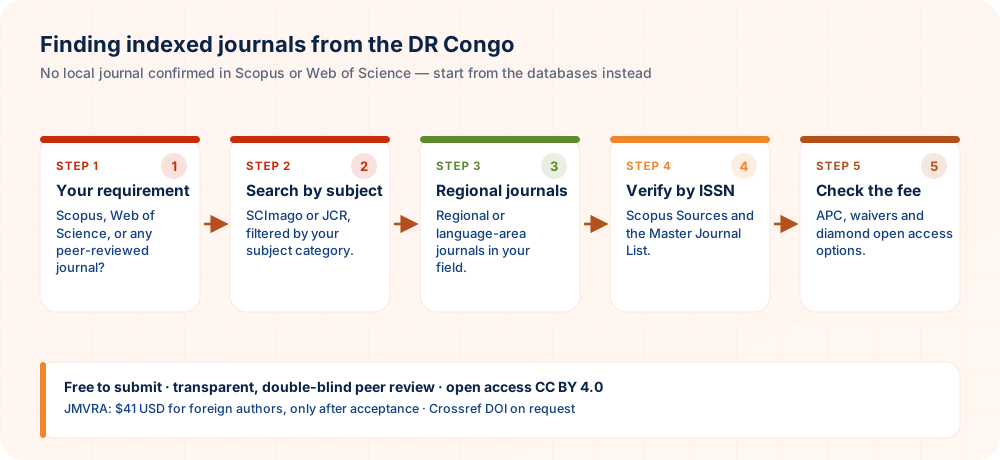
Indexing Verification Checklist
- Get the ISSNBoth print and online ISSN, taken from the official website
- Scopus SourcesEnter the ISSN and record the journal's status and years of coverage
- Master Journal ListEnter the ISSN and record whether it is SCIE, SSCI, AHCI or ESCI
- Coverage stopped?Look through Scopus's list of discontinued titles
- Keep evidenceDated screenshots for your promotion or grant file
International Publishing From the DR Congo
Few of the journals published in the DR Congo appear in Scopus or Web of Science, so most researchers who need indexed outlets also publish internationally, in African regional titles, society journals and the big international publishers. A 2025 study of Scopus coverage in Africa (Kanyika & Kim) calls this a “continued struggle”, observing that African journals in Scopus are growing in number, but at a slow pace.
Check three things before choosing an international journal. First, the article processing charge (APC), and whether the publisher gives waivers or discounts to authors in lower- and middle-income countries. Second, whether your institution or funder pays APCs. Third, whether your field has a diamond open access journal (free to read and to publish); DOAJ lets you filter by “without fees”. Collaborators abroad might be able to cover publication costs, so agree on this before you submit.
Quartiles, Impact Factor and Top-Tier Journals
Impact Factor, CiteScore and SJR each average a journal's performance, drawing on separate databases and time windows, and each is updated annually. Compare equivalent figures only — one metric, one category, one year — and verify the number at its original source, not on the journal's own homepage.
Researchers in the DR Congo will generally find that the highest-impact journals in their field are international, not local. Search by subject category in Journal Citation Reports, Scopus Sources or SCImago, and read recent articles to see how well a journal fits. Our guide to finding high impact factor journals sets out the method step by step. Reading the aims and scope page closely avoids many desk rejections.
Picking an Indexed Journal for Your Subject
| Field | Journals based in the DR Congo | Then search |
|---|---|---|
| Medicine & health | Annales Africaines de Médecine (check indexing) | African and francophone medical journals; medicine in JCR and Scopus |
| Agriculture | No confirmed journal in the DRC | AJFAND; Scopus agricultural sciences |
| Social sciences | No confirmed journal in the DRC | Francophone journals in SSCI and Scopus |
| Science & engineering | No confirmed journal in the DRC | SCIE and Scopus |
| Law & humanities | No confirmed journal in the DRC | Francophone journals in AHCI and Scopus |
Publishing in French
French is one of the main research languages in the DR Congo. Writing in French need not limit international visibility, because Scopus and Web of Science cover French-language journals, particularly in the humanities, social sciences, law and medicine, and most of them ask for English titles and abstracts. A clear English abstract also helps colleagues abroad judge your work quickly. Before submitting, check:
- what the journal's language rules say, and whether bilingual articles are welcome;
- if an abstract and keywords are supplied in English;
- if the people who read it belong to the community you hope to reach.
Never release one study in two languages unless both journals have clearly agreed; otherwise it is duplicate publication.
Getting Your Paper Ready for an Indexed Journal
Acceptance by an indexed journal depends on fit, clarity and rigour far more than on the metric. Useful steps:
- Narrow the list by scope first, and only afterwards by metric.
- Sharpen how you frame the paper: a single clear research question, a statement of contribution and candid limitations.
- Follow the journal's template and reference style precisely, as it shows attention to detail.
- Work together with co-authors from other institutions or countries when they bring needed expertise; international collaboration is also linked to greater visibility.
Frequent Mistakes With Indexed Journals
- Trusting a logo on the journal's homepage rather than the database record.
- Leaving the index unnamed — “Web of Science” could mean SCIE, SSCI, AHCI or ESCI.
- Overlooking discontinuation — last year's indexing may no longer hold.
- Choosing on metrics alone — a paper outside the journal's scope will be rejected quickly.
How JMVRA suits authors in the DR Congo
Based in India, JMVRA (ISSN 2984-8911) is an international open access journal covering many disciplines. It is not a Congolese journal, but it accepts papers from authors in the DR Congo. JMVRA is not in Scopus or Web of Science; it serves authors who want an affordable, peer-reviewed open access journal rather than an indexed one.
- Fee: Nothing is requested before acceptance; at that point foreign authors owe $41 USD, which covers up to 5 authors.
- Review: peers who know the subject review the paper double-blind and transparently; similarity must stay below 15%.
- Access: CC BY 4.0 licence, free open access; Crossref DOI provided if you ask.
- The honest position on indexing: listed in Google Scholar, not listed in Scopus, Web of Science or DOAJ.
Preparing a Submission Pack for Indexed Journals From DR Congo
| Item | Tip |
|---|---|
| Manuscript | Placed in the journal’s own template, carrying an English title, abstract and keywords |
| Cover letter | Shows why the journal suits the work and why readers beyond DR Congo will value it |
| ORCID iDs | Included for each author in order to maintain accurate records |
| Approvals | Ethics clearance and any research permit that DR Congo requires |
| Data availability statement | Either the place the data is held or the reason it can’t be shared |
Collaborating Internationally From DR Congo
Regional collaborators
Shared projects across Central Africa and francophone networks pool data, methods and reviewers.
Researchers in the diaspora
DR Congo researchers based overseas make natural co-authors and mentors.
Co-supervision
Co-authored papers come out of co-supervised theses.
Agreeing authorship
Settle roles, author order and data ownership in writing before you begin.
Practical Tips for DR Congo Authors Writing for International Journals
Researchers in DR Congo often work in French and face practical barriers such as limited connectivity. These suggestions focus on realistic steps that help your work reach international reviewers.
- Decide on your writing language early. Choose whether to write in French or English based on the journal and your intended readers. Switching halfway wastes effort, so settle the question before drafting the full text.
- Use translation tools only as a draft. Automated translation can help with a first pass, but technical terms often come out wrong. Have a subject-aware person review the translated text before it goes anywhere.
- Download and store references offline. When you have a stable connection, save the articles and datasets you need onto a local drive. This protects your progress during interruptions in service.
- Describe fieldwork conditions honestly. Explain access challenges, sampling decisions and security considerations without exaggeration. Candid methods sections help reviewers understand constraints and judge the study fairly.
- Seek co-authors who know the region. Collaborate with researchers from nearby francophone and anglophone institutions who understand the setting. Shared authorship brings editing support and credibility with international audiences.
Plan your language, protect your files against connectivity problems, and partner with experienced colleagues to present your fieldwork convincingly.
Questions Researchers Often Ask
Summary and What to Do Next
Indexed publication for Congolese researchers depends on careful choices among African, francophone and international journals. Verify through the ISSN and budget for costs early.
- Work out whether your own rule names Web of Science, Scopus, a general index or a quartile.
- Use the tables above and the international databases to shortlist journals in your field.
- Check each title by its ISSN and keep a record of what you find.
- Options outside the indexed group are covered in the research journals listed for the DR Congo.
Ready to send in your paper?
Submission to JMVRA is online and free. Review always comes first; the $41 USD publication fee applies only after your paper is accepted.
Related searches
People in the DR Congo reading this guide are usually also interested in high impact factor journals, affordable open access journals, journal publication in DR Congo, paper publication fees, and Scopus and Web of Science indexed journals. Here are guides that cover these topics:
- Low-cost journal publication in the DR Congo
- High impact factor journals in the DR Congo
- Research journals in the DR Congo
- How a low-fee journal is funded
- Locating high impact factor journals
- How to choose a journal
- Checking an indexing claim yourself
- Recognising a predatory journal
- Publishing with JMVRA from outside India
- JMVRA publication charges
References and Sources
Checked on 4 October 2026. Indexing status can change, so confirm it before submitting.
- SCImago journal rankings — DR Congo
- Kanyika & Kim (2025), Continued struggle: the growth of Scopus-indexed journals in Africa
- Discoverability of African journals by Google Scholar and inclusion in Scopus (PMC)
- African Journals Online
- Scopus Sources
- Clarivate Master Journal List
- ISSN Portal
- SCImago Journal & Country Rank
- Journal Citation Reports
Publish With JMVRA From the DR Congo
- Submit onlineWelcome from every country; it costs nothing to submit
- First reviewThe paper is screened for scope and for similarity under 15%
- Double-blind reviewSpecialists review the paper; you receive the decision by email
- Accepted — $41 USDSingle charge for as many as 5 authors
- PublishedCC BY 4.0 open access
Details: Publication charges · Peer review · Advice for authors outside India.
Ready to Publish? Submit to JMVRA
JMVRA is aligned with UGC's Suggested Parameters for Choosing Peer-Reviewed Journals.
JMVRA is a Transparent, Peer-Reviewed, Open Access Journal (Refereed Journal). Following the discontinuation of the UGC and UGC-CARE journal listing, and in alignment with the latest UGC-CARE recommendations and guidelines, JMVRA is aligned with UGC’s Suggested Parameters for Choosing Peer-Reviewed Journals.
Pages worth visiting on jmvra.org
Key Terms
Subjects and search phrases this article addresses.
Related Reading
Extra guides for researchers in the DR Congo, plus help with choosing a journal.
Affordable Journal Publication in the DR Congo
Read the guide RelatedHigh-Impact Journals for Researchers in the DR Congo
Read the guide RelatedResearch Journals in the DR Congo: 2026 Guide
Read the guide RelatedResearch Journals in Niger: Local & Regional
Read the guide RelatedResearch Journals in Tanzania: A Verified List
Read the guide RelatedWhat International Authors Should Know About JMVRA
Read the guide RelatedChecking a Journal’s Indexing Claims
Read the guideKeep Reading on the JMVRA Blog
As part of the JMVRA journal blog, this guide shares practical help on publishing, indexing, metrics and research integrity, and is written to be verifiable rather than promotional.