
Searching for low cost journal publication in the DR Congo? Getting a paper published should not swallow a whole month’s earnings. Here you will find the usual charges of journals inside the DR Congo and overseas, the places to look for free and inexpensive options, the way predatory offers use cheap prices as bait, and five checks to complete before paying a cent. It is aimed at students, scholars and faculty in Kinshasa, DR Congo; Lubumbashi, DR Congo; Kisangani, DR Congo; Bukavu, DR Congo. Keep a copy of every fee page you rely on, because journals can revise their charges.
How Much Journal Publication Costs in The DR Congo
Journals at Congolese universities decide their own charges, and many ask for little; regional and international titles range from no fee at all to expensive APCs.
| Model | What authors pay | Typical publisher |
|---|---|---|
| Diamond open access | No cost at all — open to read and to publish in | Journals supported by a university, a society or a funding body |
| National or university journals’ charge | A small fee, frequently charged in Congolese francs | Society and university-run journals |
| International APC | Ranges from a few hundred to several thousand US dollars | Large non-profit and commercial open access publishers |
| Subscription or hybrid | Often no charge, with an optional fee to make it open access | Journals whose income comes from library subscriptions |
An APC pays for several things: managing peer review, editing and typesetting, online hosting, persistent identifiers such as DOIs, and metadata for indexing. Little or no charge is possible for journals supported by a university or society; commercial open access journals typically cost more. Look at the process rather than the price alone.
Free and Affordable Routes for Congolese Researchers
Numerous publishers grant APC waivers to authors based in lower-income countries; on DOAJ you can filter for journals that charge no fees, French-language ones among them.
- Diamond open access journals — narrow DOAJ down using “without fees” and a subject.
- National and university journals — frequently inexpensive and widely read at home: look at University of Kinshasa journals and African Journals Online (AJOL).
- APC waivers and discounts — numerous publishers extend them to authors in lower- and middle-income countries, so review each publisher’s policy.
- Institutional agreements — your university or library could have arrangements that pay for or discount APCs.
- Preprints — you can share early findings at no cost, but they are no substitute for peer-reviewed publication.
What a Sound Low-Fee Journal Should Still Offer
Paying less must never mean a weaker review. When picking an affordable journal, make sure it still provides the basics that every author in the DR Congo has a right to expect:
- Real peer review — the journal states its review model, uses independent referees and gives comments that lead to action.
- Similarity screening — a stated limit and a check made prior to review, which safeguards authors and the journal alike.
- A clear licence — open access normally uses Creative Commons, letting readers know how your work may be reused.
- Permanent hosting — an article page that does not move, an archive, and a DOI when one is available from the journal.
- Correct metadata — accurate titles, author details and references let search engines and databases locate and cite the article.
- Transparent policies — written statements on ethics, corrections, retractions and refunds available before submission.
Affordable Does Not Mean Predatory
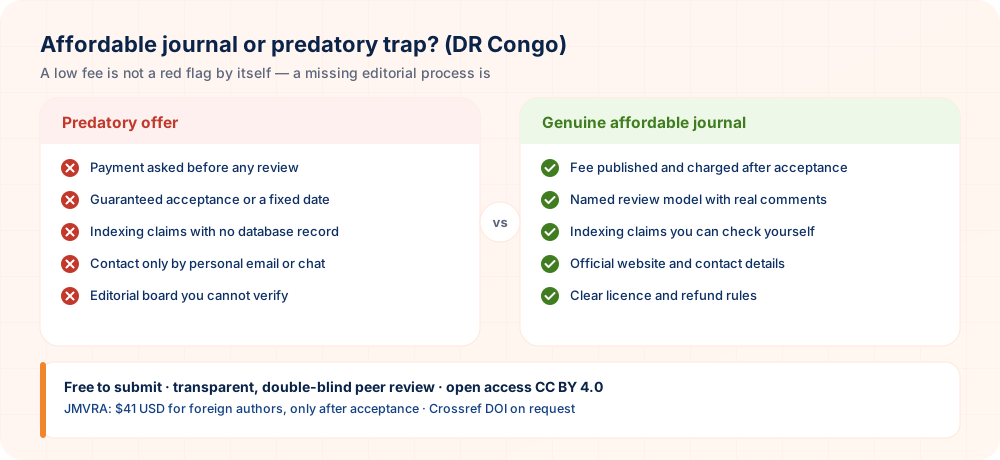
An unusually low price is a common lure. Predatory publishers pledge acceptance, fabricate impact factors, and ask you to pay up before a paper is reviewed. Honest, budget-friendly journals show their charges before submission, bill only after genuine acceptance, and return reviewer comments that you can work with. Comparing several fee pages before committing is a sensible habit.
- A request to pay before any review or decision takes place.
- A guarantee of acceptance, or a promise of it by a set date.
- Statements that the databases do not confirm, on Scopus, Web of Science or impact factor.
- A website copying a real journal’s title or ISSN.
- Charges that change once the paper is accepted, or payment to a personal account.
Five Things to Check Before Paying a Publication Fee
- Real acceptanceA decision with reviewer comments that comes from the journal directly
- Fee was announcedThe amount matches what was stated prior to submission
- Official payment channelThe journal’s own page is used, not a personal account
- Know the coverageAuthors included, along with certificates, DOI and extras
- Retain documentsThe invoice, the receipt and the acceptance letter
Funding and Support Available in The DR Congo
Partners overseas might be able to pay the publication costs; settle that arrangement before you submit.
Make the publication budget part of study design rather than an afterthought following acceptance. Include the likely fee in grant applications, find out if co-authors’ institutions can split costs, and have a second, lower-cost journal ready if the first becomes unaffordable.
Compare the Full Cost, Not Only the Headline Fee
| Item | What to check |
|---|---|
| Base fee | The APC or publication charge as published, and the currency used |
| Authors covered | How many authors are covered by the fee, and what extra authors cost |
| Extras | Page, colour, DOI, certificate or print-copy charges |
| Payment costs | What banks and currency conversion add to a payment sent abroad |
| Waivers | Find out if you are eligible for a fee reduction and the way to apply for it |
| Value | Review standards, audience reach and the type of indexing you are required to have |
How to Pay a Publication Fee Safely From The DR Congo
Cross-border payments bring extra costs that are easy to overlook: bank charges, currency conversion and, at times, intermediary fees. Prior to paying, ask the journal which payment methods it takes, whether the amount is stated in Congolese francs or US dollars, and whether the invoice can carry the name your institution requires for reimbursement. Request a written receipt so the expense can be documented later.
- Never pay before a real acceptance; use only the official bank account or payment page belonging to the journal.
- Do not pay into anyone's personal account or through an agent.
- File your acceptance letter, the invoice and the receipt together; audits and reimbursement may need them.
- Ask for an explanation in writing when the charge is different from the advertised fee, and do so before you pay.
Affordable Publication From Anywhere in The DR Congo
Everything happens online, from submission through review to payment, so authors in Kinshasa, DR Congo; Lubumbashi, DR Congo; Kisangani, DR Congo; Bukavu, DR Congo; Goma, DR Congo and any other town publish under identical conditions. Choose a journal because of its subject fit and its process; your location has no effect on the fee.
Where JMVRA suits authors in the DR Congo
Based in India, JMVRA (ISSN 2984-8911) is an international open access journal covering many disciplines. It is not a Congolese journal, but it accepts papers from authors in the DR Congo. Its fee is modest because it operates on a no-profit, no-loss basis, not because peer review is skipped.
- Fee: Authors in DR Congo pay nothing until acceptance; after that the foreign-author charge is $41 USD, covering as many as 5 authors.
- Review: first a similarity check (under 15%), then transparent double-blind peer review by specialists in the subject.
- Access: the journal is open access with a CC BY 4.0 licence; a Crossref DOI is available if you request it.
- Open about indexing: you can find articles in Google Scholar, but not in Scopus, Web of Science or DOAJ.
Budgeting for Publication Costs in Congolese franc (CDF)
| Item | What to check |
|---|---|
| Publication fee | The charging currency and its timing; JMVRA collects $41 USD from foreign authors only after acceptance |
| Payment charges | Bank or card charges on an international payment sent from DR Congo |
| Authors covered | Check that the fee takes in all co-authors (JMVRA: up to five) |
| Optional services | Language editing, a DOI or printed copies — worth choosing only if needed |
Sending an International Fee From DR Congo
- Wait until the acceptance email arrives — genuine journals do not ask for payment before review
- Only the official payment details should be used — from the website of the journal or the acceptance email
- Confirm the sum in Congolese franc (CDF) — your bank applies its own exchange rate
- File your receipts — they support reimbursement and your records
Guidance for Congolese Researchers Seeking Affordable Publication
Working in the DR Congo can mean limited connectivity, and publication may involve French and English. These practical suggestions help you protect your time, money and data throughout the process.
- Save work offline often. Keep local copies of drafts, figures and correspondence, since an interrupted connection can lose unsaved changes. Use a simple naming system that shows the date and version.
- Decide on the language early. If your first draft is in French, plan time for careful translation or professional editing before submission. Technical terms translated literally can change meaning and weaken your argument.
- Look for partners abroad. A co-author at an overseas institution may help with access to databases, software and fee support. Discuss credit, data ownership and responsibilities honestly at the outset.
- Be wary of unsolicited offers. Emails promising rapid acceptance or flattering invitations deserve scepticism. Check the journal independently and ask colleagues whether they have dealt with the publisher.
- Protect sensitive field data. If your research involves communities or vulnerable participants, remove identifying details and follow your ethics approval. Journals expect careful handling of participant information.
Back up your files, plan for language and verification, and publish only where you can confirm the journal's legitimacy yourself.
Questions Researchers Often Ask
Summary and What to Do Next
Affordable publishing in the DR Congo is achievable once you know where to search and what to verify. Favour journals with a clear workflow and a stated fee, take advantage of waivers and institutional help, and do not pay until a genuine acceptance arrives. A journal that explains its process openly is usually easier to trust than one that hides it.
- Find out exactly what your institution requires.
- Make a short list of diamond, national and reasonably priced international journals that suit your discipline.
- Complete the five checks before you pay any fee.
- Further reading: a directory of research journals across the DR Congo, and a page about journals with a high impact factor in the DR Congo.
Ready to send in your paper?
Submission to JMVRA is online and free. Review always comes first; the $41 USD publication fee applies only after your paper is accepted.
Related searches
Visitors from the DR Congo reading this page frequently look up low cost journal publication, publication charges, APC waivers, free open access journals and secure ways to pay as well. These guides deal with each of those questions:
References and Sources
Checked on 4 October 2026. Fees and policies can change, so confirm them before submitting.
Getting Published From The DR Congo With JMVRA
- Submit onlineWorldwide access, and no payment is due when you submit
- Entry checkRelevance to scope and similarity (below 15%)
- Double-blind reviewReviewers expert in the subject; you receive the decision by email
- Accepted — $41 USDA flat fee shared by up to 5 authors
- PublishedLicensed CC BY 4.0, open to everyone
Details: Publication charges · Peer review · Advice for authors outside India.
Ready to Publish? Submit to JMVRA
JMVRA is aligned with UGC's Suggested Parameters for Choosing Peer-Reviewed Journals.
JMVRA is a Transparent, Peer-Reviewed, Open Access Journal (Refereed Journal). Following the discontinuation of the UGC and UGC-CARE journal listing, and in alignment with the latest UGC-CARE recommendations and guidelines, JMVRA is aligned with UGC’s Suggested Parameters for Choosing Peer-Reviewed Journals.
Further reading on jmvra.org
Key Terms
Subjects and search phrases this article addresses.
Related Reading
Further guides for researchers in the DR Congo.
Keep Reading on the JMVRA Blog
This article sits on the JMVRA journal blog, where practical guidance covering publishing, indexing, metrics and research integrity is written to be verifiable, not promotional.