
Are you looking for Scopus journals in Bahrain? The country has only a small group of indexed journals, in computing and medicine. Below we list them, explain how to verify indexing using the ISSN, and describe how to locate strong regional and international titles for your field.
Scopus and Web of Science: The Essentials
Scopus comes from Elsevier and is a citation and abstract database that picks its titles selectively; it is the source of CiteScore, and its data feeds the SCImago Journal Rank (SJR). Web of Science comes from Clarivate: its Core Collection takes in ESCI (emerging sources), SCIE (sciences), AHCI (arts and humanities) and SSCI (social sciences), and Journal Citation Reports publishes the Journal Impact Factor. Re-evaluation of journals happens in both, and a journal can be discontinued. Dig deeper with Scopus explained and Web of Science explained.
| Term | What it is | Where to check |
|---|---|---|
| Scopus | Elsevier’s database of abstracts and citations, with a selective intake | Scopus Sources |
| SCIE | Science Citation Index Expanded — covers the sciences inside Web of Science | Master Journal List |
| SSCI | Social Sciences Citation Index — covers the social sciences inside Web of Science | Master Journal List |
| AHCI | Arts & Humanities Citation Index — covers the humanities inside Web of Science | Master Journal List |
| ESCI | Emerging Sources Citation Index — Web of Science listing for journals that pass a quality review | Master Journal List |
| Journal Impact Factor | Calculated as a two-year citation average and awarded to all Web of Science Core Collection journals from the 2023 release | Journal Citation Reports |
| CiteScore | Four-year average of citations, calculated for journals in Scopus | Scopus Sources |
| SJR | SCImago Journal Rank — prestige-weighted scoring built on Scopus data | SCImago |
| Quartile (Q1–Q4) | A journal’s place in the order of its subject category for one year | JCR or SCImago |
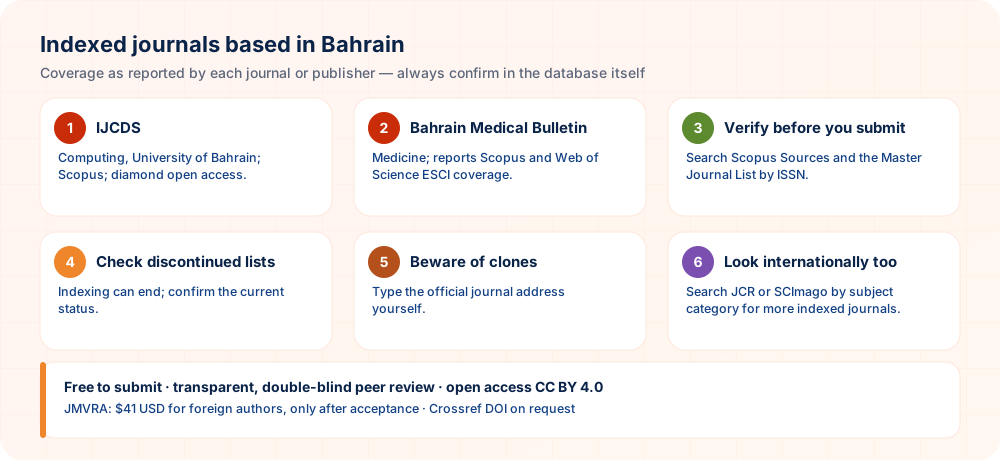
Among Bahrain’s indexed journals is IJCDS from the University of Bahrain, which, according to the university, has every volume indexed in Scopus, along with the Bahrain Medical Bulletin, which reports coverage in Scopus and ESCI. To see the up-to-date list, narrow SCImago’s rankings to Bahrain.
Journals in Bahrain Indexed by Scopus and Web of Science
The journals below are published in Bahrain and state, on their own websites or via their publisher, that Scopus and/or Web of Science covers them. Check each one by ISSN in Scopus Sources and the Master Journal List on the day you make your choice.
| Journal | Publisher | Subject | Reported coverage |
|---|---|---|---|
| International Journal of Computing and Digital Systems (IJCDS) | University of Bahrain | Engineering and computer science | Reported coverage: Scopus; diamond open access with no APC |
| Bahrain Medical Bulletin | Bahrain Medical Bulletin, Manama | Medicine | Scopus and ESCI — as reported |
Other prominent titles (indexing in Scopus or Web of Science not verified)
| Journal | Publisher | Reported coverage |
|---|---|---|
| Arab Journal of Basic and Applied Sciences | University of Bahrain (Taylor & Francis) | Verify present indexing in Scopus and the Master Journal List |
Checked 4 October 2026. “Reported” means the journal or publisher says so; we have not independently confirmed it.
Indexing Verification Checklist
- Fetch the ISSNPrint and online ISSN as given on the official website
- Scopus SourcesType in the ISSN and note the journal’s status and coverage years
- Master Journal ListType the ISSN and jot down SCIE, SSCI, AHCI or ESCI
- Ceased coverage?Search Scopus’s record of discontinued titles
- Store proofDated screenshots to include in your promotion or grant file
International Publishing From Bahrain
Bahrain offers its researchers more indexed national journals than many countries do, yet in most fields the broadest selection remains international. When searching abroad, look at the article processing charge (APC), find out if your university holds a publisher agreement that pays it, and see whether your field has a diamond open access journal (free for both authors and readers); DOAJ can filter by “without fees”. Raising the cost question early prevents unpleasant surprises once the paper is accepted.
Before submitting, find out from your university what publication support and publisher agreements it offers.
Quartiles, Impact Factor and Top-Tier Journals
Always note the source database of a figure. Journal Citation Reports publishes the Journal Impact Factor for Web of Science titles, whereas CiteScore and SJR derive from Scopus. Q1 means a journal sits in the top quarter of its subject category for one particular year, so match categories and years before comparing.
Researchers in Bahrain will usually find the highest-impact choices in their field among international journals, not local ones. Locate them through subject categories in Journal Citation Reports, Scopus Sources or SCImago, and skim recent articles to judge whether they suit your work. Our guide to finding high impact factor journals takes you through the method one step at a time.
Picking an Indexed Journal for Your Subject
| Field | Journals based in Bahrain | Then search |
|---|---|---|
| Computing & engineering | IJCDS | SCIE; Scopus computer science |
| Medicine | Bahrain Medical Bulletin | Categories for medicine in JCR and Scopus |
| Basic & applied sciences | Arab Journal of Basic and Applied Sciences (check indexing) | Scopus and SCIE |
| Business & finance | Turn to regional and international journals | Scopus business; SSCI |
| Education | Turn to regional and international journals | SSCI, ESCI and Scopus education |
Diamond Open Access: Free and Indexed
IJCDS demonstrates that an indexed journal need not charge its authors. Diamond open access journals cost nothing to read or to publish in, since a university, society or funder pays the bills. They can be found in every region and in many fields.
- Use DOAJ and apply the “without fees” filter.
- Make sure the journal still runs genuine peer review and has an editorial board whose members you can verify.
- Check indexing on its own, because diamond status tells you nothing about Scopus or Web of Science.
Getting Your Paper Ready for an Indexed Journal
At selective journals most papers are rejected at desk stage, yet this can often be prevented. Prior to submitting:
- Check suitability by going through the aims and scope plus three recent articles; should your paper seem out of place, pick a different journal.
- Give local work global meaning. Spell out what readers abroad can take from your data or context.
- Review the language and organisation. If English is not your first language, a colleague reading the draft or a professional editor can help.
- Address every reviewer comment. When revisions are requested, reply to each point in a table of responses.
Frequent Mistakes With Indexed Journals
- Placing faith in a logo on the journal’s main page over the database record.
- Not stating which index — “Web of Science” is ambiguous between SCIE, SSCI, AHCI or ESCI.
- Forgetting about discontinuation — indexing from the previous year may not be valid now.
- Metric-only selection — the journal will swiftly reject a paper that falls outside its scope.
How JMVRA suits authors in Bahrain
Based in India, JMVRA (ISSN 2984-8911) is an international open access journal covering many disciplines. It is not a Bahraini journal, but it accepts papers from authors in Bahrain. JMVRA is not in Scopus or Web of Science; it serves authors who want an affordable, peer-reviewed open access journal rather than an indexed one.
- Fee: Foreign authors pay $41 USD once the paper has been accepted; the amount covers up to 5 authors.
- Review: the similarity level must be under 15%, after which subject specialists carry out transparent double-blind peer review.
- Access: the journal is open access, licensed CC BY 4.0, and a Crossref DOI is available on request.
- Straight about indexing: Google Scholar lists the articles; Scopus, Web of Science and DOAJ do not.
Preparing a Submission Pack for Indexed Journals From Bahrain
| Item | Tip |
|---|---|
| Manuscript | On the journal’s template, showing an English-language title, abstract and keywords |
| Cover letter | Shows why the journal suits the work and why readers beyond Bahrain will value it |
| ORCID iDs | One for each author, so the records remain correct |
| Approvals | Ethics clearance and any research permit that Bahrain requires |
| Data availability statement | Where one can find the data — or why sharing is not possible |
Collaborating Internationally From Bahrain
Regional collaborators
Shared projects around the Gulf (GCC) pool data, methods and reviewers.
Researchers in the diaspora
Bahraini researchers based overseas make natural co-authors and mentors.
Co-supervision
Joint supervision of a thesis means joint authorship of its papers.
Agreeing authorship
Settle roles, author order and data ownership in writing before you begin.
Practical Tips for Bahrain-Based Authors Targeting Indexed Journals
Researchers in Bahrain often work across universities, hospitals and regional institutions, which shapes how they find partners and venues. These tips suit authors preparing for selective international journals.
- Use your university library early. Ask your institution's librarians which databases you can reach and whether they offer sessions on journal selection. Local expertise often reveals options that web searches miss.
- Describe the Gulf context clearly. International readers may not know local regulations, healthcare systems or demographics. Explain the setting briefly so your findings can be understood and compared elsewhere.
- Seek partners beyond your own campus. Reach out to colleagues in neighbouring Gulf countries and further afield who work on related themes. Joint projects strengthen datasets and make proposals more attractive to selective journals.
- Check language and terminology carefully. If English is not your first language, arrange professional proofreading or a trusted colleague's review before submission. Clear writing prevents reviewers from misreading sound research.
- Keep ethics approvals ready to show. Hold approval letters from your institutional committee and consent documentation in a ready folder. Journals frequently ask for them, and prompt answers keep review moving.
Combine local library support, clear contextual writing and regional collaboration to prepare convincingly for international indexed journals.
Questions Researchers Often Ask
Summary and What to Do Next
Computing and medicine are covered by indexed journals in Bahrain, one of which is a diamond open access title. For other fields, search regional and international options, and check every claim.
- Ask which of Web of Science, Scopus, an index or a quartile your rule actually names.
- From the preceding tables and international databases, narrow down journals in your field.
- Check each title by its ISSN and keep a record of what you find.
- Options outside the indexed group are covered in the list of research journals in Bahrain.
Ready to send in your paper?
Submission to JMVRA is online and free. Review always comes first; the $41 USD publication fee applies only after your paper is accepted.
Related searches
People in Bahrain reading this guide are usually also interested in high impact factor journals, affordable open access journals, journal publication in Bahrain, paper publication fees, and Scopus and Web of Science indexed journals. Here are guides that cover these topics:
- Low-cost journal publication in Bahrain
- High impact factor journals in Bahrain
- Research journals in Bahrain
- How a low-fee journal is funded
- Locating high impact factor journals
- How to choose a journal
- Checking an indexing claim yourself
- Recognising a predatory journal
- Publishing with JMVRA from outside India
- JMVRA publication charges
References and Sources
Checked on 4 October 2026. Indexing status can change, so confirm it before submitting.
Publish With JMVRA From Bahrain
- Submit onlineAuthors worldwide can use it, with nothing to pay at submission
- Entry checkRelevance to scope and similarity (below 15%)
- Double-blind reviewSubject-matter experts review; the decision comes by email
- Accepted — $41 USDA flat fee shared by up to 5 authors
- PublishedLicensed CC BY 4.0, open to everyone
Details: Publication charges · Peer review · Advice for authors outside India.
Ready to Publish? Submit to JMVRA
JMVRA is aligned with UGC's Suggested Parameters for Choosing Peer-Reviewed Journals.
JMVRA is a Transparent, Peer-Reviewed, Open Access Journal (Refereed Journal). Following the discontinuation of the UGC and UGC-CARE journal listing, and in alignment with the latest UGC-CARE recommendations and guidelines, JMVRA is aligned with UGC’s Suggested Parameters for Choosing Peer-Reviewed Journals.
Further reading on jmvra.org
Key Terms
Subjects and search phrases this article addresses.
Related Reading
Extra guides for researchers in Bahrain, plus help with choosing a journal.
Affordable Journal Publication for Bahrain Authors
Read the guide RelatedFinding High-Impact Journals as a Researcher in Bahrain
Read the guide RelatedResearch Journals in Bahrain: A Verified Guide
Read the guide RelatedResearch Journals in Oman: A Verified Guide
Read the guide RelatedResearch Journals in Saudi Arabia: Verified List
Read the guide RelatedWhat International Authors Should Know About JMVRA
Read the guide RelatedChecking a Journal’s Indexing Claims
Read the guideKeep Reading on the JMVRA Blog
This article sits on the JMVRA journal blog, where practical guidance covering publishing, indexing, metrics and research integrity is written to be verifiable, not promotional.