
Looking for high impact factor journals in Bahrain? Many promotions and grants hinge on impact factors, quartiles and rankings, yet these figures are easy to misread or fake. Inside: the meaning of the main metrics, ways to avoid fake impact factors, the journals published in Bahrain that report international indexing, and a stepwise method for finding the top-impact journals in your field. Its intended readers are researchers in Sakhir, Bahrain; Isa Town, Bahrain; Manama, Bahrain; Busaiteen, Bahrain.
What a High Impact Factor Actually Tells You
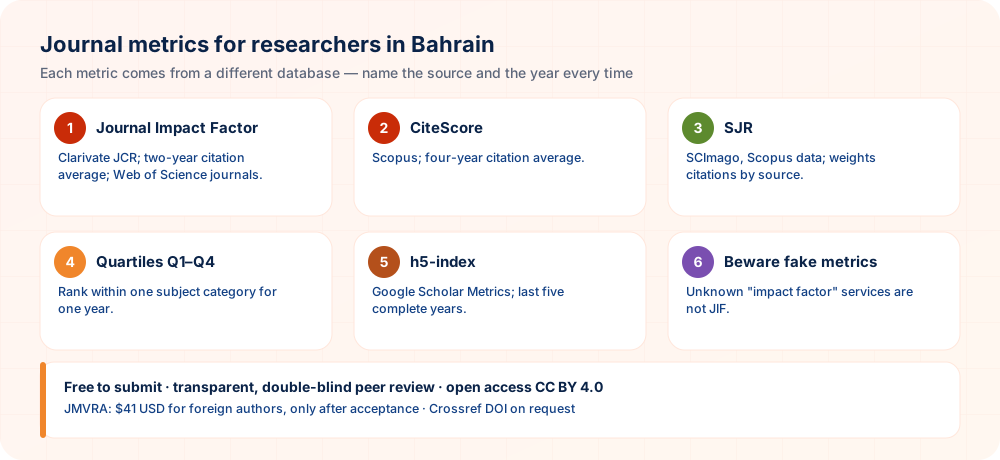
“High impact” refers to how frequently a journal’s recent articles are cited on average, relative to other journals in its field. The most familiar indicator is the Journal Impact Factor (JIF) that Clarivate releases in Journal Citation Reports; alternatives based on Scopus are CiteScore and the SCImago Journal Rank (SJR). Each of them characterises the journal and never your individual article.
| Metric | Data source | Window | Where to check |
|---|---|---|---|
| Journal Impact Factor | Web of Science (Clarivate) | 2 years | Journal Citation Reports |
| CiteScore | Scopus (Elsevier) | 4 years | Scopus Sources |
| SJR | Scopus data, SCImago | Over 3 years, weighted by prestige | SCImago Journal & Country Rank |
| Quartile (Q1–Q4) | JCR or SCImago | A single year within a single category | JCR or SCImago |
| h5-index | Google Scholar Metrics | 5 years | Google Scholar Metrics |
Invented Impact Factors and Misleading Metrics
Numerous websites sell or hand out “impact factors” unrelated to Clarivate’s Journal Impact Factor. If a journal boasts a big figure from an unknown service, or says it has a JIF yet is missing from the Master Journal List, it is misleading you. Ask three things: which database, which year, and whether the figure is visible on the database’s own website.
Journals Published in Bahrain That Are Indexed
Among Bahrain’s indexed journals are IJCDS from the University of Bahrain (Scopus) and the Bahrain Medical Bulletin (Scopus and ESCI).
| Journal | Publisher | Subject | Reported coverage |
|---|---|---|---|
| International Journal of Computing and Digital Systems (IJCDS) | University of Bahrain | Computer science and engineering | Reported as Scopus-indexed; diamond open access (no APC) |
| Bahrain Medical Bulletin | Bahrain Medical Bulletin, Manama | Medicine | Scopus and ESCI, reportedly |
This coverage was reported by every journal or publisher as of 4 October 2026. For up-to-date figures, open Journal Citation Reports for the Journal Impact Factor and quartile, and Scopus Sources or SCImago for CiteScore or SJR.
Bahrain’s Online Journals and Platforms
Nowadays most journals in Bahrain are published online as e-journals. The services below help you locate them, compare them and verify their standing:
- University of Bahrain journals — the journal portal of the University of Bahrain, which hosts IJCDS and other UoB journals.
- Education & Training Quality Authority (BQA) — Assesses the quality of education and training institutions in Bahrain, higher education included.
- Arabian Gulf University — A regional university in Manama that concentrates on medicine and graduate studies.
- Directory of Open Access Journals — Look up open access journals meeting DOAJ’s criteria; narrow by the publisher’s country (Bahrain) or by “without fees”.
- SCImago country rankings — Journal rankings based on Scopus, limited to journals published in Bahrain, showing quartiles and SJR.
- ISSN Portal — Verify the ISSN, exact title and publishing country of a journal before you place your trust in it.
Appearing on a platform or in a directory does not automatically mean high impact or international indexing; look up each journal in the citation databases.
Locating Top-Tier Journals in Your Field
- Work out which subject category (as used by JCR and SCImago) your paper falls under.
- In JCR or SCImago, list the journals of that category and sort them by the metric your requirement specifies.
- Test the fit by reading three recent articles from each journal on your shortlist.
- Check the current year's metric and quartile at the original source.
- Before submitting, check the fees, open access options and any waivers.
| Field | Journals based in Bahrain | Then search |
|---|---|---|
| Computing & engineering | IJCDS | Scopus computer science; SCIE |
| Medicine | Bahrain Medical Bulletin | JCR and Scopus classification of medicine |
| Basic & applied sciences | Arab Journal of Basic and Applied Sciences (check indexing) | Scopus and SCIE |
| Business & finance | Combine regional and international journals | SSCI and Scopus business |
| Education | Combine regional and international journals | SSCI, ESCI and Scopus education |
Open Access, Costs and Impact
Numerous high-impact journals provide open access in return for an article processing charge, a few are diamond open access, and many subscription journals take no author fee at all. Open access broadens readership, particularly where libraries cannot pay for subscriptions, yet its effect on citations differs by field, so avoid paying a large APC for impact alone.
- Look at the fee before shortlisting, together with the metric and the fit.
- Enquire about waivers: many publishers grant them to authors in lower- and middle-income countries.
- Make use of self-archiving: if the journal’s policy permits, deposit your accepted manuscript in a repository free of charge.
- Ask your library if a publisher agreement pays or discounts the APC for authors in Bahrain.
A Practical Path to High-Impact Publication
Publishing a first paper in a Q1 journal is uncommon. A sensible path is to build a track record gradually: begin with a sound paper in a respected national or regional journal, move on to indexed journals in your area, and approach the strongest journals only once you have a publication record, collaborators and a study of obvious international relevance.
- Make the study stronger: pose a clear question, choose a sound design, gather an adequate sample and report in full.
- Give it an international angle: say what readers beyond Bahrain can learn from your work.
- Work with others when they bring expertise or data you lack.
- Answer reviewers thoroughly — revision is part of the path for most high-impact papers.
Preparing to Submit to a Top-Tier Journal
- Correct categoryThe subject category of the journal fits your paper
- Metric confirmedJIF or quartile looked up in JCR or SCImago for the current year
- Fit assessedThree recent articles read; your paper would sit well among them
- Fees confirmedAPC, waivers and open access options understood
- Backup preparedA reliable second-choice journal picked beforehand
Where JMVRA Suits Authors in Bahrain
Based in India, JMVRA (ISSN 2984-8911) is an international open access journal covering many disciplines. It is not a Bahraini journal, but it accepts papers from authors in Bahrain. JMVRA does not have a Clarivate impact factor; it is a good fit for papers that need an affordable, peer-reviewed open access home rather than a Scopus or WoS-indexed one.
- Fee: The charge for foreign authors is $41 USD, settled after acceptance, and up to 5 authors share it.
- Review: a transparent, double-blind peer-review process run by subject experts; similarity has to be below 15%.
- Access: open to all readers via CC BY 4.0; authors may ask for a Crossref DOI.
- What we say about indexing: it is indexed by Google Scholar and not by Scopus, Web of Science or DOAJ.
A Step-by-Step Route to High-Impact Journals From Bahrain
| Stage | Goal |
|---|---|
| First papers | Research that is sound and transparently reported, in credible peer-reviewed journals |
| Building | Gulf (GCC) collaborations, bigger samples and stronger methods |
| Targeting | Q1 or Q2 journals for your own subject category, whose standing you have confirmed in JCR or Scopus |
| Sustaining | Consistent research direction, plus data sharing and reviewer service for journals |
The Use of Metrics in Bahrain
- Be clear about the metric — CiteScore, SJR, JIF, or a figure sourced from Google Scholar
- Seek out the source — and inspect the journal’s record there yourself
- Measure within a single field — not between fields
- Keep evidence of your checks — dated, in case evaluators ask
Practical Tips for Bahrain-Based Researchers Choosing Journals
Researchers in Bahrain often collaborate across the Gulf and beyond, which widens the available venues. These suggestions help you shortlist reputable journals while using local strengths and networks.
- Consult your university library. Librarians in Bahraini institutions can explain which databases you can access and how to check journal credentials. Their advice is free and often saves hours of searching.
- Use regional collaboration wisely. Partnerships with colleagues in neighbouring Gulf institutions can strengthen datasets and visibility. Agree authorship roles in writing before drafting, to prevent later disagreement.
- Consider language and audience. Decide whether your findings serve an Arabic-reading or international audience. If you write in English, arrange professional language editing before submitting to selective journals.
- Connect work to regional themes. Topics such as coastal environments, energy transition and healthcare in the Gulf interest international editors. Frame your contribution so readers elsewhere see its broader relevance.
- Check funding and approvals early. Confirm institutional ethics clearance and any funder conditions on open access before submission. Missing paperwork can hold up an otherwise strong paper.
Use library support, regional partnerships and careful preparation to choose journals that suit your research and your audience.
Questions Researchers Often Ask
Summary and What to Do Next
Publishing at high impact from Bahrain is possible with a strong paper, a suitable journal and a truthful reading of metrics. Check every number at its source, choose according to fit inside your category, and build your record gradually.
- Work out your subject category and requirement.
- Draw up a shortlist from JCR or SCImago and read recent articles.
- Confirm metrics and fees before submitting.
- Also see journals in Bahrain indexed by Scopus and Web of Science and affordable journal publication in Bahrain.
Ready to send in your paper?
Submission to JMVRA is online and free. Review always comes first; the $41 USD publication fee applies only after your paper is accepted.
Related searches
People in Bahrain who study this guide tend to want information on how to check a journal’s metrics, and on Q1 and Q2 journals, high impact factor journals, and Scopus and Web of Science indexing. The following guides cover those topics:
References and Sources
Checked on 4 October 2026. Metrics are updated every year, so confirm them at the original source.
Publishing With JMVRA From Bahrain
- Submit onlineAuthors in every country may apply; submission is free
- ScreeningFit with scope plus similarity test (below 15%)
- Double-blind reviewEvaluation by subject experts; result through email
- Accepted — $41 USDOnly one fee, for up to 5 authors
- PublishedOpen access, licensed under CC BY 4.0
Details: Publication charges · Peer review · Advice for authors outside India.
Ready to Publish? Submit to JMVRA
JMVRA is aligned with UGC's Suggested Parameters for Choosing Peer-Reviewed Journals.
JMVRA is a Transparent, Peer-Reviewed, Open Access Journal (Refereed Journal). Following the discontinuation of the UGC and UGC-CARE journal listing, and in alignment with the latest UGC-CARE recommendations and guidelines, JMVRA is aligned with UGC’s Suggested Parameters for Choosing Peer-Reviewed Journals.
Quick links across jmvra.org
Key Terms
Subjects and search phrases this article addresses.
Related Reading
Further guides for researchers in Bahrain.
Keep Reading on the JMVRA Blog
Our JMVRA journal blog carries this guide along with other practical advice on publishing, indexing, metrics and research integrity, all written so that claims can be verified and nothing is promotional.