
Each research paper has to acknowledge its sources, and every journal wants a specific citation style. This guide covers the main research paper citation styles — APA, MLA, IEEE and Chicago — showing in-text and reference examples side by side, which disciplines favour which, how DOIs are cited, and how to stay consistent throughout.
Defining a Citation Style
A citation style is a rulebook for crediting sources in two spots: in-text citations within your prose, and the reference list (or bibliography) at the close. Every style sets the sequence of details, punctuation, capitalisation and the way DOIs appear. Journals normally demand a single style, and applying it uniformly is part of proper research paper format. Keeping a short style cheat sheet beside you while drafting saves a lot of tedious corrections later.
Author-Date, Numbered and Notes Systems
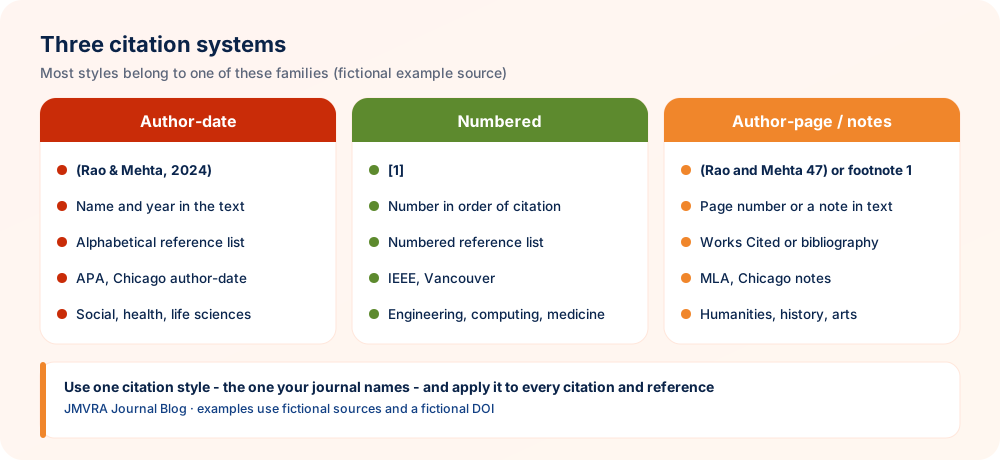
Most styles belong to one of three families. Author-date styles (APA, Chicago author-date) place the author and year inside the text; numbered styles (IEEE, Vancouver) rely on numbers that refer to a numbered list; author-page and notes styles (MLA, Chicago notes) are frequent in the humanities.
APA, MLA, IEEE and Chicago at a Glance
| Style | Edition used here | In-text example | Common fields |
|---|---|---|---|
| APA | 7th edition | (Rao & Mehta, 2024) | Psychology, education, social and health sciences |
| MLA | 9th edition | (Rao and Mehta 47) | Literature, languages, humanities |
| IEEE | IEEE reference style | [1] | Engineering, computing, electronics |
| Chicago | 17th edition (notes or author-date) | Footnote 1, or (Rao and Mehta 2024, 47) | History, arts; author-date in sciences |
APA Style Examples
| Type | Example |
|---|---|
| In-text | (Rao & Mehta, 2024) or Rao and Mehta (2024) found… |
| Journal article | Rao, A., & Mehta, S. (2024). Groundwater nitrate in semi-arid villages. Journal of Example Environmental Studies, 12(3), 45–60. https://doi.org/10.12345/jees.2024.003 |
| Book | Kumar, P. (2023). Field methods in water research (2nd ed.). Example Academic Press. |
More: APA research paper format guide.
MLA Style Examples
| Type | Example |
|---|---|
| In-text | (Rao and Mehta 47) |
| Journal article | Rao, Anil, and Sara Mehta. “Groundwater Nitrate in Semi-Arid Villages.” Journal of Example Environmental Studies, vol. 12, no. 3, 2024, pp. 45–60, https://doi.org/10.12345/jees.2024.003. |
| Book | Kumar, Priya. Field Methods in Water Research. 2nd ed., Example Academic Press, 2023. |
IEEE Style Examples
| Type | Example |
|---|---|
| In-text | … as shown in [1]. |
| Journal article | [1] A. Rao and S. Mehta, “Groundwater nitrate in semi-arid villages,” J. Example Environ. Stud., vol. 12, no. 3, pp. 45–60, 2024, doi: 10.12345/jees.2024.003. |
| Book | [2] P. Kumar, Field Methods in Water Research, 2nd ed. City, Country: Example Academic Press, 2023. |
More: IEEE research paper format guide.
Chicago Style Examples
| Type | Example |
|---|---|
| Footnote (notes) | 1. Anil Rao and Sara Mehta, “Groundwater Nitrate in Semi-Arid Villages,” Journal of Example Environmental Studies 12, no. 3 (2024): 47, https://doi.org/10.12345/jees.2024.003. |
| Bibliography (notes) | Rao, Anil, and Sara Mehta. “Groundwater Nitrate in Semi-Arid Villages.” Journal of Example Environmental Studies 12, no. 3 (2024): 45–60. https://doi.org/10.12345/jees.2024.003. |
| Author-date in-text | (Rao and Mehta 2024, 47) |
A Short Look at Vancouver and Harvard
Vancouver is a numbered style common in medicine and health sciences; its rules rest on the ICMJE recommendations and the NLM’s Citing Medicine, it abbreviates journal titles and names up to six authors before “et al.”. Harvard is not a single fixed style but a family of author-date formats; universities and publishers each issue their own version, so follow the exact guide named by your journal or institution.
| Type | Example |
|---|---|
| In-text | … nitrate levels rose (1). |
| Journal article | 1. Rao A, Mehta S. Groundwater nitrate in semi-arid villages. J Example Environ Stud. 2024;12(3):45–60. doi:10.12345/jees.2024.003 |
Citing Other Types of Source
Reference lists contain more than articles and books. The table below lists the details each style requires for other frequent source types (given in general form; consult your style guide for exact punctuation).
| Source type | Key details to record | Watch out for |
|---|---|---|
| Conference paper | Authors, title, conference name, location, date, pages, DOI | Proceedings title vs conference name |
| Thesis or dissertation | Author, year, title, degree, university, repository link | Published vs unpublished thesis |
| Website or report | Author or organisation, year, title, site or publisher, URL | Date of last update; access date if required |
| Dataset | Creator, year, title, version, repository, DOI | Version number |
| Preprint | Authors, year, title, server, DOI | Cite the published version once it exists |
| Book chapter | Chapter authors and title, editors, book title, pages, publisher | Editors are not the chapter authors |
Choosing the Right Style
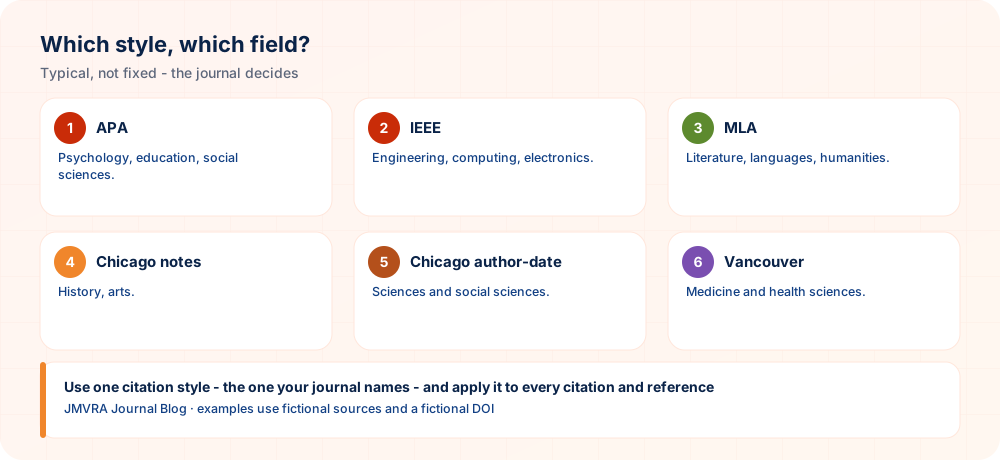
Go with the style your target journal names — read the author guidelines. Disciplines have usual habits, but the journal has the final say. When a journal allows any consistent style, pick the one most widespread in your field.
Citing DOIs and Web Sources
Most current styles include the DOI, ideally written as a link (https://doi.org/…). For online sources lacking a DOI, give a URL, and add an access date only when the style or the source calls for it. See DOI for research papers.
Reference Managers and Consistency
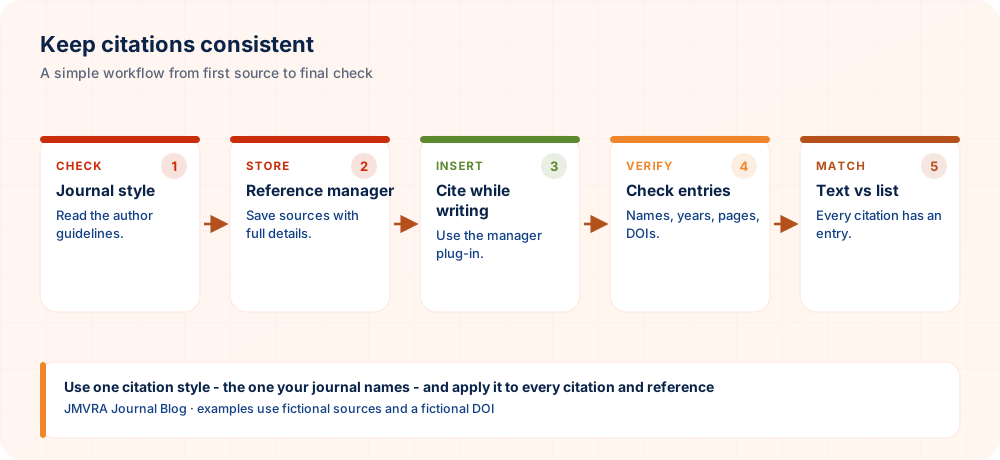
Reference managers keep your sources and format citations automatically across thousands of styles, refreshing the list as you write. Even so, they can slip on capitalisation, missing pages or duplicate entries, so review the final list yourself. See the reference manager guide and how to write references in a research paper. A quick scan for odd capital letters and empty fields takes minutes and prevents embarrassing slips.
Changing Styles on Resubmission
When a paper is rejected and you send it to a different journal, the citation style frequently differs. A reference manager makes the switch a matter of a few clicks; doing it manually needs extra time. Afterwards verify four items: the in-text format (numbers vs names), list order (citation order vs alphabetical), author name format and DOI form. Citations left over in the previous style are a typical mark of a rushed resubmission, and editors spot them.
Common Citation Mistakes
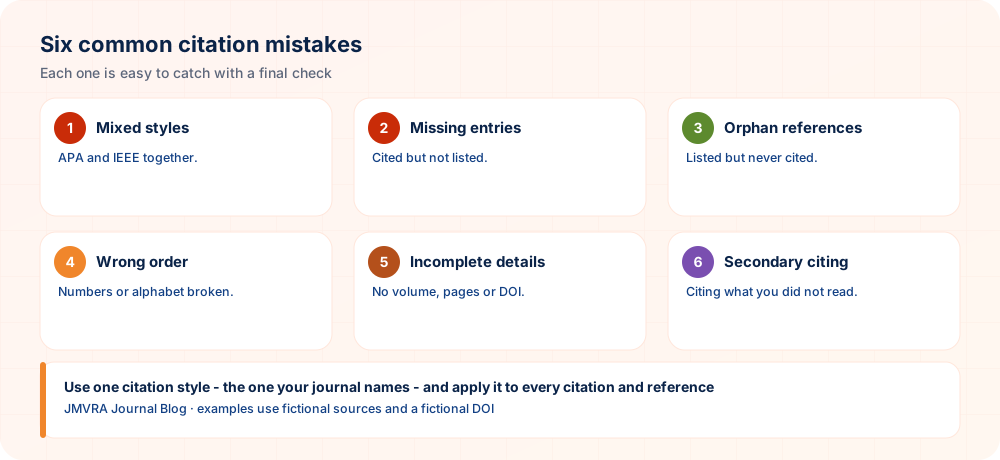
- Combining two styles within one paper.
- In-text citations lacking a reference entry, or listed references that are never cited.
- Faulty numbering or alphabetising.
- Absent volume, issue, page or DOI details.
- Citing a work you only encountered through someone else’s quotation.
Careful citation also guards against plagiarism; see plagiarism in research papers.
JMVRA’s Citation Style Requirement
JMVRA expects a single consistent citation style from the first citation to the final reference; refer to the publication guidelines and the journal template.
JMVRA in brief
- Review: transparent, double-blind peer review, normally by at least two subject experts. Specialist reviewers assess your paper, and you receive the acceptance or rejection decision by email and WhatsApp.
- Fee: Authors pay nothing to submit or to go through review; ₹971 INR (Indian authors) or $41 USD (foreign authors) becomes payable only after acceptance.
- Access: open to everyone under CC BY 4.0; ISSN 2984-8911; monthly issues; no submission deadline; Crossref DOI on request.
- Indexing: JMVRA appears in Google Scholar and is registered with Crossref and the ISSN Portal / ROAD; it is not currently indexed in Scopus, Web of Science or DOAJ.
Share Your Research Through JMVRA
Submit your research to JMVRA for publication
JMVRA (ISSN 2984-8911) is a peer-reviewed, open access journal spanning many disciplines. Submission is free. Specialist reviewers assess your paper, and you receive the acceptance or rejection decision by email and WhatsApp.
- 1. Get ready by reading the guidelines
- 2. Submit online
- 3. Peer review
- 4. Decision by email & WhatsApp
- 5. Open-access publication
Your At-a-Glance Checklist
- StyleThe journal’s required style
- OneNo mixing
- MatchCitations and list agree
- CompleteVolume, pages, DOI
- OriginalCite what you read
- CheckFinal manual check
Practical Tips for Keeping Citations Consistent in Any Style
Readers and reviewers notice sloppy references quickly, and editors often return papers for this alone. These habits help you apply whichever citation style your target journal expects without last-minute panic.
- Read the journal's instructions first. Before writing a single reference, find the style named in the author guidelines and note any journal-specific exceptions. Matching the requirement from the start avoids a tedious conversion later.
- Capture sources at the moment of reading. Add each source to your reference manager while you read it, including full details and the web address where relevant. Reconstructing a half-remembered citation from memory is where most errors creep in.
- Compare every citation with its source. Open the original article and verify author names, year, title, volume and page range against your entry. Automated tools copy errors from databases, so a human check is still necessary.
- Check the link between text and list. Before submission, confirm that every in-text citation appears in the reference list and every listed item is cited somewhere. Mismatches suggest carelessness and invite unnecessary reviewer comments.
- Clean your library before switching styles. When you change style for a new journal, first correct missing fields and inconsistent capitalisation in your library. Clean data lets the software reformat everything properly in a single step.
Learn the required style at the outset, collect complete details as you read, and verify every reference against its original before you submit.
Questions Researchers Often Ask
In Summary
Citation styles vary in detail but serve a common aim: crediting sources clearly and consistently. Find out your journal’s required style, learn its in-text and reference formats, add DOIs, use a reference manager carefully, and confirm each citation matches the list. Editors and reviewers notice consistency. Treat the final citation check as a proper editing pass rather than an afterthought.
Time to publish: submit your paper to JMVRA
JMVRA (ISSN 2984-8911) is a peer-reviewed, open access journal spanning many disciplines. Submission is free. Specialist reviewers assess your paper, and you receive the acceptance or rejection decision by email and WhatsApp.
- 1. Get ready by reading the guidelines
- 2. Submit online
- 3. Peer review
- 4. Decision by email & WhatsApp
- 5. Open-access publication
References and Further Resources
Citation Styles Summary
- APAAuthor-date
- MLAAuthor-page
- IEEENumbered
- ChicagoNotes or author-date
- RuleJournal decides
Related: APA guide · IEEE guide · Submit Paper.
Ready to Publish? Submit to JMVRA
JMVRA is aligned with UGC's Suggested Parameters for Choosing Peer-Reviewed Journals.
JMVRA is a Transparent, Peer-Reviewed, Open Access Journal (Refereed Journal). Following the discontinuation of the UGC and UGC-CARE journal listing, and in alignment with the latest UGC-CARE recommendations and guidelines, JMVRA is aligned with UGC’s Suggested Parameters for Choosing Peer-Reviewed Journals.
Handy links within jmvra.org
Key Terms
Subjects and search phrases this article addresses.
Related Reading
Further guides covering citation, referencing and formatting.
Mendeley, Zotero or EndNote? Pick a Reference Manager
Read the guide RelatedAPA 7th Edition Paper Format: Step-by-Step Setup
Read the guide RelatedIEEE Paper Format: Template, Citations & Figures
Read the guide RelatedResearch Paper Structure & Formatting Guidelines
Read the guide RelatedFinding and Verifying a Research Paper's DOI
Read the guide RelatedChecking Plagiarism Before You Submit a Paper
Read the guideKeep Reading on the JMVRA Blog
The JMVRA journal blog includes this guide, one of many practical pieces on publishing, indexing, metrics and research integrity, prepared so readers can verify them without any sales pitch.