
Reviewers often judge a manuscript by what is missing: the randomisation method, how participants were recruited, why records were excluded. Reporting guidelines exist to stop those gaps. Each one lists the minimum information a reader needs for a particular study design. This guide goes beyond a list of acronyms: it shows how to pick the right guideline on the EQUATOR Network, what the main ones (CONSORT, STROBE, PRISMA, STARD, CARE, COREQ, ARRIVE, CHEERS) actually ask for, how to fill a checklist and how to build a flow diagram.
What a reporting guideline is, and is not
A reporting guideline is a structured list of items that should appear in a paper of a given design, developed by methodologists, editors and researchers through a consensus process. Most consist of three parts: a checklist, often a flow diagram template, and an explanation and elaboration (E&E) paper that gives the reasoning and published examples of good reporting for each item.
Three misunderstandings are common:
- It is not a quality score. A poorly designed study can be reported perfectly. Following CONSORT does not make a trial well conducted; it makes its strengths and weaknesses visible.
- It does not dictate methods. STROBE does not tell you which confounders to adjust for; it asks you to say which ones you adjusted for and why.
- It is not only for medicine. Education, psychology, nursing, public health, veterinary and social science researchers use the same guidelines whenever their design matches.
The practical benefit is simple: a paper written against the right checklist answers reviewers’ questions before they are asked, which shortens review and reduces requests for missing details.
Finding the right guideline on the EQUATOR Network
The EQUATOR Network (Enhancing the QUAlity and Transparency Of health Research) maintains a searchable library of several hundred reporting guidelines. Its home page highlights the core guidelines for the main study types, and its search lets you filter by study design, clinical area and report section.
A sensible search sequence:
- Name your design precisely. “Survey” is not a design; a cross-sectional study using a questionnaire is.
- Open the core guideline for that design from EQUATOR’s main list.
- Look for an extension that fits your variation, such as a cluster or pilot trial, a scoping review, or research using routinely collected health data.
- Check the year and download the checklist from the guideline’s own website or EQUATOR, not from an old supplementary file.
- Read the author guidelines of your target journal to see which checklists it names.
If two guidelines seem to apply, for example a trial that also includes an economic evaluation, use both and say so. If none fits exactly, choose the nearest one and explain which items did not apply.
Matching your study design to a guideline
The table covers the guidelines most authors meet. Each has extensions, so treat it as a starting point.
| Study design | Guideline | Key elements reviewers look for |
|---|---|---|
| Randomised trial | CONSORT | Randomisation, allocation concealment, blinding, participant flow, harms, registration |
| Trial protocol | SPIRIT | Planned outcomes, sample size, analysis plan, monitoring |
| Cohort, case-control, cross-sectional | STROBE | Setting, eligibility, bias, confounders, missing data |
| Systematic review, meta-analysis | PRISMA 2020 | Search strategy, selection, risk of bias, synthesis, flow diagram |
| Diagnostic accuracy | STARD | Index test, reference standard, 2×2 data, flow of participants |
| Case report | CARE | Timeline, diagnostic reasoning, patient perspective, consent |
| Qualitative research | COREQ or SRQR | Researcher reflexivity, sampling, data collection, analysis |
| Animal research | ARRIVE 2.0 | Sample size, randomisation, blinding, outcome measures |
| Health economic evaluation | CHEERS 2022 | Perspective, time horizon, costs, uncertainty |
Other widely used guidelines include SQUIRE for quality improvement, TRIPOD for prediction models and AGREE for clinical practice guidelines.
Trials: CONSORT, SPIRIT and their extensions
CONSORT covers reports of randomised trials and SPIRIT covers trial protocols. Both were updated in 2025, replacing CONSORT 2010 and SPIRIT 2013, so check that you are using the current checklist; journals may accept the earlier version for a transition period, but the new one is the safer choice.
The items reviewers check most often are the ones authors forget:
- how the random sequence was generated and who generated it;
- how allocation was concealed until assignment (sealed opaque envelopes, central web-based system);
- who was blinded and how;
- the trial registration number and date, and any change to outcomes after registration;
- harms in each group, not only benefits.
Extensions exist for cluster, non-inferiority, pilot and feasibility, crossover and non-pharmacological trials, among others. In India, clinical trials must be registered with the Clinical Trials Registry – India (CTRI) before the first participant is enrolled, and the ICMJE asks for prospective registration as a condition of publication. A missing registration number is one of the fastest routes to desk rejection.
Observational studies: STROBE and related guidelines
STROBE has a 22-item checklist with versions for cohort, case-control and cross-sectional studies, and a combined version. Because most theses and many first papers in health, nursing and social sciences are cross-sectional surveys, STROBE is probably the guideline Indian postgraduate authors need most often.
Items that are often under-reported:
- Setting and dates: where and when recruitment, exposure and follow-up took place.
- Bias: what you did to reduce selection, information or recall bias, not just a generic limitation paragraph.
- Study size: how the sample size was reached, including for convenience samples.
- Missing data and loss to follow-up: numbers at each stage, ideally in a flow diagram.
- Unadjusted and adjusted estimates with confidence intervals, and which confounders were included and why.
Look for extensions when your data are special: RECORD for research using routinely collected health data such as hospital records, STREGA for genetic association studies, and STROBE-ME for molecular epidemiology. For non-health surveys, STROBE’s logic on sampling, response rates and bias still provides a useful structure.
Systematic and scoping reviews: the PRISMA family
PRISMA 2020 replaced the 2009 statement. It has a 27-item main checklist, a separate checklist for abstracts and revised flow diagram templates for new reviews and for updated reviews, with versions that separate database searches from other sources such as websites and citation searching.
Relatives you may need:
- PRISMA-P for review protocols, which should be written and ideally registered (for example in PROSPERO for health-related reviews) before screening begins.
- PRISMA-ScR for scoping reviews, which map evidence rather than estimate an effect.
- PRISMA-S for reporting literature searches in detail.
Reviewers of review articles focus on reproducibility: the full search string for at least one database, the date of the last search, how many reviewers screened and extracted, how disagreements were resolved, and which risk-of-bias tool was used. If you are planning a review, our guide to conducting a systematic literature review covers the method; PRISMA covers how to report it.
Qualitative studies, case reports and diagnostic accuracy
Qualitative research. COREQ has 32 items for interview and focus-group studies, grouped under the research team and reflexivity, study design, and analysis and findings. SRQR has 21 items and suits a wider range of qualitative approaches, such as ethnography, grounded theory and document analysis. Reviewers look for who conducted the interviews and their relationship with participants, how saturation or sample adequacy was judged, whether transcripts were returned to participants, and quotations identified by participant code.
Case reports. The CARE checklist (13 items) asks for a timeline of events, diagnostic assessment and reasoning, follow-up and outcomes, the patient’s perspective where possible, and a statement that informed consent for publication was obtained. Journals increasingly refuse case reports without that consent.
Diagnostic accuracy studies. STARD 2015 has 30 items. Its core demands are a clear description of the index test and reference standard, whether readers were blinded to the other result, a flow diagram of participants, and cross-tabulated results so that sensitivity and specificity can be recalculated.
Animal studies, economic evaluations and other fields
ARRIVE 2.0 splits its items into the “Essential 10” (including study design, sample size, inclusion and exclusion criteria, randomisation, blinding, outcome measures and statistical methods) and a Recommended Set covering context such as housing, husbandry and ethical approval. Reviewers and editors in life sciences often check the Essential 10 first. In India, animal experiments also need approval from the Institutional Animal Ethics Committee under CCSEA rules, which should be stated alongside the checklist.
CHEERS 2022 has 28 items for health economic evaluations: the perspective (health system or societal), time horizon, discount rate, sources of costs and outcomes, and how uncertainty was explored.
What if your field has no specific guideline? Psychology authors can use the APA Journal Article Reporting Standards (JARS) for quantitative, qualitative and mixed-methods work. Education and management studies that use surveys can borrow STROBE’s structure; mixed-methods studies can combine a quantitative and a qualitative checklist. Engineering and computer science papers rarely have formal checklists, but the same principle applies: report enough for someone else to repeat the work.
How to fill in a checklist properly
A checklist is a map for the editor and reviewer, not a box-ticking exercise. Use the current version and complete every row:
| Item | Where reported | Note |
|---|---|---|
| Sample size | Methods, “Sample size”, page 6, lines 112–118 | Power calculation with assumptions |
| Blinding | Methods, page 7, lines 131–134 | Outcome assessors blinded; participants not |
| Harms | Results, Table 4 | No serious adverse events |
| Funding | Declarations, page 18 | Not applicable: no external funding |
- Give a section and page or line number, not just “yes”. Line numbering in the manuscript makes this easy.
- Mark an item “not applicable” only with a short reason.
- If an item is genuinely not reported, say so honestly and, where possible, add the information instead.
- Update the page numbers after every revision; a checklist pointing to the wrong pages irritates reviewers.
The best time to open the checklist is while drafting, not the night before submission.
Drawing flow diagrams that add up
CONSORT, STROBE, STARD and PRISMA all use flow diagrams to show how many participants or records moved through each stage. The test of a good diagram is arithmetic: every box must reconcile with the box above it and with the numbers in your tables.
Practical points:
- Use the official template from the guideline website rather than drawing from memory; PRISMA provides editable versions.
- Give reasons for every exclusion at the full-text or follow-up stage, with counts.
- Show losses to follow-up and analysis numbers for each group in trials and cohorts.
- Export the diagram as a clear vector or high-resolution image; see our advice on preparing figures and tables.
Where journals ask for checklists and how to mention them
Journals request reporting guidelines in different places: as a required upload in the submission system, as a supplementary file, in the cover letter, or in the author guidelines as “recommended”. Reviewers may be asked to consult the checklist during review. Even when a journal does not demand one, attaching a completed checklist signals care and speeds up assessment.
Mention the guideline in the Methods section and, if useful, in your cover letter:
Cite the guideline paper in your references, as its authors request. Do not claim compliance you have not achieved; reviewers do compare the checklist with the manuscript. If you submit to JMVRA, include the checklist as a supplementary file with your online submission so it is available during double-blind peer review, and make sure page numbers refer to the anonymised manuscript. Our pre-submission checklist lists the other files to prepare.
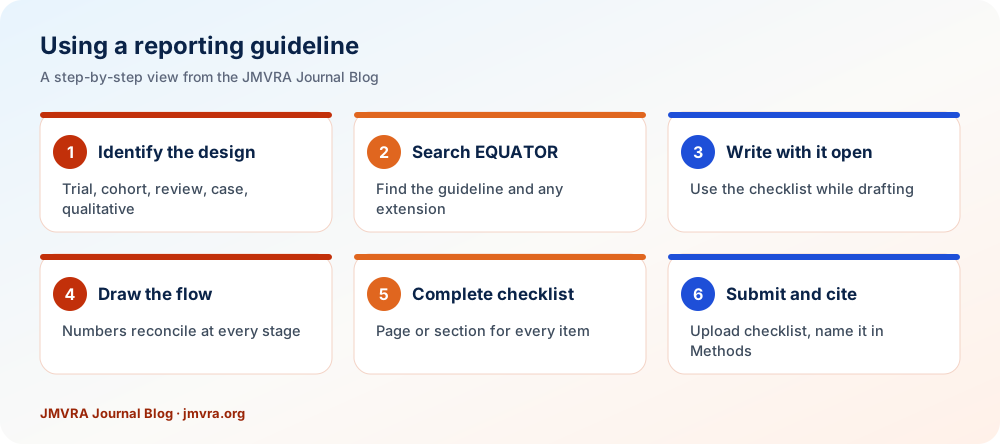
Quick Checklist
- Name the designState the exact study design in one phrase
- Pick the guidelineCore guideline plus any extension from EQUATOR
- Draft with itKeep the checklist open while writing
- Reconcile the flowEvery flow-diagram number adds up
- Map every itemSection and page or line for each row
- Cite and uploadName it in Methods and attach the checklist
Practical tips for using reporting guidelines
A few habits turn a reporting checklist from a chore into a writing aid.
- Read the explanation paper once. The explanation and elaboration paper shows what good reporting of each item looks like, with real examples you can model.
- Plan with the protocol version. Use SPIRIT or PRISMA-P before data collection; many reporting gaps are really planning gaps.
- Turn on line numbers. Line-numbered manuscripts make checklist references precise and help reviewers comment accurately.
- Keep the flow numbers in one sheet. Track counts at each stage in a spreadsheet so the diagram, text and tables all match.
- Check the version date. CONSORT, SPIRIT and PRISMA have all been revised; an outdated checklist suggests outdated methods knowledge.
Choose the guideline that matches your design, write with it open, and make every checklist row point to real text.
Questions Researchers Often Ask
In Summary
Reporting guidelines turn the question “what should I include?” into a checklist that matches your design. Name the design precisely, find the core guideline and any extension on the EQUATOR Network, write with the checklist open, and make every row point to real text. Build flow diagrams from a running count so the numbers reconcile, cite the guideline, and attach the completed checklist when you submit. Combined with a clear methods section and the journal’s publication guidelines, it removes many of the questions that otherwise come back from peer review.
Ready to send in your paper?
Online submission to JMVRA is free of charge. Papers are screened first and then go through transparent, double-blind peer review; ₹971 INR (Indian authors) or $41 USD (foreign authors) is due only after acceptance. Retain every confirmation email for your records.
References and Sources
Taking a Draft Through to a Published Paper
- PrepareStick to the template and author guidelines
- Submit onlineCosts nothing; write down your paper ID
- ScreeningSubject scope, declarations and similarity below 15%
- Double-blind reviewDecision by email and WhatsApp
- AcceptedThe ₹971 INR / $41 USD fee becomes due, and the paper is then published in open access
Details are available under Publication guidelines · Peer review · Publication charges.
Ready to Publish? Submit to JMVRA
JMVRA is aligned with UGC's Suggested Parameters for Choosing Peer-Reviewed Journals.
JMVRA is a Transparent, Peer-Reviewed, Open Access Journal (Refereed Journal). Following the discontinuation of the UGC and UGC-CARE journal listing, and in alignment with the latest UGC-CARE recommendations and guidelines, JMVRA is aligned with UGC’s Suggested Parameters for Choosing Peer-Reviewed Journals.
More useful pages at jmvra.org
Key Terms
Subjects and search phrases this article addresses.
Related Reading
More JMVRA guides that pair well with this one.
Keep Reading on the JMVRA Blog
You are reading part of the JMVRA journal blog, a source of hands-on guidance about publishing, indexing, metrics and research integrity that aims to be verifiable, not promotional.