
A systematic literature review is more than a lengthy literature review: it is a research study in itself, built on a protocol, a reproducible search and open reporting. Here is how to conduct one step by step, covering question framing, protocol writing and registration, search building, screening, the PRISMA flow diagram, data extraction, risk of bias, synthesis and reporting.
Defining a Systematic Literature Review
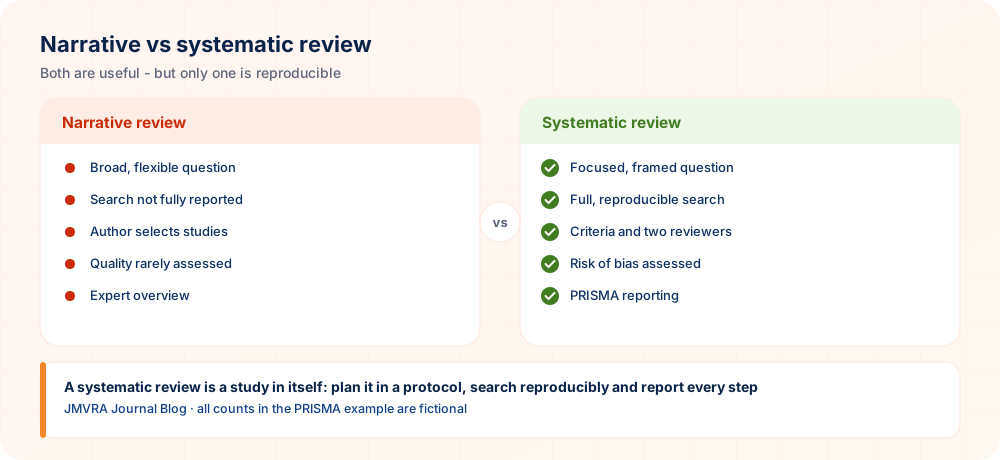
A systematic literature review (SLR) addresses a focused question by locating, appraising and synthesising all relevant studies through explicit, reproducible methods fixed beforehand. Unlike a narrative review, it lets another researcher repeat your search and arrive at the same studies. Meta-analysis is an optional statistical step, used in some systematic reviews, that numerically pools results. Treat the whole exercise as research that others must be able to audit.
For the literature review section of a regular paper, read how to write a literature review instead.
Comparing Narrative, Scoping and Systematic Reviews
| Type | Purpose | Method |
|---|---|---|
| Narrative review | Expert overview of a topic | Flexible; search and selection often not fully reported |
| Scoping review | Map what evidence exists and identify gaps | Systematic search; usually no quality appraisal; PRISMA-ScR |
| Systematic review | Answer a focused question | Protocol, full search, two reviewers, appraisal, PRISMA 2020 |
| Meta-analysis | Pool effect sizes statistically | Within a systematic review when studies are similar enough |
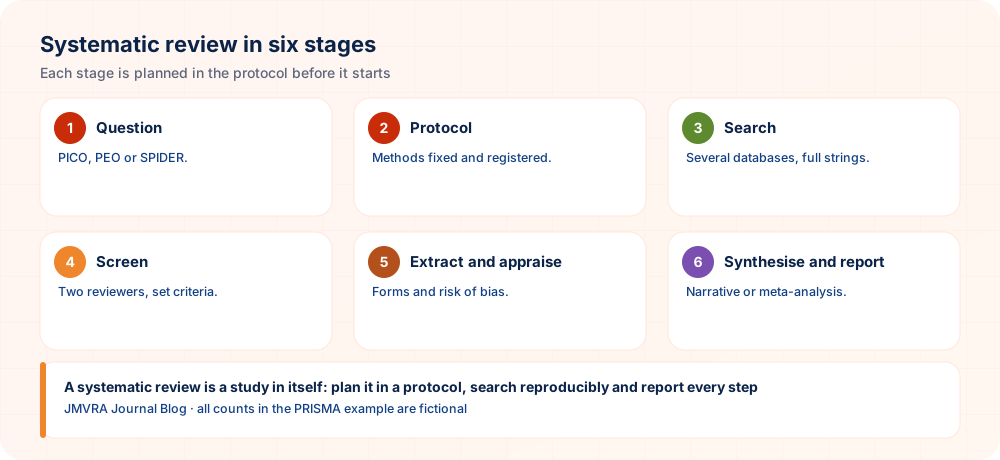
Step 1: Define the Question
| Framework | Elements | Typical use |
|---|---|---|
| PICO | Population, Intervention, Comparison, Outcome | Effects of interventions |
| PEO | Population, Exposure, Outcome | Associations and risk factors |
| SPIDER | Sample, Phenomenon of Interest, Design, Evaluation, Research type | Qualitative evidence |
Made-up example (PICO): Among rural households (P), does filtering household water (I), as opposed to no treatment (C), lower the rate of diarrhoeal illness (O)?
Step 2: Draft and Register Your Protocol
A protocol records the synthesis plan, risk-of-bias tools, data items, screening process, search strategy, databases, eligibility criteria and question, all fixed before you start. Registration limits bias and duplicated effort: PROSPERO takes reviews with a health-related outcome, while OSF Registries accepts protocols from any discipline. Mention any later changes in the final review.
Step 3: Build a Systematic Search
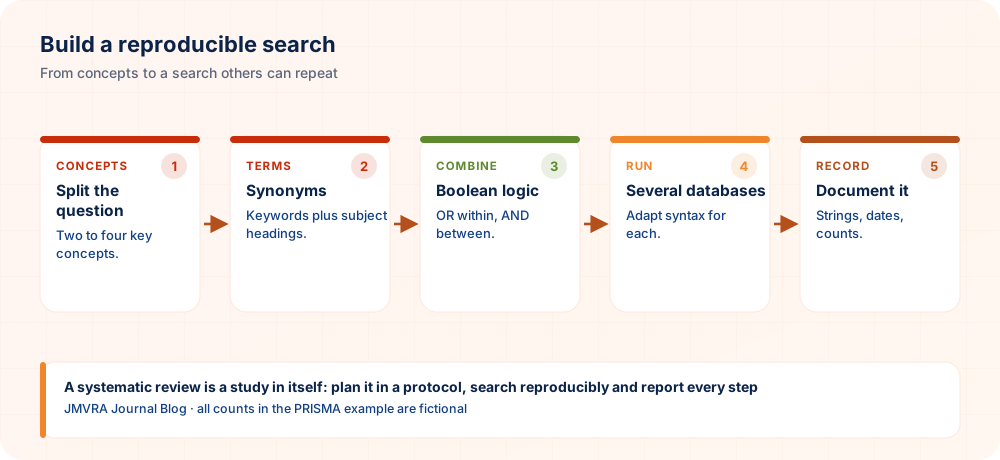
Query several relevant databases (say, one multidisciplinary index plus subject-specific ones) and supplement them with reference lists, trial registers and grey literature. Join synonyms using OR and concepts using AND, tailor the syntax to each database, and note the complete search strings, dates and number of results. Asking a librarian to review your strings helps catch gaps you may have missed.
| Concept | Terms combined with OR |
|---|---|
| Population | (rural OR village* OR household*) |
| Intervention | (“water filter*” OR “water treatment” OR chlorinat*) |
| Outcome | (diarrh* OR “gastrointestinal illness”) |
| Final | Population AND Intervention AND Outcome |
Step 4: Screening the Studies
Delete duplicates, then screen titles and abstracts against the eligibility criteria, followed by full texts. Ideally, two reviewers work independently and settle disagreements through discussion or a third reviewer. Note why each full text was excluded.
PRISMA Flow Diagram Explained
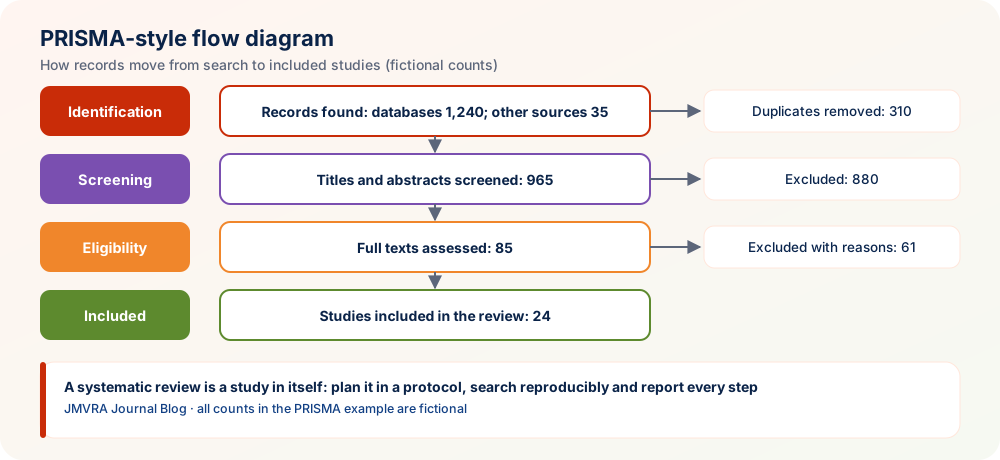
The PRISMA 2020 statement supplies a 27-item reporting checklist plus a flow diagram showing the number of records identified, screened, excluded and included. Most journals expect systematic reviews to adhere to it. Fill in the diagram while you screen rather than rebuilding it afterwards.
Step 5: Data Extraction
Work from a piloted extraction form covering study details, setting, participants, design, intervention or exposure, outcomes, results and funding. Errors fall when two people extract independently, or when one extracts and another checks. Testing the form on a few studies first exposes unclear fields early.
Step 6: Appraise the Risk of Bias
| Study type | Example tool |
|---|---|
| Randomised trials | Cochrane RoB 2 |
| Non-randomised studies of interventions | ROBINS-I |
| Qualitative studies | CASP qualitative checklist |
| Certainty of a body of evidence | GRADE approach |
The Cochrane Handbook offers detailed guidance.
Step 7: Synthesising the Evidence
When studies resemble each other in population, intervention and outcome, a meta-analysis can pool their results while taking heterogeneity into account. If not, use a structured narrative synthesis that groups studies and explains the patterns and differences. Qualitative evidence may be combined through thematic synthesis.
Step 8: Writing Up and Reporting
- A title that marks the paper as a systematic review.
- An abstract structured according to PRISMA guidance.
- Methods: cover the protocol and registration, criteria, sources, complete search, selection, extraction, bias assessment and synthesis.
- Results: include the PRISMA flow diagram, a table of study characteristics, a risk-of-bias summary and the synthesis.
- Discussion: address how certain the evidence is, the limitations and the implications.
- Supplementary files: the complete search strings and the extracted data.
Mistakes to Avoid
- Labelling a narrative review “systematic” when it has no protocol or complete search.
- Relying on one database only.
- A lone reviewer screening everything without any verification.
- Combining studies that differ too much.
- Failing to list excluded full texts along with the reasons.
Getting a Systematic Review Published in JMVRA
JMVRA welcomes review articles from all disciplines. When submitting a systematic review, be open about the protocol, the search, the PRISMA flow and the appraisal, and follow the publication guidelines. Publishing review articles is also worth a look.
JMVRA in brief
- Review: transparent, double-blind peer review, normally by at least two subject experts. Specialist reviewers assess your paper, and you receive the acceptance or rejection decision by email and WhatsApp.
- Fee: Authors from India pay ₹971 INR and foreign authors pay $41 USD, in both cases only once the paper has been accepted. Submission and review cost nothing.
- Access: open access under CC BY 4.0; ISSN 2984-8911; one issue every month; you may submit at any time; a Crossref DOI is available on request.
- Indexing: JMVRA appears in Google Scholar and is registered with Crossref and the ISSN Portal / ROAD; it is not currently indexed in Scopus, Web of Science or DOAJ.
Share Your Research Through JMVRA
Share your research through JMVRA
JMVRA (ISSN 2984-8911) is a peer-reviewed, open access journal spanning many disciplines. Submission is free. Specialist reviewers assess your paper, and you receive the acceptance or rejection decision by email and WhatsApp.
- 1. Prepare your paper per the guidelines
- 2. Submit online
- 3. Peer review
- 4. Decision by email & WhatsApp
- 5. Release as open access
Your At-a-Glance Checklist
- QuestionPICO, PEO or SPIDER
- ProtocolWritten and registered
- SearchSeveral databases, documented
- ScreenTwo reviewers
- AppraiseRisk of bias tool
- ReportPRISMA 2020
Practical Tips for Running a Systematic Literature Review
A systematic review is only as credible as its recorded process. These habits keep your work transparent, reduce bias and make it easier for others to check or update your findings.
- Log every search as you run it. Note the database, date, exact query string and number of records returned each time. A complete log lets another team repeat the search and explains any differences in results.
- Screen with a second person. Have at least one other reviewer assess titles and abstracts independently, then resolve disagreements by discussion. Independent screening reduces individual bias and strengthens the report.
- Pilot your extraction form. Test the data extraction sheet on a few studies before the full run. Early testing exposes unclear fields and saves you from repeating extraction later.
- Keep reasons for exclusion. Record why each full-text study was left out, using short consistent categories. These reasons feed directly into your flow diagram and answer reader questions about selection.
- Do not change the question midway. If you must alter inclusion rules after seeing results, report the change and the reason openly. Hidden adjustments undermine the trust that a systematic approach is meant to create.
Treat transparency as the main product: record, double-check and report each decision so that someone else could follow your steps exactly.
Questions Researchers Often Ask
In Summary
A systematic literature review is valuable because of how it is done. Start from a focused question and a registered protocol, run a reproducible search, screen independently, appraise carefully and report openly with PRISMA. Plan it like a study, keep a record of each step, and let the evidence, not your selection of it, shape the conclusions.
Set to publish? Send your manuscript to JMVRA
JMVRA (ISSN 2984-8911) is a peer-reviewed, open access journal spanning many disciplines. Submission is free. Specialist reviewers assess your paper, and you receive the acceptance or rejection decision by email and WhatsApp.
- 1. Prepare your paper per the guidelines
- 2. Submit online
- 3. Peer review
- 4. Decision by email & WhatsApp
- 5. Release as open access
References and Further Resources
Systematic Review Snapshot
- QuestionPICO
- ProtocolRegistered
- SearchReproducible
- ScreenTwo reviewers
- ReportPRISMA 2020
Related: Literature review · Methodology · Submit Paper.
Ready to Publish? Submit to JMVRA
JMVRA is aligned with UGC's Suggested Parameters for Choosing Peer-Reviewed Journals.
JMVRA is a Transparent, Peer-Reviewed, Open Access Journal (Refereed Journal). Following the discontinuation of the UGC and UGC-CARE journal listing, and in alignment with the latest UGC-CARE recommendations and guidelines, JMVRA is aligned with UGC’s Suggested Parameters for Choosing Peer-Reviewed Journals.
More useful pages at jmvra.org
Key Terms
Subjects and search phrases this article addresses.
Related Reading
Further guides on reviews and writing up research.
Writing a Literature Review for Your Paper
Read the guide RelatedLiterature Review in 2026: A Step-by-Step Method
Read the guide RelatedResearch Methodology: Types, Methods & Examples
Read the guide RelatedWriting a Review Article and Picking the Right Journal
Read the guide RelatedWriting References in a Research Paper Correctly
Read the guide RelatedResearch Paper Structure & Formatting Guidelines
Read the guideKeep Reading on the JMVRA Blog
You are reading part of the JMVRA journal blog, a source of hands-on guidance about publishing, indexing, metrics and research integrity that aims to be verifiable, not promotional.