
Review Type
The UGC Parameters New Notification on Transparent Peer Reviewed Journals requires a Transparent Double-Blind Peer Review process, and JMVRA follows it. Here, authors and reviewers do not learn each other's identities while the review is under way. Anonymity protects both sides from bias, so write and assess the paper on its content alone.
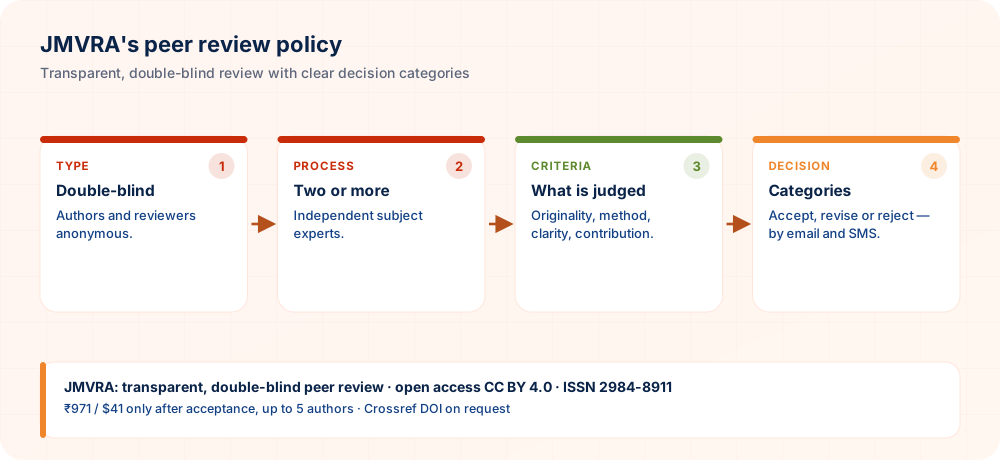
Review Process
- A submitted paper first goes through editorial screening for scope, formatting and plagiarism
- Papers that pass are given to 2–3 subject experts chosen from our reviewer panel
- Reviewers assess the originality, methodology, results and quality of language
- The corresponding author receives the reviewers' comments in compiled form
- Where needed, authors revise in response to the comments and resubmit
- The Editor-in-Chief takes the final decision to accept or reject
Reviewer Panel
The reviewer panel of JMVRA comprises 3000+ expert reviewers from respected universities and research institutions in India and overseas. Selection rests on each reviewer's expertise, publication record and academic credentials.
Review Criteria
- How original and novel the research is
- Methodological soundness, scientific or technical
- Clear expression, structure and language standard
- How relevant the citations and references are
- How much the work contributes to the field
Decision Categories
| Decision | Meaning |
|---|---|
| Accept as is | The paper can be published as it stands |
| Minor revision | A few minor corrections are needed; a second review may be unnecessary |
| Major revision | Substantial changes are required, and the paper will be reviewed again |
| Reject | The paper falls short of the standards for publication |
Getting Your Manuscript Ready for Double-Blind Review
- Delete names and affiliations — in the manuscript file
- Make self-citations anonymous — use “Author (2024)” or refer to yourself in the third person
- Take out acknowledgements — restore them once the paper is accepted
- Wipe file properties — the author fields stored in the document metadata
Making Sense of a Decision Letter
| Decision | Next step |
|---|---|
| Accept | Move on to the publication stages |
| Minor revision | Revise, and reply to each comment in turn |
| Major revision | Heavy revision is needed, and a fresh review may follow |
| Reject | Think over the comments and improve the paper prior to sending it to another journal |
Decisions are sent by email and WhatsApp. See responding to reviewer comments.
Practical Tips for Passing Double-Blind Peer Review
Reviewers judge only what they can see, so your manuscript must stand on its own without your reputation. These habits help it read clearly and fairly to an unfamiliar expert.
- Cite yourself neutrally. Refer to your earlier work in the third person, such as a study by the same group, rather than phrases that reveal identity, and avoid heavy reliance on your own prior papers.
- Explain the context for outsiders. Assume the reviewer works in a nearby field, not your laboratory. Define specialised terms and justify choices so the argument holds without insider knowledge.
- Align claims with evidence. Check that each conclusion in the abstract is supported by results in the body. Reviewers often reject papers whose headlines go beyond what the data can show.
- Anticipate methodological questions. Think like a sceptic and address sample choice, controls, assumptions and alternative explanations before they are raised. Pre-empting objections makes the paper look careful.
- Respond to decisions methodically. After a decision, wait until you feel calm, list each requested change, and revise point by point instead of rewriting everything at once.
Write for an informed stranger, anonymise carefully, and match every claim to evidence so the work persuades without your name attached.
Questions Researchers Often Ask
At-a-Glance Checklist
- File anonymisedReady for double-blind review
- Criteria knownAhead of submitting
- Comments addressedOne at a time
- Decision studiedAlong with reviewer comments
- Available on requestTransparent Peer Review Report
How Transparent Peer Review Works, Stage by Stage
- SubmissionPlagiarism, formatting and scope are all checked at the outset.
- Reviewers assignedSubject experts get the paper through the Scholar9 portal.
- Double-blind reviewExperts judge the work's originality, significance and clarity, along with the soundness of its method.
- DecisionEmail and WhatsApp both carry the result, which is accept, revise or reject.
- RevisionAuthors go through all comments, replying to each.
- TransparencyScholar9 keeps the review record, and a report is given if requested.
Open reports, optional reviewer identity and open participation are the three transparency models; how JMVRA applies them follows.
Ready to Publish? Submit to JMVRA
JMVRA is aligned with UGC's Suggested Parameters for Choosing Peer-Reviewed Journals.
JMVRA is a Transparent, Peer-Reviewed, Open Access Journal (Refereed Journal). Following the discontinuation of the UGC and UGC-CARE journal listing, and in alignment with the latest UGC-CARE recommendations and guidelines, JMVRA is aligned with UGC’s Suggested Parameters for Choosing Peer-Reviewed Journals.
Where to go next on jmvra.org
Key Terms
Subjects and search phrases this article addresses.
Related Reading
Further reading on the same theme from the JMVRA blog.
OpenAlex or Google Scholar? Key Differences
Read the guide RelatedJMVRA Payment Terms & Accepted Methods
Read the guide RelatedDocumentation
Read the guide RelatedConference Management Systems Explained
Read the guide RelatedAcademia.edu, ResearchGate or Google Scholar?
Read the guide RelatedTerms & Conditions
Read the guideKeep Reading on the JMVRA Blog
Find this guide on the JMVRA journal blog, a collection of practical guidance on publishing, indexing, metrics and research integrity that favours verifiable content over promotion.