
The short answer: send an email to [email protected] attaching your CV and naming the subject area(s) you know best, and say whether you wish to serve as a Reviewer, an Editorial Board Member, or both. The reasons for joining and the benefits you receive are covered in Join the JMVRA Reviewer & Editorial Board Team — here the focus is on what to get ready and how registration works. A short, well-organised CV makes it easier for editors to match you with suitable manuscripts.
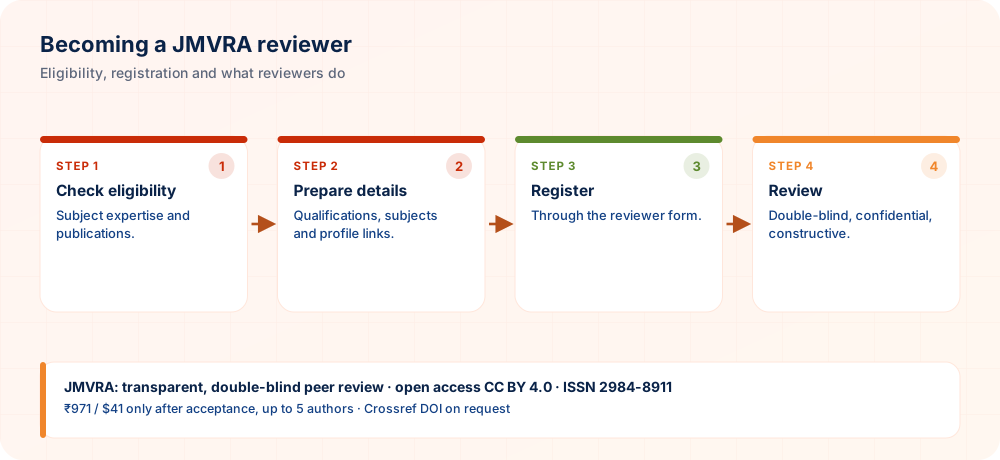
Who Is an Academic Reviewer?
An academic reviewer assesses manuscripts sent in within their own field for originality, scientific soundness, methodology and clarity, and then returns comments and a recommendation as part of JMVRA's double-blind peer review process. This is a real contribution to scholarship and is separate from the work you publish yourself.
Who Can Apply?
Look at the current eligibility criteria on the live reviewer application before you apply — this guide does not make up a fixed minimum-degree rule. According to JMVRA's published pages, a typical reviewer is a Ph.D. holder, a seasoned academician or faculty member, a researcher with published work to show, or an industry professional whose subject-matter expertise fits.
Information to Prepare
- Full name
- Academic qualification
- Designation
- Institution
- Your subject expertise and research keywords
- Publication experience
- Active email address
- An ORCID iD or other research profile, when requested
How to Register
- Put together your CV, including the details listed above.
- Send it by email to [email protected] and make it clear whether you are applying as a Reviewer, an Editorial Board Member, or both.
- Report only the fields and steps actually shown on the live reviewer form or email process when you apply — the editorial office may change them over time.
What Happens Once You Have Joined
- The editorial team evaluates your profile
- You are placed on a subject panel as a reviewer
- Manuscript invitations that match your stated expertise
- Each invitation comes with a conflict-of-interest check
- You submit your review on the anonymised manuscript
- The editor decides, drawing on your comments and those of other reviewers
Reviewer Responsibilities
- Keep the manuscript you are reviewing confidential
- Stay impartial and base your assessment on evidence
- Declare any conflict of interest before you take on an assignment
- Write your comments in a respectful and constructive tone
- Do not plagiarise, and do not use unpublished ideas from a manuscript for your own benefit
- Reply within a reasonable period, or turn the invitation down quickly if you are unable to review
Reviewer Documentation
According to current JMVRA pages, active reviewers can receive a transparent peer review certificate, a reviewer appreciation letter, verified proof of their review activity, and, where current policy allows, the option to disclose their identity on a review report. Keep copies of these documents for your own records, since appraisals may ask for them.
At-a-Glance Checklist
- Expertise statedFields you can assess
- Profile attachedORCID or Scholar
- Conflicts disclosedPrior to acceptance
- Confidentiality keptNo sharing of manuscripts
- Precise reportsComments to act on
Qualities of a Good Review
Editors appreciate reviewers whose reports support their decisions and help authors improve. Typically, a good review:
- Summarises the paper briefly, in two or three sentences — which shows you grasped its purpose and claims
- Names the key strengths and weaknesses — concentrating on originality, method, evidence and clarity
- Distinguishes major issues from minor ones — so authors can see what is most important
- Offers concrete suggestions that can be acted upon — pointing to particular sections, tables or lines
- Ends with a justified verdict — whether to accept, ask for minor changes, ask for major changes or reject, always with the reasoning
How Reviewing Benefits Your Career
Sharper writing
Critically reading other people’s manuscripts sharpens your own writing.
Field awareness
You get to see recent work ahead of publication.
Recognition
Your reviewing can be listed on profiles and in appraisal files.
Service to science
The research community keeps its quality up through peer review.
Further reading: the JMVRA peer review process, and how reviewers are recognised through RMS points.
Preparing Yourself to Join as a Peer Reviewer
Accepting a reviewing role is a commitment of time and judgement. A little preparation before you register helps you serve editors and authors well and keeps the experience rewarding.
- Define your true expertise. List the methods and topics you can assess confidently, and decline manuscripts outside them. Honest boundaries help editors match papers to you and protect the quality of every report.
- Block time in your calendar. Reserve fixed hours for reviewing rather than hoping gaps appear. Reports written in a rushed final moment tend to be vague and less helpful to authors.
- Check conflicts before accepting. Consider whether you know the authors, share a funder or compete on similar work. Tell the editor about any doubt at once instead of reviewing and disclosing later.
- Prepare a reusable report outline. Draft a personal template covering significance, methods, evidence, clarity and ethics. A structure keeps your comments organised and makes it easier to stay consistent across manuscripts.
- Protect the manuscript's confidentiality. Never share, upload or discuss a manuscript under review without the editor's permission. Respecting confidentiality is the foundation of trust between reviewers, authors and journals.
Join only when you can offer fair, timely and confidential reviews, because a few careful reports do more good than many hurried ones.
Questions Researchers Often Ask
How Transparent Peer Review Works, Stage by Stage
- SubmissionThe opening step is a screen for plagiarism, formatting and scope.
- Reviewer allocationScholar9 is the portal on which subject experts get assigned to a paper.
- Double-blind reviewThe work is judged on how original it is, how sound the method is, and how significant and clear it is.
- DecisionThe verdict (accepted, revision needed or rejected) is sent over email and WhatsApp.
- RevisionAuthors address each comment individually, point by point.
- TransparencyThe review is recorded on Scholar9, and the report is provided if it is requested.
The three transparency models are open reports, optional reviewer identity and open participation; here is how JMVRA applies them.
Ready to Publish? Submit to JMVRA
JMVRA is aligned with UGC's Suggested Parameters for Choosing Peer-Reviewed Journals.
JMVRA is a Transparent, Peer-Reviewed, Open Access Journal (Refereed Journal). Following the discontinuation of the UGC and UGC-CARE journal listing, and in alignment with the latest UGC-CARE recommendations and guidelines, JMVRA is aligned with UGC’s Suggested Parameters for Choosing Peer-Reviewed Journals.
Handy links within jmvra.org
Key Terms
Subjects and search phrases this article addresses.
Related Reading
Further reading on the same theme from the JMVRA blog.
Keep Reading on the JMVRA Blog
The JMVRA journal blog includes this guide, one of many practical pieces on publishing, indexing, metrics and research integrity, prepared so readers can verify them without any sales pitch.