
The title is the only part of your paper that nearly everyone will read. Editors use it to judge whether a manuscript fits their journal, invited reviewers accept or decline partly on the strength of it, and databases and search engines weigh it heavily when ranking results. Yet many authors write it in five minutes, often before the study is finished. This guide shows how to build a title from the core elements of your study, choose the right title type, keep it findable, and avoid the mistakes that make good research look vague or overstated.
What a research paper title has to do
A title does three jobs at once. It describes the study, so a reader knows what was investigated, in whom or what, and how. It attracts the right readers: the specialists who will cite and build on the work. And it indexes the paper, because search engines, library databases and citation indexes match queries against title words more strongly than against most other fields.
These jobs pull in different directions. A precise title can become long and dense, a catchy one vague, a keyword-stuffed one awkward. A good title balances them by answering four questions in as few words as possible:
- What was studied: the main topic, variables or phenomenon.
- Who or where: the population, sample, material or setting, when it matters to the reader.
- How: the design or method, if it helps credibility or searching (for example “randomised controlled trial”, “systematic review”, “case study”).
- What was found: optional, and only when the finding is clear and robust.
Editors screen new submissions by title and abstract, so a title that misrepresents the paper can trigger a quick desk rejection. For how the title fits the rest of the manuscript, see Writing an IMRaD Paper Journals Accept.
How long should a research paper title be?
There is no universal rule, but most effective journal titles fall between 10 and 15 words, roughly 80 to 130 characters including spaces. Below about eight words, titles tend to lose essential information such as the population or design. Beyond about 20 words, they become hard to scan, get truncated in search results and usually contain filler.
| Title length | What usually happens | Example |
|---|---|---|
| Under 8 words | Too general; key details missing | “Stress in Teachers” |
| 10–15 words | Room for topic, population and often design | “Occupational Stress and Coping Strategies Among Rural Primary School Teachers in Gujarat” |
| 16–20 words | Acceptable if every word carries information | A two-part colon title that also names the design |
| Over 20 words | Hard to scan, often truncated, likely padded | Titles that list every variable measured |
Check the target journal’s author guidelines first. Many set a word or character limit and ask for a separate running title (short title) of around 40–60 characters for page headers. APA Style (7th edition) sets no word limit but asks for a focused, succinct title. Density matters more than length: ask of each word whether a reader or a search engine would lose anything if it disappeared.
Putting the right keywords in the title
Researchers find papers by typing the words they would use themselves. Your title should contain the two or three terms a specialist is most likely to search for, usually the main concept, the key variable or intervention, and the population or material.
- Front-load the important words. Search results and mobile screens often cut titles after 60–70 characters. “Machine Learning Prediction of Wheat Yield…” is stronger than “An Attempt to Apply Machine Learning to…”.
- Use the field’s standard terms. If your discipline says “type 2 diabetes” or uses an established construct name, use it exactly rather than a paraphrase.
- Spell out abbreviations. Write “Chronic Obstructive Pulmonary Disease”, not “COPD”, unless the abbreviation is universally known (DNA, HIV, COVID-19).
- Name the setting when it matters. A study of microfinance in Bihar should say so; readers looking for regional evidence search for that word.
Your title and keyword list work as a team. Terms already in the title rarely need repeating in the keyword field; use that list for synonyms, broader terms and alternative spellings instead. Choosing Keywords That Get Your Paper Found explains how to build it.
Descriptive, declarative and question titles
Most research titles belong to one of three types. The right one depends on your field, the strength of your finding and the journal’s style.
| Type | What it states | Example | Works best for |
|---|---|---|---|
| Descriptive (indicative) | Topic and scope, not the result | “Effect of Peer Tutoring on Mathematics Achievement in Class 8 Students” | Most fields; exploratory, descriptive or mixed-result studies |
| Declarative (informative) | The main finding as a statement | “Peer Tutoring Improves Mathematics Achievement in Class 8 Students” | Clear, robust findings from designs that support the claim |
| Question (interrogative) | The research question | “Does Peer Tutoring Improve Mathematics Achievement in Class 8 Students?” | Genuinely debated issues; commentaries and some social science papers |
Descriptive titles are the safest default: neutral, suitable for null or mixed results, and accepted almost everywhere. Declarative titles give the answer immediately, which can raise interest, but a single study rarely proves a general claim; use one only when the result is strong and the design supports the wording. Some editors discourage them for that reason. Question titles spark curiosity but hide the answer, so they suit contested questions, not yes/no questions with an obvious answer.
Whatever the type, the title must match the content: “causes” over a cross-sectional survey is an overstatement reviewers will flag.
Colon titles and two-part titles
A colon splits a title into a main title carrying the topic and a subtitle carrying extra information, typically the design, setting or angle. Two-part titles are common across disciplines and are often the easiest way to fit both topic and method into a readable line.
- Put the searchable content before the colon. Some displays emphasise the main title or truncate long subtitles.
- Use the subtitle for design or scope. Reporting guidelines encourage this: CONSORT asks that a randomised trial be identified as such in the title, PRISMA 2020 asks the same for systematic reviews, and STROBE recommends naming the observational design in the title or abstract.
- Avoid an empty creative opener. “Breaking the Glass Ceiling: …” says almost nothing alone, and a reader scanning a list may never reach the subtitle.
- Use one colon only. A title with a colon, a dash and a question mark reads like a puzzle.
In the humanities, an evocative phrase before the colon is an established convention; if you use one, make sure the subtitle carries every term a searcher would need.
Making the title work in search engines and databases
Once published, your title travels into Google Scholar, library systems, citation databases and reference managers. A few habits help it arrive intact.
- Keep the title identical everywhere. The submission form, manuscript, final PDF, preprint and any repository copy should match word for word. Different versions can split citations or create duplicate records.
- Limit special characters. Greek letters, formulas, superscripts and symbols often break in metadata. Spell terms out where your field allows.
- Make the title prominent on page one. Google Scholar’s inclusion guidelines ask that the title appear at the top of the first page in a larger font than the body text, because that is how the crawler identifies it.
Search-friendly does not mean keyword-stuffed; readers and search engines both reward a natural title that matches the paper. For discoverability after publication, read Making Your Paper Easier to Find Online and Getting a Published Paper Into Google Scholar.
Common title mistakes and how to fix them
Editors see the same weaknesses again and again. Check your draft against this list:
- Empty openers. “A Study on…”, “An Investigation into…” and “Some Observations on…” add words but no information. Start with the topic itself.
- Vagueness. “Impact of Technology on Education” could describe thousands of papers. Name the technology, the outcome and the learners.
- Overclaiming. “Proves”, “novel”, “first” and “causes” invite scrutiny. Use them only when the evidence clearly supports them, and remember that “first” is very hard to verify.
- Unexplained abbreviations and jargon that shut out readers from neighbouring fields.
- Listing every variable. Name the main ones and leave the rest to the abstract.
- Mismatch with the content. A national-sounding title over a one-school sample, or “effect” over a correlational design.
- Puns and in-jokes, which rarely survive translation or search.
The same faults often appear in the abstract; Abstract Writing Guide 2026 helps you align the two. Overstated titles are also among the patterns covered in Common Rejection Reasons and How to Avoid Them.
Before-and-after title examples by discipline
The examples below are illustrative, not taken from published papers. Each “before” is a typical first draft; each “after” adds the missing elements and removes filler.
| Discipline | Before | After |
|---|---|---|
| Education | A Study on the Use of Mobile Phones by Students | Smartphone Use for Homework and Academic Performance Among Secondary Students in Rural Rajasthan |
| Nursing / Medicine | Diabetes Awareness in Women | Awareness of Gestational Diabetes Risk Factors Among Pregnant Women at a Tertiary Hospital: A Cross-Sectional Survey |
| Computer Science | A Novel Approach for Fake News Detection | Detecting Fake News in Code-Mixed Hindi–English Social Media Posts With a Fine-Tuned Transformer |
| Commerce / Management | Impact of GST on Business | GST Compliance Costs and Profit Margins of Micro Enterprises in Surat |
| Environmental Science | Water Quality Analysis | Seasonal Variation in Heavy Metal Concentrations in the Sabarmati River, 2022–2024 |
| English Literature | Women in Indian Novels | Voice and Silence: Female Narrators in Indian English Fiction After 2000 |
Each revision names a specific topic, a population or material, a setting and sometimes a design, without empty openers. The commerce example avoids “Effect of”, which implies a causal design the data may not support.
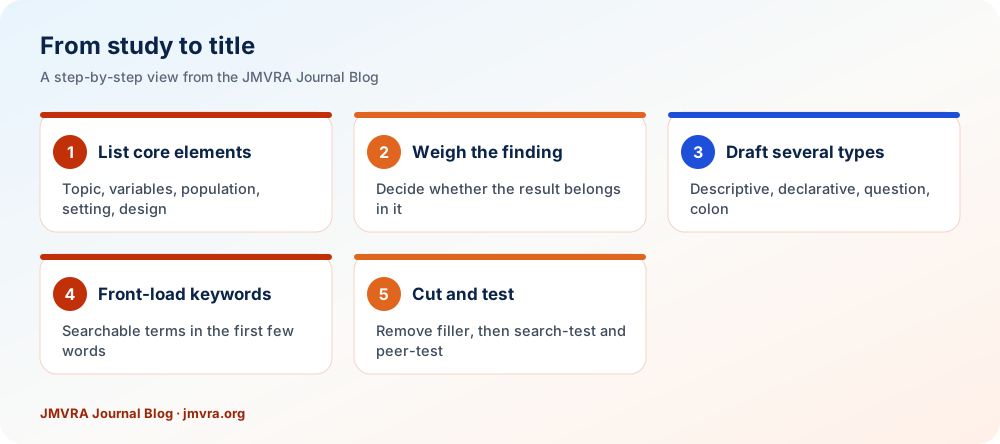
A practical method to draft and test your title
Draft a working title early, but finalise it after the results and discussion are settled:
- List the elements: topic, key variables or intervention, population or material, setting, design and principal finding.
- Draft several versions: at least one descriptive, one colon title, and a declarative or question version if justified.
- Cut the filler: remove “a study of”, redundant words and anything a reader would not miss.
- Run a search test: type the main terms into Google Scholar or a subject database. If the results are full of papers like yours, your terms work.
- Run a colleague test: show only the title to someone outside the project and ask what the paper is about. If their answer differs from yours, revise.
- Apply the journal’s style: capitalisation, length limit and running title.
If you submit to JMVRA, enter the title in the online form exactly as it appears on the manuscript’s first page and check the publication guidelines for formatting details. A title that stays consistent from submission to publication gives cleaner metadata later.
Quick Checklist
- Key terms firstMain concept appears in the first few words
- Population namedSample, material or setting stated where it matters
- Design statedTrial, review or study type named where expected
- No fillerNo “A study on”, puns or unexplained abbreviations
- Claim fits dataNo causal or “first” wording the design cannot back
- Journal styleLength limit, capitalisation and running title checked
Five habits for stronger titles
These habits take a few minutes and prevent most of the title problems editors raise during screening.
- Finalise it last. Keep a working title while writing, then revise it once the results and discussion show what you actually found.
- Borrow the field’s vocabulary. Scan the titles of ten recent articles in your target journal to see which terms and title types are standard there.
- Read it aloud. If you run out of breath or stumble, the title is too long or the word order is awkward.
- Match it to the abstract. Every key term in the title should appear in the abstract, and the abstract should not reveal a different focus.
- Keep rejected drafts. A phrase you discard from the title may become a good subtitle, keyword or running title.
A strong title says what you studied, in whom or where, and how, in the words your readers would type into a search box.
Questions Researchers Often Ask
In Summary
A good research paper title is short enough to scan, specific enough to describe the study, and built from the words your readers search for. Start from the core elements of your work (topic, population, setting, design and, if justified, the main finding), then choose the title type that matches your evidence. Cut filler, expand abbreviations, keep the claim honest, and test the result on a search engine and a colleague. That extra half hour is well spent: the title is read by far more people than any other part of your paper, and it shapes their first impression of everything that follows.
Ready to send in your paper?
Online submission to JMVRA is free of charge. Papers are screened first and then go through transparent, double-blind peer review; ₹971 INR (Indian authors) or $41 USD (foreign authors) is due only after acceptance. Retain every confirmation email for your records.
References and Sources
Taking a Draft Through to a Published Paper
- PrepareStick to the template and author guidelines
- Submit onlineCosts nothing; write down your paper ID
- ScreeningSubject scope, declarations and similarity below 15%
- Double-blind reviewDecision by email and WhatsApp
- AcceptedThe ₹971 INR / $41 USD fee becomes due, and the paper is then published in open access
Details are available under Publication guidelines · Peer review · Publication charges.
Ready to Publish? Submit to JMVRA
JMVRA is aligned with UGC's Suggested Parameters for Choosing Peer-Reviewed Journals.
JMVRA is a Transparent, Peer-Reviewed, Open Access Journal (Refereed Journal). Following the discontinuation of the UGC and UGC-CARE journal listing, and in alignment with the latest UGC-CARE recommendations and guidelines, JMVRA is aligned with UGC’s Suggested Parameters for Choosing Peer-Reviewed Journals.
More useful pages at jmvra.org
Key Terms
Subjects and search phrases this article addresses.
Related Reading
More JMVRA guides that pair well with this one.
Keep Reading on the JMVRA Blog
You are reading part of the JMVRA journal blog, a source of hands-on guidance about publishing, indexing, metrics and research integrity that aims to be verifiable, not promotional.