
Anyone searching for fast publication journals typically has one thing in mind: a deadline. A thesis to submit, a degree requirement, a promotion file or results that cannot wait may all make speed a priority. Yet the most rapid promise is seldom the best option. In this guide you will learn what fast publication actually involves, how long each stage lasts and the reasons, how to spot a journal whose process is timely and transparent, and which red flags distinguish efficient journals from risky ones.
What Do We Mean by Fast Publication Journals?
Authors use the phrase “fast publication journal” for a journal that handles manuscripts efficiently: quick editorial screening, reviewers appointed without delay, clear communication, and swift production after acceptance. This is a far cry from guaranteed publication. Such a journal is fast thanks to a well-organised workflow, and not because it omits review or takes every paper.
Put differently, seek efficient processing subject to peer review and editorial decisions. A journal that announces the result beforehand is not a fast one; it is a risky one.
Why Researchers Care About Publication Time
| Researcher | Typical time pressure |
|---|---|
| Students | Deadlines for projects, dissertations or coursework |
| PhD scholars | Publication requirements ahead of thesis submission or viva |
| Faculty members | Appraisal, promotion or accreditation rounds |
| Conference authors | Extended versions or requirements linked to proceedings |
| Applicants for jobs and grants | Deadlines for applications and reports |
| Time-sensitive research | Findings whose value drops if they are held back (for instance in public health or technology) |
Deadlines are genuine, and that is precisely why choosing with care pays off. A rejection, or a doubtful journal, wastes much more time than a considered decision. A few extra days spent on checking the journal usually repay themselves.
What Is Meant by Fast Publication, Exactly?
“Publication time” can describe different stages of a journal’s process, so two journals that quote different figures may be measuring different things:
Submission → Editorial screening → Peer review → Revision → Final decision → Production → Publication
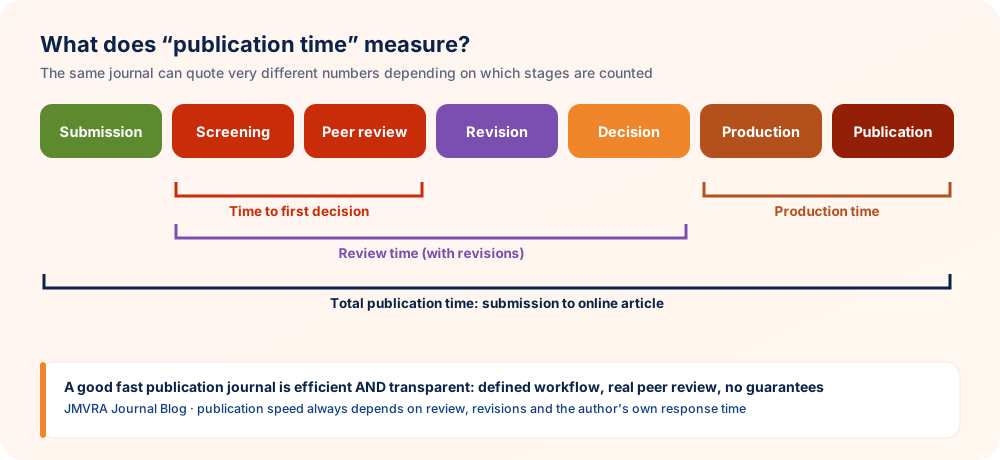
- Time to first decision: the span from submission to the first decision by an editor or reviewers.
- Review time: may or may not count revision rounds.
- Production time: the period between acceptance and the article appearing online.
- Total publication time: the whole span from submission to the published article, which is the figure most authors really want.
What Is the Usual Duration of Journal Publication?
| Stage | What happens | What influences its duration |
|---|---|---|
| Submission | Manuscript is submitted | Whether files and declarations are complete |
| Initial screening | Checks of scope, format and basic requirements | Fit with scope, formatting, similarity |
| Peer review | Reviewers assess the manuscript | How many reviewers are available, the topic, and how many are used |
| Revision | The author responds to reviewer comments | How deep the changes are; how fast the author replies |
| Final decision | The editor decides on publication | Whether more review is required |
| Production | Typesetting, proofreading and metadata preparation | Corrections to proofs; formalities for the author |
| Publication | The article is made publicly available | The issue schedule (monthly, for example) |
No honest timeline applies to every case: speed differs with the journal, the manuscript, the reviewers and the revisions. Read any single figure as a typical value rather than a promise, and ask the journal how it was calculated.
How to Spot a Journal With a Timely Publication Process
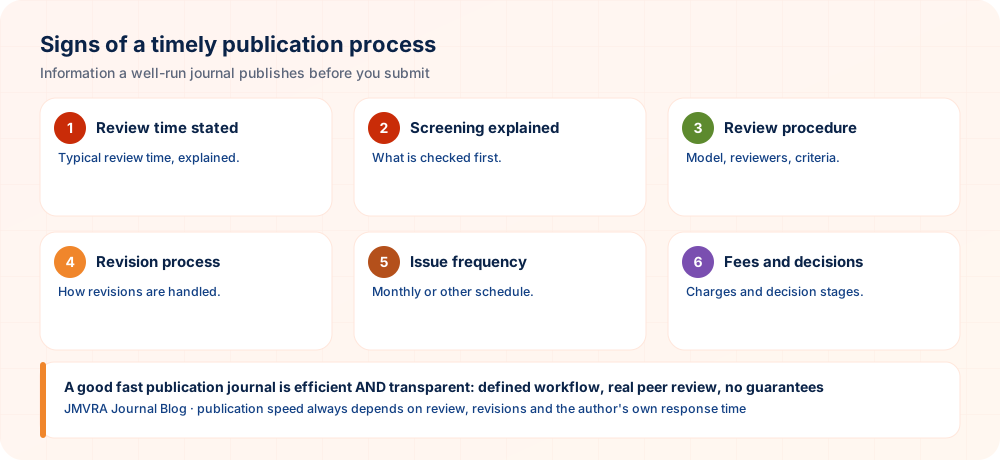
A journal that is run well explains the following before you submit:
- Average or typical review time, and what it covers.
- Editorial screening: the first checks, and the reasons papers get returned.
- Peer-review procedure: the model used, how many reviewers there are and the criteria applied.
- Revision process: how revised versions are sent in and checked again.
- Publication frequency: whether monthly, quarterly or continuous.
- Article processing charges: the amount, and when it is due.
- Editorial decision process: who makes the decision and how you hear about it.
- Online publication process: proofs, placement in an issue, and a DOI where one is provided.
Find the Real Timeline: Study the Dates on Recent Articles
A lot of journals show “received”, “revised”, “accepted” and “published” dates on each article. Examining five to ten recent articles tells you much more than any advertised figure does.
- Open recent articles from your own subject area, and not only the first paper of the latest issue.
- Write down the received, accepted and published dates of each one.
- Work out how long passed between receipt and acceptance (review and revision), and between acceptance and publication (production).
- Consider the whole range and not only the quickest case: a wide spread is to be expected.
- Take care if the received and accepted dates are regularly identical or one day apart, because genuine review takes longer.
| Article | Received | Accepted | Published | What it suggests |
|---|---|---|---|---|
| A | 3 Jan | 19 Feb | 2 Mar | Review plus one revision round, then rapid production |
| B | 10 Jan | 28 Mar | 6 Apr | Longer review, perhaps a major revision |
| C | 12 Jan | 12 Jan | 13 Jan | Acceptance on the same day: ask how the review was carried out |
Questions for the editorial office
- What does the review time you state cover: the first decision alone, or revisions as well?
- How many reviewers look at each paper, and are their comments passed on?
- At what point is the publication fee payable, and what is included in it?
- Once a paper is accepted, in which issue will it come out, and when does DOI registration happen?
A genuine journal gives straight answers to these. If the answers are vague, or promise a result, that tells you what you need to know.
Fast Publication Is Not a Guarantee of Acceptance
This is the key message of the guide. A journal may run an efficient workflow and uphold peer review and editorial standards, yet no genuine journal can know the result before reviewers have read your paper.
Agents who promise you a place in a journal for money, and journals that take payment ahead of review, are not providing fast publication; they put your reputation at risk. Refer to our predatory journal checklist.
Fast Publication Together With Transparent Peer Review
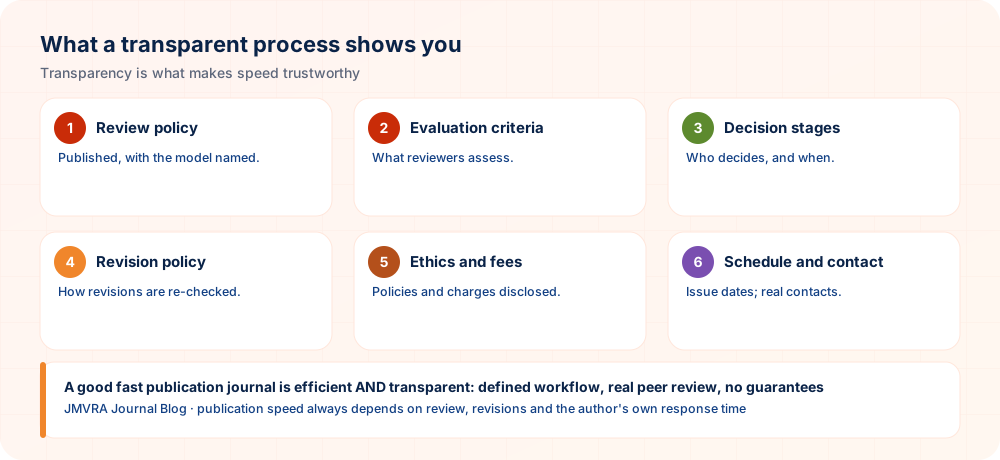
Speed can only be trusted when there is transparency. A transparent journal makes the following public:
- a plain review policy together with the criteria reviewers use;
- the stages of its editorial decisions and its revision policy;
- publication ethics, covering plagiarism, conflicts of interest and use of AI;
- complete disclosure of fees, genuine contact details and a stated publication schedule.
For further reading, see transparent peer review journals along with low-cost journals with a transparent peer-review process.
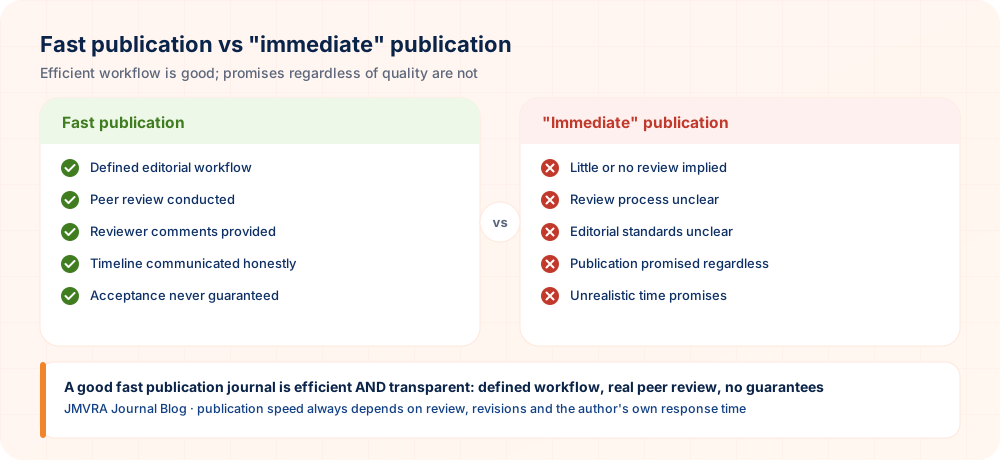
Fast Publication Compared With Immediate Publication
| Fast publication | “Immediate” publication |
|---|---|
| Works through a set editorial workflow | Can suggest little review, or none |
| Peer review takes place | The review process is not clear |
| Reviewer comments are supplied | Editorial standards are not clear |
| The timeline is stated truthfully | Publication is promised whatever the quality |
| Acceptance is not assured | Frequently linked with unrealistic promises |
Warning Signs When Picking a Fast Publication Journal
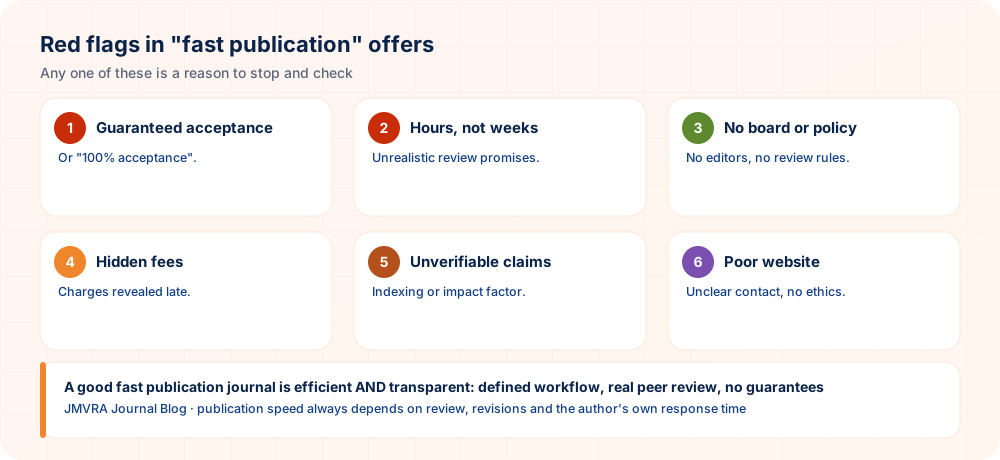
- Assured acceptance or “100% acceptance”.
- Promises of unrealistically brief review (hours or a day).
- An editorial board nobody can identify.
- A missing peer-review policy.
- Publication fees that are concealed or disclosed late.
- Indexing claims that are false or cannot be verified.
- Impact-factor claims that mislead, with no source or method given.
- A website that is badly maintained.
- Unclear contact information.
- A missing publication ethics policy.
Do your own verification of what a journal claims. Resources: ISSN Portal, Scopus Sources, Master Journal List and Think. Check. Submit.
How to Select a Suitable Fast Publication Journal
Before submitting, check:
- The journal’s scope fits your research
- The ISSN is verifiable
- The editorial board is clearly named
- A peer-review policy can be found
- Publication charges are plainly stated
- The publication frequency is given
- Review and publication timelines are set out
- Indexing claims can be checked independently
- Policies on ethics and plagiarism can be found
- Earlier articles are open to inspection
A step-by-step method: how to choose the right journal.
How Authors Can Prevent Delays
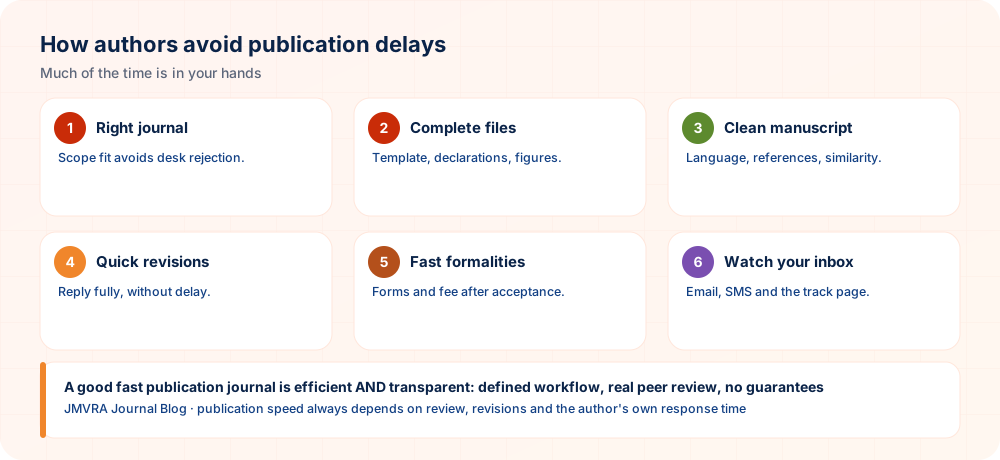
A large part of the total time is in your hands. The quickest path to publication is a paper that suits the journal, comes in complete, and is revised without delay:
- Select a journal that fits: a desk rejection followed by resubmission elsewhere wastes the most time.
- Send complete files: the template, declarations, figures and references all in order.
- Polish beforehand: check language, references and similarity prior to submission.
- Revise quickly and thoroughly: an incomplete reply leads to another round — read how to respond to reviewers.
- Finish the formalities fast: the copyright form, final copy and fee once the paper is accepted.
- Watch your email and WhatsApp and the journal’s tracking page.
Fast Publication for Students and Research Scholars
| Group | Consider first | Then |
|---|---|---|
| B.Tech / B.E. students | Advice from your supervisor; a journal that takes student and project work | The publication schedule set against your semester deadline |
| Master’s students | Whether the scope suits your dissertation topic | Fees and the review timeline |
| PhD scholars | Your university’s present publication rule | Start planning months before submitting the thesis |
| Faculty members | Requirements of the institution and UGC | The workflow the journal states |
| Independent researchers | The journal’s identity, ethics and fees | Transparent schedule |
Suitability and quality matter more than speed, so weigh them first. You may also want these guides: low-cost journal publication, reference journals for UGC-CARE at low cost, high-impact journals at low cost and the UGC-CARE list with up-to-date guidance.
The Timely, Transparent Process at JMVRA
How JMVRA deals with your paper
- Submit whenever you like: there is no submission deadline; JMVRA brings out monthly issues and publication is a continuous process, so accepted papers join the current issue as soon as the formalities are finished.
- Fixed workflow: you submit and receive a paper ID, then screening covers scope, completeness, declarations and similarity, followed by transparent, double-blind peer review, a decision, revision if required, acceptance formalities, production and finally publication.
- No guarantees, no fixed dates: Specialist reviewers assess your paper, and you receive the acceptance or rejection decision by email and WhatsApp. Every stage can be followed on the track page.
- Fees in the open: Indian authors pay ₹971 INR and foreign authors $41 USD, and only after acceptance; submitting costs nothing.
- Open access: CC BY 4.0; ISSN 2984-8911; Crossref DOI on request. JMVRA appears in Google Scholar and is registered with Crossref and the ISSN Portal / ROAD; it is not currently indexed in Scopus, Web of Science or DOAJ.
For more information, read the publication guidelines, the peer review policy and how to publish a research paper.
Share Your Research Through JMVRA
Bring your research to JMVRA
JMVRA (ISSN 2984-8911) is a peer-reviewed, open access journal spanning many disciplines. Submission is free. Specialist reviewers assess your paper, and you receive the acceptance or rejection decision by email and WhatsApp.
- 1. Prepare according to the guidelines
- 2. Submit online
- 3. Peer review
- 4. Decision by email & WhatsApp
- 5. Publish with open access
Your At-a-Glance Checklist
- FitThe scope suits your paper
- ProcessWorkflow and review policy are public
- HonestyAcceptance is never guaranteed
- VerifyISSN and claims have been checked
- ScheduleFrequency and fees are given
- YouSend complete files; revise quickly
Practical Tips for Choosing a Journal With Clear Timelines
A journal that explains its stages honestly is easier to plan around. Apply these checks when comparing venues, so that your expectations match what the editors can actually deliver.
- Read the stage descriptions. Look for plain statements about screening, review, revision and production. Journals that describe each stage and its typical duration are usually organised enough to keep to them.
- Compare dates on published papers. Examine the received and accepted dates printed on recent articles. Consistent gaps tell you more about real practice than any slogan on the homepage.
- Message the editorial office. Send a short, polite query about expected handling time and how delays are communicated. A clear, courteous answer is a good sign of a responsive team.
- Plan your own turnaround. Authors cause delays too. Decide who will answer reviewer comments, check proofs and sign forms, and block time for those tasks in your schedule.
- Distrust certain-sounding outcomes. No ethical journal can promise acceptance or an exact date in advance. Treat any such assurance as a warning rather than a benefit.
Judge a journal by the evidence of its published dates and the clarity of its answers, not by promises.
Questions Researchers Often Ask
In Summary
The best fast publication journal is not always the one that quotes the shortest time. It is one that offers a clear editorial workflow, transparent peer review, sensible processing timelines, publication ethics and suitable academic standards, and that never promises the result. Begin by choosing for fit and transparency, then support the process with a complete, well-prepared manuscript and quick revisions.
Prepared to submit? JMVRA takes papers at any time
JMVRA (ISSN 2984-8911) is a peer-reviewed, open access journal spanning many disciplines. Submission is free. Specialist reviewers assess your paper, and you receive the acceptance or rejection decision by email and WhatsApp.
- 1. Prepare according to the guidelines
- 2. Submit online
- 3. Peer review
- 4. Decision by email & WhatsApp
- 5. Publish with open access
A Timely Process in Brief
- ScreenScope, files, similarity
- ReviewGenuine peer review
- ReviseQuick and complete replies
- DecideNever guaranteed
- PublishMonthly issue
Related: Transparent peer review · Low-cost journal publication · Submit Paper.
Ready to Publish? Submit to JMVRA
JMVRA is aligned with UGC's Suggested Parameters for Choosing Peer-Reviewed Journals.
JMVRA is a Transparent, Peer-Reviewed, Open Access Journal (Refereed Journal). Following the discontinuation of the UGC and UGC-CARE journal listing, and in alignment with the latest UGC-CARE recommendations and guidelines, JMVRA is aligned with UGC’s Suggested Parameters for Choosing Peer-Reviewed Journals.
Related pages on jmvra.org
Key Terms
Subjects and search phrases this article addresses.
Related Reading
Further guides on choosing a journal and publishing your paper.
Transparent Peer Review: The System, Certification and Steps
Read the guide RelatedLow-Cost Journal Publication: Affordable Options Compared
Read the guide RelatedPublishing a Research Paper: A Complete Step-by-Step Guide to Research Paper Publication
Read the guide RelatedPredatory Journal Checklist for 2026
Read the guide Related10 Steps to the Right Journal for Your Paper
Read the guide RelatedKeeping Publication Moving Without Rushing Review
Read the guideKeep Reading on the JMVRA Blog
Published on the JMVRA journal blog, this guide gives practical direction on publishing, indexing, metrics and research integrity, with a focus on what can be verified instead of on promotion.