
Quality shows in a journal’s editorial board only when members agreed to serve, do real work and appear accurately on the list. This guide deals with managing the board once it is in place: terms of reference, duties for each role, appointment with written consent, terms and rotation, conflicts of interest, meetings, a yearly board review, inactive members and audits of the board page.
After the Board Is Built
How to recruit a board is explained in Assembling an Editorial Board for a New Journal. The tougher job comes afterwards: keeping the board active, accountable and correctly listed year after year. This guide deals with editorial board management — the documents, routines and reviews that preserve a board’s credibility.
Draft the Terms of Reference
Terms of reference form a brief document that sets out the board’s purpose and how it operates. Each member ought to receive a copy before agreeing to join.
| Section | What to include |
|---|---|
| Purpose | What the board contributes to quality, scope and policy |
| Roles and duties | The duties of each role and the expected workload |
| Term | How long appointments last and when they renew |
| Decision-making | Who makes decisions on papers and on policy |
| Conflicts of interest | The way to declare conflicts and when to withdraw |
| Confidentiality and ethics | Treatment of manuscripts and reviewer identities |
| Communication | Meetings, reports and ways to make contact |
| Leaving the board | Resignation, inactivity and removal from the board |
Set Out Roles and Duties
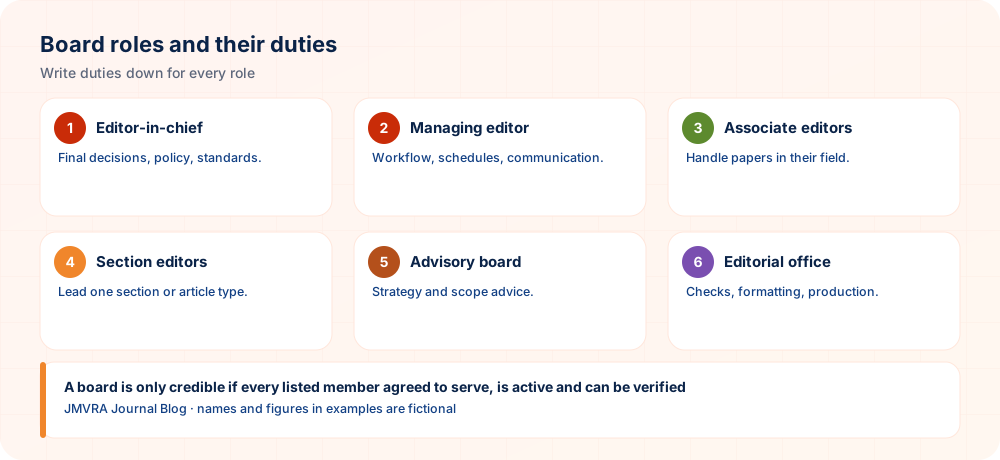
A title carries little weight without duties attached. For every role, spell out the tasks (such as handling a set number of submissions a year, finding reviewers or advising on scope), the response expected to editorial requests and the person they report to. Duties written down also make it easier to judge fairly whether a role is being fulfilled.
Written Consent and Appointment Letters
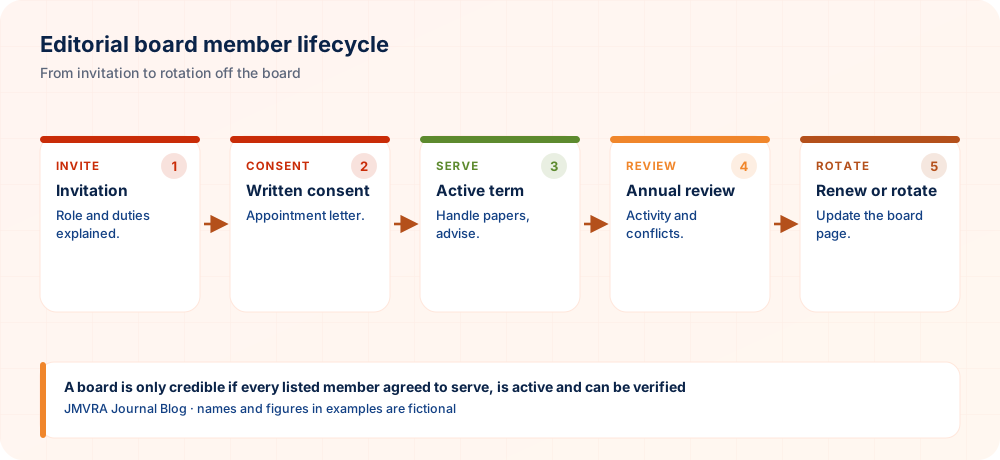
Do not list anyone who has not agreed in writing. Send an appointment letter stating the role, duties, term and terms of reference, and file their written acceptance. Naming people without consent is a well-known mark of predatory journals and can badly damage a journal’s reputation.
Terms and Rotation
A board stays fresh when appointments run for a set period that can be renewed (for example, two or three years). Offset the end dates so nobody departs all at once, and prepare a successor for the editor-in-chief. Rotation introduces new expertise and lets inactive members bow out gracefully.
Conflicts of Interest
Have members declare conflicts on joining and refresh the declarations every year. Board members should not handle their own papers, those of close colleagues or students, or papers in which they have competing interests. An independent editor should handle papers by board members, following COPE core practices. Writing these rules down early avoids awkward disputes later.
Meetings and Communication
- Meet as a board at least once every year, online if necessary, and record minutes.
- Circulate a yearly report covering submissions, decisions, scope trends and policy changes.
- Seek the board’s views on scope, special issues and policy updates.
Reviewing the Board Each Year
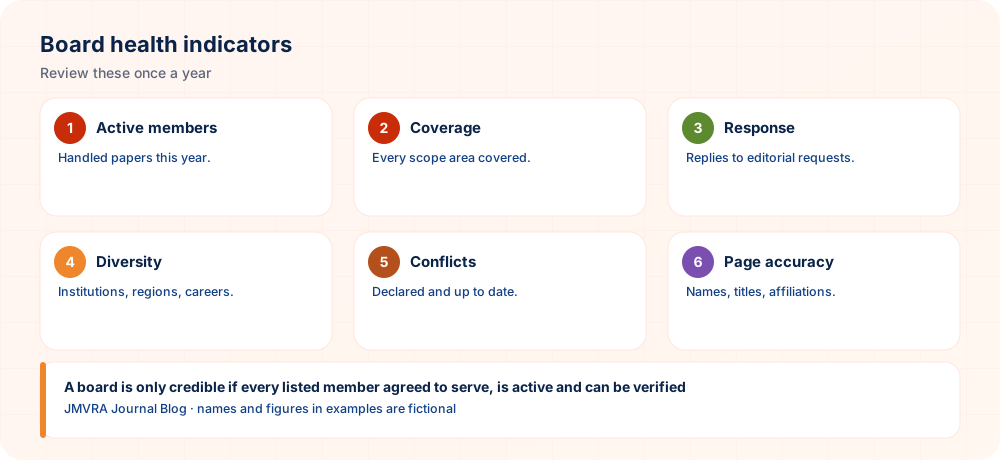
| Check | Finding | Action |
|---|---|---|
| Activity | No papers were handled by 3 of the 14 members | Reach out; propose a role change or stepping down |
| Coverage | Environmental chemistry has no member covering it | Appoint one associate editor |
| Affiliations | Institutions changed for 2 members | Update board page |
| Conflicts | All declarations current | None |
| Diversity | Most board members come from a single region | Prioritise wider recruitment |
Handling Inactive Members
Inactivity erodes trust: authors and indexes notice boards packed with names that do no work. Approach inactive members privately, propose a lighter role or an honourable exit, and amend the board page promptly whenever someone leaves.
Carry Out a Board Page Audit
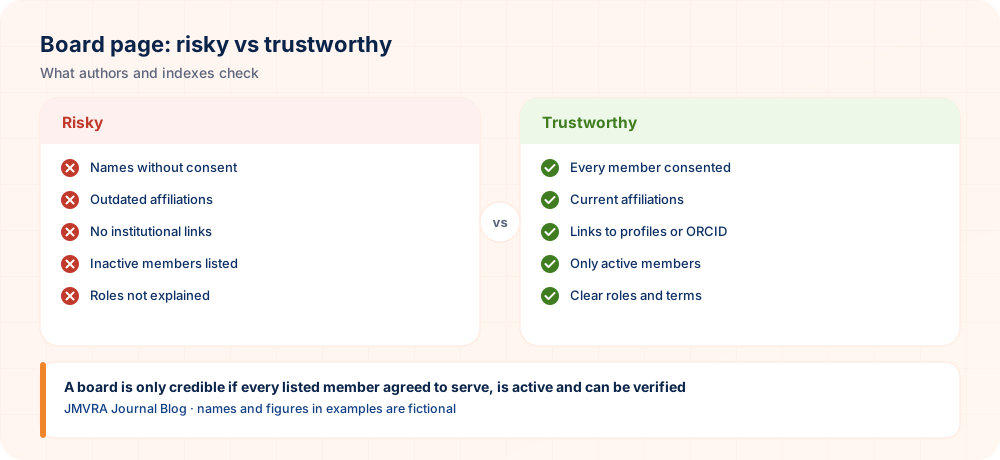
Boards are checked by authors and indexes; see editorial board credibility. Every entry should give the full name, role, present institution and country, plus a link to an institutional profile or ORCID record. Take off members who have departed, and show when the page was last updated. A periodic scan for broken links keeps the page trustworthy.
Editorial Boards and Registering a Journal
Boards are examined by registration bodies and indexes alike. The guidelines of the ISSN National Centre for India, for instance, ask for a minimum of five editorial board members using institutional email addresses. See the new journal and ISSN guide and how to index a new journal.
Mistakes to Avoid
- Naming well-known people who never agreed to serve.
- Without terms, the board never renews itself.
- Members of the board dealing with their own submissions.
- Old affiliations and broken links on the board page.
- A board that neither meets nor learns how the journal is performing.
The Editorial Board at JMVRA
JMVRA lists its editorial board publicly online, and researchers who wish to take part can apply to the reviewer and editorial team (see join the JMVRA reviewer and editorial board team). Manuscripts are handled according to JMVRA’s double-blind peer review policy.
JMVRA in brief
- Review: transparent, double-blind peer review, normally by at least two subject experts. Specialist reviewers assess your paper, and you receive the acceptance or rejection decision by email and WhatsApp.
- Fee: Nothing is paid for submission or review; once accepted, the fee is ₹971 INR for Indian authors and $41 USD for foreign authors.
- Access: free-to-read open access (CC BY 4.0); ISSN 2984-8911; issues appear monthly; submit whenever ready; Crossref DOI on request.
- Indexing: JMVRA appears in Google Scholar and is registered with Crossref and the ISSN Portal / ROAD; it is not currently indexed in Scopus, Web of Science or DOAJ.
Share Your Research Through JMVRA
Bring your research to JMVRA
JMVRA (ISSN 2984-8911) is a peer-reviewed, open access journal spanning many disciplines. Submission is free. Specialist reviewers assess your paper, and you receive the acceptance or rejection decision by email and WhatsApp.
- 1. Prepare according to the guidelines
- 2. Submit online
- 3. Peer review
- 4. Decision by email & WhatsApp
- 5. Publish with open access
Your At-a-Glance Checklist
- Terms of referenceIn writing
- ConsentBefore listing
- TermsFixed, staggered
- ConflictsDeclared yearly
- ReviewAnnual
- PageUp to date, with links
Practical Tips for Managing a Journal Editorial Board
A board works well when expectations are clear and people feel their time is respected. These suggestions help editors keep members engaged and keep the journal's records straightforward.
- Send a welcome pack. Give new members the scope, the ethics policy, the review workflow and a named contact. Early clarity prevents misunderstandings and makes the first assignment far less intimidating.
- Set realistic reply windows. Agree on how quickly members should answer editorial requests and how to flag absence. Reasonable deadlines, published in your guidelines, reduce stalled manuscripts and awkward reminders.
- Rotate review assignments fairly. Spread manuscripts across members according to expertise and workload instead of relying on the same few people. Fair distribution keeps volunteers willing to continue.
- Record decisions and reasoning. After meetings, circulate brief notes listing agreed actions, owners and next steps. Written records protect continuity when editors change and support transparent journal practice.
- Thank contributors openly. Acknowledge reviewers and board members in the journal's editorial notes or annual message. Recognition costs little and builds loyalty among unpaid colleagues.
Clear expectations, fair workloads and written records keep an editorial board active, accountable and pleasant to serve on.
Questions Researchers Often Ask
In Summary
Credibility comes from managing an editorial board, not merely assembling one. Record roles and rules in writing, obtain consent before naming anyone, apply fixed terms and rotation, keep conflicts declared, meet and report each year, review activity and coverage, and keep the board page accurate. Authors, reviewers and indexes will see the difference.
Have a manuscript to share? Submit it to JMVRA
JMVRA (ISSN 2984-8911) is a peer-reviewed, open access journal spanning many disciplines. Submission is free. Specialist reviewers assess your paper, and you receive the acceptance or rejection decision by email and WhatsApp.
- 1. Prepare according to the guidelines
- 2. Submit online
- 3. Peer review
- 4. Decision by email & WhatsApp
- 5. Publish with open access
References and Further Resources
Board Management in Brief
- DraftTerms of reference
- ConsentBefore listing
- RotateFixed terms
- ReviewAnnual
- AuditBoard page
Related: Building a board · JMVRA board · Submit Paper.
Ready to Publish? Submit to JMVRA
JMVRA is aligned with UGC's Suggested Parameters for Choosing Peer-Reviewed Journals.
JMVRA is a Transparent, Peer-Reviewed, Open Access Journal (Refereed Journal). Following the discontinuation of the UGC and UGC-CARE journal listing, and in alignment with the latest UGC-CARE recommendations and guidelines, JMVRA is aligned with UGC’s Suggested Parameters for Choosing Peer-Reviewed Journals.
Related pages on jmvra.org
Key Terms
Subjects and search phrases this article addresses.
Related Reading
Further guides on editorial teams and journal management.
Assembling an Editorial Board for a New Journal
Read the guide RelatedReal Editorial Boards & Honest Review Timelines
Read the guide RelatedBecome a JMVRA Reviewer or Editorial Board Member
Read the guide RelatedRecruiting and Keeping Peer Reviewers: Editor Guide
Read the guide RelatedLaunching a Journal: 50 Items to Finish Before Issue 1
Read the guide RelatedIndexing a New Journal: The Realistic Order
Read the guideKeep Reading on the JMVRA Blog
Published on the JMVRA journal blog, this guide gives practical direction on publishing, indexing, metrics and research integrity, with a focus on what can be verified instead of on promotion.