
Most advice on verifying journals tells authors to look at UGC CARE listing, ISSN validity and indexing status. These checks are necessary but not enough. Two other signals are skipped far more often, and they reveal just as much: who is really reviewing your paper, and how long that review realistically takes. A homepage can fake both easily, yet each can be checked independently if you know what to look for.
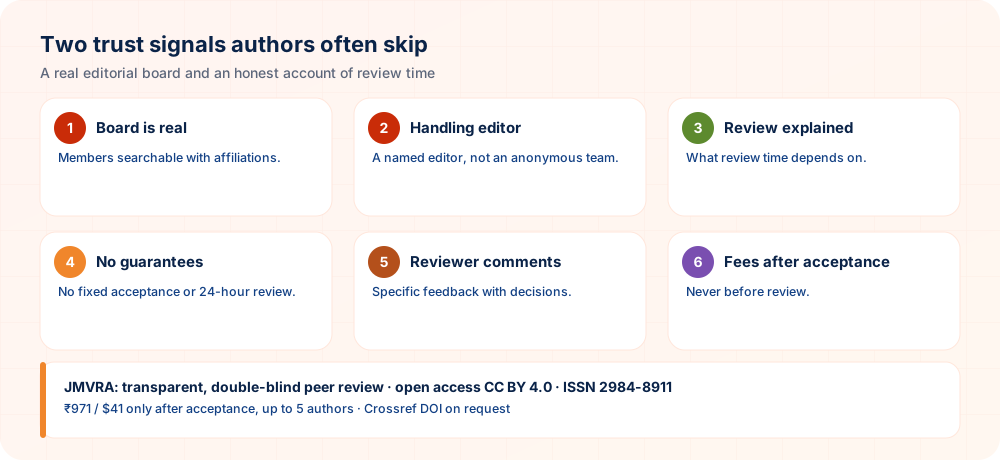
Two Trust Signals That Authors Often Overlook
A journal may have a valid ISSN and a convincing UGC CARE badge and still run a rubber-stamp review process behind the scenes. The make-up of the editorial board and the review timeline are among the few signals that are hard to fake convincingly once you actually check them, instead of accepting what the journal's homepage says. Writing down what you find helps you compare several journals fairly.
Why the Make-Up of the Editorial Board Matters
- A mix of institutional affiliations lowers the chance that the "board" is just one person's list of colleagues or made-up names
- Fit with subject matter — a truly multidisciplinary journal should list reviewers who are really qualified across the disciplines it claims, not a single generalist panel
- A named handling editor for your submission is a stronger sign than an anonymous "editorial team" that never says who is responsible for a decision
How to Confirm That a Board Is Genuine
- Search each board member by name together with the stated institution — a real academic will usually have an independently verifiable profile (university page, ORCID, Google Scholar)
- See whether the named institution itself confirms the affiliation, instead of relying only on the journal's own listing
- Look for signs of an active review workload; a listed "editorial board" with no visible link to the review history of any published paper is a mild red flag
- If it is unclear, ask who your own handling editor is — a legitimate journal can answer without hesitation
The Myth That "Fast Review = Predatory"
Take fast review as a cue to examine the surrounding process, not as a verdict in itself: was the paper screened for plagiarism? Did you get substantive reviewer comments or only a decision? Is a reviewer count and panel size stated anywhere?
A Practical Framework for Timelines
| Signal | Legitimate Fast Review | Predatory Red Flag |
|---|---|---|
| Plagiarism screening | An automated tool (Turnitin/iThenticate) runs before a reviewer sees the paper | None, or only a claim that cannot be verified |
| Reviewer feedback | Specific comments on methodology and clarity | A generic "accepted" with no comments |
| Reviewer panel size | Disclosed and verifiable (for example 3,000+ reviewers) | Not disclosed, or one unnamed "editor" |
| Acceptance rate | Some submissions are truly rejected or sent for revision | Acceptance of effectively 100% regardless of quality |
| Fee timing | Billed only after an acceptance decision | Charged when you submit, ahead of any review |
How JMVRA Fares on Both Checks
Editorial board: JMVRA keeps a panel of 3,000+ expert reviewers who hold a PhD or equivalent and come from institutions in India and around the world; assignment follows a double-blind process under the Reviewer Policy. Reviewers who repeatedly miss deadlines or give inadequate reviews are taken off the panel — a quality bar that is actually enforced, not a static homepage list.
Review timeline: No fixed review time is promised by JMVRA, since how long it takes rests on reviewer availability and the revision required; decisions reach authors by email and WhatsApp. The stages kept short are those surrounding review, namely initial checks, a similarity check ahead of review, and prompt publication when an accepted paper's paperwork is complete. For the full explanation, including what fast publication must never imply, seeKeeping Publication Moving Without Rushing Review.
At-a-Glance Checklist
- Board members looked upOn your own
- Review policy studiedIts model and process
- Speed claims assessedExplanations rather than promises
- Feedback providedAlong with the decision
- Fee timing confirmedFollowing acceptance
Roles on an Editorial Team
| Role | Typical duties |
|---|---|
| Editor-in-Chief | Sets overall direction and makes final decisions |
| Section or associate editors | Manage papers in their own areas |
| Editorial board members | Give advice, review and suggest reviewers |
| Reviewers | Evaluate manuscripts and give comments |
| Editorial office | Handle correspondence, checks and production |
Monitoring Progress at Every Stage
- Following submission — expect an acknowledgement
- While under review — expect periodic updates, not daily replies
- Once a decision arrives — go through the comments with care
- Once accepted — carry out the payment and document steps
Verifying an Editorial Board and Judging Review Time Sensibly
Before sending a manuscript, an author can run a few independent checks on who edits the journal and how it describes its schedule. These steps need only patience and a search engine.
- Search board members individually. Look up several editors by name and confirm that their institutional pages mention the journal. Real editors can usually be traced, and their research should plausibly match the journal's scope.
- Email an editor if unsure. A short, polite message to a listed board member asking whether they serve the journal is a perfectly acceptable check, and a genuine editor will normally respond.
- Distrust absolute promises. Review involves human judgement, so a journal that promises an outcome or a fixed duration without conditions deserves caution. Look for honest language about variability.
- Compare stated stages with experience. Ask colleagues who have published in similar venues how long each stage took them. Their accounts are often more informative than any marketing summary.
- Keep your own log. Record each date when you submit, respond or receive a decision. A personal log lets you raise a delay politely and with facts.
Confirm that the editors really exist, treat sweeping speed promises with caution and keep a dated record of every step of your own submission.
Questions Researchers Often Ask
Your Paper's Journey at JMVRA, From Submission to Publication
- SubmitReceive your paper ID
- ScreenScope & similarity
- ReviewDouble-blind
- DecideEmail & SMS
- RevisionComment by comment
- AcceptCopyright & fee
- ProduceDOI at the author's request
- PublishMonthly issue
How long review takes depends on the reviewers and on any revision required, so no set turnaround is promised; you are told of acceptance or rejection by email and WhatsApp.
Ready to Publish? Submit to JMVRA
JMVRA is aligned with UGC's Suggested Parameters for Choosing Peer-Reviewed Journals.
JMVRA is a Transparent, Peer-Reviewed, Open Access Journal (Refereed Journal). Following the discontinuation of the UGC and UGC-CARE journal listing, and in alignment with the latest UGC-CARE recommendations and guidelines, JMVRA is aligned with UGC’s Suggested Parameters for Choosing Peer-Reviewed Journals.
Quick links across jmvra.org
Key Terms
Subjects and search phrases this article addresses.
Related Reading
Further reading on the same theme from the JMVRA blog.
Keep Reading on the JMVRA Blog
Our JMVRA journal blog carries this guide along with other practical advice on publishing, indexing, metrics and research integrity, all written so that claims can be verified and nothing is promotional.